Home Blog Page 303

CORNWALL, Rosemary Brenda Ida

Rosemary Brenda Ida Cornwall
October 3, 1935 – May 11, 2021

Brenda passed away at Greenwoods Eldercare on Salt Spring Island.

Born in London, England, marrying Frank Cornwall in 1953. They moved to Canada in 1956 and over to Salt Spring in 1973.

She was predeceased by her husband Frank Cornwall who passed in 1999.

Loved and survived by her 5 children; Lewis (Beth) Cornwall, Tracey Cornwall, Dorothy Cornwall (Dean Read), Dean Cornwall and Rosheen (Mark) O’Donnell along with 10 grand children, and 2 great grandchildren.

Brenda was a realtor in Richmond BC and Salt Spring Island. She was fun loving, enjoyed choir, church, line dancing, tennis, hiking, exercise classes and world traveling.

Brenda was a frequent shopper at the Lady Minto Thriftstore, the Lions and garage sales. She left behind a heck of alot of stuff.

Brenda loved eccle cakes from Embe’s Bakery, coffee at Dagwoods, pies from Jana’s and treats from Penny’s.

The family would like to thank all of the wonderful Greenwoods Eldercare staff, doctors and support caring for mom.

A celebration of life will be held at a later time. 

Donations may be made to the Greenwoods Eldercare Society.

HARROP, Sheila Gordon (nee Pirie)

Sheila Gordon Harrop (nee Pirie)
March 17, 1928 – May 9, 2021

Sheila passed away on May 9th, Mother’s Day, at Lady Minto Hospital on Salt Spring Island with her family by her. A wife, sister, aunt, mother, grandmother and great-grandmother, she was loved by all. Sheila was the hub of a large extended family. She is survived by her husband of 70 years Trevor, her four children: Jim (Jen), Catherine (Bill), Ian (Judy) and David (Kaoru), 12 grandchildren and 7 ½ great-grandchildren, and her sister (Netta McNab and family in Scotland).

A lover of the outdoors, a world traveller, an avid tennis player and most of all an incredible loving and caring person. Sheila cared for her family and the extended circle of friends including the DeRosa family (New Denver), Arlene Bastion (Singapore), Alan Murphy (Japan), Richmond Tennis Women’s league and UBC Faculty Wives Hiking Club.

Born in Motherwell, Scotland, Sheila immigrated to Vancouver with her fiancée Trevor. They married in 1951, then moved to New Denver, B.C., followed by Halifax, N.S., and then back to B.C. (Campbell River). In 1961, it was off to Iowa (USA) for graduate school and Sheila for Taxidermy training. They returned to B.C. (Vancouver) in 1965, where they lived until 1989. Sheila and Trevor retired to New Denver, the base for many worldwide travel holidays. In 2017, they moved to Vancouver and finally to Meadowbrook on Salt Spring Island to be closer to family.

Sheila passed away after a brief illness, at peace with her world. Zoom enabled the family to share and support her in her final days. Thank you to all the staff at Lady Minto Hospital and our wonderful support workers. No service or flowers by family request. Donations may be made to the BC SPCA, in honour of all her dog friends.

New COVID cases reported in Gulf Islands

Southern Vancouver Island has seen a positive decline in COVID-19 cases over the past month, although the Gulf Islands local health has new cases after reporting none for three weeks running.

New data released by the BC Centre for Disease Control shows the Southern Vancouver Island region went from 291 new cases during the week of April 4-10 down to 148 in the most recent reporting week, April 25-May 1. On Southern Vancouver Island, every sub-area had significant downward trends in numbers over the past week aside from a very small decrease in the area from Chemainus to Nanaimo.

With three news cases, the Gulf Islands local health area is the only part of the region where case numbers actually went up.

Salt Spring Fields store set to open this summer

7

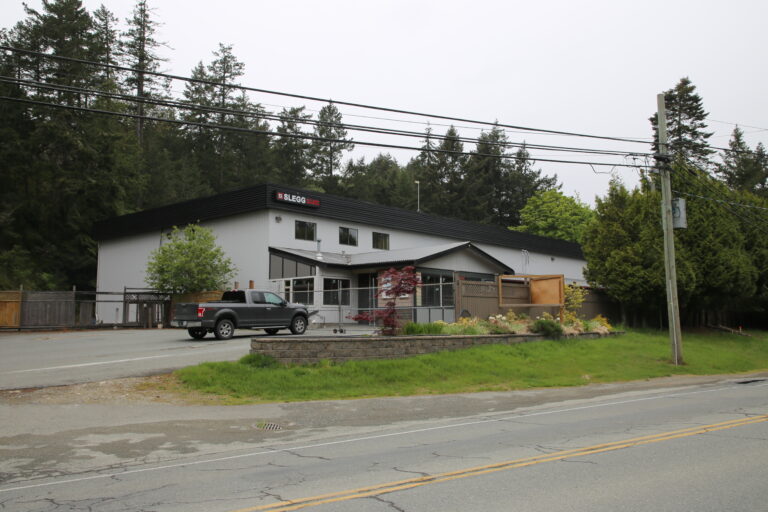
Salt Spring’s low-cost retail offerings are set to expand this summer, when Fields Holding Company (FHC) hopes to have a new outlet open and ready for business.

The company’s owner and CEO Jason McDougall told the Driftwood on Monday that renovations at 804 Fulford-Ganges Rd. are underway. Although lots needs to be done to turn the former Slegg Lumber premises into a retail store — including installation of new walls, insulation, flooring and lights — the goal is to have the store open by July 1.

“Our opening date keeps moving a bit because there’s a little more work we have to do. We know the community needs us and we’re working to get there as soon as possible,” McDougall said.

Salt Spring last had a Fields outlet in 2009, when its lease at the Country Grocer complex expired. FHC bought the historic Western Canadian chain after that, and has been actively looking for a new Salt Spring home for the past seven or eight years, McDougall said. 

The former Slegg Lumber branch closed on Nov. 30, 2019. 

“It was someone from Salt Spring who actually called us to let us know the building was available and might be a suitable location,” he said. 

McDougall said the store will be a typical Fields with a mix of merchandise that includes clothing, toys, stationery and foods. He noted the latter department won’t be very large, though, because the company is aware Salt Spring is well represented by grocery options. 

“Depending on the needs of the community, the departments can increase or shrink,” he explained. “We’re pretty flexible in terms of what we sell. We want to make sure we’re adding to the community, not bringing something that isn’t needed.”

McDougall said he also wants Salt Springers to have the option to buy low-cost clothing or footwear without having to take a ferry, unless they want to make a trip. People who are shopping for one thing off-island will likely do other shopping as well, he observed. 

“Keeping dollars in the community is better for the community,” he said.

Fields will be operating its commercial business on an industrial-zoned property with a temporary use permit (TUP) issued by the Islands Trust in October 2020. Getting the correct commercial access permit from the Ministry of Transportation and Infrastructure (MoTI) in order to use a driveway off a highway was required as a condition of the TUP.

Some islanders who spoke during a February 2020 Local Trust Committee meeting said they were concerned about increased traffic to the site, which is located off an 80 km/hour highway and on a curve. 

McDougall said he believes the store won’t attract more traffic than Slegg Lumber did, because that was a busy location, but the company has been petitioning MoTI to add a slow-down area to that part of Fulford-Ganges Road. So far they have been unsuccessful. 

McDougall said FHC will keep trying and will also expand the slow-down area at the property’s entrance.

“We’ll do what we can control, anyway. And I guess it will take a while for people to get used to there being a store there again,” he said. 

Look for announcements with the store’s opening date in coming weeks.

Baker Road sightline concerns aired

1

The Salt Spring Transportation Commission is hoping to take a more active role in pathway planning after hearing numerous delegations and considerable negative feedback on its current project. 

Commissioners directed Capital Regional District staff to immediately examine options for improving safety at the Baker Road intersection and along concrete barrier curbs, while ensuring the pathway is completed in time for a funding deadline after hearing delegations at the April 26 business meeting. They also resolved that any future pathway designs must come to the commission for their recommendations before they are finalized.

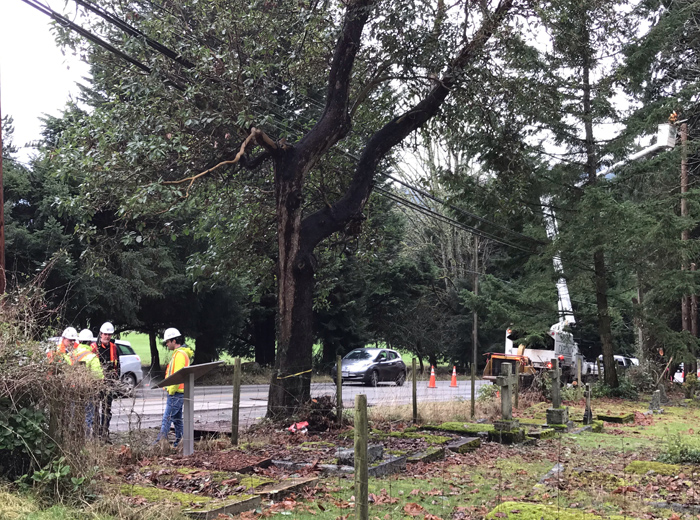
Residents and frequent users of Baker Road who presented concerns to the commission last Monday said sight lines at the Lower Ganges Road intersection have been dangerously impacted by the new retaining wall installed as part of pathway construction. Cars turning into Lower Ganges Road from Baker may have difficulty seeing southbound traffic cresting the hill, especially if those vehicles are going faster than the speed limit.

“Due to the placement of the concrete blocks, the ability to see oncoming traffic is severely diminished,” explained Jan Fellenius, who has property next to the intersection. 

Fellenius added he had a recent near-miss when a small car was coming down the hill, and said measures must be taken before someone is seriously hurt. 

Ken Jackson, a retired safety professional who worked for 25 years assessing risk and investigating incidents at major industrial sites, said he believes risk at the intersection has increased significantly in a place that had problems to begin with.

“It was not great before, but you could actually improve the sight lines if you moved the blocks right up against the cemetery,” Jackson suggested.

The commission also heard presentations from Luisa Maffi, David Rapport and Gay Utter, who had similar concerns. Utter outlined the intensive process she underwent when creating the Acland Road subdivision and strata 20 years ago. Delegates also urged the commission to fund an independent traffic consultant.

The pathway was designed by Stantec engineering consultants and was contracted to Don Mann Excavating for construction. 

CRD engineering staff did a sight visit on April 23 after receiving multiple complaints. They found the visibility at the Baker Road intersection appears to meet Ministry of Transportation and Infrastructure guidelines. Staff have also observed there is a 30-km/hour slow down sign on the hill before the bend heading toward Booth Canal Road. 

Commissioner Myna Lee Johnstone wondered if at least some of the concrete blocks in the retaining wall could be removed, an idea the commission ultimately directed staff to investigate.

“I have heard from the delegates here today that the issue is mostly that last batch of cement,” Johnstone said. “Surely there could be some portion removed that could improve visibility for them.”

The commission stopped short of ordering a halt to the project or dismantling the work. Electoral area director Gary Holman said there was no question that safety concerns must be dealt with; the question was how far to go in that direction when the project had received MoTI grant funding and the completion deadline had already been pushed back once.

“I would suggest to the commission we don’t want to jeopardize our $500,000 in funding,” Holman said. “If we start taking apart the project as currently designed, we risk half a million in funding.”

A second safety issue related to the project is the high curb that was installed to separate the pedestrian pathway from the road. Cyclists have said this barrier and the narrow marked shoulder lane could be a “death trap” if vehicles are passing too close and they have no way to escape onto the shoulder. 

Holman said asphalt had been added to the side of the road to provide a wider space, but he agreed the two-feet-high curbs might be a bigger factor.

“I don’t think that anyone intended that improved safety for pedestrians might come at the price of decreasing safety for cyclists,” Holman said. 

The commission passed a resolution that future pathway designs must take into account both cyclist and pedestrian safety. Staff are also to seek immediate short-term measures for improving safety through things like flags, road sweeping and signage. 

Holman said the CRD could also look into whether it could replace the high curb with a lower structure later on.

Swanson Road strata plan introduced

0

A strata development proposal seeking to bring six new houses to Ganges is opening questions about how and why density should be managed in the village area.

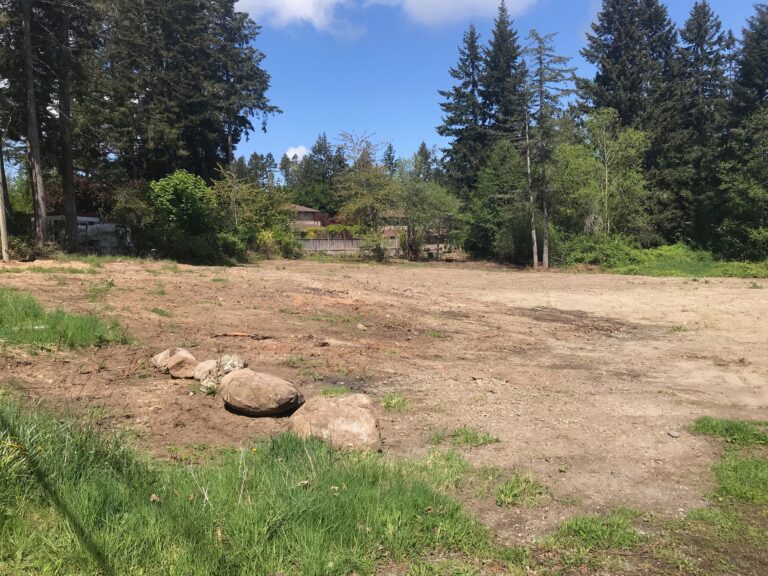
The Salt Spring Local Trust Committee gave preliminary consideration on April 27 to a rezoning application submitted by Sea Isle Development Group for 114 Swanson Rd. Representative Dale Rivers said the company has been working on plans for the land for close to a decade, and had originally planned to build a 12-unit townhouse complex similar to their Park Place Estates development. The current plan is for six single-family homes, with the seniors market in mind.

While the LTC allowed the application to advance by requesting a number of professional reports, proof of water supply and connection to Ganges sewer, the trustees predicted the way forward would be difficult for the applicant given the nature of the request.

“In terms of land-use density, this is 1.2 acres. It’s actually a tiny lot, and six dwellings on that lot strikes me as an awful lot,” said committee chair Peter Luckham, who added his inclination was to vote the application go no further.

“There are a lot of hurdles here and I’m not sure the applicant is going to be able to meet all those hurdles,” he said.

The applicant’s former plans for the property were upended in part by the 2014 moratorium on new connections to the North Salt Spring Waterworks District. Rivers said Sea Isle has since drilled two wells and the capacity is double what is needed to supply six homes. The developer will still need to be licensed as a water utility through the Ministry of Forest, Lands, Natural Resources Operations and Rural Development, which is a lengthy and often difficult process. 

Trustee Laura Patrick was not as concerned about adding density in the neighbourhood for the right reasons, noting the Valhalla Road subdivision on the next street over has 12 homes on a similar-sized lot. The type of housing proposed caused more concern, however. Patrick underlined the almost complete lack of housing for workers and proposed having a mixed-use strata that didn’t focus on one demographic would be more appropriate. 

An additional resolution the LTC passed last Tuesday requires Sea Isle to revise the application with consideration of a community amenity in exchange for the increased value rezoning would bring. Trustees would like to see rental and/or affordable housing factored into the project.

Regional planning manager Stefan Cermak reported that a one-to-one amenity exchange had been required for a rezoning nearby. Since the Swanson Road property zoning allows a duplex now and an additional four dwellings are requested, Cermak said two of the four units could be designated as the amenity.

Rivers said the company was open to mixed use and other possibilities, but he also noted that high construction costs would make it difficult to build anything “affordable.” Those costs have gone from around $350 per square foot a year and a half ago to $500. The homes being planned would total about 1,400 square feet each. 

The project was also the topic of a delegation by Jenny McClean earlier in the day. McClean asked the LTC to hold off on the application until the Ganges village planning project proceeds further on its work. She also brought up potential water drainage problems in the neighbourhood, where her family owns property, and said she was waiting for a hydrology report that could provide more information. 

Baker Road neighbourhood revitalizes emergency pod activities

Salt Spring’s large geographic area and its widespread rural population are two realities that can make emergency planning and response a challenging proposition.

As neighbourhoods can easily be cut off by trees and power lines if they come down over a single entry road, and major disasters such as fire or earthquake would make access even more difficult, having the lines of communication established and some local resilience is ideal.

Residents of the Baker Road area are some of the islanders who have been keeping emergency planning top of mind even while the COVID-19 pandemic has made in-person connections difficult to maintain, and thoughts of any additional emergency likely just too much to deal with.
“We’re trying to get people conceiving the unimaginable during unthinkable times,” observed interim pod leader Ken Jackson.

Jackson and neighbour Bob Lynch have been supporting the Salt Spring Island Emergency Program by working to bring the Baker pod up to readiness. They’re hoping to include all 60 households on the contact list, have monthly radio check-in sessions and are mapping out a set of viable escape routes in case the neighbourhood is ever cut off.

During the windstorm of December 2018, for example, Baker Road was blocked by trees in 17 different places with power lines down over top.

“As we learned after every one of our bigger storms, a little cooperation goes a long way to making life easier for all of us. We’re determined to see if we can help bring together an even better local network that will surely benefit all of us should circumstances require,” Jackson explains in an information letter to residents.

Jackson stepped up to be the interim pod leader when he noticed no one else had volunteered during an emergency program debriefing after the windstorm. He has a lot of relevant leadership experience, including emergency evacuations at international sites where oil and gas extraction was taking place.

He is hoping to have initial escape route mapping for the Baker Road area completed before this summer’s peak wildfire season hits. The contact list is also in good progress, with the area split into three smaller neighbourhoods where notifications can go out by telephone tree.

As Jackson points out, the island has finite firefighter, paramedic and rescue personnel, who will probably be called to multiple areas in a major emergency.

“We have limited resources in a formal sense, so the more we can do in our neighbourhood or pod, the more we’re helping the rest of the island and not just ourselves,” he said.

Under Lynch’s leadership, the radio check-in initiative has seen establishment of a network using GMRS radios (walkie talkies). Neighbours and people who are able to reach them from other pods are invited to check in using Channel 19 at 6 p.m. on the first Wednesday evening of each month. The entire exercise takes around 15 minutes, and while not everyone participates every month, Jackson said there are usually a couple of new people for every session.

The benefits of the two-way radios are they are easy to use, can be relatively inexpensive, and they have an astonishingly long battery life. Jackson said people who turn them on just for the check-in time could go several months before needing to charge them. During an actual emergency, Lynch will broadcast situational updates three times a day from his more sophisticated system.

Jackson has purchased extra radios to lend out to people who want to try them, and many more people in the neighbourhood are getting their own.
“Depending on what sort of emergency we have, this could be really useful,” Jackson said.

In addition to building local resiliency in case the unimaginable does ever happen, the work of updating the pod’s contacts and functions has already helped bring people together.

“We’re building a community when there may not have been many opportunities for connecting in the past, and that’s encouraging,” Jackson said.

Child limits help climate

BY PETER OMMUNDSEN

An individual climate action available to Canadians is to minimize the number of children they have. 

The Intergovernmental Panel on Climate Change has stated that population growth is a “key impediment” to limiting climate change. Since release of the first Salt Spring climate action plan in 2011, Canada has added over one million people (in excess of those that died) through reproduction, cancelling out energy efficiency gains on Salt Spring and elsewhere.

In Canada, the birth rate typically exceeds the death rate, and the per capita environmental impact is among the highest in the world. A Canadian family with a single child has an energy footprint equivalent to that of a multi-child family in a lesser developed nation.

Currently, each day, some 200,000 people are added to the Earth in excess of those that die, which is equivalent to adding the population of a city the size of Calgary every week. This requires perpetual expansion of agriculture, forestry, mining, housing, transportation and manufacturing, while simultaneously we expect those industries to reduce climate-warming greenhouse gas emissions to net zero! Ecologists have warned for decades that a sustainable future is possible only with a human population size that is a fraction of what we have today.

If, worldwide, there were an average of only two children born per family, the global population would still grow 19 per cent by 2050 and would grow 24 per cent by 2100 due to population momentum (the backlog of young people yet to reproduce), this according to the Millennium Alliance for Humanity and the Biosphere. 

Meeting 2050 (net zero emission) climate targets will be a costly and intrusive venture under the best of circumstances, and failure to flatten the population curve will place a significant burden on transition to clean energy. Energy specialist David Hughes calculated that for Canada, the transition could involve building 100+ Site C-sized dams (assuming sufficient suitable rivers and dam sites even exist), 59 nuclear reactors, 36,996 windmills, 258 solar farms and 540 biomass plants. And industrial carbon capture is not a panacea, it is a daunting challenge.

Renewable energy can have a land area footprint larger than that of fossil fuels, creating energy sprawl that displaces forests and wildlife. The Salt Spring appropriated clean energy footprint will be far-reaching, as when consumer goods are imported from afar.

Climate consequences of family size arise not just from the added energy load of children and their descendants but also from increased consumption by their parents. A recent survey in Sweden found that during child-raising, parents increased their own carbon footprint by some 25 per cent through use of high-carbon conveniences in support of their busy lifestyles. 

Local climate action education and school programs can encompass population ecology, and student groups can develop sustainable population pledge initiatives. Supportive materials are available from such environmental organizations as Population Matters, World Population Balance, Population Institute Canada, Population Connection, and Our Carbon Footprint. 

Printmaking group shares craft in two shows

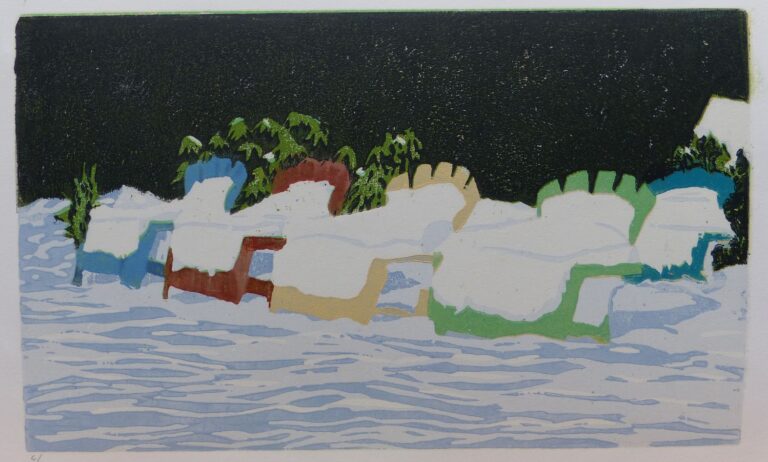
Painters’ Guild printmaking group are demonstrating the vast potential for different tools, technique and creativity within the medium at two different shows this month.

Impressions 6, the sixth annual show of new work by the group, was scheduled at the Salt Spring Public Library for April and was held over for an additional month. A retrospective show featuring 16 printmakers is also running at the Salt Spring Gallery to Wednesday, May 12.

Some of the seemingly endless ways to press an image onto paper are helpfully laid out in the library’s lobby display case, where group members exhibit prints alongside the materials used to make them. These range from soapstone to rubber to natural wood. Imagery can be carved in reverse form using sharp tools or burned into the surface with acid or fire.

The exhibition in the program room may not be huge, but even still gives a good taste of the possibilities, including a cute sample piece that includes mini prints by eight participating members.

Prints can be simple or infinitely complex, depending on how much carving and layering the artist wishes to do. Several of the works on exhibit for this show prove that sometimes a single colour can have the most visual impact. Jeanne Lyon’s work Not Forgotten, for example, references the Red Dress Project honouring missing and murdered Indigenous women and girls using a deep red ink as the only pigment. Lyon’s composition with a winding highway twisting through the space divided by landscape on one side and empty dresses on the other is powerful. She skillfully chooses how to balance negative space, as well as areas with more definition and those in solid colour or bare paper.

Leslie Corry is another artist who makes good use of the visual impact of deep red ink on white paper. Her unnamed imprint of a flower over an inverted teardrop-shaped vase makes great use of the framing, while tacky ink has produced areas of texture and softness. The imagery also has the gift of duality. With its shape and colouring, there is a hint of the sacred heart motif.

Pami Sira makes a striking contrast with a cerise ink over a mottled watercolour background in Koi Fish. He uses the yin-yang type positioning of the two fish as the central hub for a circular swirl of ripples for a winning combination of elements. Another untitled block print by Sira creates an abstract, almost floral patten in multihued ink to produce a nuanced contrast to an expanse of rich cream background.

Working with a more complex layering of elements to delightful effect is Suzanne Prendergast. Her piece From the Garden somehow recalls Japanese paper artforms and kimono silk through the careful stacking of contrasting colours, patterns and different sized rectangular blocks.

A cyan blue with finely etched lines resembling wood grain is the base layer, with perfectly contrasting soda pop orange over top. This layer has a more limited pattern of tiny horizontal waves. Then comes a thin layer of rice paper embedded with dried stems and leaves that Prendergast has printed on in black, and a final layer of a printed chickadee to crown it all. It’s a wonderful example of how far one can go with the medium even without employing a complicated carving reduction scheme.

The printmaking group has been active for eight years and it welcomes new members. See www.ssipaintersguild.ca under Programs/Printmakers or contact Johanna at johoskins@telus.net.

DR. SHEA, Don

Dr. Don Shea
December 5, 1941 – May 1, 2021

Dr. Don Shea passed away suddenly at home in Victoria on May 1. Survived by his loving wife of 38 years, Wendy, and their blended family, sons Greg (Jolie), Tim (Kirstie), daughter Kate Palmer (Matt), step daughter Jacqueline Zan (Roger), step son Stephen Robinson (Annette), grandchildren Sarah, Christopher, Jordan, Denman, Curtis, Emma, Kyle, Ryan, Mowatt, Nico, Maese, Hudson, Audrey and Hadley and great granddaughter Rylie. Also survived by his sister Patricia Turnbull, nephew, Nicholas Bapty and nieces Becky Moore and Megan Clemitson.

Born in Vancouver on December 5, 1941, Don moved with his family to Victoria after completing high school and graduated from, what was then Victoria College, in 1963 with a Bachelors Degree in English and Zoology. After a year of travelling in Europe, Don worked as a research assistant at Kings College Hospital in London before returning to Canada to attend McGill Medical School in Montreal in 1965. On receiving his medical degree, Don returned to the West Coast in 1970 and did his residency in Radiology at UBC. His first position as a Radiologist was at Nanaimo Regional General Hospital where he spent many happy years. In 1998 the ultimate semi retirement opportunity knocked and Don had his dream job providing radiological services for Lady Minto Hospital on Salt Spring Island. During his time at Lady Minto, Don mentored numerous international medical graduates and was Chief of the Medical Staff for a number of years. When he turned 70, Don decided it was time to retire and moved back to Victoria in 2013 where for a short time he voluntarily did some teaching at the Island Medical School at the University of Victoria. Don spent his retirement years as a professional news junkie, devouring every online newspaper known to man, that was his thing.

Due to current restrictions there will be no service or celebration of life at this time. In lieu of flowers donations in Don’s memory can be made to the Lady Minto Hospital Foundation, 135 Crofton Road, Salt Spring Island, BC, V8K 2R8. ladymintohospitalfoundation.com Condolences may be offered at www.earthsoption.com