Home Blog Page 304

MOGGRIDGE, Clarke Irvin

Clarke Irvin Moggridge
November 8, 1934 – April 25, 2021

Clarke passed away peacefully at Victoria General Hospital.
He is survived by his children; Mike (Leslie), Lise, Matt, Tim (Angela) and Susan (Peter), his 9 grandchildren, 3 great grandchildren and his sister Joan Jones (St. Catharines, Ont.).

Clarke grew up in St. Catharines, Ont., the youngest of three siblings. He was an RMC graduate and a commissioned artillery officer with 10 years service. He spent the next 20 years in the federal public service and was Director Human Resources when he retired. Clarke retired to Salt Spring Island where he built a house with an extensive garden on Bullock Lake. He volunteered for Meals on Wheels and Salmon Enhancement. He enjoyed carpentry, making wine and restoring old cars and scooters. RMC reunions and the chance to reconnect with old classmates was always a highlight for Clarke.

We will remember his sense of humour, competitive spirit and homemade pizza.

Clarke will always be in our hearts.

No service will be held due to Covid.

FOULKES, Graham Paul

Graham Paul Foulkes 
June 8 1965 – April 25 2021
 
It is with great sadness that we announce the sudden death of Graham, known by many as Oz or Ozzy. He was the loving husband of Leanne, father of Tabitha (Tavis), Jenoah (Brandy), Trylan (Aleah), Rosemary, stepfather of Coast, and grandfather of Sayla. As the lynchpin of a large extended family, he was also a “bonus dad” to Kaiya and Maria, and a caring uncle to many nieces and nephews. 

Graham was born in Watford, UK to Audrey and Michael, and brother to Trevor, Steven, David and Sally. After attending Watford Grammar School and a brief stint in university studying environmental sciences, he started on his great adventure in Canada in 1987. He attended film school in Victoria, incorporating film and photography throughout all aspects of his life. Graham was most comfortable behind the lens, often seen with a camera slung around his neck. Over the years, in his unique way, he became a vibrant member of the communities of Saturna Island, Cortes Island, Slocan, and Salt Spring Island. Photography, playing guitar, and bird watching were among his passions.  

His death, fittingly, was close to Earth Day. As a dedicated environmentalist, he lived a minimalist, low-impact life and was an early adopter of more sustainable technologies like electric cars. He was determined to do his part in preserving the world in which he lived and in making it a better place for his children and grandchild. 

He had the inquiring mind of an engineer, a philosopher’s reflective nature, and the gentle, compassionate temperament of the Dalai Lama. He will be sorely missed by his family and friends around the world. Graham is predeceased by his father Michael and brother Steven -his ashes will be spread in the UK, Cortes Island, and Salt Spring Island.

In lieu of flowers, a memorial fund has been set up for the family. 

CRAWFORD, Dale Anne

Dale Anne Crawford
Feb 23, 1952 – May 3, 2021

Dale Anne Crawford passed into the presence of her Lord and Saviour in the early morning of Monday, May 3rd. She will be sadly missed by her loving husband John. Her mother, Agnes Cunningham on Salt Spring Island. Children; son Keith (Lisa)Crawford, daughter Charlene (Steve) Mason, son William and daughter Sharon (Markus) Crawford. Her sister, Dawn (Mel) Williamson in Colorado. As well as her many grandchildren whom she loved to the moon and back.

Dale was known for her kindness, generosity, compassion and sensitive caring to the needs of others.

In lieu of flowers, donations may be made to the Langley Hospice Society.
The family wishes to thank Dr. Douglas McFee, Dr. Kevin McDermid and Dr. Jennifer Corpuz.

A Celebration of Life will be held at North Langley Community Church at a future date.

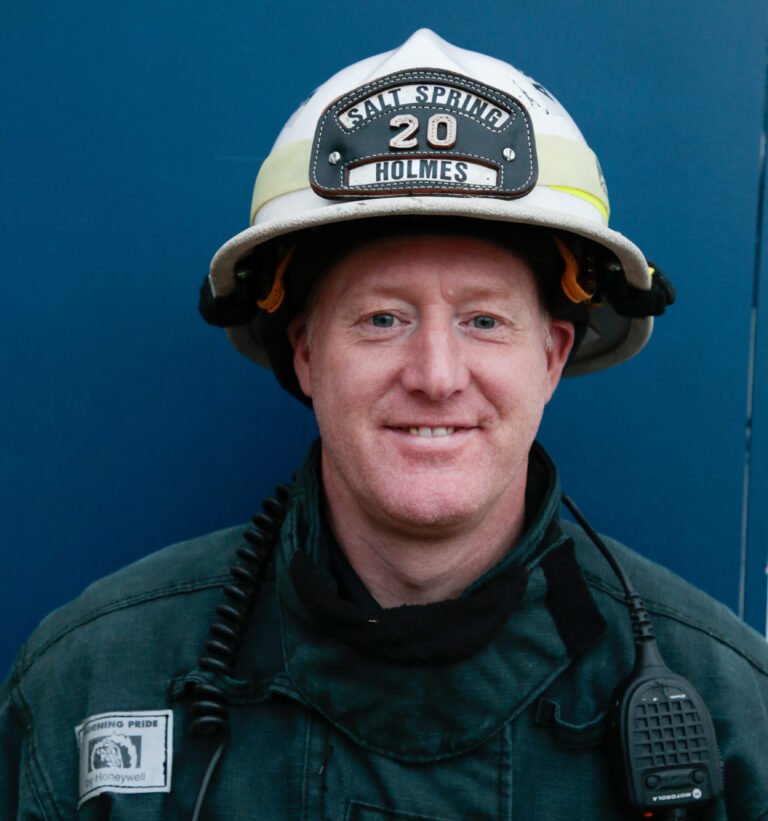
Jamie Holmes appointed as Salt Spring’s deputy fire chief

0

A long-standing gap in Salt Spring Fire Rescue management has been partly resolved at last with appointment of Jamie Holmes to the deputy chief position.

The Salt Spring Fire Protection District announced the appointment, effective May 1, at the April 26 business meeting.  

“The board of trustees is fortunate to have Acting Chief Holmes’ skills and experience on their management team. We are grateful for his continued service to our community and excited for the future of emergency services on Salt Spring Island,” said board chair Per Svendsen.

Holmes thanked the board for their support.

“I’m willing to continue to support Salt Spring Fire Rescue and the community of Salt Spring Island as best as I can,” he said at the meeting.

Holmes has been serving as acting fire chief since November 2020 and will continue in that position for the time being. The announcement states he has served Salt Spring Island Fire Rescue for 25 years since joining the department as a paid-on-call volunteer in January 1996. He became a career firefighter in 2002 and ascended though the ranks, becoming assistant chief in 2015. 

“During his 15-year tenure as training officer, the department successfully trained many volunteer firefighters that would go on to become career professionals both within our own department and in other departments across the province,” Svendsen said. “Acting Chief Holmes set a benchmark that members be trained to the NFPA 1001 standard. This high standard allows members to apply for a career with any department in North America.”

The deputy chief position has been vacant since 2015, when former deputy Arjuna George took on acting chief duties. George was officially hired as chief in 2016, but has been on personal leave since the end of June 2020. Having Holmes appointed deputy chief means there will be a non-union management position available to him if George returns.  

Open positions on the board of trustees may be more difficult to fill. There are currently two vacancies at the seven-member table, and another two trustees will see their three-year terms expire at the end of this year’s annual general meeting. While that meeting would normally take place in April, COVID-19 meeting restrictions pushed last year’s AGM to December and a date has not yet been set for this year. 

The board had attempted to fill the two vacancies before the end of 2020, but a call for nominations went unheard. New interest from a prospective board member in former school trustee John Wakefield has inspired the board to try again. 

The trustees voted last week to initiate the election process and appoint a returning officer. Announcements of the nomination period are expected in the coming weeks. 

Gulf Islands COVID-free for third consecutive week

0

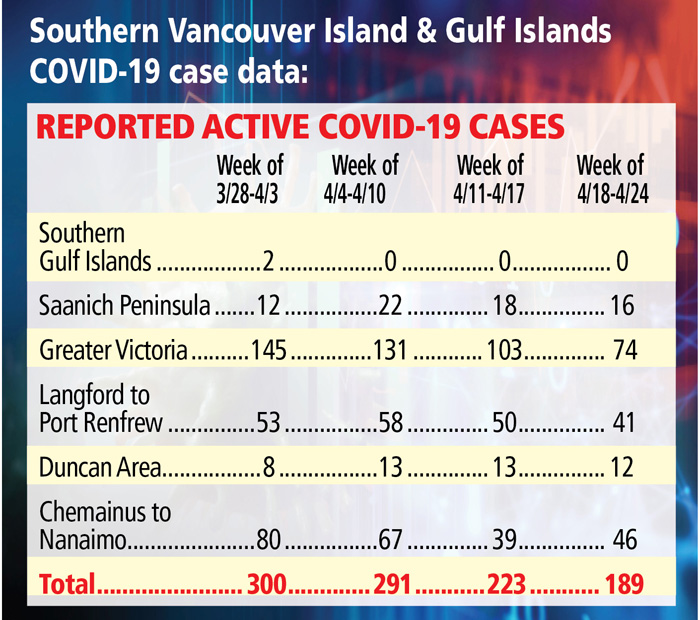
The latest data from the BC Centre for Disease Control released today indicates that there were no active cases of COVID-19 in the Southern Gulf Islands from April 18 to 24.

As well, numbers across southern Vancouver Island overall have continued to drop, as shown in the above chart. (Click on the image for a full view.)

Nobody Asked Me But: Only canapes could improve vaccination experience

0

There’s nothing like an open invitation from BC Health to make me feel good about myself. 

Well, actually, the invite is not really “open,” but extended to my entire CEV group. I read further down the notice to learn that CEV is the acronym for “clinically extremely vulnerable.” I qualify because the chemotherapy treatments I have been receiving for the last eight months have moved me and the rest of my group who are suffering from serious health conditions up to the front of the COVID-19 vaccination line. The notice gives me a phone number to call to book my appointment and emphasizes that the invitation is “for you and you alone.” Don’t I feel special!

I check the invitation to see if there is a dress code requiring attendees to be outfitted in formal attire, but the only two specifications mentioned are a short-sleeved shirt and a mask. Apparently, nobody cares what is covering the lower half of my body.

I RSVP the invitation by dialling the booking number, but I make sure to pull up War and Peace and a couple of other nice long novels I can read while I am put on hold. I have heard that they can keep you waiting for hours and often some people have not been able to get through at all. I hear a click on the other end of the line, which alerts me that a representative will be with me shortly and then some insipid Muzak tune is played into my ear. A more appropriate song for booking a vaccine injection, I think to myself, would be Pat Benatar’s Hit Me with Your Best Shot.

Now comes the surprise. Less than 30 seconds into my holding and waiting, the music clicks off and I find myself speaking to an actual human being who really wants to help me. After we run through a few formalities such as name, birth date and personal health number, the health rep gives me the date and time for my vaccine shot and tells me that the clinic will take place at the local ArtSpring centre. And just like that, it’s all been arranged and I’m ready to get jabbed or poked when the time comes.

The next few days before the vaccination appointment are spent fantasizing about and obsessing on the upcoming event. Will it be like the opening to an art show? Will we, the CEV group, be given the red carpet treatment? Will there be uniformed waiters and servers carrying around silver trays loaded with canapes and hors d’oeuvres such as shrimp quiches and mini sausages? Perhaps instead of food, each tray will be loaded with samples of the leading vaccines. I picture myself with toothpick in hand selecting the Pfizer after having already tried the Moderna, Johnson & Johnson’s, and AstraZeneca.

As it turns out, all of my musings on the invitation to the vaccination event are completely misinformed. There is no rubbing elbows with the rich and famous (even at a distance of six feet apart). I am greeted at the door by someone who could possibly be doing the same thing at a Walmart, and I have my identity verified. I am then asked to sanitize my hands and adjust my mask so it fits over both my nose and mouth. Although my mouth is completely hidden by my moustache, I slip the mask as far under my chin as my beard will allow, where it perches precariously. I am subsequently ushered into one of the side rooms at ArtSpring which usually serves as a meeting room or as a gallery for an art exhibition.

I am suddenly transported back in time to the mid-1950s when I was still in elementary school. Polio was then the epidemic of the day and the virus caused nerve damage that could lead to partial or complete paralysis. It was very contagious and particularly dangerous to children. When the polio vaccine was developed, it made sense to administer the vaccinations at school. Our class teacher had the habit of organizing school activities alphabetically by student surname and since my name began with Z followed by Y, the last two letters, I felt relatively safe, especially after catching a glimpse of the super-sharp dagger of a needle the public health nurse clutched in her rubber gloved hands. For once in my short life’s experiences I would be only too happy to have to wait to be the last one to be able to do something. Imagine my dismay when the teacher announced that this time we would go alphabetically but in reverse order. What happened after that has been pushed far into the recesses of my subconscious.

With that odious memory in mind, I walk into the ArtSpring makeshift clinic and am directed to the nearest table. The attending nurse takes my CEV invitation letter and goes through a checklist of standard questions to eliminate the possibility that I am presently infected with the virus. She informs me that the vaccine may give me side effects of pain, itchiness, swelling and redness in my arm from immediately after the injection up to seven days after. She mentions that other symptoms such as swollen lymph glands, fatigue and joint soreness may also appear but are less common. She assures me that although some of these symptoms are similar to those caused by COVID-19, the vaccine will not give me the disease.

When she is satisfied that I understand the risks and aftereffects of the procedure, she reaches for her injection kit and innocently asks if I am prone to fainting when poked by a needle. It is at this point that I notice in the far corner of the room a recliner chair partially hidden by a curtain. This is obviously the place they haul the fallen and definitely not where I want to end up today. When I see how tiny the diameter of the business end of the needle is, my fears are quelled as I breathe out a sigh of relief. Compared to the vaccination needle, the IV catheter the nurses try to shove into my veins at my weekly chemo sessions looks to be about the size of a highway culvert.

A few moments later the deed is done. I honestly don’t remember feeling anything, pain or otherwise. I am asked to remain seated on the perimeter of the room for a few minutes to make certain that I don’t develop any allergic anaphylactic shock to the Moderna vaccine. When the allotted time goes by, I am reminded that I will be contacted in four months to arrange for my second dose and then I am sent on my way.

Nobody asked me, but I don’t think the roll out of the COVID-19 vaccine could have gone any more smoothly for me here on Salt Spring. The only knock I can give to the entire vaccination operation is that they could have served a few shrimp quiches and mini sausages as well.  

SIMS Music gets creative for year-end concert

Like most of the performing arts community around the world, students in Salt Spring Middle School’s music classes have had to find alternatives to performing to an audience this year.

Michelle Footz, who leads the music programs at both SIMS and at Gulf Islands Secondary School, has been committed from the start of the pandemic to finding comparable learning outcomes as much as possible. For the SIMS Quarter Three final concert last week, that meant bringing every band student outside for one song performed together at last.

“We haven’t played live shows for a year and a half now,” Footz said. “It brings so much experience to play in front of a crowd, and they haven’t experienced that, but this gives them an idea of what it would be like.”

Under the Ministry of Education’s system for allowing in-class learning this school year, every homeroom class at SIMS has been designated a separate cohort. That means only students within the same cohort can study or socialize with each other — and that’s had a huge impact on the band and the choir, which normally draws a few students from each classroom. Music lessons and practice have therefore been taking place in small groups or even sometimes individually. 

Footz said this has posed some challenges to how small ensembles work together, because the students in one cohort may happen to play a strange combination of instruments. Bringing together all the little groups to perform one piece together after practising separately brought additional challenges. The students had just one rehearsal together before filming the song. Their small groups needed to be well spaced from each other even though outside. That made it a little difficult to hear, and the sound quality also changed being outside.

“It’s a way for them all to see what it’s like to play together in a group of 50 students instead of five or 15. We can’t even be in the gym with mixed cohorts, so that’s the solution,” Footz said. “Listening to each other in a different acoustic environment was one challenge, but after running through our piece a couple of times it did start to gel, and I think they had fun doing it.”

Footz noted everyone is starting to get fatigued after more than a year of pandemic restrictions, so keeping kids motivated and excited about music has been her top priority. Something that might be helping with that is the prospect of a marching band being formed sometime down the line. Footz has already purchased some of the instruments and equipment needed with a Salt Spring Foundation grant. The outdoor performance was a good taste of what might be involved.

“It is hard work, standing and playing. It’s a very physical task,” she said, noting marching band is actually a competitive sport in the United States. “This is just a great way to get them started and excited about it.”

The performance event was also a reminder of what to expect after the pandemic, when the music program will be performing live concerts and travelling on field trips once again.

In addition to the big group piece, the online concert includes a selection of recorded pieces from the ensembles and choir groups. Anyone who would like to see the show can email mfootz@sd64.org to get a link to the unlisted playlist. 

Beddis area residents seek private road resolution

0

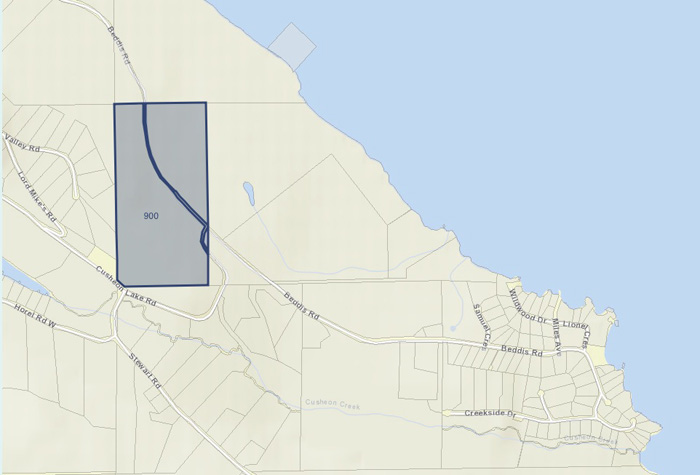
People living near Beddis Beach and Creekside Drive are calling upon the provincial government to intervene in a property dispute impacting the main access route to their neighbourhood.

A petition that had gained 118 signatures as of last week asks the Ministry of Transportation and Infrastructure (MoTI) “to exercise its legal jurisdiction over and responsibility for” a section of roadway that passes through Laughing Apple Farm at 900 Beddis Rd., which the owners say is private property.

The petitioners state the ministry must direct its contractors to immediately recommence maintenance of that section; remove “private road” and “use at your own risk” signs; and remove speed bumps and rocks placed at the ends of those speed bumps or humps.  

The petition asserts “allowing this owner to continue the illegal road obstruction without consequences sets a very unfortunate precedent for the hundreds of kilometres of similar public roads over private lands throughout British Columbia. We the undersigned ask that MoTI reassert proper public control over this public road, for the safety of residents and visitors alike.” 

Saanich North and the Islands MLA Adam Olsen submitted the petition to the B.C. Legislative Assembly on Thursday.

“Residents of the neighbourhood are requesting the Ministry of Transportation to address a long-standing issue with respect to the road and road ownership. This has been going on for a long, long period of time. This is the neighbourhood asking MoTI to step in and assist the neighbourhood,” Olsen said.

Laughing Apple Farm owners Brian Swanson and Mary Laucks had the speed bumps created in 2016 to calm traffic in front of their farm, citing excessive speeds and the fact the road had never been dedicated as a public highway. 

“Before we had the humps, some people used to drive at high speed (over 100 km/hr) on the straight stretch of our road, and most people did not slow down near our gate where there is a curve with less visibility. We felt unsafe crossing the road at our gate,” Laucks and Swanson told the Driftwood.

”Another reason that we installed the humps was so that the many people who enjoy walking and riding their bikes on the road would feel more safe and be able to enjoy the rural landscape. We thought we were enhancing this section of the road.”

MoTI appeared to have difficulty determining whether its contractors had been performing maintenance on that stretch of road at the time of the installation. Doing so would make the roadway a public highway even if it had never been formally dedicated, according to provincial law. 

The Ministry of Transportation and Infrastructure was unable to provide an update on the situation before the Driftwood’s press deadline.

For more on this story, see the April 28, 2021 issue of the Gulf Islands Driftwood newspaper, or subscribe online.

Viewpoint: Military spending should be curtailed

By JAN SLAKOV

Earth Day was celebrated on April 22. By now, I’m sure we all understand that individual efforts to wean ourselves off factory farm products, to go carbon neutral, to reuse and recycle, though valuable, can’t possibly get us where we need to go.

As for systemic change, it’s hard to know where to start. Relationship is key. How do we relate to each other and to the Earth?

From April 10 to May 17 are the Global Days of Action on Military Spending. If we are to transform our relationships, I think it’s essential that we reflect on our implication in the military industrial complex and how important it is to change that system. Historically, governments would conscript citizens in order to fight wars. Now they “conscript” natural resources and public financing to buy warships, fighter jets and generally to keep up with what military experts already referred to as the “revolution in military affairs” in the early years of this century. Our sons are not being sent off to kill and be killed, but there are, nonetheless, enormous costs to this way of “defending” ourselves. Our children’s lives are still under threat; in a way, instead of sending them off to war, our current situation has brought the war “home” everywhere. 

As Eisenhower once said, “Every gun that is fired . . . signifies, in a final sense, a theft from those who hunger and are not fed . . This world in arms is not spending money alone. It is spending the sweat of its laborers, the genius of its scientists, the hope of its children.” As we buy into discourse that fuels fear and hatred, as we stand by as the never-ending “war on terror” spreads death through drones and bombs, we buy into a logic that is bound to engender yet more terror. Hats off to the late Richard Moses, who wrote an article in this paper in 2003 to suggest flooding Iraq with food instead of bombs. Eileen Wttewaall applauded that idea, suggesting that sharing is the only kind of “war” worth engaging in.

Of course, actions conducted by militaries are not always harmful, just as actions conducted by adherents of nonviolence are not always useful. But I agree with Albert Camus, who wrote, after WW II, that we needed to reflect on murder and to make a choice. “Over the expanse of five continents throughout the coming years an endless struggle is going to be pursued between violence and friendly persuasion . . .”

To find out how our right to freedom of conscience can help restore balance to this “world in arms,” check out the Conscience Canada peace group, now in its 44th year. Parliamentarians, including NDP MPs Jim Manly and Svend Robinson, Liberal senator Eugene Forsey, Conservative senator Nancy Ruth and our MP, Elizabeth May, have supported Conscience Canada’s efforts over the years. Personally, the group has served as a kind of incubator to deepen my sense that another world is indeed possible.

The writer is a long-time member of Conscience Canada and other peace groups.

Editorial: Kudos for clean-up

0

After watching the Driftwood’s 2021 clean-up campaign unfold, we can now say with confidence that islanders are not afraid to get grubby for a good cause. 

We took a hiatus from organizing a spring trash and litter campaign last year due to COVID-19, but decided to refloat the idea under a Let’s Pick It Up, Salt Spring banner in 2021. With so many people spending time outdoors since the pandemic began, awareness of trash on our roadsides and beaches was heightened. 

Maybe that’s one reason Let’s Pick It Up, Salt Spring prompted an incredible response from islanders, who donned gloves and roamed island roads, ditches and beaches with garbage bags in hand to pick up trash and recyclables. Some 50 different teams — mostly comprised of one or two people but as large as the Salt Spring Girl Guides group of 11 — signed up and tackled specified areas of Salt Spring throughout the month of April, covering an astonishing amount of terrain. (See the map on page 16 of this paper.)

We can’t say enough about the people who took on areas large and small with such enthusiasm. They seized an opportunity to become part of a collective effort where every individual’s contribution makes a difference in reducing the amount of plastics and other toxic materials that would otherwise degrade our land and marine environments and harm wildlife.  

Laurie’s Garbage, Recycling and Organics has been an essential partner, not only donating garbage bags but covering the cost of disposal for those who required it. TJ Beans happily jumped on board mid-month by offering free beverages for participants who presented a coupon created by our office. 

The clean-up campaign runs through April 30th, so if you see an available part of the island on our map that you could easily clean up in the next few days, please feel free to go for it and let us know! 

Picking up garbage is a dirty business, but someone has got to do it. Thanks to everyone who did it this month and to those who do it throughout the year.