Home Blog Page 306

Salt Spring RCMP release first-quarter stats

0

SUBMITTED BY Salt Spring RCMP 

Salt Spring Island RCMP responded to 646 calls from January to March 31, 2021, including, but not limited to, five child pornography investigations, eight sexual assaults, 139 mental health complaints, various traffic violations and multiple COVID-19 complaints. Some 305 foot patrols in Ganges and Centennial Park and 85 licensed premises checks were also conducted during this period.

SSI RCMP are asking residents to be mindful of online and social media safety: naked pictures or videos sent to an individual or a website can immediately be placed on the internet for all to see, or for sex-based extortion (“sex-tortion”) by the recipient. Threats to post sexual photos/videos to all the contacts on a person’s Facebook page have been made to Salt Spring residents. Also, numerous online scams have been reported to local RCMP stemming from animals purchased over the internet and monies paid, but the animals are never sent. Police encourage residents to remain aware of fraudsters and online cheats.

Some of the calls of the last few months include the following:

January 

• A COVID-19 ticket was issued for $2,300 after an illegal gathering was held.

• A male who was on court-ordered conditions to not be in the province of B.C. was found and arrested on Salt Spring Island; the male was also arrested for two acts of indecent exposure and an assault that also occurred on the island.

• Multiple abandoned campers and various vehicles were towed and subsequently taken to a salvage yard for destruction.

• A male who erected a tent and began camping on BC Ferries property was arrested for outstanding warrants from Victoria.

• Police were requested to conduct a well-being check on an individual; police were asked to go to their residence and “have a cup of tea with them.”

February 

• The owner of a vacant lot on Salt Spring reported to police that unknown persons had cut down hundreds of trees on their property; police attended and observed multiple buildings that had been started using the fallen trees as walls and rafters. It is believed that multiple people were planning on building illegal cabins and squatting on private property.

• Ecological reserves had been met with unknown persons removing gates/locks/signage/boulders for individuals’ own access and land use; police continue to investigate.

• A report of a multi-child sexual assault was reported to police; the investigation is continuing.

• Police received a report of a male spray-painting traffic signs near downtown Ganges; the male has now been identified. 

• Police initiated an investigation into an allegation of child abuse on the island.

• RCMP responded to a male who was high on drugs and armed with knives and a baseball bat stating that he wanted to kill people; members responded and took the male into custody without violence.

• An elderly female who could not remember her name, address, phone number or friends was located by police and returned to her residence. 

• Two males broke into an unlocked residence; one local male was arrested and a warrant is being sought for the other off-island male.

• RCMP responded to a local ferry for a report of a male on board with a knife who wanted to die; police responded and apprehended the male before he could hurt himself, others or the police. He was then taken to Lady Minto Hospital for assessment.

March 

• Police responded to a report of a young male who allegedly advertised he had multiple properties on Salt Spring and was willing to rent them out; police attended the youth’s only residence and discussed with him the legalities of asking women to send naked photos/videos of themselves to ensure the approval of their tenancy.

• Police responded to a report of a naked male throwing street signs at passing cars on Lower Ganges Road; police attended and, after discussion, the male donned his clothes and left the area peacefully.

• A cell phone was stolen from an unlocked car in downtown Ganges.

• By court order, RCMP assisted with removing a child from a parent.

• Police responded to a male known to police who had been banned from numerous businesses on Salt Spring for refusing to wear a mask while shopping; the situation was mediated and the male left the property.

• RCMP arrested an older male for sexual assaults after he allegedly exploited the needs of young women wanting housing on Salt Spring.

• Salt Spring RCMP assisted the BC SPCA with an animal negligence investigation.

• RCMP assisted the BC Coroners Service (BCCS) with found human remains. The area is a possible historic burial site and the discovery is not believed to be suspicious. The BCCS has maintained conduct of the investigation.

• An impaired driver was caught and his driver’s licence suspended.

• Reports of a suspicious male walking through various properties resulted in two foot chases and a 90-minute search of various woods and properties. The male was located and arrested by RCMP. Incidents of break and enter and theft at various locations were able to be attributed to the arrested male.

• Police responded to a gun call in Ganges Harbour where a shotgun was being fired at clay targets near vessels and island residences. Police spoke with the owner about the importance of shooting at safe distances and gun safety.

RCMP remind residents that crime, violence and illicit drug use occur here on Salt Spring, and that mental health calls are higher per capita than on Vancouver Island. Also, property crime, including theft (whether theft of animals or theft of vehicles/boats), mischief and break and enters continue to happen. Residents are encouraged to remain vigilant in locking their residences and their vehicle doors and to not leave their keys in the vehicle’s ignition.

Alexandra Morton at library Zoom evening on Wednesday

Islanders are invited to an event featuring two of B.C.‘s most prominent environmental activists on Zoom tonight (Wednesday, April 21).

In a Salt Spring Library sponsored event beginning at 7 p.m., biologist and author Alexandra Morton will talk about her new book called Not on My Watch: How a Renegade Whale Biologist Took on Governments and Industry to Save Wild Salmon. Joining her will be Salt Spring author and environmentalist Briony Penn. 

According to library materials, Morton’s book is not just about salmon. 

“This is a story of a fight to keep part of this Earth alive. And it will break your heart and fill you with rage. It’s about our country. Our (unforgivable) provincial and federal governments. Our environment and ecosystem. Our survival, our stewardship and what we are leaving our children. It’s an exposé of one of the greatest scandals of recent Canadian history.”

To register and get the link, people should email programs@saltspringlibrary.com.

ASK Salt Spring Retrospective on this Friday

0

By GAYLE BAKER

ASK SALT SPRING

Would you like to hear answers from all of of our elected officials? You will have that opportunity at an ASK Salt Spring Zoom gathering this Friday, April 16, from 11 a.m. to 1 p.m. by simply emailing ask@asksaltspring.com for the link.

By joining us, you will be able to ask MP Elizabeth May, MLA Adam Olsen, CRD’s Gary Holman, and our Islands Trust trustees, Laura Patrick and Peter Grove, questions and participate in discussions of the Salt Spring issues that matter most to you. 

An ASK Salt Spring Retrospective. . . As this ASK Salt Spring opportunity approaches, it makes sense to recap challenges, traditions and highlights of its first 18 months. Every Friday, Salt Springers have gathered to ask questions, listen to those of others, and participate in respectful conversations about Salt Spring concerns and hopes. While a variety of special guests are welcomed the fourth Friday of every month, elected officials join us from 11 a.m. to 1 p.m. every month: Adam Olsen, the first Friday; Gary Holman, the second Friday; and Laura Patrick, the third Friday. 

Called by one participant “the best moving poker game in town,” ASK Salt Spring has been challenged by the pandemic, moving from its comfortable location in the Thrifty Florist Shop to idyllic summer Fridays under the apple trees in the United Church Meadow, rainy summer Fridays in the windy Portlock Picnic Pavilion, verdant luxury in the Foxglove Nursery greenhouse, and — when protocols demanded — to Zooming about together. 

Highlights include: 

• That glorious Friday last summer when Elizabeth May chose ASK Salt Spring as her first outing after all of our months of isolation;

• The Friday when 49 showed up to ask the Emcon managers about our roads maintenance. While one manager told us that he had been expecting pitchforks, islanders left well-informed and much happier, armed with the number to call when problems arose: 866-353-3136.  

• The large gathering welcoming mental health professionals that also unexpectedly welcomed a number of our insecurely housed residents, all learning together. 

• That sunny summer Friday under the apple trees in the Meadow when Adam said, “I love it here!”

• Fifty-nine reports (asksaltspring.com) documenting the concerns of over 1,200 participants,

• And, how much folks genuinely appreciated the homemade chocolate chip cookies! 

So, what has been accomplished? While some issues persist, invaluable information, rich connections and better understanding of those issues has resulted. Lauded by Adam Olsen as “a weekly town hall” that he wishes other communities would replicate, participants have gotten to know our elected officials in a way not possible for many before. One almost-90-year-old participant said that, for the first time in her life, she now routinely emails her representatives, something she had never even considered before. Another said that getting to discuss issues with a wide variety of folks from different economic circumstances has convinced her that any who seem different are not “those people” but neighbours instead. 

Just simply, ASK Salt Spring offers regular opportunities to engage in respectful conversations with our elected officials. It is the chance to join your neighbours to ask questions, learn and discuss solutions to those most important issues. The perfect alternative to the more anonymous social media opportunities, while ASK Salt Spring is not the answer for everyone, everyone is welcome. See you Fridays!

No COVID-19 cases recorded in Gulf Islands for April 4 to 10 period

0

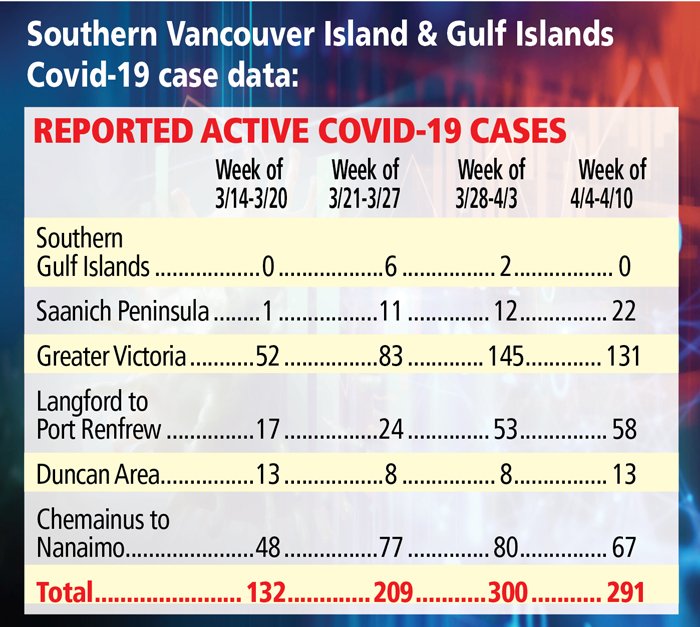
Data released today (April 14) on active COVID-19 cases in B.C. indicates that no new cases were recorded in southern Gulf Islands communities between April 4 and 10, despite rumours to the contrary circulating on Salt Spring Island last week.

The accompanying chart using B.C. Centre for Disease Control data and prepared by community members Curt Firestone and Stan Derelian details case numbers for the region for the past four weeks.

(Click on the image above to see the full data chart.)

One Cool Island: On rain-soaked Salt Spring, every drop is precious

BY ANDREA PALFRAMAN 

TRANSITION SALT SPRING

On our raincoast island, it can seem like there’s “water, water, everywhere.” In a landscape dotted with lakes and streams and an average 900 mm of rain every year, it might be hard in a soggy January for Salt Springers to relate to calls for water conservation. 

But fast-forward to August. Soils in our forests get bone dry, and leaf litter underfoot sounds more like autumn. Our lakes and streams provide over half of our drinking water, with groundwater and rainwater storage making up the other half. And the recharge of those sources comes entirely from rainfall. Climate forecasts tell us what we know in our bones: that the amount of rain falling in the winter is getting heavier, with more of it running away to the ocean, and our summers are getting hotter and drier.  

The warning signs are clear, and more troubling when you add to that an overall trend that sees our population forecast rising almost 10 per cent by 2030, on top of a typical tourist season which sees our numbers almost double to 20,000.   

The conservation of water is already a habit for many of us. But many of us don’t fully understand where our water comes from or think enough about our role in ensuring an adequate quality water supply for our communities and our ecosystems. Forests, streams, marshes and all the non-human species that populate them also need their share. This not only keeps our island’s ecosystems healthy and beautiful but keeps our communities safer from the ever-increasing risk of forest fires.  

Climate change impacts the water cycle by influencing when, where and how much rain falls. Warming global temperatures cause water to evaporate faster, which leads to higher levels of atmospheric water vapour and more intense and heavy rains.

Climate modelling for our region shows that those increasingly intense winter rains will fall faster than soil, plants and forests can absorb them. This muddy runoff drains into nearby waterways, picking up contaminants like fertilizer on the way. All this ends up in our lakes, estuaries and the ocean, polluting waterways and causing overgrowth of harmful algae. Reliant as we are on lakes for drinking water, worsening algal blooms rob lake systems of purifying sunlight and oxygen and drive up the cost of potable water.

Salt Spring’s newly released Climate Action Plan weaves the links between rainfall, freshwater and forest conservation. While setting out a bold plan to reduce island emissions by 50 per cent by 2030, the plan also lays out a stark warning: the future viability and safety of our island’s drinking water will be under increasing threat if we do not act now to protect ecosystems ahead of increasing drought, higher temperatures and damaging storms. 

Aside from the obvious fire risks from tinder-dry summers on Salt Spring, low-lying Ganges village — portions of which are built over what was once ocean and estuary — faces a future of ocean flooding during king tides in storm season only 80 years from now. Overdrawing well-water and rising oceans also risk saltwater intrusion that would affect not just one well, but all of them within a shared aquifer. 

Anyone who has applied for a building permit lately knows that freshwater scarcity is also constraining development on Salt Spring Island. Since 2014, North Salt Spring Waterworks District has placed a moratorium on new water connections and imposed conservation regulations. Pressures for affordable housing are at an all-time high; these constraints are causing real hardship for families, workers and island businesses. How will we balance these needs? 

Transition Salt Spring, under the “One Cool Island” banner, aims to chart a way forward for inter-agency collaboration to protect water supplies and wildlife, prevent flooding, boost low water levels, improve aquifer recharge rates and enhance water quality. 

We welcome you to take part in two upcoming informative online events — described below — to learn more about the interconnectedness of water, forests, climate and our shared future. 

Water Storage Options for the Gulf Islands

• Sunday, April 18 from 3 to 4:30 p.m. Registration by donation at tinyurl.com/collectwaterSSI 

Every year, nearly one cubic meter of rain falls on every square meter of Salt Spring Island. So why do we have a water shortage problem? How and why should we collect and store water?

This live virtual discussion will feature a panel of experienced practitioners involved with different water conservation approaches, collection and storage.

Freshwater Stewardship for Challenging Times

• Wednesday, April 21, 6:30 to 8:30 p.m. Registration by donation at www.tinyurl.com/SSFreshwater

There’s a lot we can do to reduce fire risks while addressing water quality and supply issues. At this special two-hour event, you will hear about exciting real-world solutions to these big picture problems from:

• Robin Annschild on efforts to restore wetlands at Xwaaqw’um (“Burgoyne Bay”);

• Shannon Cowan and Bryan Young on the most important freshwater recommendations in the Climate Action Plan;

• Julie Pisani and Laura Patrick in a conversation about local government priorities related to freshwater stewardship. 

We encourage you to join us! One Cool Island indeed.

What You Can Do 

• Collecting rainwater is practical on any scale. Take a “virtual rainwater harvesting tour” to see how fellow islanders are storing and using rainwater: visit https://www.ssiwpa.org for a host of other resources on rainwater harvesting. 

• Conserve water at home and in the garden. Use drip irrigation, mulch your garden beds, install low flush or even composting toilets, ultra low flow showerheads and tap aerators to save money, water and electricity. Consider reseeding your lawn with clover and say goodbye to your lawnmower (and sprinkler!). 

• Trees slow water down, allowing it to seep back into aquifers. Practise and promote responsible forestry and land use to maintain creekside vegetation and trees, and favour selective harvesting over clear-cuts to prevent erosion and flooding, especially during extreme weather events. 

• Make the land you steward more climate change resilient. Download two handy graphics we developed for you and the Islands Trust on what we can do on the land we care for to help maintain the health of our freshwater and forest ecosystems. Just go to the Climate Action Plan page at transitionsaltspring.com and look for the link to the “Reducing Risk Infographic.” 

One Cool Island is a regular series produced by Transition Salt Spring on how we can all respond to the climate crisis, together. Andrea Palframan is a TSS director and communications lead. More information: transitionsaltspring.com. 

Devastating sheep kills prompt calls for dog control

0

Salt Spring livestock farmers are asking members of the public to respect the island’s  agricultural community and to keep their dogs under control following a deadly spate of dog attacks on sheep.

Falcon Farm owners Julia McKinley and Fraser Baldwin lost six breeding ewes and a lamb at the end of March, while eight of their newborn lambs were left orphaned. A nearby neighbour lost one more sheep that same night.

McKinley said she and Baldwin were woken up by a commotion in the sheep barn around 11:30 at night and discovered there had been an attack. They could hear dogs but could not see anything in the dark. They only discovered the true extent of the matter the following morning. 

Five of the ewes they lost were euthanized by veterinarian Aleta Schmah later that day because they were too hurt to be saved. 

“The one mother that was killed outright had two-day-old lambs, so for a sheep farmer, it’s a real heartbreak,” McKinley said. “We just hope the bottle babies survive, and we’ll do our best to feed them.”

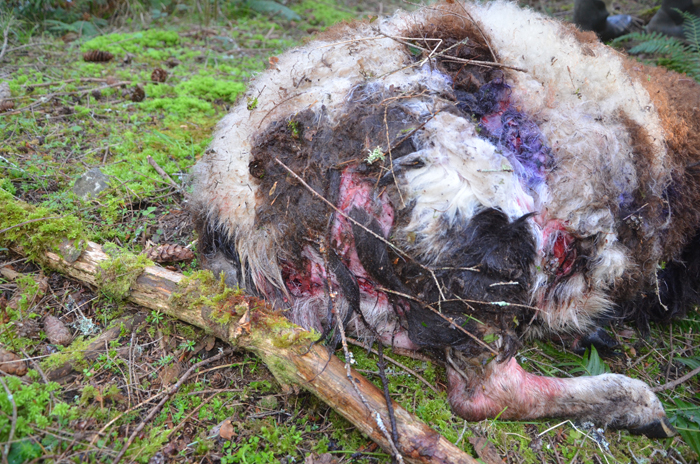
Dogs’ natural chase instinct can be deadly even if they don’t use their teeth. Pregnant ewes can be particularly vulnerable and may spontaneously abort when in danger. The Falcon Farm sheep were grievously injured, though, some with their skin torn off and their internal organs left hanging out.

McKinley said her Musgrave Road farm pasture is fenced, but not sufficiently well to keep out determined dogs. She and Baldwin will most likely need to create a smaller area with a secure perimeter. But they wouldn’t need the added expense if people had control of their dogs.

Sheila Windsor of Windsor Farm helped McKinley and Baldwin recover after the attack and gave them milk replacer for the lambs. She knows from experience how devastating such an event can be. While some people on social media have suggested livestock farmers shouldn’t care if their animals are killed, a dog attack means both that an investment is lost and that those animals die in a horrific way.

“There’s a complete difference between one quick shot at the abattoir and being ripped apart alive by a dog,” Windsor observed.

Even more troubling than having this happen on Falcon Farm is the fact it’s suspected the dogs involved are known to island farmers and were the same ones sought after a series of attacks that took place in the north end of Salt Spring in 2018. Windsor said those dogs were seen in the Musgrave Road area and in Fulford in the weeks before the recent killing spree.

Allowing dogs to run at large is an offence under Capital Regional District bylaws. As well, the Right to Farm Act permits farmers to shoot any dogs found on their property that could pose a risk to their operations, whether or not those dogs are actively chasing or harming livestock. 

The CRD can declare a dog to be dangerous and require it to be leashed and muzzled at all times. They can also seize such dogs and either rehome them somewhere where there are no farms, or euthanize them. 

“The trouble is, once a dog gets involved in an attack, usually they are going to do it again,” said Don Brown, CRD chief of animal control and bylaw enforcement. “And if there are two or more dogs, they can kill an animal just by chasing it to death.”

Brown said two of his officers were seeking an island resident believed to own the dogs implicated in the Falcon Farm attack. The dogs may be mixed shepherd breeds. As of last Tuesday, he said that person was no longer at their former residence or job and their phone had been disconnected, so they might have left the island. Even if that person is found, however, Brown said the evidence is “pretty circumstantial.”

Windsor and other island farmers are frustrated by the CRD’s lack of action so far. They believe the suspect dogs are responsible for close to 60 livestock deaths on multiple farms over the past few years and should have been destroyed long ago. At the same time, though, there have been other incidents attributed to different dogs. The overall issue of pet control needs to be addressed, especially during spring, which is lambing season.

“Because of COVID, everyone has dogs now and no one has the proper etiquette,” Windsor said. “These days everyone is getting dogs and having off-leash walks.”

The CRD has a program for compensating livestock owners whose animals are killed by unknown dogs. Known owners of dogs that cause the loss of sheep or lambs are themselves responsible for those costs, but that is not a solution farmers want to see either.

“It’s not okay to [get an offer of] reimbursement when you’ve cared for a sheep for four years and nursed it while it’s giving birth,” Windsor said. “That makes me sick. I did not okay your dog to rip it to shreds while it’s still alive.”

Another damaged Falcon Farm ewe.
Damage caused by a Falcon Farm dog attack.

Crawford retrospective show opens Friday at Mahon Hall

Long-time islander and local arts champion Ronald T. Crawford takes the spotlight this season as anchor of the Salt Spring Arts Council’s 14th Annual Spring Art Show — formerly the Easter Art Show — opening this Friday, April 16 at Mahon Hall. 

The show Cave Chanting: A Ronald T. Crawford Retrospective is curated by Rosalie Matchett and will feature some of the artist’s early work dating back 40 years, artworks that are now in private collection and a good selection of Crawford’s most recent ongoing project, Chasing Shadows.

The arts council observes Crawford has been a strong instigator for the visual arts on Salt Spring. He is a past chair of the organization, one of the original organizers for Art Night, and the founding director of the Salt Spring National Art Prize.

Crawford’s paintings and stone sculptures can meanwhile be found in private and public collections. Well-known works include the large wall piece Once Upon a Time at the entrance to the Salt Spring Library, and the Standing Stone Circle, commonly known as The Babas, a landmark installation at the Stonehouse B&B on Fulford-Ganges Road.

Visual artist Matchett said when she took on the role of curator for the retrospective, she was keen to create a catalogue for the show. 

“This way I could really get to know Ron’s work and include pieces that were no longer on the island. I chose the piece Cave Chanting as the title because it is a mid-career painting that touches on many of the themes in Ron’s work: his use of pattern to create structure, his suggestion of expanded space and geological forms and the allusion to a mythic narrative that occurs in many of his pieces.”

Crawford was heavily influenced by abstract expressionism in his early years, but after seeing an exhibition of the ancient Book of Kells he began to consider the power of pattern, and to explore their expression in traditional cultures as well as their occurrence in nature.

“I am always thinking what kind of forces went together to make that happen,” Crawford said of the natural phenomena. “Then I think, ‘what is the quality there that is attracting me to it and how can I replicate that in a painting?’”

His most recent work merges the boundaries between sculpture and painting in three-dimensional wall pieces that begin with creating organic-feeling plaster formations over the base layer. In the final stages of painting, colour is neutralized to emphasize the sculptural elements, but as Matchett points out, the more the viewer looks, the more under-layers of colours emerge and the paintings’ rich visual palette becomes evident. 

A limited number of catalogues will be for sale at the show. Both the show and the catalogue are sponsored by Steffich Fine Art.

The retrospective runs from April 16 to May 2, 11 a.m. to 5 p.m. daily at Mahon Hall, following all provincial health orders, including mandatory masks. The arts council is also offering a diverse selection of free artist talks, kids workshops and public programs starting next week. 

Full details and registration links can be found at https://ssartscouncil.com/eas2021/.

CREST/Rogers tower support requested by CRD director

By GARY HOLMAN

SALT SPRING CRD Director

As CRD director, I’ve written to the Salt Spring Local Trust Committee urging their support for the proposed telecommunications tower in the Channel Ridge area by Rogers and the non-profit CREST emergency telecommunications agency.

This proposal does not deal with the coverage gaps in the Ganges area, which a previous CREST proposal attempted to address, but will provide needed improvements in communications coverage for north Salt Spring that will better serve any of our first responders working in that area of the island.

CREST has been upgrading its system throughout the Capital Regional District. Through the CRD, taxpayers on Salt Spring are participants in and contribute to the regional emergency communications system and its upgrading costs. The co-location of CREST equipment on the Rogers tower is a cost-effective approach to improving telecommunication coverage while minimizing the number of towers. It should be noted that the TELUS tower in the same Channel Ridge area was not available to accommodate either Rogers or CREST. Also, Rogers proposes to construct a tower with or without CREST, so building a tower specifically for emergency communications would be more costly (including for local taxpayers) and would not necessarily preclude the erection of yet another tower. 

 Dr. Richard Stanwick, Vancouver Island’s chief medical health officer, has written the Trust previously, stating that in his view, and that of the BC Centre for Disease Control (BCCDC), the benefits of emergency communications outweigh any perceived health risks. The wave strength at the base of the tower, which would be located adjacent to a protected forest, is below that recommended in the Local Trust Committee guidelines, which themselves are even stricter than federal standards. 

The Salt Spring Fire Protection District (through CRD), BC Ambulance Service, and RCMP are all members of CREST and support these improvements, as do our local search and rescue organizations and the CRD Emergency Program. 

But the Trust also needs to hear from the community at large. Please contact Local Trust Committee planner Geordie Gordon at (ggordon@islandstrust.bc.ca) in support of a cost-effective improvement to emergency communications for all of our first responders on Salt Spring. Comments are accepted until close of business on April 16.

Valhalla neighbourhood path closure explained

0

A pathway between Valhalla Road and the Meadowbrook seniors complex that was blocked off sometime around the end of February is likely to remain closed to the public, according to property representatives and Capital Regional District staff. 

Jenny McClean, a member of the family who owns the Atkins Road property, told the Driftwood a pedestrian pathway had never been permitted on the easement at the back of the lot. The family recently received information confirming that and therefore took steps to prevent public access.

Residents of the area like Mary Hughes said they have been surprised and dismayed to find part of the “Stevens Memorial Pathway” blocked after many years in use. Hughes frequently took the route and always believed it to be a public amenity.

“It’s been a favourite walk of ours, up Swanson to Atkins, appreciating the pathway up Atkins to Meadowbrook, along the asphalt walkway to that short gravelled narrow section leading to Valhalla, and on home. It’s been a great shortcut to get to Meaden Hall, Country Grocer and other destinations,” Hughes said.

Salt Spring Parks and Recreation manager Dan Ovington said there is an easement on title for Ganges Sewer along the back end of the property where the pathway connects to it. That easement does not include language that would require or permit access for pedestrian use, however. 

While the situation is unfortunate, Ovington said, it’s ultimately a case of private property rights.

“We have a lot of this on Salt Spring, where people have historically passed over private property and then the property is sold and the new owner doesn’t want the liability. And people get up in arms, but actually they’re trespassing,” Ovington said, speaking generally. 

The property in question has not been sold.

Trust must act on climate emergency declaration

By SHAUNA DOLL & CHRIS GENOVALI

In 2019, the Islands Trust issued a “Climate Emergency Declaration” that committed them to “intensifying . . . efforts to better match the urgency of the climate change emergency.” 

Unfortunately, meaningful action associated with this declaration has yet to materialize. Considering that coastal Douglas-fir ecosystems within the Islands Trust Area store 82 per cent more carbon and have 43 per cent higher carbon sequestration potential than other parts of the region, ecosystem protection must be prioritized as a climate change response. 

The Gulf Islands represent 33.2 per cent of the provincial extent of coastal Douglas-fir forests and associated habitats, which are among the most biodiverse in the province. Yet, this region is also the most degraded. According to the B.C. Conservation Data Centre, there are 43 ecological communities at risk within the coastal Douglas-fir zone. Even prior to the current climate and biodiversity crisis, the Islands Trust was uniquely mandated to “preserve and protect” the habitats and ecosystems of the Trust islands and ensure the sustainability of their communities. 

An Oxford University publication from 2019 stated that coastal regions, islands and ecosystems “exist in a delicate balance at the land-sea interface,” making them exceptionally vulnerable to climate change impacts. The loss, degradation and conversion of native habitats, forest canopy, forest understory, and wetlands, reduces water storage, perpetuates water shortages, increases soil desiccation and erosion, increases flood and fire risk, increases temperatures and heat waves, perpetuates declines in biodiversity and weakens community resilience.

A Nature series publication last month expanded on the implications from such risks, noting that habitat and climate-induced threats to biodiversity could have ripple effects from extinctions that can cascade beyond just a single species, impacting whole food webs and services that humans rely on. In light of the fundamental need for functioning food webs and the regional, national and international recognition of a global climate and biodiversity crisis, the Trust needs to act. 

The loss of forest habitat on Trust islands is occurring because, despite the Trust’s “preserve and protect” mandate, on some islands there are few to no constraints on the development of single or multi-unit properties, footprint of houses, or house amenities, nor are there limits on the extent of habitat conversion per lot, the extent of impervious surfaces, limits on water and other resource demands, limits on extensive tree removal, or limits to development and growth on finite islands. In addition, there appears to be no recognition of cumulative impacts on, or the carrying capacity of, the Gulf Islands.

As part of the Trust Policy Statement review process, Raincoast Conservation Foundation submitted a document reminding the Islands Trust that there is no place for a pro-development, urban planning approach in the Gulf Islands, which by definition are rural and by law were intended to be protected and managed for ecological and conservation value above all else. Whether “green” or not, more development is not the answer to mitigating climate change and creating ecological resilience on the Gulf Islands. Developers and development interests often exploit climate change, using it as an excuse to keep building in rural landscapes and green spaces which should serve as regional refugia, and not be subject to further incursion.

The Trust Council needs to follow through on its Climate Emergency Declaration. Making such commitments without active implementation of substantive mitigative action renders the declaration nothing more than a public relations exercise. Arguments can be made that most islands have reached their development limits and additional anthropogenic pressure will exacerbate the climate-change-related issues the Trust claims it has prioritized. The Trust Policy Statement in its current form leaves too much open for interpretation and, despite a plethora of commitments and recommendations, very little is actionable via operational strategies or plans. 

According to the IPCC, we have nine years to avoid the impacts of 1.5°C global warming above pre-industrial levels. The Trust must move toward implementing innovative environmental policies in collaboration with island communities, First Nations, scientists and policy experts. Land use and policy decisions affecting the rural landscapes of the Gulf Islands cannot continue to be shaped by urban planning perspectives. These decisions should be filtered through an ecological lens. 

The most recent Trust Council meeting demonstrated a pervasive hesitancy to fully commit to the Trust’s mandate and instilled little hope that consequential climate action will be taken. 

Time is running out as business-as-usual practices strip the Gulf Islands of its forests and ecological resilience. The exigencies of the climate crisis are undeniable. The time for political bravery is now. 

Shauna Doll is Raincoast Conservation Foundation’s Gulf Islands forest project coordinator. Chris Genovali is Raincoast’s executive director.