Home Blog Page 310

Hayes and Meyers CD and video released

The first video connected to Deeper Into the Forest is attached to this story excerpt from the March 24, 2021 Driftwood newspaper.

Respected island poet and photographer Diana Hayes and equally accomplished musician and music producer Andy Meyers are proving the power of collaboration in a new project being launched this week. 

Deeper Into the Forest is an album of spoken word set to music, with Hayes performing a selection of work from her 2019 book Labyrinth of Green. The poetry is set to music written and performed by Meyers, with recording done at his Allowed Sound Studio.

The CD was produced with help from the British Columbia Arts Council’s Microgrant Pilot Program.

The project is the first of its kind for Hayes, who has usually felt more comfortable behind the pen or a camera than a microphone. Several people approached her after she did a reading for Labyrinth of Green, though, and suggested a recording would be a good idea. 

“They felt it was something that I should pursue — they liked my presentation and they thought it would be kind of an extension of the book itself or a recreation of it,” Hayes said. “I had often thought about it, and I was really fond of listening to Brian Brett’s CD, which he did with Andy. And I think especially now that so much is happening online, it’s a really good way to share poetry.”

Hayes and Meyers first began talking about the project in December 2019, and they got to work selecting a short-list of poems the following January. Recording of Hayes’ vocal tracks was done in February of 2020. Then COVID hit.

“We had a slice of all the various things that go on in the book,” Meyers recalled. “We had a certain trajectory . . . It was a good thing we had Diana’s parts down, because I was allowed to work with myself in that setting, but it would be harder to work as a duo.”

For more on this story, see the March 24, 2021 issue of the Gulf Islands Driftwood newspaper, or subscribe online.

Public eyes wanted to detect Asian giant hornets in 2021

0

B.C. and Washington state governments were boosting the buzz on Asian giant hornets just as spring was on the horizon last week.

Officials from both jurisdictions’ agriculture departments presented a joint news conference on March 17, updating the public on plans for detecting and trapping the invasive species (Vespa mandorinia) and educating them on what to look for. 

“Last year half of Washington’s confirmed detections and all of B.C.’s came from alert community members, so the importance of participation from residents can not be overstated,” said Karla Salp, a communications specialist for the Washington State Department of Agriculture.  

Thirty-one confirmed Asian giant hornet detections occurred in Washington and six in the Fraser Valley of B.C. in 2020. One of the Washington detections was from a trap that allowed a hornet to be tagged and tracked back to a nest, which was then destroyed. Sven Spichiger of Washington state’s agriculture department said that nest contained 500 specimens and about 200 virgin queens. While the nest was destroyed, it did contain some empty cells, which means queens could have already left and be establishing new nests for this year. 

Paul Van Westendorp, the provincial apiculturist for B.C.’s Ministry of Agriculture, Food and Fisheries, said 60 traps were put out by the ministry in 2020, but no hornets were caught in them. More traps will be set this year, he said. 

Whatcom County will see some 1,500 traps set: one trap per one kilometre in a grid format, and more if needed, said Spichiger. 

Van Westendorp added that no hornets were detected in the Nanaimo area last year after a nest was found and destroyed there in 2019. 

Spichiger explained that the hornet queens will emerge from protected cells at this time of year and start to form a nest, eventually rearing a number of workers. 

“From about July through September the colony really starts to increase in size,” he said. 

Traps are set out from July through November.

Nests are usually found in the ground but the one destroyed in Blaine, Wash. last year was about a foot off the ground in a tree in a family’s yard. The hornets themselves are between 2.7 and five centimetres (one to two inches) in length, with some queens growing even larger.

While the Asian giant hornet does have a powerful sting that can cause death to people who are allergic to them, their nickname “murder hornet” pertains to their voracious appetite for other pollinators such as honeybees and wasps. 

Spichiger gave the example of a Washington beekeeper who reported all of the specimens of a very healthy honeybee colony being decapitated by the hornets.

“There are some cascading effects to agriculture that are really quite severe,” he said. 

Based on genetic analysis it is believed the Nanaimo introduction originated closer to Japan, as opposed to South Korea like the Washington state specimens. It is speculated that a fertilized queen arrived in Nanaimo in the engine compartment of a new vehicle. Van Westendorp said that suggests the coast will be vulnerable to future introductions via that mode and that vigilance to detect and destroy the hornets will continue to be required.  

While Van Westendorp said he is optimistic that the population can be contained in B.C., he feels he has been given adequate resources to tackle the problem this year.

“Here in B.C. we will do whatever it takes to address this issue appropriately.”

British Columbians who think they may have seen an Asian giant hornet or a nest can report their findings to the Invasive Species Council of BC:

• by telephone, toll-free: 1-888-933-3722;

• via the council’s “Report Invasives” mobile phone app, or

• online:
https://bcinvasives.ca/take-action/report/

Viewpoint: Mental health plan crucial for B.C.

BY SONIA FURSTENAU, Cowichan Valley MLA;

and ADAM OLSEN, Saanich North and the Islands MLA

We have been asking questions of the provincial government about their response to the growing mental health crisis in B.C. 

Every one of their responses has been framed with sincere condolences. Yet, urgent action is lacking. We have heard from numerous community advocates that the provincial programs to deliver a safe supply of pharmaceutical- grade alternatives to poisonous illicit street drugs are not enough. We have heard that the province has not moved quickly enough to decriminalize people who possess a personal supply of illicit street drugs.

For too long our friends, family and neighbours who struggle with mental health and addictions have faced relentless stigmatization and judgement instead of receiving the support and care they deserve. There are far too many stories of how our fellow citizens have been forced to overcome obstacles deeply entrenched in government institutions.

Rather than receiving the medical treatment they need, people suffering from addictions have been arrested and sent to the criminal justice system. Rather than receiving the medical treatment they need, people suffering from a mental health crisis have been belittled and sent on their way without the support or treatment they are seeking.

People are dying in British Columbia because of outdated drug policy. People are dying in British Columbia because when they seek treatment for a mental health crisis, they cannot get the help they need. 

It doesn’t have to be this way. One big step government can take towards providing specialized mental health care for British Columbians is to pursue a pilot project authorizing psychologists to become eligible providers through the Medical Services Plan or Psychological Services Plan. This would help expand the access and affordability of mental health services and ensure all British Columbians can access the health care they require.

The B.C. NDP government has not demonstrated the urgency that is needed to address these crises. When we ask questions, we often receive lists of piecemeal actions being taken related to mental health. Though many of them are great — more treatment beds and online supports, for example — they do not address the broader, systemic problem at hand.

Our government does not treat mental and physical ailments equitably. If you are experiencing a cardiac event, stroke, or are diagnosed with terminal cancer it is unlikely that you will be diminished or blamed for your condition. In fact, you are likely to receive world-class treatment from the B.C. health-care system. However, we have heard too many examples that are far from this response from people who present to a health-care facility with a mental health crisis and/or addiction.

We asked Premier John Horgan in question period when his government is going to change the culture in our health-care system so British Columbians can expect the same treatment when they present with ailments of the mind or the body. Unfortunately, there was no answer, but we think everyone can agree that the situation is dire and getting worse. If we are to “build back better” after the pandemic, truly caring for British Columbians’ mental wellbeing will need to be at the forefront of that effort. 

Editorial: Trust Council strikes right balance

0

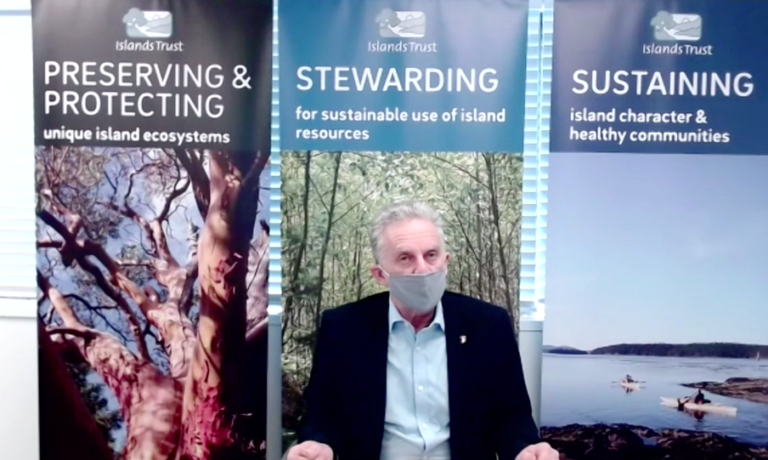
Islands Trust Council’s last quarterly meeting held via the Zoom platform was more lively than usual.

Motions presented by South Pender trustee Steve Wright to not include policies on housing in the Trust Policy Statement and to remove the current “Sustainable Communities” section, among other similar suggestions, were soundly defeated. Supporters of Wright’s position said they felt the Trust’s energies were spread too thin and that the Trust should instead try to do a few things well, with protecting the natural environment being at the top of the list. 

The Trust mandate is and has clearly been the preservation and protection of the environment above all else, despite often having inadequate legislative tools to do that effectively. But as one trustee pointed out during meeting discussions, the vast majority of applications dealt with by local Trust committees are related to housing. It would be bizarre to have the Trust’s guiding policy document be completely silent on the subject when trustees are looking for guidance in making decisions related to housing. At the same time the inclusion doesn’t mean the Trust must be proactive about housing.

Islands Trust Council has seen similar philosophical conflicts among trustees in its 47-year history. As the most populated island, Salt Spring’s focus and challenges have not always been the same as most other islands in the federation. Affordable housing is a concern to some degree on all islands, but the breadth and impact of the problem, and the urgency, is not the same as on Salt Spring. That’s why local trustee Laura Patrick has been leading the charge for action from all levels of the Trust. 

It is true that a local Trust committee can make an official community plan and land use bylaw amendments, and undertake some leadership and advocacy activities that could positively impact the housing situation. But we should not be deluded into believing that the Islands Trust can necessarily provide or even facilitate effective solutions to an extremely complex problem that is dependent on other government bodies and private interests. 

Trust Council took the responsible route by not removing references to housing and communities in the Policy Statement, while at the same time reiterating that its prime purpose is preserving and protecting the natural environment within its legislative bounds. The process and outcome was a healthy example of our regional government in action. 

Black Sheep Books closed due to COVID-19

0

Black Sheep Books in Ganges is temporarily closed following a positive COVID-19 test from a staff member. 

Store owner Cat Cooper said Monday that the health ministry advised her that staff needed to quarantine, do a deep clean of the premises and close for a couple of days as a result. However, Cooper said, “We will remain closed until we feel it is safe to re-open.”

Cooper added that, “After asking the numerous health officials I’ve spoken with over the last two days, they were of the opinion that anyone who was in the store from Thursday, March 18 onward, (the infectious period prior to symptoms), is not considered at risk if they wore masks, maintained a six-foot separation and did not have more than 15 minutes of open face-to-face contact with staff. If you were in the store during those times, and have questions or concerns, please contact your health-care provider as to how you need to proceed.

“Despite the ministry advising me that we did not have to do anything else above quarantine, do a deep cleanse to the store, and close for a couple days, we will remain closed until we feel it is safe to re-open.”

Updates will be posted on the store’s social media sites.

Island bookkeeper Meron Moroz was notified of the exposure as part of the contact tracing process because her employee had interacted with Cooper last Thursday. Moroz’ initial Facebook page posting about the notification and her need to quarantine led to people asking if it was due to a separate exposure event. Moroz clarified on Tuesday that Black Sheep Books was the client in question.

Canadian biodiversity expert speaks with islanders

By DAVID DENNING

SPECIAL TO THE DRIFTWOOD

The most important piece of the puzzle for stopping drastic climate change is the part most often overlooked. The simple reality is that nature can help us avert a deepening climate crisis.

Our problem, of course, is that we continue to emit excessive greenhouse gases.

Technologies such as renewable energies and electric vehicles are partial solutions, but will not solve our climate crisis on their own. That’s true also for behavioural changes such as reducing our travel or growing and buying more of our own food locally. Carbon capture and sequestration technologies are exceedingly expensive, and have little to no promise to significantly reduce atmospheric carbon.

We need to call on nature. Healthy ecosystems, rich in biodiversity, provide one of the best and most effective ways to capture and store the excess carbon we have released to the atmosphere.

On Sunday, March 28 from 3 to 4:30 p.m., Risa Smith will provide a unique opportunity for islanders to learn about Canada’s commitments to preserve and rejuvenate our natural ecosystems, through her live zoom presentation and discussion called Using Nature’s Ways to Fight the Climate Crisis.

Smith is a world leader in biodiversity, environmental monitoring and promoting the concept of nature-based approaches to the climate crisis. She is a key advisor to the Canadian government shaping our responses to the climate and biodiversity crises, and has presented to many world conferences, including both COP 24 and COP25.

Smith is the author of Enhancing Canada’s Climate Change Ambitions with Natural Climate Solutions, a study that lays out five key approaches we can use to maximize the effects of preserving and restoring nature. In this presentation, she will examine what we must do at national, provincial and local levels to work with nature to slow and reverse greenhouse heating.

Smith is an inspiring naturalist, community leader and climate activist living on Galiano Island where she serves on the boards of both the Galiano Conservancy and the Salish Sea Renewable Energy Cooperative.

Sunday’s event is a fundraiser for both the Salt Spring Island Conservancy and the Transition Salt Spring Society.

Tickets are $10, available at EventBrite using this URL: www.tinyurl.com/RisaSmith.

Students can join for free and can obtain their tickets by emailing: info@transitionsaltspring.com

Craft vendors will be part of 2021 Saturday market

0

Salt Spring Parks and Recreation is anticipating the return of the popular Saturday Market in the Park on April 3 with both food and craft vendors participating as a result of an update to COVID-19 health orders.

Provincial health officer Dr. Bonnie Henry rescinded her earlier order on March 18, with the result that non-food related vendors will now be allowed at outdoor episodic markets. Salt Spring’s market at Centennial Park will therefore open for the season as normally scheduled on the first Saturday in April with a range of vendors present. The market will remain at smaller capacity than in pre-pandemic years in order to meet safety guidelines.

“We think we will be able to have around 50 booths, depending on size, and there will be some overflow available on the boardwalk,” said Dan Ovington, the Capital Regional District’s Salt Spring parks and recreation manager. 

Ovington said the CRD has been accepting registrations for market space since February but had held off collecting fees from vendors since it wasn’t clear whether a market would be permitted or not. 

“We have had a lot of interest from both seasonal and day-use vendors,” Ovington reported.

Returning market coordinator Dawn Larden and other staff learned valuable lessons from last year’s truncated season on how to run a smooth experience this year, although there are some new things to get used to in the health order.

“COVID is a challenging time, and now the rules have changed again,” Larden said. “The new rules allow artisans back, which is excellent. But there will be changes such as one direction of flow, masks for vendors and visitors, and possibly the spacing between booths.”

“We think we will be able to have around 50 booths, depending on size, and there will be some overflow available on the boardwalk,” said Dan Ovington, the Capital Regional District’s Salt Spring parks and recreation manager. 

Ovington said the CRD has been accepting registrations for market space since February but had held off collecting fees from vendors since it wasn’t clear whether a market would be permitted or not. 

“We have had a lot of interest from both seasonal and day-use vendors,” Ovington reported.

Returning market coordinator Dawn Larden and other staff learned valuable lessons from last year’s truncated season on how to run a smooth experience this year, although there are some new things to get used to in the health order.

“COVID is a challenging time, and now the rules have changed again,” Larden said. “The new rules allow artisans back, which is excellent. But there will be changes such as one direction of flow, masks for vendors and visitors, and possibly the spacing between booths.”

For more on this story, see the March. 24, 2021 issue of the Gulf Islands Driftwood newspaper, or subscribe online.

Islanders protect old growth at Fairy Creek

2

A grassroots effort to protect old-growth forest slated for logging near Port Renfrew is reaching a critical point next week, when a hearing at British Columbia Supreme Court will determine if the Teal Jones forestry company wins an injunction against protestors.

Concerned individuals including those from Salt Spring have been blocking road construction into the Fairy Creek watershed since August of last year. They will have the chance to argue their case at the injunction hearing scheduled for March 25 and 26. Protesters intend to continue their action regardless of the outcome, unless the provincial NDP government stops logging in Vancouver Island’s critical old-growth stands.

“No one wants to end all logging or take away a livelihood, but there are third-growth renewable forests,” said Salt Spring environmental activist Cathy Lenihan. “This is the last stand for ancient forests in B.C., and really the world.”

The Rainforest Flying Squad is the name taken by the grassroots collection of people at the centre of the Fairy Creek watershed blockades. Islanders who have been active with the core group include Molly Murphy and Kim Murray, both of whom have helped build up campaign infrastructure such as camp facilities and communication outreach and have put in considerable time on site.

Murray said a woman named Carol Tootle who lives on Vancouver Island put the first call out for defenders last summer. The fight to save the area has since attracted young people from all over, in addition to experienced forest campaigners who were fighting in the “War of the Woods” in the 1990s.

Even legendary Canadian musician Bruce Cockburn has lent his support. He performed a voice-over in a forest-protection ad released this week. Playing in the background is his well-known song, When a Tree Falls in the Forest.

“I think they thought it would be a few days kind of thing, but there’s been this convergence of people who are interested and frustrated and have had enough. And it just took that one little spark and people just started coming,” Murray said.

The Fairy Creek watershed, located close to the tragic lone-standing old-growth fir tree known as “Big Lonely Doug” and the Avatar Grove, is the last unlogged valley in the San Juan Valley on Vancouver Island. With only an estimated two per cent of B.C.’s original old-growth forests left untouched, the area is a living resource for sequestering carbon emissions and sustaining biodiverse species.

“It goes in the face of common sense and reality,” said Tom Mitchell, an islander who has made day trips to support the blockade. “So many countries have declared climate emergencies.”

Forest defenders have been preventing logging at five other old-growth remnant forests as well as Fairy Creek. They are calling for the immediate deferral of logging at the entire Fairy Creek rainforest, the forests at Bugaboo Creek, the Caycuse watershed, Edinburgh Mountain, Camper Creek, the Upper Walbran and the Central Walbran valley.

As the Sierra Club of B.C. pointed out this week, the B.C. government-appointed Old Growth Review Panel called for “a paradigm shift to safeguard the biodiversity of forests, with a three-year framework and logging deferrals for all at-risk old-growth forests within the first six months.” The NDP committed to following all 14 of the report’s recommendations as a campaign promise last fall, but has not stopped logging those critical areas six months after the promise was made.

In response to questions from the Driftwood, Forests Minister Katrine Conroy said the province remains committed to implementing all 14 recommendations.

“We know some are calling for an immediate moratorium, but this approach risks thousands of good family-supporting jobs. We know others have called for no changes to logging practices, but this could risk damage to key ecosystems,” Conroy said in an emailed statement. “There is a better way for B.C. to manage old-growth forests and our government will work collaboratively with all our partners to do this.”

Conroy said the province began by collaborating with Indigenous governments to protect almost 196,000 hectares of old-growth forests in nine different areas across B.C. last fall. They are now working through the three-year timeline identified by review panel report authors Al Gorley and Garry Merkel.

“We know there is much more work to do. To get this right, we will follow the advice of the old-growth report and fully engage Indigenous leaders, industry, workers, communities and environmental groups to find the right way forward for old-growth forests in B.C.,” Conroy said.

Mitchell said B.C. additionally faces difficulty in meeting its commitment to the Declaration on the Rights of Indigenous Peoples Act. The Fairy Creek watershed is in the unceded territory of the Pacheedaht Nation. While there has been no public statement, for or against the blockades, from the chief and council, the blockade has received an official welcome from Pacheedaht elder Bill Jones.

Brian Smallshaw is another Salt Spring resident supporting the blockades. Along with Lenhihan, Mitchell and their friend Gary Gagné, he has helped supply the rotating camp teams with groceries and firewood. That group was intending to increase their participation in the weeks ahead and to make a bigger stand if the injunction goes through, as they assume it will.

“We really believe old-growth logging has to stop. This has to be the bottom line,” Smallshaw said. “It’s a hard struggle, but it’s worth it. It’s like the banners say: It’s worth more standing.”

“This is it. We don’t have a window of opportunity in the future,” Lenihan added.

People who have been out to the blockades and walked the old-growth forests encourage anyone who can to make the trip to see what they are trying to save. Protocols for how to get involved can be found at fairycreekblockade.com.

For more information, look for Fairy Creek Blockade and Rainforest Flying Squad pages on Facebook and Instagram. A GoFundMe campaign to support the blockaders’ legal fees can be found under “Direct Action for the last Ancient Rainforests.”

Communities affirmed as part of Islands Trust mandate

1

Islands Trust Council made steps toward prioritizing protection of First Nations cultural heritage while also resolving that protection of healthy and inclusive communities is part of its core mandate during the March quarterly meeting. 

Council approved a budget of $9,059,919 with a $7,079,771 general tax requisition that includes significant spending for Salt Spring projects at the March 9-11 quarterly meeting, which was held over the Zoom platform. The requisition amount marks an increase of 4.37 per cent over the previous year. Salt Spring taxpayers are additionally responsible for a $75,500 special requisition to fund water protection work.

Salt Spring trustee Laura Patrick said she was happy to know housing and Ganges village planning projects can now proceed as planned. 

“Salt Spring’s budgets are intact and we’re going to buckle down and go to work,” Patrick said after the meeting. “It’s all systems go.”

Housing and Trust policy were major topics of conversation throughout the three-day meeting. Trustees expressed some frustration and disagreement on how to fulfill the Trust’s primary object of preserving and protecting the environment and the “unique amenities” of the Gulf Islands, as well as what that part actually means.

In response to motions raised by South Pender trustee Steve Wright, council fully supported defining “unique amenities” as being inclusive of the cultural heritage of Indigenous Peoples within the Islands Trust Area, and agreed protecting these aspects be prioritized in policy work. 

Council voted down including “the natural character of the environment” in that definition, however, since protection of the environment is clearly stated in the mandate in the first place. They also failed to support Wright’s motion to exclude housing policies from the Trust Policy Statement, and another motion to remove items associated with housing from the strategic plan. 

Several trustees noted the programs committee is in the midst of a policy statement review process that started in September 2019, and Wright’s proposed changes were not included in the public consultation part of that work. Draft policy amendment changes are scheduled to come before Trust Council in June.

“I’m concerned this narrowing is happening too early in the process — it’s a short-circuiting of the process we’re in,” commented Bowen trustee Sue Ellen Fast. 

Council voted instead to approve two alternate motions raised by Gambier area trustee Dan Rogers, affirming the Trust executive and its programs committee will continue to work on improving policy on affordable housing and sustainable communities. Rogers noted Trust Council had received a huge amount of correspondence related to these motions. 

Elizabeth FitzZaland of Salt Spring Solutions, a group dedicated to tackling the housing crisis on the island, said she was “relieved and deeply appreciative that our local trustees — Laura Patrick and Peter Grove — along with a majority of trustees from across the region, voted down the motions that sought to undermine the Islands Trust mandate to plan for sustainable communities.”

She added that “While I am troubled that this keeps presenting itself as a possibility at our regional Trust Council, I am heartened by the leadership of those who understand that we cannot confront climate change and protect the natural environment without simultaneously and proactively planning for healthy and inclusive local communities. This is the calling of our time. I am also grateful to the over 100 individuals and organizations from across the Islands Trust region who took the time to write letters to Trust Council.” 

Salt Spring hosts DFO marine mammal training

0

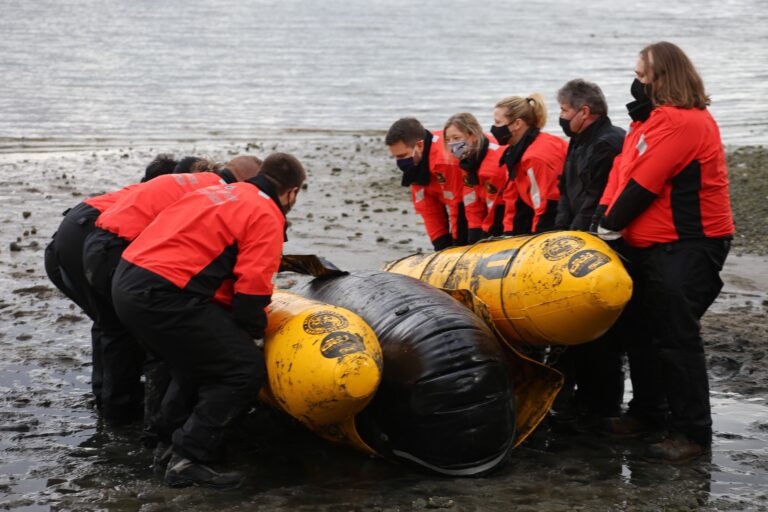
Visitors to Ganges Harbour on the afternoon of March 9 may have witnessed a large team of fisheries officers working to free a 450-kilogram black cetacean stranded on the foreshore near Beachside.

The team from Fisheries and Oceans Canada’s whale protection unit was successful in their efforts to insert a tarp under the animal, inflate side pontoons and then tow the whale back into the ocean for eventual release. It was an exciting conclusion to a difficult job — even though the whale in question was made of synthetic material and its smile was only painted on.

The whale protection unit officers were on Salt Spring for four days of training on a variety of marine mammal rescue responses. In addition to how to help in a stranding, they trained on the hydrophone network and practised on the water how to deter whales from visiting an area where an oil spill had taken place.

Officers also learned to take samples from a deceased Pacific white-sided dolphin (a real one, this time), before observing a post-mortem exam with biologist Steven Rafferty at a field station set up behind the Harbour House Hotel.

This hands-on part of their job education has been delayed for a year due to COVID-19, but a variety of factors made it important to proceed now with the correct safety measures in place.

“I’m pretty excited we can keep doing this,” said program coordinator Genevieve Cauffopé. “We’ve trained a lot of officers over the years, but this week we are focusing on our whale protection unit officers. They’re really the specialists in the region.”

Also overseeing the training was an officer who grew up on Salt Spring, Paul Cottrell, who is DFO’s marine mammal coordinator and disentanglement expert.

“We’re fortunate that with the Oceans Protection Plan we’ve been able to purchase some of this equipment,” Cottrell said with an eye toward the reflotation gear. “Of course if something happened, we want to be ready to go. It’s important to get out and experience as best you can what it would be like, so when you get that call and it’s high stress, and there’s things going on, you know what to do.”

Kirsty Walde, a senior compliance program officer and Oceans Protection Plan coordinator who also happened to have grown up on Salt Spring, explained the Whale Protection Unit was formed under the federal government’s commitment to protect the southern resident killer whales.

Officers are there to enforce compliance with the Fisheries Act, Species at Risk Act and Marine Mammal Regulations for protection of SRKW prey availability, critical habitat and freedom from disturbance, as well as responding to marine mammal incidents. The unit has offices based out of Victoria and Annacis Island, and has ongoing funding support that will continue beyond the five-year Oceans Protection Plan.

The Gulf Islands hosts two of the three interim sanctuary zones as identified under Transport Canada’s Interim Order SRKW management measures, located just off Saturna and Pender islands.

“With SRKW currently in British Columbia waters, increased potential for incidents with the upcoming boating and fishing season, and ongoing and future spill events, it is key that DFO ensures that front-line fishery officers are trained,” Walde said. She noted that on the day of the stranding exercise, J-pod members were confirmed to be nearby in Boundary Pass.

Another part of last week’s session was a day on the water learning how to help in the event of a whale entanglement.

“The focus is on safety training for the officers and others, as well as actually helping the marine mammals,” Cauffopé explained. “It’s very cool and super useful.”

Participants learned how to attach a satellite beacon to the fishing gear encumbering a whale so that Cottrell and his team can locate and free the animal later on, in a way that maximizes effective use of space and time.

It can take a day or so for the experts to reach a remote coastal site, and then even longer for ocean conditions to be safe enough to send the boats out. In that time an at-risk whale could have moved on from where it was first spotted. Training involves learning how to grapple the equipment onto any trailing gear safely and effectively, as well as how to operate the boat safely in the presence of a whale.

In addition to DFO staff, Cottrell’s team has given this same training to Parks Canada staff, non-governmental agencies and designated guardians in Indigenous communities.

“I lead the large whale entanglement rescues on the coast here, but of course it takes a team,” Cottrell said. “One of the key components is that it’s a huge coast, and often we’ll have whale entanglements in Bella Bella, Haida Gwaii or on the west coast of Vancouver Island.

“So if we get key areas with key people, and if we get a call about a humpback entangled off Tofino, we’ve got a team that’s trained. If we decided it’s a candidate for disentanglement, they’ll go put the stat tag on and I’ll get my kit together, get up there and join them and wait for the right weather, and hopefully help the whale.”

“This technology’s crazy — it’s changing everything,” Cottrell added. “If we can get to the whale, the chance we get to save it is really high. And that’s what I love. It’s the best part of my job.”

People who witness whales in trouble of any kind — from stranding to entanglement to harassment from boaters — are urged to call the Marine Mammal Incident Reporting hotline at 1-800-465-4336, or to send emails to DFO.ORR-ONS.MPO@DFO-MPO.GC.CA. Attaching photos or videos to emails, if possible, is extremely helpful for officers.