Home Blog Page 312

Fire destroys Fulford Harbour building

0

Vortex property developer Merchant House Capital is planning to take its Fulford Harbour project known as the Vortex off the back burner soon, in spite of a recent fire that could change some of the plans for the site.

A small derelict house on part of the property was completely destroyed by fire in the early hours of Feb. 25. Salt Spring resident and Merchant House Capital principal David Fullbrook said he was unaware of the fire until he got a call from police that morning.

“I was quite upset, just because I had a plan for that structure,” Fullbrook said. “I think it’s unfortunate and disappointing because it’s such a needless event to have occurred.” “It’s not going to deter our project,” he added.

Salt Spring Fire Rescue Captain Mitchell Sherrin received a call about the fire around 2 a.m. on Feb. 25, and he was the first to arrive on scene. He wasn’t sure how serious it would be since only one person had called it in and their information was vague because they couldn’t actually see the fire from where they were. Once Sherrin arrived, though, he could see the house was fully involved.

“The roof had already burned off and there were flames coming out of every window,” Sherrin said. “The walls were still standing but they weren’t going to be for long.”

The destroyed house had not been occupied for many years. The body of presumed squatter Joseph Bernie was discovered by the nearby Fulford Creek in 2015. Police believed he had been attacked inside the house, but the case was never solved.

A crew of 12 firefighters attended the fire with three apparatus. They were on site until 6 a.m. and used the tender shuttle system to bring water from the Fulford fire hall. RCMP and BC Ambulance Service personnel were also on scene.

Sherrin said not much was left of the house to aid an investigation. There did not to appear to be any people nearby at the time. 

“There was way too much damage for us to determine what the cause was,” he said. 

Merchant House Capital is currently partway through an Islands Trust development permit process to build the Vortex, which is to incorporate commercial accommodation units, a restaurant and retail sales on the former Fulford Inn site. While the destroyed house was on part of a lot that has rural zoning, Fullbrook said this team was intending to renovate and were looking into how they might use the space. Some ideas that have come up are creating staff housing for employees that will work at the Vortex, or to create a cultural centre for the Tsawout First Nation.

For more on this story, see the March 10, 2021 issue of the Gulf Islands Driftwood newspaper, or subscribe online.

Community seed swap hits farm stands

Island Natural Growers (ING) is ensuring Salt Spring has access to seeds this spring even though pandemic restrictions have put the usual events on hold. 

This weekend the organization will present the very first Salt Spring Island Farm Stand Community Seed Swap, taking place from 9 a.m. to 5 p.m. on Saturday, March 6 and Sunday, March 7 at a variety of locations across the island.

“In response to the current limits on gatherings and events, we’ve decided to switch up the annual Seedy Saturday event that is usually hosted at the Farmers’ Institute,” the organizers explain in a press release. “This year, we’ve planned an event spanning the whole island, and taking place at individual farm stands. This will allow Salt Springers to buy, sell and trade seeds in a safe environment, patronize their local farm stands, and have a fun day out and about while dreaming of their gardens for 2021.”

Visitors to participating farm stands can bring packaged homegrown seeds to trade or give away, buy seeds from the farm who is selling them (prices as marked) or take packages of donated seeds with a donation to Island Natural Growers. 

“Your donations continue to support our work in promoting sustainable agriculture on Salt Spring Island,” the group explains. 

Anyone who would like to learn more about interacting with the island seed bank should  make sure to visit the Seed Sanctuary at The Root at 189 Beddis Rd. on Saturday. A volunteer who can answer questions about this important local resource will be on site until 3 p.m.

“The staff at The Root are also seeking community donations of tools for the new permaculture garden that will be built on-site. If anyone has unused garden tools to give away, the team at The Root will gratefully accept them,” ING states.

Guidelines for farm stand visits given by Island Natural Growers are to “honour the honour system” by paying the full price indicated by seed growers. When trading or taking donated seed, it’s best to take amounts that will actually be used, and to leave some for the next participant, they say.

Additional requests are that people observe physical distancing and keep two metres apart at farm stands, wear a mask around others, use the hand sanitizer provided before shopping, or bring their own, and drive and park responsibly and safely. 

Participants should also remember to “enjoy yourself, and be mindful of others.”

Everyone is encouraged to share their experience and post photos to Facebook and Instagram with the hashtag #saltspringseedswap.

A map with all of the locations is below.

Participating Farm Stands 

• North End Farm – 2521 North End Rd

• 1982 North End Rd.

• Average Acre Life – 105 Fernwood Rd.

• The Piper’s Buns – 740 Walkers Hook Rd

• Whims Road Rainbow Farm Stand – 173 Whims Rd.

• Top O’ the Hill Farm Stand – 191 Fort St.

• Park Drive Neighbourhood Farm Stand – 187 Park Dr.

• The Seed Sanctuary at The Root – 189 Beddis Rd. (Saturday only – until 3 p.m.)

• Heavenly Roots Farm – 430 Dukes Rd.

• Chateau Minvielle Farm Stand – corner of Fulford-Ganges and Kitchen roads

• The Lee Road Farm Stand – 140 Lee Rd.

• Salt Spring Flowers by Tali – 401 Beaver Point Rd. 

• Stowel Lake Farm – 109 Reynolds Rd.

• Salty Botanicals and Gifts – 146 Meyer Rd. 

• The Quarry Farm -190 Jasper Rd.

• 2823 Fulford-Ganges Rd.

Pathway funding deadline extended

0

Salt Spring residents will hopefully not lose $490,000 in grant funding toward a complicated section of pathway on Lower Ganges Road thanks to a deadline extension negotiated between the Capital Regional District and the Ministry of Transportation and Infrastructure (MoTI). 

Construction work on the pathway from Baker Road to Booth Canal Road is now well underway. Salt Spring CRD engineer Allen Xu reported last Monday the ministry had extended the pathway’s completion deadline from the end of March to the end of June. As he told the Salt Spring Transportation Commission, that should leave plenty of time to complete the work.

“I think there’s very little risk of the project not being completed by June 30th,” Xu said, adding most of it will be done by sometime in early May.

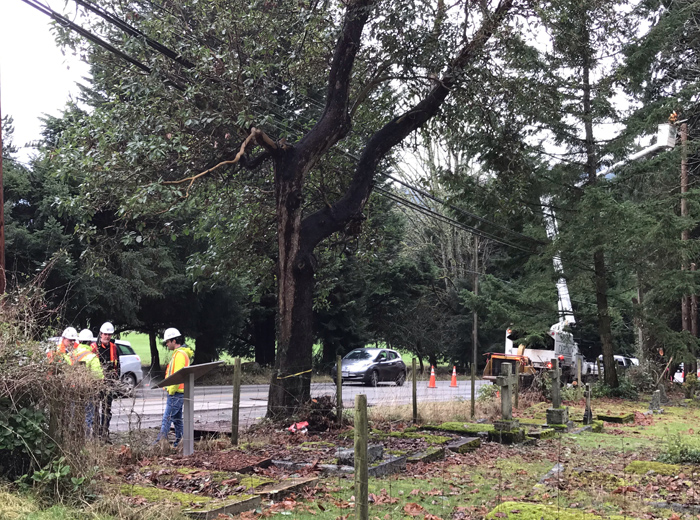
Some delays were incurred at the start of the project due to dangerous trees that were identified as needing to be removed for workers’ safety, plus winter weather. The only parts that will need some extra time after the bulk is finished are installing fencing and concrete block retaining walls in a few stretches. 

Xu said the commission may need to increase the total project budget, currently set at $700,000. Efforts to protect some “precious trees” through hand-excavating and hydro-vac soil removal around the roots of one arbutus tree have added to costs. Xu said the contractors have also encountered some utility lines that are very close to the southern terminus, so design modifications will be needed.

Money has been saved by reducing the pathway structure depth in some places to avoid removing more trees, which also reduced excavation costs and gravel fill. However, Xu said the $40,000 project contingency is being used up quickly.

The transportation commission will not find it hard to make up the shortfall, as CRD electoral area director Gary Holman pointed out, since the North Ganges Transportation Plan has come in under budget. Final invoices have not been reconciled, but Xu said he expects there to be close to $300,000 left over. 

Holman thanked CRD staff for their oversight and for coming under budget so significantly.

“It’s quite stunning, actually,” he commented. 

The transportation commission passed several motions at the Feb. 22 meeting to help guide future pathway work. Two motions that direct staff to create policies on tree cutting and rural pathway standards aim to avoid the controversy that arose out of the current work on Lower Ganges Road. 

CRD senior manager Karla Campbell pointed out staff are already working on the first item. Commissioner Gary Lehman reported he and his fellow Island Pathways member Philip Grange are developing a checklist of features that can be considered to meet a “rural” pathway definition. They will share the checklist with CRD staff to help inform the draft policy. 

The commission additionally passed a resolution regarding its pathway proposal on Ganges Hill, which is to take place in conjunction with a MoTI repaving project on Fulford-Ganges Road. 

MoTI area manager Don Legault told the commission last month there probably would not be room for the pedestrian pathway planned for the uphill side of the road because the road and paved shoulder will take up most of the available space. In some cases the ministry will need to acquire property and move utility poles to achieve a consistent road right-of-way of 25 metres.

The commission has asked staff to negotiate with MoTI to include paving of the ditch and underground drainage in its project design to make pathway work more efficient and cost-effective.

Xu said he believed that might be possible.

“If they agree, I think that would be the best possible option for us,” he said.

Xu himself will not be around for the eventual pathway construction. It was announced at the meeting he will be leaving his position near the end of March for a move to the Lower Mainland. The CRD’s engineering technologist for Salt Spring will manage projects until the senior engineering position is filled. 

The commission also gave a fond thanks and farewell to Tracey Shaver, a long-time administrator with the local CRD office who recently took a new position at Greenwoods Eldercare. 

Arts council launches COVID music chronicles

SUBMITTED BY SS ARTS COUNCIL

A year of living with COVID has taught us so much about what is truly important, what we can live without, and what we desperately look forward to getting back to. 

The pandemic has shown us fragile fault-lines in those things we previously took for granted. Musicians and live music have taken a substantial blow as a result of the last year. Working musicians who rely on gigs, session work or teaching have had to restructure their livelihoods. Yet so many continue to find ways to create, collaborate and share their music with fans — and for those of us who love music, their songs are the balm we need now, more than ever. 

We invited eight Salt Spring Island musical acts to Mahon Hall and asked them each to perform a song we could share on their behalf. We also asked them what kind of support they need now — until live music returns — from their fans and their community. 

It’s going to be a while before the live music economy can rebuild. In the meantime, we can support our incredible local talent. 

Throughout March we are featuring videos by IRTH (Mar. 1), El Jose (Mar. 4), Renée Layla (Mar. 9), Fawkes & Hownd (Mar. 11), Suzy Gay (Mar. 15), The Buck Dodgers Stringband (Mar. 18), Trisha Spire (Mar. 22) and Luke Wallace (Mar. 25), all captured by local production team Syd Woodward (videography) and Harley Dunn (sound). 

Watch the arts council’s social channels and website for all eight videos and make sure to share them: ssartscouncil.com/covid-chronicles/.

If you are looking for other ways to support local musicians: find them online and buy their music, follow their social channels, hit the like, heart, follow and pre-save campaigns – it’s a way to boost their music in the playing field of algorithms and make your support count. 

For more information on all these artists, check out the musician directory on the arts council website. 

Viewpoint: Pathway project disturbs

By LUISA MAFFI & DAVID RAPPORT

As islanders with environmental values, we are fully in favour of paths and trails as means to foster active transportation and discourage the car culture, with clear health benefits for both people and the planet. As residents of the Baker Road to Booth Canal Road area, however, we are appalled by the current pathway construction along that stretch of Lower Ganges Road, which we find woefully misconceived and highly damaging of both the natural and the cultural heritage of the area.

Other islanders have already expressed dismay for the unannounced and unexamined loss of nearly two dozen trees along the pathway — trees that the project had deemed problematic for construction. As we see it, however, the trees were not the problem. Rather, the problem resided squarely within us humans. That’s what happens when we set out to pursue our goals — laudable in principle as they may be — in ways that are insensitive to and damaging of the natural world, instead of working with nature in a thoughtful and respectful manner. Most, if not all, of those trees might have been spared if project planning had been grounded in ecological principles rather than being driven by engineering concerns.

Now it turns out that a similarly aggressive approach has also been applied to some of Salt Spring’s cultural heritage, which likewise happened to be an “obstacle” to construction work.  On both corners of Baker Road, where it meets Lower Ganges Road, lies one of Salt Spring’s historic cemeteries, a tranquil spiritual site that exudes the island’s rural character. That spirituality and that character have now been desecrated and defaced. The narrow, sloping shoulder has been dug out completely, right up to the cemetery’s fence, and a jarringly unsightly retaining wall of concrete blocks has been erected to prevent collapse of the now exposed edge of the graveyard. 

How could something so egregiously out of line with rural character come to pass? In conversations with both CRD director Gary Holman, and Allen Xu, the CRD engineer overseeing this project, we learned that funding for this particular section of the pathway was obtained from the transportation ministry hastily and with a tight deadline for work completion. Hence a rushed and heavy-handed approach that aimed far more at meeting the deadline than at being mindful of the area’s natural and cultural features. And hence, too, the omission of a well-publicized community consultation process. 

The damage is done, and we were told it is impossible to stop the project now and rethink it from a less intrusive perspective. But the worst of the damage can and must be remediated, ensuring that the concrete blocks along the cemetery’s edge and further down the road are completely covered over with backfill and that significant revegetation is done. We had assurances that the CRD will do its best to conduct such restoration, but this intent must be confirmed publicly and an action plan and timeline be put forth just as soon as possible.

Above all, some serious soul searching must take place within and among the CRD, the transportation commission, the volunteer organizations working on pathways, and the community at large, so that that such an egregious debacle never happens again.

The writers are long-term residents of Salt Spring Island.

Editorial: Petition for safer, cleaner Gulf Islands waters

0

Three years ago, the Canadian government introduced the Interim Anchorages Protocol in response to many complaints about international freighters parking in waters between the Southern Gulf Islands and
Gabriola Island. 

It was part of the much touted $1.5-billion Oceans Protection Plan, and while island residents were skeptical that the protocol would really make a difference, it at least appeared to be a step in the right direction. In fact, except for data on vessel use of anchorages and complaints about them being collected, nothing has changed in the past three years. 

Some 33 spots are designated as approved spots for huge ships to drop anchor while they wait to be accommodated at the Port of Vancouver. Sometimes those ships wait for weeks for a spot, with noisy generators running around the clock, lights blaring away and crews engaging in ship maintenance. The biggest concern, though, is that a collision will result in a fuel spill in our waters. 

Information contained in a recent Transportation Safety Board report points to valid reasons to worry. The TSB investigated a March 2020 incident that saw two ships’ anchors get tangled in Plumper Sound. In addition to identifying “gaps in the effectiveness of safety management” in that case, the report revealed that 102 incidents of ships dragging anchor had been recorded on our coastline between 2015 and 2020. 

The Islands Trust and its chair Peter Luckham have devoted considerable time and energy to keeping this issue in the spotlight, along with citizens’ groups, First Nations, other local governments, the province and some area MPs. Last week Luckham told the Driftwood, “The incident where those two ships’ anchors got tangled was a serious wake-up call, and we haven’t woken up.”

This is a situation that could be ameliorated if there was a sincere desire to do so on the part of the federal government, the shipping industry and the Vancouver Fraser Port Authority. It’s time for all parties involved to “wake up.”

It truly feels like a David and Goliath scenario, but First Nations, residents and local governments are not going to give up fighting this intolerable situation. A House of Commons petition at petitions.ourcommons.ca — under e-2985 — is the first place for islanders to make some waves and have their voices heard. 

Weekly COVID report – Gulf Islands and Southern Vancouver Island

PREPARED BY STAN DERELIAN & CURT FIRESTONE

In the four weeks ending Feb. 20, there has been only one active COVID-19 case in the Southern Gulf Islands. Throughout the same four weeks, the total number of cases in B.C. has continued to grow. On Vancouver Island, the regions stretching from Duncan through Nanaimo and north to Campbell River are currently of concern.

Remember: COVID is a bear, don’t let it catch you. Social distancing, staying local, wearing masks and hand washing are critical protections as we await vaccinations for everyone.

(Click on the image to see the full list of data.)

Anchorages issue continues to frustrate islanders

2

With funding for the federal government’s five-year Oceans Protection Plan due to run out this year, island residents working on the freighter anchorages issue are disappointed to see negligible action on that front.

Islands Trust Council chair Peter Luckham and staff attended a three-day forum on the plan hosted by Transport Canada last week. Luckham observed the $1.5-billion initiative, which launched in 2016, is Canada’s largest-ever investment in marine environment protections. But while advances have been achieved in respect to things like whale protection and the understanding of bitumen, next to nothing has changed when it comes to commercial freighters using sensitive Gulf Islands waters as a long-distance parking lot for the Port of Vancouver. 

“We’re more than four years into the process. They’re talking about wrapping it up next year — and so far the process has been completely absent of any recommendations or solutions,” Luckham said.

The Islands Trust has advocated for years for the eventual elimination of freighter use of the anchorages and has asked that a port management plan be developed to reduce waiting times at the Port of Vancouver. Voluntary protocols were established to decrease anchored vessels’ impacts on island residents in terms of lights and noise, but Luckham said these are not often followed. Indeed, ship crews frequently take advantage of their time waiting to enter the port by doing maintenance work, with accompanying loud noise that disturbs wildlife as well as humans. Air pollution and substances dumped overboard into the ocean are additional issues, along with anchor drag across the seabed and the potential for fuel spills.

On Feb. 8, the Transportation Safety Board of Canada released the findings of its investigation into the entanglement of two ships’ anchor lines and the subsequent collision between the Golden Cecilie and Green K-Max 1 that occurred in Plumper Sound during a windstorm last March. 

According to the report, “TSB investigations have found that, even when formal processes are present, they are often not effective in identifying hazards or reducing the risks. The Golden Cecilie’s safety management system was certified and audited by an approved authority. However, the investigation identified gaps in the effectiveness of safety management relating to the vessel’s preparedness for adverse weather.”

The authors note 102 anchor dragging occurrences were reported along the B.C. coastline between January 2015 and March 2020, or around 20 per year. Their  investigation did not address broader issues of potential environmental impacts, however.

“The report was alarming. It pointed out some obvious shortfalls in safety and situational awareness . . . but there was lots left unsaid. It didn’t really dig deeper,” Luckham said.

Luckham added oil spill response times are still not being adequately addressed, despite the work of the Oceans Protection Plan. There is a six-hour delay before a response team reaches the Salish Sea, which is enough time for an outgoing tide to turn and the waves to bring fuel in towards the shore.

Additional matters not being addressed, Luckham said, are that freighter sizes have increased to such a degree they are too big to get all their cargo loaded at once, meaning they actually return to a long-distance anchorage midway, and thereby double the opportunity for incidents to occur. Shipping traffic has also increased.

“The number of vessels transiting our area is so large, it’s not a question of ‘if‘ there will be incidents,” Luckham said. “The incident where those two ships’ anchors got tangled was a serious wake-up call, and we haven’t woken up.”

Luckham said the Islands Trust will continue trying to work with the federal government, and he hopes to meet with new Transport Minister Omar Alghabra. The Trust appeared to be making headway with provincial government support prior to last fall’s election, and they plan to do some proactive follow-up there.

Islands Trust Council has also given its full support to a federal private member’s bill introduced by Alistair MacGregor, MP for Cowichan-Malahat-Langford. The bill proposes to amend the Canada Shipping Act to prohibit freighter anchorages throughout the proposed Southern Strait of Georgia National Marine Conservation Area. The boundary extends from Saanich Inlet and Cordova Bay to the southern tip of Gabriola Island.

A petition to the House of Commons to support the bill is open until March 31 at petitions.ourcommons.ca under e-2985 (Transportation). Luckham encourages island residents concerned about freighter anchorages to sign on.

“The more voices we can bring to the table, the better,” he said. 

New climate action plan released

0

While the coronavirus pandemic has preoccupied Salt Spring Island and the world in the past year, a core group of 23 volunteers has continued working on how to manage another crisis: climate change.

Eighteen months of intense effort spearheaded by the non-profit Transition Salt Spring (TSS) has resulted in the just-released Climate Action Plan (CAP) 2.0, a 102-page report containing 250 recommended actions.

TSS estimates that if those actions are taken they could reduce Salt Spring’s greenhouse gas emissions by 50 per cent by 2030, and mitigate the increased risk of forest fires, drought, sea-level rise and biodiversity loss, among other climate-change impacts.

The CAP 2.0 document will be officially launched at a public Zoom event on Tuesday, March 2 at 6:30 p.m. (with registration at www.tinyurl.com/CAPLiveZoom). Saanich-Gulf Islands MP Elizabeth May and Capital Regional District director Gary Holman are scheduled to participate, along with TSS chair Bryan Young. 

“It’s good to see climate action planning on Salt Spring finally gaining traction,” said Elizabeth White, a CAP 2.0 steering committee member who oversaw editing of the final document with Young. “We have an actionable set of recommendations for the organizations, governments and businesses that serve our island. And, most importantly, much more alignment between governments, agencies and the general public on the need to act.” 

The plan covers a vast swath of island life: transportation, food and agriculture, forest and freshwater ecosystems, built infrastructure, and land use and settlement patterns. 

For each suggested action the plan identifies public agencies that should have a role in enacting them, and also outlines what individuals, non-profit groups and businesses can do to make a difference, when applicable. A review of the Salt Spring Island Official Community Plan and Land Use Bylaw, which are Islands Trust documents, is also recommended.  

In light of recent push-back against Islands Trust efforts to explore protection of the Coastal Douglas-fir ecosystem, one CAP 2.0 area that could be controversial is support for granting greater regulatory and enforcement powers over clear-cutting and tree-clearing on private land to the Islands Trust (as lead agency) and the CRD. However, the plan also suggests creating financial incentives for landowners to protect forest lands, and to promote “sustainable forestry practices and tree-thinning through incentives or other program initiatives.”

“We don’t need to have a zero-sum game here on Salt Spring with respect to our forests,” states the plan. “With the right tools we can balance private property entitlements with the requirements to lower emissions and adapt to a hotter, drier and more dangerous future. In order to get there, landowners need to be properly rewarded for enhancing forest ecosystems rather than cutting them down.” 

Assuming sufficient financial and community support is available, Transition Salt Spring envisions serving a role as “keeper of the plan and as community convenor to facilitate collaboration leading to project development.” 

TSS chair Young was a lead editor of the document. 

“What’s striking,” he said, “is that as Transition Salt Spring has retooled to take on the implementation of this plan, a number of doors are opening. This just seems to be the right moment for this plan. I think it’s because people now really understand that while climate action means big changes, it offers lots of opportunities for good change — for livelihoods, for the land and for our future on this island.”  

The plan creators drew on the input of dozens of experts and input from more than 2,000 islanders. It builds on the previous climate action plan for Salt Spring, which was published in 2011.

To read the whole plan, the 10-page executive summary and supporting material, follow the links on the transitionsaltspring.com website.

Artists show strong support for SSI Conservancy auction

SUBMITTED BY SSI CONSERVANCY 

Painters, photographers, sculptors, potters, basket makers and fibre artists have responded to the call for donations of art work for an online silent auction in support of the Salt Spring Island Conservancy. 

As of last Friday, about 70 pieces of art had been donated to the conservancy to run an online auction for their fundraising campaign. The online silent auction will run from Monday, March 1 to Sunday, March 7, and the conservancy will be accepting art donations until Feb. 25. 

On the theme of “Art Inspired by Nature,” there is art available for all tastes and at a variety of prices ranging from $50 to $5,000-plus. Patrons are also donating works from artists who are not from Salt Spring but who, clearly, have also been “inspired by nature.”

To inquire about donating, people can email ssiconservancyartauction@gmail.com or go to the conservancy’s website at www.saltspringconservancy.ca. 

Pat and Rosemarie Keough, who donated a copy of their award-winning masterpiece book called Antarctica, sum up the feeling expressed by several of the artists.

“Having been involved with the preservation of wilderness and endangered species from the sub-arctic to the Antarctic, this COVID period has focused our attention on the nature we are blessed to enjoy right here at home. What better way to express one’s gratitude than to support efforts such as those of the Salt Spring Island Conservancy.” 

In a similar vein, RM Dupuy, who donated one of her award-winning paintings, explained her reasoning this way: “Supporting the Salt Spring Conservancy has been important to my husband and me since its inception in 1994. Donating to worthwhile organizations when there are so very many can be a tough decision, especially when our dollar can go so much further in far-away lands, but we like to ‘think globally and act locally’ by keeping our main focus on social and environmental causes close to home.”

Other notable artists donating to the cause include well-established artists, such as painters Jill Louise Campbell, Judith Borbas, Don Hodgins and Mel Williamson; photographers Anette Schrage, Avril Kirby and Janet Dwyer; potter Judy Weeden and sculptors Karen Reiss and Melanie Thompson, to name just a few. 

Says Pierre Mineau, one of the organizers of the auction and a member of the conservancy’s board: “In helping the conservancy, it was also my wish to highlight the tremendous diversity and quality of visual arts that we have on Salt Spring and to also show the incredible importance of nature in inspiring much of the artistic process.”

The auction catalogue link will be released on the conservancy website a few days before bidding begins.