Home Blog Page 314

BC Entertainment Hall of Fame fêtes Lynne Partridge

A long-time Salt Spring Islander was recently honoured by being named a StarMeritus in the BC Entertainment Hall of Fame. 

Lynne Partridge’s nomination was initiated by legendary B.C. singer-songwriter Roy Forbes to recognize her pioneering work in representation for performing artists and songwriters.

“When I first came to Vancouver in the summer of 1971, the music industry was a lot like the Wild West,” said Forbes. “And through her work with BMI and PROCAN [Performing Rights Organization of Canada], Lynne generously guided me and so many other writers through the tangled web of the fledgling Canadian music industry.”  

Partridge began working at Aragon Studios, which was one of the first music studios in Canada, established by her father Al Reusch and others.  

“Here she met many luminaries of the Vancouver music industry while doing everything from managing the office and bookings to studio set-up,” states the BCEHF website.

“In 1968 she was hired to establish the Vancouver office and oversee Western Canada for BMI (Broadcast Music Inc.) Canada, recruiting new members, being the first contact for new and established members and building relationships with the local industry. At that time, when no one in the West was aware of performing rights, Lynne single-handedly educated hundreds of songwriters on the value of their copyrights and music publishing, providing support and encouragement to a fledgling music industry.”

Partridge gives an example of why songwriters needed support.  

“They would only get one cent per song per record sold,” she told the Driftwood. 

Her work ensured the songwriters were also compensated when their songs were performed. That change would make a big difference to someone like Jim Vallance, who co-wrote songs with rock star Bryan Adams, she said.

At a tribute event to Partridge in 1988, Adams said, “Lynne is one of the few people in the music business who knows what she’s talking about.”

Paul Horn also spoke at that event. 

“When it comes to performing rights, Lynne is one of the most knowledgeable people in the business and she has had a great impact on the composing and publishing end of my career,” he said.

Partridge also worked with Tommy Banks at Century II Studios, where she met her future husband, Dale Partridge, and then returned to Vancouver. 

“In 1978, while working with The Irish Rovers and their manager Les Weinstein, she heard rumours that the western office was closing and returned to BMI Canada to revitalize the organization,” says the BCEHF site, “which was renamed PROCAN and today is known as SOCAN [Society of Composers, Artists and Music Publishers of Canada].”

By 1989, when Partridge retired from PROCAN, the office had 13 staff taking care of the rights of 7,000 music industry professionals.

She continued to work in publishing and management for The Irish Rovers and Raffi until her move to Salt Spring in 1993. 

She said she wanted to move to the island so badly that she bought a property she could operate as a bed and breakfast. 

“It got me over here,” she said. 

Partridge ran the B&B for seven years, and then in 2000 became the operations director for ArtSpring in its early days, working with then executive director Paul Gravett.

Although she has been active in the community in a number of ways, her past accomplishments aren’t known by most people here. 

“I was in the industry for 25 years, but that was a long time ago and it is rare for it to come up [in conversation],” she said.

She might be more known for recent years spent volunteering at the Extended Care Unit at Lady Minto Hospital serving tea and cookies, and at the Visitor Centre in Ganges. She is also a driver for the Salt Spring Seniors Services Society. Like many people, she misses her volunteer activities, which are currently suspended due to COVID-19 pandemic restrictions. In the local arts realm she has also served on the Salt Spring Folk Club board. 

The StarMeritus recognition is not Partridge’s first major honour. She also received a special JUNO award in 1987 following her retirement from the Canadian Academy of Recording Arts & Sciences (CARAS) board of directors. It was bestowed “in recognition of her dedicated efforts on behalf of CARAS and the JUNOS.” 

No live event to honour hall of fame inductees will take place this year due to COVID-19. StarMeritus members, previously known as “Pioneers,” are acknowledged with brass plaques on display in the BC Entertainment Hall of Fame gallery at the Orpheum theatre in Vancouver.

Islands added to Island Coastal Economic Trust area

A long-made call to include Salt Spring and the other Gulf Islands in the Island Coastal Economic Trust (ICET) has been answered.

The provincial government announced today that the islands will now be eligible to apply for funding from ICET and be included in other services that ICET provides.

“Expanding the trust’s service area means more small communities will be eligible for funding that will help them grow and thrive, supporting projects such as building new infrastructure, enhancing small-business opportunities or supporting Indigenous economic development,” said Ravi Kahlon, Minister of Jobs, Economic Recovery and Innovation.

Until now, communities in the Capital Regional District were excluded from the ICET service area because the CRD itself is an “urban” area. Juan de Fuca, one of three electoral areas in the CRD, was quietly added to ICET last December, prompting suggestions that occurred because it is part of Premier John Horgan’s riding. Today’s B.C. government press release framed Juan de Fuca’s inclusion as coming into effect along with Salt Spring and the southern Gulf Islands.

Francine Carlin, chair of the Salt Spring Community Economic Development Commission, has long advocated for her island to be included in ICET. She described today’s announcement as “a huge milestone for our community.”

Carlin said, “We now have the ability to take full advantage in applying for government grants that up till now we were excluded from. The inequality has kept us from receiving supports for projects like a regional food hub, village and cultural revitalization, broadband network planning, destination trails and pathways, as well as initiatives including agri-food innovation strategies and green business attraction. We can now have access to larger funding that will ensure COVID economic recovery is prioritized.”

Adam Olsen, MLA for Saanich North and the Islands, was also pleased.

“ICET has an exceptional 15-year track record for strengthening and diversifying local economies in the region, and I’m delighted that more people and communities will now enjoy the benefits,” he said. “The southern Gulf Islands have been asking for this change for more than 10 years, and I’d like to raise my hands in gratitude to Minister Kahlon for his efforts in making this expansion happen so early in his time as minister.”

Weekly COVID Report – Gulf Islands and Southern Vancouver Island

0

PREPARED BY CURT FIRESTONE & STAN DERELIAN

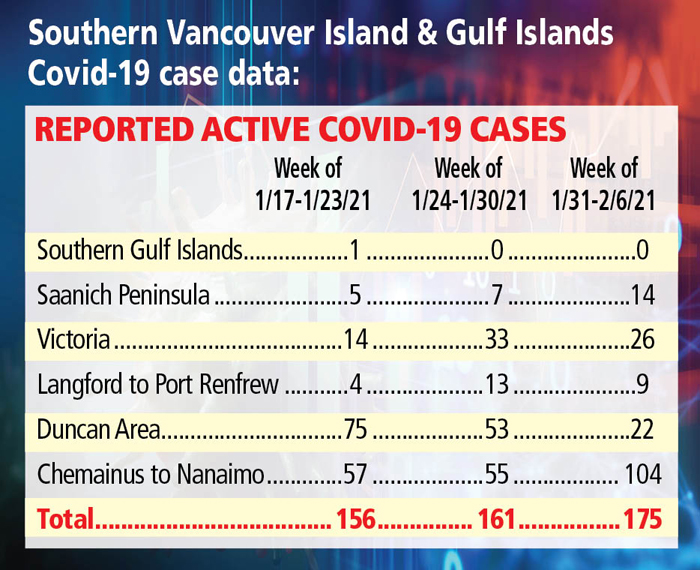
For the past three weeks, the absence of active COVID-19 cases on the Southern Gulf Islands has been very welcomed.

Unfortunately, the chart above shows that the number of active cases has increased in the Chemainus to Nanaimo corridor. We also wish to share with you that Whistler has become a high risk area; just in case you are considering a ski trip. If you are considering leaving Salt Spring Island, please pay careful attention to the COVID levels in the area you plan to visit. Protect your health and the health of our Salt Spring family. 

Note: Click on the image at the top of the page to see the full chart.

Some Bunny Loves You livestreamed event on for Family Day

The Salt Spring Arts Council will move online for its seventh annual Family Day Celebration, a livestreamed but still interactive version of the hit puppet show Some Bunny Loves You by Jesse Thom. 

Coming to audiences live from Mahon Hall at 11 a.m. this Monday, Feb. 15, the show will bring kids and parents on a journey “through an imaginative world of some very peculiar bunnies.” 

Thom is a puppeteer, author, songwriter and meditation teacher who has been living on Salt Spring with his family for about six years. Some Bunny Loves You features a cast of seven puppets that Thom built and has been touring with for the past four years. They include bunnies like Liza, who sleeps inside a raspberry, and Gilfred, who glides on flying toast. Taking inspiration from kids’ artists and authors whose work appeals to adults, such as Shel Silverstein and Dr. Seuss, parents tend to laugh out loud as much as the kids.

The show is geared to kids aged three to seven, and rather than being scripted it’s largely informed by the young audience members and how they respond to the questions the puppets pose. For the Family Day event, puppeteer Lolo Hendin will operate a designated internet puppet to collect those responses from parents via web chat.

“We’ve never done this before. We’ll see how it goes — I think it will be really fun,” Thom said. “My sense is there will be some surprising and wonderful things in this format that would never have happened in a live show.”

Thom’s approach to puppetry arts is an extension of his studies in clowning. He trained under David MacMurray Smith at his Fantastic Space studio in Vancouver and then with Didier Danthois in Tenerife. As Thom explains, their approach to clowning is very much about embodied expression and flowing with spontaneity and authenticity during performance. Thom describes the experience as akin to meditation in motion, because performers are so present in their bodies.

Puppetry deviates from the form somewhat because it employs exterior forms with fixed personalities. But even though the puppets’ individual characters have gelled over the years since he created them, Thom said their actions are driven by audience participation — and the puppets don’t always react as expected.

“I know their voices and their movements, but how they respond is often a surprise, because it’s improvisation,” Thom explained. “There’s often spontaneity and surprises for me. They have their own energy, and they’re fluid in responding to their own environment.”

“Within the boundaries, a lot can happen. And a lot comes through the puppets that would never come from me,” he added.

Thom has also published a picture book called Some Bunny Loves You (featuring artwork by the Vancouver artist Christache). Anyone who registers for the free Family Day livestream by this Friday, Feb. 12 will be entered to win one of two copies of the book. Find the RSVP form and the livestream link at https://ssartscouncil.com/event/some-bunny-loves-you/.

SD64 grad rates now best in Vancouver Island region

School District 64 has exceeded expectations in its work to improve graduation rates, while acknowledging more work needs to be done to ensure all learners have the same opportunity for success.

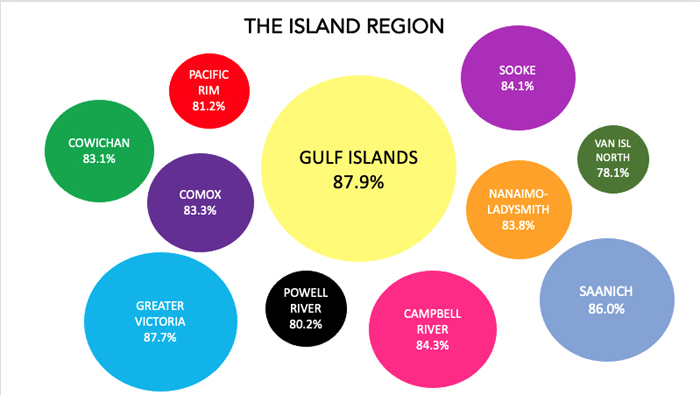
Data recently published by the Ministry of Education for the 2019-20 school year shows a dramatic shift for Gulf Islands graduation when compared to just a couple of years ago, when the district ranked among the lowest in the province with a 68 per cent grad rate. With 87.9 per cent of students graduating in 2020, the most recent figures not only reflect a 13 per cent increase in graduates over the previous two years but put SD64 at the top of all the districts in the island region.

“Improvement like this is not an accident,” said superintendent Scott Benwell, who  singled out graduation rates as a key area to address when he joined the district in 2019. “It represents a concerted effort in our schools and district to ensure we are keeping track of each learner and what we need to do to ensure they graduate.”

District employee Clare Nuyens has been assembling and analyzing ministry data in order to make it reflective of the actual situation and to support actionable steps. She observed the district was first able to report good results at the January 2020 school board meeting.

“We made strides with our 2018-19 completion rate, increasing by 8.5 per cent over the previous year. Although the numbers sound good, the real success was that 17 more students obtained their Dogwood [graduation certificate] than the year before, giving them over 90 per cent more opportunity for jobs in B.C. as compared to if they didn’t have their Dogwood,” Nuyens said.

SD64 and Gulf Islands Secondary School have employed a number of strategies over the past couple of years to get the B.C. graduation certificates into students’ hands. Principal Lyall Ruehlen started by contacting people who had left school but still needed one or two classes and encouraged the process by which they could complete those credits. Benwell refers to that step as the first “horizon.” School staff are now on a more proactive mission of recognizing when students may be at risk of falling behind and intervening with support well before their intended graduation date. During the current school year, which includes the added stress of COVID-19 and a compressed, more-intense quarterly timetable, staff are similarly supporting students to complete assignments not done within the quarter in order to complete those courses and get their credit. 

Benwell said the Gulf Islands Board of Education has helped the district improve learner success with its financial direction.

“We have seen added supports put into places of need. Notably, GISS has added additional staffing in numeracy to ensure students have opportunities in that area,” Benwell said. 

 The six-year completion data for 2019-20 covers a cohort of 147 students. While the overall graduation rate is high, students who identify as Indigenous or special needs did not have the same success rate. Of the 18 Indigenous students in that cohort, only 10 (60 per cent) graduated, while 16 out of 25 students (68 per cent) with special needs did so. According to the Ministry of Education, typical completion rates for Indigenous students across the province range from 65 to 80 per cent.

“As we open the aperture on Horizon Two, that’s where we’re seeing an underperformance in our system,” Benwell said. “Not that that indigeneity creates a vulnerability, but there is a notable under-performance against provincial averages, and certainly where we morally and ethically want to be.”

As part of the strategy to improve success for all sectors, SD64 administrators are moving to put interventions in place as early as the elementary school years. Benwell said having standards of student success that can be measured against the B.C. curriculum is an important tool in this process. The district has been reviewing reporting methods, which had moved away from using letter grades in previous years. 

As well, Benwell said participation in the standardized Foundation Skills Assessment in grades 4 and 7 is important, although those tests have been controversial and are largely opposed by teachers, including the Gulf Islands Teachers’ Association. Increasing the participation rate will help longer-term education goals, he said.

“Graduation matters, full stop,” Benwell said. “As an educator in the province of British Columbia, I have to hang that awning out.”

Hatching project gives kids ‘egg-citing’ insights

0

SUBMITTED BY SALT SPRING ISLAND POULTRY CLUB

Poultry enthusiasts are sharing their chicken love with children by supporting hatching projects at Salt Spring Elementary (SSE). 

With proceeds from 2021 poultry club calendar sales, two clear-topped incubators were purchased for school use. 

“It was so special to be able to do this project with expert assistance and guidance. Watching these eggs develop into chicks was a real highlight for my students,” said SSE teacher Janisse Browning. “They loved counting down to hatching day and it was so exciting when they did.” 

Fertile eggs were provided by poultry club board members Julie Nowell, Ted Baker, Danielle Osiek and others; Amber Billard compiled clear incubation instructions; and Robin Jenkinson, who is also the SSE garden instructor, offered to work with teachers on this educational project. 

Special moments included school visits from hens and a duck in the new outdoor dome tent, and also candling the eggs and seeing the movement of new life inside. Most exciting, of course, was watching the wet chicks push out of their shells, then gently holding them after they’d rested and fluffed up.  

On Thursday after school, six families took chicks home, either to start new flocks or to augment existing coops. As poultry club members, they now have Facebook and list-serv access to a plethora of island poultry experts, should questions arise. 

Also this week, Fernwood Elementary School’s K-1 Nature Class started a hatching project with help from teacher Andrew McPhee, and grades 3 and 4 classes at SSE will begin theirs after the Family Day weekend.

To support more of this work, people are invited to become a member of the Salt Spring Island Poultry Club or to purchase a 2021 calendar, featuring photography by Ramona Lam. More information can be found at saltspringpoultry.com. 

LTC support sought to keep rental unit

1

A rezoning application meant to legalize a nonconforming dwelling as affordable housing will be on the Salt Spring Local Trust Committee meeting agenda Feb. 16, where the committee will decide whether to close the file for good or to carry on with the property owners’ preferred path.

Applicants Robyn Kelln and Jamie Colligan are seeking support to keep a second dwelling on a property where cottages are not permitted as a rental unit, and plan to guarantee it stays affordable with a registered housing agreement. Islands Trust staff have recommended otherwise, citing a long history of unlawful use, the danger of setting precedent by accepting such behaviour and lack of information on how water use might impact the neighbourhood. 

Kelln is frustrated by staff’s recommendation, given the LTC has made housing one of its top priorities. Closing the application would eventually mean one less home is available when supply is critically short. The current tenant is a young woman who works in a retail business. 

“Staff needs to be told to work with the applicant regardless, and come up with a work-around,” Kelln said. “If the true intent of our trustees is to actually address the need for housing, then one would think the instructions to staff would firmly convey every effort to assist and not to obstruct.”

Kelln has owned the property on North End Road since 1994. The secondary home that fronts onto Mariko Place has been occupied since 1992, and was originally permitted as a residence for the previous owners’ parents. The building was supposed to have been decommissioned after those people no longer lived there but has continued to be occupied. Islands Trust bylaw enforcement has been active since 1996, with actions including a 2010 court order prohibiting the cottage’s use as a dwelling. 

Staff have suggested that it would be difficult to enforce a housing agreement and ensure the unit meets the conditions for “affordable rent,” and that such enforcement could be necessary given the applicants’ previous history of noncompliance.

Previous hydrologist reports that Kelln acquired state his well has enough water to supply both residences on the property, and that such use would not impact any streams in the area. The Trust’s freshwater specialist William Shulba feels their testing measures were probably inadequate, however. 

In December 2019, the LTC passed a resolution asking the applicant to provide a sustained well pump test of at least 12 hours and to monitor a neighbouring well to see how the local water supply might be impacted. 

Kelln said he has asked some neighbours whether they would be willing to participate in the test and they have regretfully declined — a position he completely understands given the need to shut off their water supply for two days and to intrude on their well operations. 

“The water test cannot be met. This is outside my power; I cannot force the neighbours to do a pump test,” Kelln said. “All of a sudden you’re put under a microscope and you can’t meet the conditions.”

The applicants don’t believe there will be any new impact to the neighbourhood given the cottage’s long history. 

“It’s been occupied for 30 years and there’s never been any problem,” Kelln said.

The Feb. 16 meeting agenda and a link to participate in the Zoom meeting are available on the Islands Trust website at www.islandstrust.bc.ca/islands/local-trust-areas/salt-spring/.

Viewpoint: Islands Trust – From Conservationists to Density Brokers

By ALIX HODSON

For evidence that the Islands Trust has abrogated in its mandate to “preserve and protect” the Gulf Islands for all British Columbians, look no further than the recently approved housing development on Gabriola Island.

The rezoning of one of the last areas of Coastal Douglas-fir to allow for 24 apartment units is just the latest in an ongoing trend of deforestation and urbanization. Three years earlier, a huge tract of nearby forestland was sacrificed as the Trust horse-traded 27 new lots for undevelopable riparian marshland elsewhere on the island.

None of this makes sense on a small island with limited capacity and resources, and no community water or sewage systems. Not surprisingly, groundwater contamination is now widespread due to over-development and the proximity of septic to wells.

Over half of the 300 wells on Gabriola are within one square kilometre of the apartment complex site. This part of the island has the greatest water demand due to commercial, industrial and domestic uses. Clearing five more acres of forest within this important water catchment and recharge zone is reckless.

Unlike cities such as Vancouver, Victoria and Nanaimo, the Gulf Islands cannot tap into distant watersheds. The precipitation that falls on each island is all there is, and as the impacts of climate change intensify, the future becomes more uncertain. Alarmingly, all test wells on the island are showing a persistent drop in water levels.

Proponents of the project argue that more affordable housing is necessary for local employees, but fail to mention the Islands Trust has no means to designate housing for employees only. Anybody in the right income bracket from on or off island can qualify to live in the complex. So what is really being accomplished?

The constant push to provide affordable housing on Gabriola and other islands flies in the face of a 2016 telephone survey proving that the vast majority of islanders want to put the brakes on development while only about 10 per cent are in favour of affordable housing. It also ignores last year’s State of the Island Report showing Mayne, Hornby and Gabriola are already at or near the threshold for ecosystem health.  

If trustees believe they have now solved the housing problem, they are sorely mistaken. The Gulf Islands are surrounded by fast-growing cities with soaring real estate values and limited rental accommodation, and that means the protected area will always be under pressure to provide more housing. It’s never-ending.

The Islands Trust has to make a choice: focus on its original mandate of limiting development and protecting ecosystems, or continue with its current, misguided attempts to juggle environmental, social and economic goals at the same time. We have reached a tipping point where any further development is unsustainable. Islands by nature have limits.  

The writer is a long-time resident of Gabriola Island.

Editorial – One small form of housing action can be taken now

Salt Spring trustee Laura Patrick’s dedication to tackling our island’s housing crisis, with support from her fellow trustees, is admirable. 

A lack of affordable housing is the one problem that almost all island residents are aware of and can identify as needing some concrete attention, even if their own housing situation is secure. Difficulty attracting and maintaining qualified workers due to a lack of housing is something that impacts everyone who lives on the island. To not do something about it could be viewed as an irresponsible act by those we have elected to lead our community. 

The Salt Spring Island Local Trust Committee (SSILTC) has stepped up in recent months by creating what is dubbed a Housing Action Program, with a task force about to be created. It has done so even though it is but one government agency whose policies contribute to residential housing or a lack thereof. One could  argue that since the Trust’s original mandate was and remains one of environmental preservation, that it is not the most appropriate body to be leading the housing charge.

Ironically, an application that is before the SSILTC at its next meeting on Feb. 16 blatantly illustrates the conflict inherent in the way the Trust does its business. After years of bylaw enforcement pressure, a property owner wishes to legalize through rezoning a north-end cottage that has been used as a rental property for some 25 years. It is currently lived in by a young woman who works in a retail business on Salt Spring. 

This person’s home is on the chopping block, and if a Trust staff recommendation is followed by trustees, it will perpetuate the trend of the island’s rental stock shrinking one dwelling at a time. 

We don’t want to rain on the Housing Action Program parade before it is even assembled. Some practicable recommendations will hopefully and assumedly arise from its work. But how absurd is it to be pouring untold amounts of energy and resources into another housing study on one hand, while on the other to be forcing the eviction of exactly the kind of person the program aims to house.

The Housing Action Program charter references a need to promote “art of the possible” thinking in its work. The SSILTC has a chance to do just that in the case of the north-end cottage.

Weekly COVID report – Gulf Islands and Southern Vancouver Island

0

Prepared by CURT FIRESTONE & STAN DERELIAN

For the past two weeks, the absence of active COVID-19 cases on the Southern Gulf Islands has been very welcomed. Unfortunately, the same can not be said for the close by areas on Vancouver Island where many Salt Springers travel for services.  

The chart above shows that while the number of active cases declined by 24 in the Duncan to Nanaimo corridor, the number increased in the Saanich Peninsula to Port Renfrew corridor by 30 more active cases.  

Salt Springers’ excellent public health practices are paying dividends. Always maintain two-metre minimum social distancing, wearing your masks while in indoor public spaces, and staying on island. Protect your health and the health of our Salt Spring family. 

NOTE: Click on the image at the top of the page to see the full chart.