Home Blog Page 316

THOMSON, Carley Eleanor

0

Carley Eleanor Thomson
12 February 1928 – 7 February 2021

Beloved mother of Kelly, Kenny, David, Carel; grand-mother of Kelsey; great grandmother of Cash Emory and wife of Ian (1927-2018) passed in Winnipeg, attended by  the caring staff at Grace Hospital. 

Thanks especially to Carley’s stepson Dr. Ian R. Thomson (ret.) for his care and assistance. 

A frequent visitor to Salt Spring she will be remembered and missed by family and many friends.  

Carley served in the Canadian Forces and was a 75 year Legion member as well as a devoted community volunteer. Her leadership and mentoring was apparent through a long association with Toastmasters International. Having raised her family as a single mother, love came to Carley later in life with firefighter and former RCAF fighter pilot Ian. They enjoyed a warm relationship that took them on travels and adventures around the world. 

In our hearts forever. 

In lieu of flowers please consider a donation to the Legion.

SORRENTINO, Luciana

0

Luciana Sorrentino
1929 – 2021

Luciana, age 91, passed away peacefully with family at her home at Heritage Place on Salt Spring Island on Friday, Feb 5, 2021.

Born in 1929 in Trieste, Italy, Luciana came to Canada in 1956 with her husband and young son. After residing in Montreal for 10 years, she and her family moved to West Vancouver in 1966 and lived in their Eagle Harbour home until moving to Salt Spring in 2018.

Always fun loving and energetic, Luciana loved to play tennis with her friends, swim at her favourite beaches and cook her traditional Italian dishes for family and friends. Luciana had exquisite style and was an expert seamstress. Always dressed in the latest classic elegant fashions of her European upbringing. Along with her late husband Fulvio, Luciana travelled extensively and made many friendships around the world.

She is pre-deceased by husband Fulvio (2019) and leaves behind son Furio (Candace); daughter Michela (Matteo); 4 grandchildren, Chris, Carla, Sebastian, Julia; 2 great-grandchildren Amelia, Ella.

PITMAN, Lewis William

0

Lewis William Pitman
1926 – 2021

Born in Liverpool, England in 1926, Lewis died in his home on Salt Spring Island, on the 8th February 2021.

Lewis was the second son of Frederick and Muriel Pitman. He received his early education in the city of Liverpool and in nearby Lancashire. He joined the army in 1944 and became an army pilot, and a member of the famous Glider Pilot Regiment. Later, he attended universities in England and Canada and trained to become a teacher of English.

In 1951 he married Valerie Joyce Lelliott (he claimed that he never deserved her) and they emigrated to Canada 1955, eventually living in Kenora, Welland, Hamilton, Aurora, and Blyth before retiring to beautiful Salt Spring Island. Over the years Lewis also become a distinguished potter, a health nut, a bagpiper, a keen runner, and periodically contributed articles to various newspapers. He had a full and busy life. The Pitman family became complete when they eventually had three wonderful children during the memorable sixties: Nancy Jo (1960), Andrew (1963) and Matthew (1965) all of whom were much loved, and who taught their parents more than they ever realized. Later, the family grew to include three grandchildren and two great-grandchildren.

There will be no service: the rest is silence.

GRAYSON, David Keith

0

David Keith Grayson
1949 – 2021

David passed away peacefully at his home on Salt Spring Island, January 10, 2021.

David was born on February 9, 1949 in Moose Jaw, Saskatchewan to parents, Keith and Gwen Grayson. He enjoyed a happy childhood with his parents and brother John at their waterfront acreage on Buffalo Lake, near Moose Jaw. It was a life filled with sailing, swimming, horses, and riding on the Canadian prairie.

After graduating from the University of Saskatchewan, David attended a Teacher Training Course in Transcendental Meditation (TM) in 1973. His greatest joy was teaching TM and working on meditation projects around the world for 48 years.

A man of refined taste in both art and music, he was a connoisseur of beauty. Throughout his life, he enjoyed collecting contemporary art. His other passion was listening to classical music and opera in addition to his wide-ranging interest in rock, jazz, and rhythm and blues.

Moving from Vancouver to Salt Spring in 2005, David was well known as the co-owner and general manager of Ganges Alley as well as two housing sites. He could often be seen around town wearing one of his trademark hats, often a cowboy hat, while stopping to chat with tenants and friends.

David was a man of many gifts: he was highly intelligent, always bubbling with creativity, and had a deep spirituality. He was quiet and shy, but when he spoke, people listened. His friends and colleagues enjoyed his droll sense of humour – he saw the funny, absurd side of things and would quickly come up with one of his famous quips.

David is survived by his loving wife, Carolyn, who treasures their 39 happy years of marriage, career partnerships, travel, and daily laughter. There were no children.  David was dearly loved by his family, friends, colleagues, and all who knew him. He was a rare and beautiful soul and will be greatly missed.

An amazing and beautiful Zoom Celebration of Life for David was held on January 31, attended by family and friends from Europe, the US, and across Canada.

BRAITHWAITE, (Jocelyn) Nancy

0

(Jocelyn) Nancy Braithwaite
Sept 29, 1928 – January 27, 2021

Nancy passed away January 27 after a slow decline with the same stoicism and stubbornness that she demonstrated throughout her life—uncompromising in her belief that we should live politely and modestly upon this gentle earth. It was easy to misconstrue her acerbic remarks, but to her closest friends and those who had no voice—the homeless, the natural world, the sick and victims of injustice—her actions, friendships and philanthropy spoke to a deep concern for the planet and humanity’s survival. She leaves behind the amazing women of her generation who fought hard to be heard, and an increasing circle of the next generations of cousins and friends who see their contributions.

Born in Victoria, an only child, to Captain John Grant and Jocelyn (nee) Weaver-Bridgman, she spent summers on Saltspring at WENNANEC (Lyoness) with her widowed grandmother, artist Maud Weaver-Bridgman and her great aunts who she described as “fun, original women” who taught her to build rafts, dig clams, recite poetry, speak Chinook and hike in the mountains while still remaining stylish. She also loved the mountains of Vancouver Island and her name comes from her mother who is the namesake of Jocelyn Hill in Victoria’s Gowlland Range; named by Commander Parry of the survey ship HMS Egeria after his friend’s first granddaughter. It was during this childhood with these original women that she developed her lifelong love of the natural world and islands.

As a young woman, she went to the enigmatic college, House of Citizenship, in London to develop her flair for languages which launched her into a career of which she spoke very little. To some she described herself as a “courier” based in London and to others a “tour guide” with “Italian employers.” Many of us joined her on her travels as companions, whether it was hiking in the mountains, sailing on the coast or exploring a hidden corner of Europe. Her cousins were always important to her; each of us quietly reminded of our lineage and whether we were once removed or second cousins. Our grammar was corrected, all attempts at assistance rejected. She would order meals at a restaurant in fluent Italian, German or French, demanding quality but never quantity. She was parsimonious to those of us with privilege, but generous to those without.

At fifty she returned to Canada permanently to nurse her aging parents. While broken down at the side of the road on Saltspring, she met the love of her life, Roy Braithwaite, an oysterfarmer, who pulled over to assist. They spent the first years of their marriage at Sansum Narrows and it was this time about which Nancy recalled most deeply. Roy christened his boat “The Fancy Nancy” which encapsulated everything about her—a sailboat built for beauty and practicality as they worked their oyster farm in the Narrows. They later moved to Trincomali Heights where Roy gently built their new home into the forest with his son Peter. Nancy embarked on the pioneering work with her women friends of starting the Salt Spring Conservancy—placing her own lands in one of their first conservation covenants named Ruffed Grouse Covenant, after the threatened bird she loved to hear in the spring. At this time, she adopted the title of honorary granny to the granddaughters of her beloved cousin Rosemary—Brighde, Christie and Charlie.

In the last thirty years of her life, living alone, she became a steadfast supporter and philanthropist of all facets of island community life in the arts, social justice and environmental movements. She volunteered at the library, attended every lecture and performance from the operas in Victoria to the Forum on Saltspring, supported local farmers, went to demonstrations against logging and pipelines turning up at protests with her iconic hats, woodpecker sign and sensible green wool coat made during the war. Many of her friends predeceased her, but she was always moving with the times, making new young friends who shared her values of not conforming to a patriarchal, corporatizing world. She took responsibility for the impacts of her own early BC ancestors and supported the formation of the Stqeeye’ Learning Society to promote well-being of indigenous youth through ecological restoration of the land. Even in death, she challenged corporate values with a forest burial at the Saltspring Natural Cemetery—returning her body to the forest she loved. The last three years of her life were difficult as she lost her mobility and independence, especially a year of isolation through COVID. The companionship of Amanda Love and staff at Greenwoods gave her comfort and love as did the support of her last “Committee” of friends, stepson Peter and cousins including Heather Robertson, who predeceased her, and Briony Penn.

Blom, Wim

0

Wim Blom (1927-2021)
Gone to the Great Studio in the Sky

Wim Blom passed away peacefully in his sleep, January 18, on Salt Spring Island. Many thanks to the health care workers, Lady Minto Hospital and his friends at Thrifty’s and around town, who helped him and gave him friendship and joy. And to all those that loved his art, here and around the world. We will raise a glass to Wim and his life when the sunny days arrive. Always remembered.
Love, Peter Haase, Mona Fertig, Sophia & Paris.

“In the midst of modern unrest, temptations arise from the unlimited freedom of the artist. Wim Bloom is aware of his solitariness as a representative of a timeless style and he knows that isolation is the prerequisite condition of concentration on, and believe in, a personal tradition.”

Fuel from abandoned vessel impacts Burgoyne shellfish

3

Shellfish harvesting at Burgoyne Bay was closed by emergency order on Thursday, Jan. 21 and will remain so until further notice as a result of a marine fuel spill. 

While harvesting in the inner part of the harbour is prohibited year-round due to sanitary contamination, the emergency closure extends the zone as far as Daffodil Point on the northern side of the bay. The effects of the spill may also extend to other marine species, putting pressure on limited resources and threatening First Nations’ access to their traditional fisheries.

“We have real interest in taking a leadership role in trying to respond to this specific issue and how to build a process to prevent this from happening in the future,” said Cowichan Tribes biologist Tim Kulchyski. “We want to limit, if not eliminate, these types of spills because it’s happening so frequently that it has impacted our ability to harvest.”

According to the Canadian Coast Guard, a vessel with an unknown owner that is moored in Burgoyne Bay shifted during a storm earlier in January and began discharging pollutants in the marine environment.

“Coast Guard Environmental Response assessed the vessel on Jan. 14 and concluded the vessel was a threat to pollute due to its listing to port side and fuel onboard. To mitigate the threat to pollute, approximately 125 litres of diesel was recovered from the vessel,” the agency said.

Environmental response teams did not observe pollution in the Burgoyne Bay waters after Thursday, Jan. 21. They deemed the vessel as a low threat to pollute and handed the file over to Coast Guard’s Vessels of Concern Program.

Kulchyski observed Burgoyne Bay with its former Xwaaqw’um village site is right in the middle of Cowichan Tribes’ core territory. Elders refer to Sansum Narrows as their community’s grocery store, but multiple shellfish closures have reduced possibilities in nearby waters. 

Cowichan elder Tousilum remembers how people used to say, “When the tide’s out, the table is ready,” but that’s no longer the case. Cowichan Bay, for example, has been closed to shellfish harvesting for 48 years.

As well, spills can harm food species that aren’t monitored as closely as shellfish, such as crabs and urchins. For these reasons, fuel spills that may not seem like a big issue compared to some the Coast Guard responds to can have a major impact on First Nations’ seafood harvesting.

“It’s sounding a death knell for those harvests, because the resources are so limited,” Kulchyski said. “It’s no longer practical. And for our community, it’s a way of life. The entirety of Cowichan territory is quite heavily impacted.”

The impact of houseboats at Xwaaqw’um has been identified as a concern by the Salt Spring-based Stqeeye’ Learning Society, of which Kulchyski is a board member and Tousilum is chair. Tousilum said he often likes to walk the beach at low tide. His uncle in his 90s can remember when the beach was clean and white with shells — a stark difference to how it looks today.

“When I see a bunch of boats on the beach and wheelbarrows and little floats; when I see the many ropes tied to the trees, who is responsible for that?” Tousilum asked. “Just the anchors alone, how much other damage has happened to the bay already? And what is happening to the sewage? It just infuriates me.”

The issue of abandoned boats and how to deal with them has been a growing problem all along the B.C. coast, as cheaper fibreglass vessels reach the end of their lifespan at the same time that housing pressures have forced more people to seek alternative options.

Salt Spring resident John Roe helped remove three derelict vessels from Burgoyne Bay in 2019 with the Dead Boats Disposal Society and federal funding support. He said his group will be doing more surveying this March and will most likely be back for further vessel clean-up in April thanks to B.C. government stimulus spending under the Clean Coast, Clean Waters Initiative Fund.

“We’re compiling information and making applications right now. We intend to take around 150 boats this year out of the Salish Sea and the Islands Trust area,” Roe said. 

Roe has also been talking with the Stqeeye’ Learning Society about a long-term plan for Burgoyne.  The society said they support and appreciate Roe’s efforts and look forward to strengthening the relationship.

Tousilum said he wants to start contacting the provincial and federal governments to come up with a solution at Xwaaqw’um, and said the local community also has a part to play.

“Salt Spring Island is strong with people coming together and good things are happening, but this is 10 or 100 steps back,” he said. “We’re having a look at it now. Let’s wake Salt Spring up and let’s do it. It’s time for us all to come together to work with one mind and one heart to save the bay before it’s too late.”

Anyone who has a boat that is no longer seaworthy but can’t afford to deal with it is encouraged to contact the Dead Boats Disposal Society and sign over ownership rather than abandoning the vessel to become a wreck. Call Roe at 250-383-2086 for more information.

Editor’s note: A resident of the Burgoyne Bay area notes that the vessel in question was not from the bay.

Risky trees identified along new path route

0

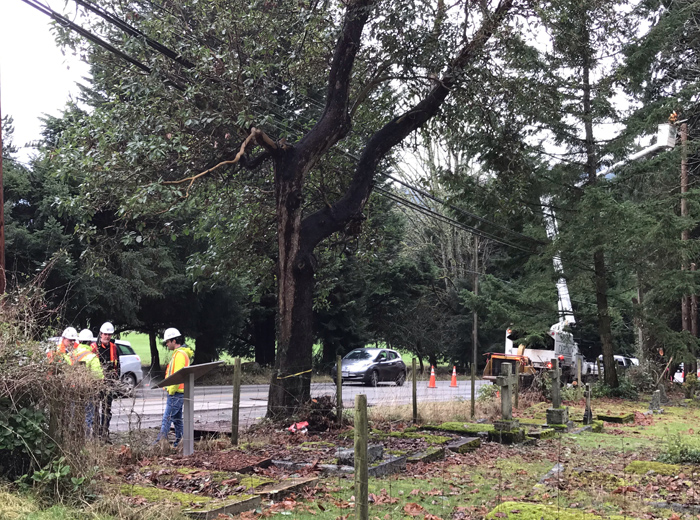
Pathway construction on Lower Ganges Road between Baker and Booth Canal roads will mean a number of dangerous trees growing on the right-of-way must be removed for worker safety.

The Capital Regional District tendered the construction contract for Phase 2 of the pathway between Central and Booth Canal to Don Mann Excavating last fall. Salt Spring CRD director Gary Holman has acknowledged community concern around keeping large trees, but reported at public meetings last week that a number of trees have been identified as posing risks to the contracting crew. WorkSafeBC regulations mean they must be removed for work to continue. 

Despite that ruling, one arbutus tree that has captured the hearts of community members may be saved as long as it’s not compromised during construction work.

“We’re directing the contractor certainly to not cut down that tree and to take as much care as possible,” Holman said. 

The CRD’s engineer for Salt Spring, Allen Xu, said an arborist with dangerous tree certification has determined some Douglas-firs and other trees are dead at the top or in very poor health and are therefore a danger to the worksite. 

“The risk of them falling on the workers is very high,” Xu said. “According to WorkSafeBC regulations, the contractor has the right to refuse to work and they sent a note saying these risks need to be mitigated before we proceed.”

The stretch of road where the pathway is going was heavily damaged during the catastrophic windstorm of December 2018, with multiple large trees blown down. Xu said the CRD examined the area of concern and concurred the trees identified by the arborist had to go. 

The arbutus tree is another matter because it intrudes over the pathway route near the historic Anglican cemetery. Space there is limited by the property line, a water main and the need to install stormwater culverts.

An 80-year-old island-born resident is one of the community members who was dismayed by the prospective loss.

“I couldn’t say how old the tree is, but I do know that it is more than 100 years old,” he told the Driftwood. “Arbutus trees are very slow growing and to have grown that large is a miracle. It has survived disease (which in recent years have killed many) and has survived not only snow and wind but the hurricane-force storm of December 2018. If any, especially big trees, survived that storm it should have the ‘forever’ right to keep living.”

The CRD has responded to community appeals by modifying the pathway design and asking the contractor to not excavate the area where the arbutus roots may be located, and to do hand digging instead.

“The public can be assured we are making every effort to save it,” Xu said, adding, “I hope it can be saved, but we don’t really know for sure.”

Holman said it may have been possible to hire another arborist to see if there was a different opinion on the dangerous trees, but it’s unknown if that would actually change the result and such a step would cost critical time and money. Further delays in the work plan are a concern because of funds the CRD received from the Ministry of Transportation and Infrastructure’s Active Transportation Infrastructure Grants Program. The organization stands to lose $490,000 if it can’t complete the pathway by March 31. 

Xu agreed the timeline is tight. Inclement weather in the weeks ahead could potentially cause further construction delays. He reported to the Salt Spring Transportation Commission on Monday that it might not be done before the end of May, in which case the CRD would try to negotiate for more time with the ministry.  

Xu noted that pathway construction scheduled this week and the weeks ahead could cause delays on Lower Ganges Road and asked that drivers plan trips accordingly. 

Stewardship project for western screech-owl begins

By REN FERGUSON 

SALT SPRING ISLAND CONSERVANCY

Have you ever been outside on a still evening in late winter and heard a series of mellow, muted hoots that speed up towards the end but remain at the same pitch? You may have detected a western screech-owl. 

These secretive owls are about the size of a standard pair of binoculars and are clad in plumage that resembles Douglas-fir bark, making them very hard to see. They roost by day in tree cavities or tucked next to the trunk of a tree, emerging at night to call to potential mates and hunt for small mammals. 

This endearing owl was once common on Salt Spring Island and in our region but numbers have declined dramatically for the coastal subspecies (Megascops kennicottii kennicottii), and they are now federally listed as threatened. There are many reasons why screech-owl numbers have diminished to a worrisome level on the south coast: loss of forest habitat, removal of dead trees needed for cavity nesting, as well as predation by barred owls, who have, in recent decades, expanded into the coastal regions of B.C. 

The Salt Spring Island Conservancy is launching a three-year project, led by me, Ren Ferguson, to help protect the western screech-owl on our island. A team of local volunteers will be conducting nocturnal surveys starting in February. With surveys and increased public awareness, we hope that we will find more of these threatened owls and work to enhance their habitat. 

How can you help? If you live on a large forested property, or you live in an area with intact forest, you may have this owl living nearby. Step outside after the sun goes down and listen for this little owl’s song. February is the start of their breeding season and that is when these nocturnal birds of prey become more vocal. Their song has the quality of a bouncing ball, with short hoots that become more rapid towards the end. You can listen to recordings of the western screech-owl by going to allaboutbirds.org.  

Finding the owls is just the first step. The conservancy will be engaging interested landowners and visiting properties where owls are present, or were known to be in the past, to determine if the habitat could support breeding screech-owls. Part of that determination is to assess whether there are trees with old woodpecker cavities, which these birds require for nesting. If not, the conservancy may work with landowners to install nest boxes to interest the owls in returning to raise their young.  

If you think you may have a screech-owl on your property or are interested in more information about the Western Screech-Owl Stewardship Project, please email info@saltspringconservancy.ca.

This project is undertaken with the financial support of the Government of Canada through the federal Department of Environment and Climate Change.

Rental housing shortage a life and death issue for one islander

By Elizabeth White, Michael Cooke, Pat Miller and Lisa Dahling

Salt Spring’s lack of affordable rental housing is a fact of life for Salt Spring renters, but for those fortunate to own our own homes, it is a detail of island living that is easy to forget. 

We ignore, or do not know, that workers shuttle daily to Salt Spring from the big island, that many working farms harbour “non-compliant” dwellings — trailers, converted sheds, yurts, tiny homes — and that families consider themselves lucky if they can rent one of these, or can find somewhere to park a trailer or tiny home they already own. We hear stories of islanders leaving Salt Spring because they cannot find a place to rent.

What happens if you are disabled, cannot leave Salt Spring because your support network is here, and there is no place to rent? This is Sharon Shewchuk’s dilemma. The cabin Sharon has lived in for four years is being reclaimed by her landlord and Sharon must find a new home. The Salt Spring resident of 13 years, and operator of Salt of the Earth Farm, has suffered a relapse in her longstanding Multiple Systemic Infectious Disease Syndrome (also known as Lyme disease) that has left her with reduced mobility and impaired vision — she is currently unable to read a book or use a computer. 

Her immune system is also compromised, resulting in multiple chemical sensitivities that make assisted living options untenable. In other words, severe allergies prevent her from living at Braehaven or Croftonbrook, or in a hotel room or apartment. There are treatments available, and one of the few benefits of COVID-19 has been the new availability of online medical consultations. However, the prerequisite for successful treatment is a living space that does not trigger allergic reactions. Sharon needs an electrically heated, mould-free cabin, away from traffic pollution.

Anyone can become disabled. Sharon comments, “As an able-bodied person, I above all prized independence, industriousness and self-sufficiency.” She still values those qualities, and is also deeply appreciative of the help she has received from islanders since her relapse. Sharon turned 48 this month. She is bright, funny, multi-talented, as independent as her condition allows, and she wants to live. A suitable living space is fundamental to her recovery. 

Is there someone on Salt Spring willing to rent Sharon an electrically heated cabin where she can successfully complete her course of treatments and achieve remission? If you have a cabin that you would consider renting to Sharon, please call Elizabeth White at 250-537-2616.

This piece is submitted on behalf of Sharon Shewchuk’s support group.