Home Blog Page 317

Peaceful paradise lost due to freighter noise

1

By AARON KIPNIS

We all hear planes over head, chainsaws in the woods, leaf blowers in the yard and construction noise at times. These normal sounds of contemporary life might be annoying if we are having a quiet moment, listening to the birds or trying to take a nap. 

But then it stops. Nights are quieter. Someone’s music at a party is loud, but then it stops. We may hear a freighter pass in the channel, but then it stops. This is life. But freighters at anchorage just off shore make noise all night and all day long. It does not stop. 

Diesel generators reverberating through cavernous steel hulls generate grating, incessant noise for days, weeks, even a month before they move on and then . . . the next ship arrives. Some crews do loud maintenance late at night. Ships frequently drop anchor well past midnight with a thunderous cacophony of huge anchor chains disrupting sleep. Some people may think increasing industrial noise in coastal residential areas is just inevitable change we have to learn to live with. However, these loud engines running 24/7 can have dramatic impacts on human and animal health. We just can’t live with that. 

Numerous studies document negative effects of human-generated noise on dolphins, crabs, oysters and whales, to name just a few. Stressed invertebrates clamp their shells shut and feed less while whales make louder vocalizations to communicate and can become disoriented. Sea and shore birds can also be affected. Traumatic impacts of freighter-generated noise echo through the entire ecosystem. As for us humans on shore, the unremitting, throbbing growl of anchored freighters, combined with the sleep disruptions they cause can raise blood pressure, cortisol (stress hormone) and glucose. Sustained low frequency noise can even cause heart irregularities and higher incidents of stroke, along with increased depression and anxiety levels — our quiet, peaceful paradise lost. 

Not everyone is sensitive to unceasing noise, but those of us who are and live near shore are suffering along with the marine animals from the growing numbers of large ships anchoring here. The Port of Vancouver could, however, incorporate an early arrival system to keep these international ships, whose noise levels are completely unregulated, in port where they belong. Of course these ships also foul our water and air while destroying seabed habitats with anchor chains. An oil spill seems inevitable. These are topics for another time. 

Please see protect-the-islands-sea.org for  for more information about the Gulf Islands’ freighter invasion. 

The writer is a professor emeritus of clinical psychology, author and a psychotherapist in private practice on Salt Spring Island. 

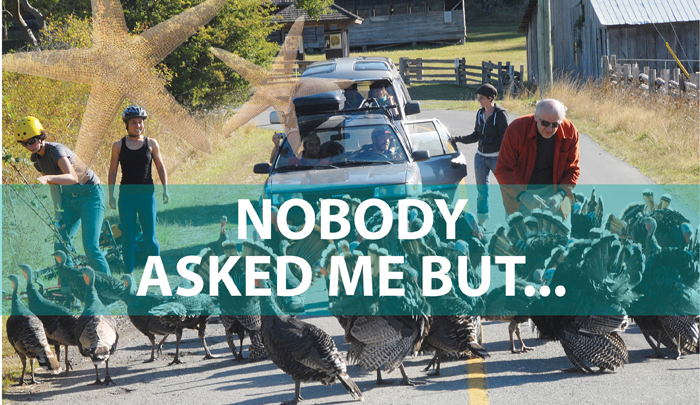
Nobody Asked Me But: Bait choices among pest control advice

0

We are entering the season when it becomes particularly difficult to rid ourselves of unwanted household pests. No matter what form they may take, they tend to hide in dark places, linger in the shadows, and generally make life miserable for those of us who rightfully lay claim to our abodes. And just when we think that we have finally exorcised ourselves of their annoying existence, they come crawling out again from behind the woodwork.

Sometimes these pests take the shape of scurrying rodents such as rats and mice. They can also flutter their way down into our air space like moths and other flying insects. As if that wasn’t harrowing enough, pests such as spiders and bed-bugs will gross us out by creepy-crawling over, under and through our furniture and bedding.

In this, the year 2021, heading the list of pests we can’t seem to get rid of are ex-presidents. You can censure them, impeach them, vote them out of office, protest their policies and demonstrate against them out in the streets, and still they find a way to stick around and lurk in the murky darkness as they wait for an opportunity to inflict themselves on our consciousness again.

At the front of this unwanted vermin line stands one Donald John Trump. It may seem, after his disputed election loss and subsequent claim that a second term was stolen from him, that he has retreated back to his usual habitat of exclusive golf courses, luxury hotels and ostentatious condo towers. It would be a mistake to assume that this is the case. Trump has about as much interest in blending into the background haze as a peacock on steroids.

As any reliable pest control professional will tell you, the best way to eliminate bothersome pests is to observe their behaviour. No matter how random their movements may seem to you, they are laying down a pattern that, if you can decode their routines, will help you to eliminate them once and for all.

In the case of rodents, these movements take the form of traffic patterns across your floors. Rats generally prefer to scamper along the baseboards of a room and they show a genuine disdain for crossing any open area where escape is much more difficult. For this reason, traps laid out alongside room walls are much more likely to get in the way of and eliminate the intruding rodent. And speaking of walls, this might be the motivation indeed for Trump’s obsession with walls of any kind, especially when dealing with his immigration policy.

Of course, when employing traps to catch intruding pests, careful consideration must be given to what kind of bait you should use. Poisons are out of the question (unless you are representing Putin and his Russian cronies) because the offending nuisance will likely drag itself back to its lair inside the wall where it will breathe its last breath. The resulting stench of an animal decomposing behind your drywall should be reason enough to rule out poison bait.

Small chunks of cheese have been the go-to standard for baiting rat and mouse traps for centuries, but have fallen out of favour because of their propensity to become dislodged from their position before the kill can be completed. The other problem is that they tend to go stale if left in the trap and consequently lose the odour that attracts the rodents to explore the trapping device. The current number 1 replacement for cheese is a smear of peanut butter, which is sticky enough to remain in place while the offending rodent reconnoitres around the doomsday device. For those whose critters display a more gourmet palate, pest control experts recommend a medium helping of Nutella.

One of the main reasons we are so disgusted by these invasive pests is that they continually attempt to help themselves to our stuff. Perhaps it is food stored on the shelves of the pantry. Maybe it’s that big sack of black oil sunflower seeds that we have designated for filling our bird feeders. Then again, it just might be that expensive bag of dry cat food meant for our household pets.

In the case of Trump, we find that he has also tried to infiltrate and damage much of what we hold near and dear. During the course of his presidency, he has attempted to rout out many of our values such as democracy, human rights and personal dignity. He has used fake news to cover up his tracks, and has relied on populism, cheap personal charisma and flamboyant flag waving to confuse the public regarding his true intentions.

It may be too early to close the book on our dear Donald. It may look to us like we have finally rid ourselves of his annoyingly turbulent presence and that he has ridden his horse of many colours off into the sunset, but we might be fooling ourselves here. We must prudently ask ourselves who is laying the trap for whom. As long as the cheese, or Nutella, is still up for grabs, we can’t expect Trump to remain satisfied blasting his golf balls into fairway traps in the southern Florida sunshine. It is not too much of a stretch to anticipate, just when we think that the war is over, that the battle-cry of “Make America Great Again” will come crashing down on our ears once more.

Nobody asked me, but there is a good possibility that we might find the next little while a bit on the tame side. Without Donald Trump and his daily Twitter feeds, his snarky attacks on legitimate media journalists and his misdirection of blame onto anyone who disagrees with him, modern life will surely be lacking in excitement.

Just as likely, Trump is capable of sniffing out the return path to Washington and the White House. The road may be littered with failed insurrections, trashings of the Capitol and gun-toting Proud Boys, but don’t put it past the Donald to follow his scent and worm his way back. And don’t go putting that jar of Nutella too high up on a shelf in the pantry. 

Editorial – Trail trials

0

Since achieving park status in 2004, Burgoyne Bay Provincial Park has become an increasingly popular and important part of Salt Spring.

Lands were acquired for park purposes after community efforts saw them saved from logging and development at the hands of the Texada Land Corporation. The trail network now in place in the park (and connecting to Mount Maxwell Provincial Park) has made it a centrepiece for people who love to hike and otherwise enjoy nature. Island equestrians have been among those who use the park’s designated multi-use trails. 

More recently the bay has seen a resurgence in understanding of its traditional importance to the Quw’utsun’ peoples as Xwaaqwu’um, with various cultural programs and activities taking place there.    

One of those activities is a watershed restoration project led by the Quw’utsun’ through the Stqeeye’ Learning Society. Last year it saw creation of three small wetlands to slow sediment-laden runoff, swales made across old logging roads to restore natural flows of spring water and removal of a failing bridge and gravel backfill that was blocking in-stream ponds and culverts and impacting fish habitat as a result. Seeding and planting of wetland forest species and invasive plant removal are also being done.

Unfortunately for island horseback riders, the work resulted in a popular trail being made unusable for their purposes. Other changes prompted by adjacent property-owners’ concerns have also reduced multi-use trail options. The equestrian community understands the value of the watershed restoration work,  but feels inadequate effort has been expended by BC Parks to create alternate trails for cyclists and equestrians. 

As proponents of multi-use trails have pointed out, equestrian use has been part of the Burgoyne Bay Provincial Park vision since the early days and is prominent in its official park management plan. An online petition in support of multi-use trails has seen almost 1,400 signatures to date, so this is an issue of concern to many people.

A potential alternative an island group has identified  should be seriously explored, and if that does not prove viable then another should be found. 

BC Parks needs to take the time to listen to community members and explore all alternative solutions with an open mind.

COVID-19 vaccine strategy and timeline explained

0

Message to the community from Dr. David Butcher, chief of staff, Lady Minto Hospital

As you will have heard on the news, vaccinations against COVID-19 are now underway in B.C., and that includes Salt Spring Island. 

Residents of our care facilities have received vaccinations and frontline health-care workers are currently being vaccinated. This offers us a ray of hope that we are starting to see the end of the COVID-19 pandemic. 

The provincial government has laid out a strategy and timeline for vaccinations based on priority populations and risk groups with the dual aim of reducing the risk of community spread of the virus and ultimately providing immunity to all individuals who want to be vaccinated. Information on the provincial strategy for vaccine rollout, of which Island Health is a participant, can be found at http://www.bccdc.ca/health-info/diseases-conditions/covid-19/covid-19-vaccine/bcs-plan-for-vaccine-distribution.

Please be advised that the COVID-19 vaccine is not available for everyone at this time. The first doses are being provided to those most at risk, starting with elderly residents in long-term care facilities and staff who care for them, as well as health-care providers working in ICUs, ERs and COVID medical wards. Other priority groups will receive the vaccine in the coming weeks. The timetable for this is constantly being updated based on vaccine supply, such as with the recent announcement of a delay in the delivery of Pfizer vaccine.

Please be patient with your family doctors and medical staff as they work hard to provide medical care for us all. There is no need to call your doctor’s office to book an appointment or have your name on a list to be vaccinated.As the vaccine is made available to population groups (e.g. people over the age of 80) there will be public communication with information on how to book an appointment. The local Public Health Unit is working closely with family physicians and other health-care providers to ensure that we have a smooth and efficient system for providing vaccinations on the island. As more information becomes available we will keep you updated.

It is important that we don’t take the arrival of the vaccine as an opportunity to drop our guard or be less vigilant in maintaining infection control. We need to continue to limit our contacts to those in our households, maintain physical distance from others, wear a mask in public spaces and when we can’t maintain distance, and wash our hands. It will take time to achieve a level of immunity in the community that will act as a barrier to community spread. 

Until then, our individual and collective adherence to the public health orders and guidelines will determine whether or not we continue to have low levels of COVID-19 activity on Salt Spring.

Suspicious device at Drummond Park prompts bomb squad call; determined to not be explosive

UPDATED: Salt Spring RCMP Sgt. Clive Seabrook reports that the device in question was determined to not be explosive and has been destroyed. Drummond Park is again open to the public.

Salt Spring RCMP are asking members of the public to stay away from the Isabella Point Road area this afternoon after a suspicious device was located at Drummond Park earlier this morning

Sgt. Clive Seabrook said the detachment received a report about the potential device around 10 a.m. on Wednesday. The object is consistent with a pipe bomb, although the casing is plastic and not metal. RCMP explosive specialists from the Lower Mainland have been called in to deal with the potential threat and are expected to be finished by later Wednesday afternoon.

“There’s a high likelihood that it just looks like a device and is completely harmless, but there is a small possibility that it isn’t,” Seabrook said. “Out of an abundance of caution we are having it disposed of appropriately.”

RCMP are asking people to avoid the area until the device is removed. Traffic to Fulford village and the ferry terminal has not been affected. Isabella Point Road remains open to residents but police are asking that traffic remain local-only, and warn the road could be closed if traffic seems to be increasing.

TRAVIS, Dr. James

Dr. James Travis
1935 – 2020

Dr. James Travis of Athens passed away on November 26, 2020.
If you knew Jim, you remember a man in constant motion, wasting little of his 85 years.

Just consider the more than 250 research papers he published as a biochemistry professor at the University of Georgia.

Much of Jim’s career involved working to understand the finely-tuned balance between two critical classes of proteins in the human body — proteases and protease inhibitors. When that balance is disrupted, it can often lead to the development of certain diseases.

Through his work, some of it ground-breaking, he helped the scientific community better understand the reason for diseases like emphysema, gingivitis and periodontal disease. In his busy lab, he mentored hundreds of younger scientists, inspiring new generations of researchers who shared his passion for asking why and how and whether there might be a better way.

Jim’s gregarious nature, scientific expertise and appreciation for the value of teamwork resulted in him forging collaborations with scientists throughout the world. The result of these many collaborative interactions not only led to greater scientific understanding but also made Jim an icon in his field. This worldwide renown was never flaunted by him, rather it was used to help promote the young scientists Jim mentored.

For his work helping Polish scientists, Jim received an honorary degree from Jagiellonian University in Krakow, a 650-year-old institution where Copernicus graduated. When he signed the book accepting this degree, the signature before Jim’s was Pope John Paul II.
But for every professional accomplishment, Jim enjoyed far more in his personal life.

A native of Winnipeg, he cherished his college years working summers as a waiter on the transcontinental Canadian railroad, putting himself through graduate school at the University of Manitoba.

He was a Little League coach. Taught his sons how to complete and play fair.

He always had a positive attitude and a generous smile. Taught his daughter hard work can overcome life’s challenges.

He loved to travel. Taught his children to respect other cultures and constantly seek new adventures.

He loved sports, books, film and theatre, especially musicals. Those passions live on not jut with his children, but his six grandchildren as well.

His wit, boundless. His hugs legendary.

He loved his family and, above all, being a father.

In 1983, he met his wife Freida. Their most joyous days were spent living part-time on Salt Spring Island off the coast of Vancouver, often accompanied by is beloved brother-in-law Donald Hall. But in recent years, after Jim developed Parkinson’s Disease, they returned to live full-time in the home they built in Athens.

Jim was preceded in death by his parents Sam and Gwennie Travis, sister Velma McIntyre and brother Dr. Larry Travis. He’s survived by his wife Freida Travis: his first wife Lillian Yeatts and their children Randy, David, Teri Lynn and Joe.

A memorial service will be held sometime in 2021.

Donations in Jim’s name can be made to the Parkinson’s Foundation.

Arrangements by Lord and Stephens, Athens, GA www.lordandstephens.com

SAVAGE, Susan Carole

0

Susan Carole Savage (nee Beck)
1943 – 2021

Susan Savage born in London, England August 2, 1943, died peacefully on Salt Spring Island January 26, 2021. Sue emigrated to Canada with her parents George and Elsie Beck in 1948. She grew up in Toronto, completing her M.Ed. degree at U of T and taught for the Toronto School Board.

Sue greatly enjoyed her Salt Spring and Toronto friends, anything by Handel, the Bach Cantatas, Billy Collins, the Anglican Church, her allotment, flowers, birds, the provenance and preparation of food and sharing a home-cooked meal with friends.

Predeceased by her husband Mike Lourim in 2016, she is survived by son Dylan (Becky), grandchildren Colton and Ayden, step-son Sean, her sister Debbie (Dave), nieces Sarah (Mike) and Becky (Luke), nephew Graham, and cousin Bruce (Deb).

Donations in Sue’s memory may be made to UNICEF, The Lady Minto Hospital Foundation, or a charity of your choice. (Private interment due to Covid restrictions.)

“All you probably need is a sense of humour and some duct tape to get through your adult life.” ~ Sue 2021

Francis Bread earns enforcement reprieve

0

Fans of the specialty products produced at Francis Bread on Salt Spring’s Churchill Road don’t have to worry about being deprived of those treats while business owners Meghan Carr and Peter Hunt work to legalize the operation.

Overwhelming community support led to a quick result at the Salt Spring Local Trust Committee meeting on Jan. 19, where trustees voted unanimously to allow the business to continue without facing bylaw enforcement activity until a rezoning application is resolved.

LTC chair Peter Luckham, who also chairs Islands Trust Council, commented he had never seen as many letters of support for any application, anywhere, with close to 500 messages received. 

“We’re hearing loud and clear about the value of this business and a community amenity in your midst,” Luckham said.

Salt Spring trustee Peter Grove agreed: “I think it’s quite clear from the correspondence and the community involvement that the community is asking us to allow them to continue their operation during the rezoning process.”

While the support for the bakery was undeniable, LTC members questioned whether the same community need applied to a second part of the rezoning application that seeks to legalize two bed and breakfast units that don’t conform with zoning. 

Hunt said that part of the business is owned by his parents Celia Duthie and Nicholas Hunt and that they would be the best ones to speak about it when the application is considered. 

Horse riders decry loss of Burgoyne trails

1

Members of the Salt Spring Trail Riders group and other equestrians in the community are calling on BC Parks to reverse course on work at Burgoyne Bay Provincial Park that has limited recreational trail use for many participants. 

Along with environmental restoration work done at the park in 2020, part of a multi-use trail loop was decommissioned and a metal grid bridge was replaced with a smaller span with steps, through which horse riders can’t pass and is difficult for cyclists and some hikers. A series of swales created across old logging roads on the lower reaches of Mount Sullivan has meanwhile made portions of a trail still designated for multi-use more difficult to navigate.

Watershed and ecosystem restoration work has been done in consultation and in partnership with First Nations with interest in the area.

“No one disputes that the plan to restore wetlands and control watercourses is a worthy park management initiative. What is troubling is the lack of dialogue, or opportunity for community input regarding the impacts of that work. Little serious attempt seems to have been made by BC Parks to find ways to meet the concerns of park users,” stated Salt Spring Trail Riders member Patricia Lockie, in an appeal for community support. 

As of Monday, a petition to preserve multi-use trails had gained nearly 1,100 signatures in just six days.

Burgoyne Bay Provincial Park was established in 2004 after an an extensive public campaign to protect the land. Texada Land Corporation had clear-cut much of the forest on Mount Sullivan in the five years prior, while the valley had been transformed for agriculture use beginning in the 1860s. Funds to purchase the park were raised by a coalition of federal, provincial and local governments and several environmental groups. 

The management plan adopted in 2015 included stakeholder and community consultation, with participation by Salt Spring Trail Riders and the Back Country Horsemen of B.C.’s Salt Spring chapter, among other groups. Lockie was among community members who lobbied for recreational trails suitable for all types of users.

BC Parks was not able to provide an official response to concerns before the Driftwood’s press deadline. In correspondence to community members concerned by the project, area supervisor Sarah Joanisse explained the bridge structure and fill to support it was slumping into the creek, which was causing “negative effects on the habitat in the salmon-bearing stream below, and in 2018 caused damage to an archaeological site downstream at the head of the bay.”

The 400-metre section of trail that was decommissioned is a separate issue, in that it had led park visitors onto private property. Access to the next trail ran through a private road shared by three property owners. 

Joanisse had previously said BC Parks would be willing to consider an alternate route, but after a site visit they turned down the option proposed by the Salt Spring Trail and Nature Club given the confines of the geography, which includes a forested gully along the park’s boundary line. 

Trail users are frustrated the offer seemingly ended there.

“In spite of hours and hours of on-site research and recommendations for alternate trail routes by one user group, BC Parks management does not seem inclined to listen,” Lockie wrote in the appeal. “This is disrespectful to a community that raised more than a million dollars to help purchase the Burgoyne Bay lands, enabling their rescue from the industrial logging operations of the Texada Land Corporation.”

Islands Trust trustee Peter Grove has written to BC Parks to support community members who feel management has been unresponsive to their requests for participation.

“Of particular concern to me is that this work is proceeding without input from our community and those who use the park. There is a long history of community involvement with the park and the development of the management plan and so it would seem appropriate to continue to involve us in your plans,” Grove wrote in a letter dated Jan. 18. “I ask that you meet with community members and user groups to discuss the concerns raised and how they might best be addressed.”

The trail riding group has asked community members to support multi-use trails by signing their petition “Burgoyne Bay Provincial Park Multi-Use Trails Under Threat” at change.org, and to write to BC Parks management at Sarah.Joanisse@gov.bc.ca and to MLA Adam Olsen at adam.olsen.MLA@leg.bc.ca

Viewpoint: Burgoyne multi-use trails needed

0

By PATRICIA LOCKIE

More than 1,000 people have signed an online petition in support of multi-use trails in Burgoyne Bay Provincial Park (Xwaaqw’um).  

Based on the number of posted comments, the petition seems to have hit a nerve for many people. The park’s current management clearly is of deep concern to the Salt Spring community and beyond. 

Recent remediation work within the park has changed the trail network, especially two of the multi-use trails. With no prior public consultation with user groups, BC Parks has decommissioned portions of one trail and blocked access in other areas. A popular, closed-loop circuit has disappeared. No one disputes the need for repair work, addressing trespass issues with the park’s neighbours and controlling watercourses, but why must those management tasks preclude the preservation or replacement of existing multi-use trails?

Burgoyne Bay occupies a special place in the hearts of both local First Nations people and the settler community who 22 years ago campaigned hard, and successfully, to protect these unique lands from industrial-scale logging by the Texada Land Corporation. The Cowichan Tribes have a spiritual and historical connection to Burgoyne Bay. It is they who spearheaded the work of wetlands restoration in the park. Many of those who signed the trails petition applauded that initiative, and others acknowledged the special relationship between Indigenous people and Burgoyne Bay lands.

Two issues, in particular, trouble those who signed the petition. One is the real threat of losing trails that hikers, mountain bikers, equestrians, birders and dog walkers can share, just as they have since the park’s inception in 2004. 

Nadia Bizzotto commented: “I’m signing (the petition) because I use this park five days a week. It is truly the only expansive multi-use park in the south end of Salt Spring. This park is essential to us and its use should remain diverse.”

The second issue is the seeming intransigence on the part of BC Parks’ management, which has demonstrated an unwillingness to accept alternatives for the lost trails. Recommendations for different trail routings and problem-solving solutions have so far been ignored. This dismissiveness is, at best, an insensitive approach to a community that fundraised more than a million dollars to help purchase the lands which became Burgoyne Bay Provincial Park (Xwaaqw’um).

Lloyd English wrote, after signing the petition: ”Community consultation should have been integrated into this process. We already have far too much governance from bureaucrats that don’t live here. Please allow us some part in deciding what is right for the island. After all, we live here.”

In response to those who submitted letters expressing concerns about changes in Burgoyne, BC Parks’ south Gulf Islands area supervisor Sarah Joanisse wrote: ”It is unfortunate that we were not able to maintain some of the multi-use trails that you used to frequent.” Joanisse also made it clear there were no alternative solutions: “While we engaged Salt Spring Island Trail and Nature Club to look at reroute options for an in-park loop trail, we found no suitable location.” Several long-time park users have disputed this conclusion.

The park’s management plan outlines an array of recreational opportunities in Burgoyne. Key user groups are identified and their activities promoted. For example, there are no fewer than 25 mentions of horses and horseback riding. This is one activity that will be curtailed by the changes to the trail network since horseback riding is limited to designated multi-use trails. Surely, then, BC Parks should be held accountable for living up to the provisions of its management plan, including maintenance of multi-use trails. If it doesn’t intend to do that, then we need to hear why. 

People can sign the petition at www.change.org/BBSupporters.

The writer was part of a Friends of Salt Spring Parks group that produced the first background report for the Burgoyne Bay protected area (2003). She is also a Salt Spring Trail Riders member, and VP of the Gulf Islands Horse Association.