A three-metre-wide, separated walking and cycling trail linking Fulford and Vesuvius — and connecting Salt Spring with the regional trail networks of Victoria and the Cowichan Valley — is no longer just a dream. After 50 years of vision and advocacy, the stars are aligning. Now is the moment to help turn this long-held goal into a legacy project.
This month, the Capital Regional District (CRD) Regional Parks Committee will review the completed preliminary design and feasibility study for the Fulford–Ganges–Vesuvius multi-use pathway, which was kickstarted by Island Pathways. We need our community’s voice now to ensure current momentum carries on into action.
Mark Your Calendar
Nov. 26 — CRD Regional Parks Committee (Victoria): Submit your letters of support.
Dec. 10 — CRD Board of Directors (Victoria): Join Island Pathways as a delegation.
Dec. 11 — Salt Spring Local Community Commission (at SIMS): Show up in person — we’ll bring the petition signatures!
This pathway alignment has been part of CRD and Islands Trust planning since 2005. Island Pathways initiated design work and CRD Regional Parks took on the contract in 2024, producing detailed maps, cross-sections and cost estimates. But the $630,000 design funding has been delayed to 2027/28, with construction now slated for 2029/30.
We believe Salt Spring is ready now. Island Pathways is calling for design work to begin in 2026. Every year we delay increases costs and risks losing access to matching grants and federal infrastructure funding.
The Business Case Is Strong
Across B.C., multi-use trails are delivering 3-to-6:1 returns on investment.
The Okanagan Rail Trail generates $15 million in annual tourism spending.
Victoria’s Galloping Goose and Lochside trails return up to 600 per cent in health and economic value.
Cycle tourists spend 40 per cent more per day than car-based visitors. They linger longer, frequent local businesses, and support accommodations, cafés and shops right here on Salt Spring.
This project supports our island’s climate and mobility goals, offers safe access for all ages and abilities, and reduces short car trips and ferry congestion — while building a more resilient, connected community.
Inspiration from Our Neighbours
Pender Island Pathways Association recently raised over $140,000 in local donations, contributed in-kind resources and leveraged that into major public investment to build the first 1.2 km of the Schooner Way Trail. Their proactive approach got shovels in the ground. Salt Spring can do the same — and more.
Take Action Now
Island Pathways is raising funds for early design, surveying and coordination. Salt Spring isn’t eligible for major funding now because we don’t yet have engineered drawings. Returning CRD design funding to 2026 would change that. Design readiness unlocks infrastructure grant programs that routinely fund 50 to 80 per cent of construction costs, and the Liberal government’s new budget includes large transportation investments that we don’t want to miss.
Please visit islandpathways.ca/sali to write a letter using our simple template; sign and share the petition; make a donation — every gift matters.
Let’s show the CRD that Salt Spring isn’t just ready, we’re leading and ready to pitch in.
Looking for something to lift your spirits and to blow away the winter blues? Look no further than Viva Chorale’s upcoming performance of Spirits Up Above.
Performances run at ArtSpring on Friday, Nov. 14 at 7:30 p.m. and Saturday, Nov. 15 at 2 p.m.
Repertoire ranges from hand-clapping, groove-in-your-seat gospel by the likes of Moses Hogan to the ethereal heavenly voices of Ēriks Ešenvalds. The choir will sing through various aspects of faith, hope and resilience from sources all over the world. Viva Chorale will be singing songs from the African diaspora with traditional songs of South Africa, leading to a jazz rendition of a piece by experimental jazz saxophonist Rahsaan Roland Kirk. There are some fabulous Canadian composers being featured too, including the moving lyrics of Salt Spring’s own Clark Saunders in his gorgeous piece entitled Delight and Wonder.
Viva Chorale is also pleased to present a piece by the Ojibwe filmmaker and composer Corey Payette. Gimikwenden Ina (Do You Remember?) was featured in his film The Children of God. Payette will be visiting Salt Spring to present his latest film — Les Filles du Roi — in a musical soundtrack evening at ArtSpring this coming January.
We are proud to feature local musicians including our ever-talented accompanist Patricia Flannagan on piano, Bo Curtis on flute, Ian Van Wyck on bass, Marc Sira on trombone, Alan Ett on saxophones and Jamie Wollam on percussion.
Viva Chorale is lead by Caroni Young and she is very proud of her singers who keep responding to every challenge she sets before them with spirit and aplomb. Interested in joining a choir? Come check out our concert! All of our singers are islanders and members of this community.
Can’t make the Nov. 14-15 concerts?
Save the date for our Food Bank Fundraiser on Friday, Dec. 19. All proceeds go to our local food bank. This year the choir will take you on a trip to Cornwall, England and the tale of the Mousehole Cat as narrated by Mary Lowery. Enjoy some treats, stay for the sing-alongs and support a very important local cause.
How much are an average islander’s thoughts worth?
For the Salt Spring Local Trust Committee, the amount is $40,000 higher, which is how much they agreed to up the budget on the first “public engagement” part of the official community plan review last week.
It was a bit disconcerting to hear from consultant rep Sandra Borton that “these aren’t necessarily things that will gather information, but they will help to mobilize knowledge of the process more broadly into the community,” describing ways the Trust will communicate to the public, not the other way around.
Use of online tools such as an interactive StoryMap platform to get input was suggested, but really, until there are specific proposals for people to read, consider, discuss with friends and family and give their feedback on, the return on investment is going to be quite low.
Most of all, we feel it’s unfortunate that town hall meetings — or in-person gatherings of any kind — are no longer considered a staple of public engagement. It’s perceived that the loudest voices dominate, inaccurate information is heard and people feel unsafe in an environment that might become emotionally charged. That can be true. But without some kind of emotion — a byproduct of caring — it’s hard for community members to be interested in any topic or understand why it might be important to them. And often it’s the people listening at such meetings who benefit the most from hearing a range of opinions which they can consider there or at a later date. Staff or elected officials can also immediately correct misinformation and carry on — harder to do from a poster.
We can bury the island in anonymous coloured post-it note ideas, get 1,000 online survey responses and go blind looking at sanitized story boards. It’s not going to get everyone to a state of consensus, blissful reason or understanding of the issues well enough to provide the pristine, useful, authentic “input” the Trust is looking for.
Ironically, the town hall environment can’t even be wholly avoided, as legislation requires a public hearing for the bylaws to pass. The feared discomfort is at best being postponed.
People who “show up” don’t do so simply from a position of privilege; they mobilize themselves because of their passion. Involved islanders care deeply about our island — sometimes loudly, often awkwardly and usually intractably — but always sincerely. Hopefully we’re not spending more just to hear from those who care less.
In the early 1970s while living in California, I became aware of two visionary initiatives in a faraway place called British Columbia: the Agricultural Land Reserve (ALR), devoted to protecting farmland for future generations, and the Islands Trust, whose mandate was to protect the unique environment of a small chain of islands located off the west coast of the province.
The idea that the people of British Columbia had come together to give legal protection to the lands that feed our bodies and to the natural environment that feeds our souls seemed almost unbelievable in an era when unrestrained greed and consumption were the coin of the realm.
At the time I looked to our northern neighbors with glowing admiration, seeing the ALR and the Islands Trust as beacons of light, amazed that protection of the natural world and consideration of future generations was not just an idea or a dream, but that it had been codified and made into law.
As a young man, these two far-sighted initiatives gave me an almost quixotic view of this province, and I am sure became the seed for my eventual move here some 30 years later.
My experience living and farming in California at the time could not have been more different. During my tenure on a small farm there, all of my farming neighbours sold out to developers, believing that their most valuable crop was the land itself. In a remarkably short period of time an entire agricultural valley with 30 feet of fertile topsoil and a perfect Mediterranean climate was incorporated, paved over and built on, and our little farm became an island floating in a sea of tract homes and shopping centres.
There were a few of us sounding the alarm, reminding the community that without good land there could be no good food. We rallied to save that little farm from its zoning for 52 condominiums, were successful in placing the land under a covenant that protected it forever, and formed a non-profit to own the farm. But the battle to protect that land and keep it going continues to this day, and I have come to see that land and its legal protection only holds fast when those who are in power are in alignment. The original vision is essential, but the real work is in maintaining and protecting that vision, and that work never ends.
When I first moved to Salt Spring I thought that living on an island would be good discipline as every human interaction, material consumption, bit of waste and morsel of food would have clear links, impacts and reactions. On an island, if you are paying attention, the feedback loop is immediate. There is no vast landmass where the ripples of one’s actions and interactions can radiate over long distances and large populations in a grand anonymous dilution.
Reality came quickly and with unusual force. Soon after moving here I was introduced to our version of Mordor, the Crofton mill, a stone’s throw from our shores, when they proposed burning tires, railroad ties and coal to fuel their power boilers. A group of us got together and organized and stopped them, engaging Neil Young and others to perform at a Clean Air concert in Duncan. But while this effort was successful, in the end it too was a temporary band aid, and the energy and will to address the real problem with the pulp mill could not be sustained. So while tires and railroad ties and coal are not smoldering away at the Crofton mill, it still continues to pollute our air and waters. Once again, opposition and activism are only the beginning; the real work is in sustained and ongoing protection, and that work never ends.
If we consider the earth itself as an island floating in a sea of space, in fact our only ship at sea, we might reconsider how we take care of it. We have an unusual opportunity right here and right now to do something extraordinary, by reinforcing and strengthening the “preserve and protect” mandate, not diluting and changing it.
The Islands Trust Act guides us in how to do that, and in spite of the wrangling and desire to manipulate and change its language, the act is pretty clear. There is no ambiguity around the words “environment” or “coastline and sheltered waters,” no question about the meaning of “natural features” or “vegetation and wildlife” or “continuous tree cover,” and there is no debating something so core to our ability to survive here — our reliance on groundwater — which is totally dependent on intact forests. We can argue over and twist and analyze the language, but the words are clear.
The Islands Trust, just like the ALR, both of which have been under assault since their inception, are far from perfect. Each of these extraordinary initiatives depend on humans to manage and govern them in the real world. The pressures of population, economics and access and affordability of housing are real and cannot be ignored. But too often those issues become a goodwill guise that hide less philanthropic motives, and too often we are told that the tension is between human needs and those of the natural environment as if we are separate from, not a part of, the natural world we inhabit. The answer may be in embracing this complexity.
There is zero wisdom, only arrogance, in rushing to change the rules that have protected these islands for more than 50 years. We need more time for open dialogue, more consultation with First Nations, more careful and thoughtful consideration of all that is at stake.
Islands are wonderful metaphors for our existence on earth, reminding us of our independence and our interdependence, of real limits and of boundless space, all mirroring the paradox we now face.
We live on an island, maybe we can start thinking and acting like one.
Mahon Hall was buzzing with celebration on Thursday, Nov. 6 as the community gathered for the 2025 Salty Awards, honouring the island’s most inspiring businesses, innovators and changemakers.
Hosted by the Salt Spring Chamber of Commerce, the event recognized excellence across eight categories, from emerging entrepreneurs to long-standing community cornerstones.
“The Salty Awards are a chance to celebrate what makes Salt Spring so special — our creativity, resilience, and the incredible people who pour their hearts into their work,” said Salty Award Committee chair Solveig Brickenden. “This year’s winners truly embody the spirit of the island.”
Award winners are:
Business of the Year: WIndsor Plywood
Emerging Business: Sweetwater Distilling Co.
Island Ambassador: Salt Spring Visitor Information Centre
Community Impact: Salt Spring Island Foundation
Green Business: SALT JAR Refillery
Trades: Diggin’ It Excavating
Cornerstone: Windsor Plywood
Hand + Land: Salt Spring Wild Cider
Tourism + Hospitality: Salt Spring Visitor Information Centre
The evening was hosted by Michael Mann and Michael Bean, with lively support from GISS improv students Reason Perry, Alil’a Perlux de la I’o and Leelu Mann.
Adding to the fun, guests also had the chance to win Saltiest Awards — playful attendee prizes recognizing things like Best Dressed and The Saltiest Complaint About Salt Spring — with prizes of locally made Salt Spring Sea Salt.
Each winner was also presented with a surprise gift from fellow local businesses — making their win even sweeter.
Beautiful award statuettes were handcrafted by Angelo Scaia of Red Mountain Forge, adding an extra touch of island artistry to the celebration.
Special thanks were extended to Kirsty Smythe for event coordination, Sweetgrass Food Co. For catering, Salty Awards Committee members Solveig Brickenden, Robert Steinbach, Teile McDonald and Katie Brennan, photographer Rob Lowrie and jury panel members Tanja Akerman, Bruce Cameron, Neil Casey, Julian Clark, Shannon Cowan, Brigitte Diebold, Elizabeth FitzZaland, Lesley Grott, Greg Hanks, Jess Harkema, Monica Maile, Elizabeth Nolan, Tuula Rea, Aubrey Smith, Dave Walls, Walter Stewart, Fiona Walls and Yael Wand.
More info about the winners, sponsors, and prizes is here, followed by photos from the evening in addition to this story’s featured photo. ALL PHOTOS BY ROB LOWRIE
EMERGING BUSINESS WINNER: Sweetwater Distilling Co.
Sweetwater Distilling Co. is a true Salt Spring success story! Using local apples and artesian water, this family-run distillery crafts award-winning gin, vodka, and more, all while supporting the island community. From farmers markets to restaurants across BC, Sweetwater has tripled revenue, won national prizes, and built a reputation for quality and perseverance. The Walls family members prove that hard work, creativity, and love of place make for spirits — and business — that shine.
PRESENTER: Return On Insight – Bruce Cameron
SPECIAL PRIZE: 120 min forest hydrotherapy spa ritual, Julie James at Solace Spa $230
HAND + LAND WINNER: Salt Spring Wild Cider
Salt Spring Wild Cider turns apples into community magic! Sourcing over 200,000 apples from around the island each year, their ciders give orchard owners and pickers real income while ensuring nothing goes to waste. Over 11 years, they’ve grown with the island’s needs, offering indoor and outdoor dining spaces that welcome families, pets, and friends. Craft, care, and community all in one refreshing glass!
PRESENTER: Gallery 8 / Coast Gallery – Razali May
SPECIAL PRIZE: Visit with Naturopath Patrick Callas plus gift basket from Madrona Integrative Health, Hannah Webb, $350.
TRADES WINNER: Diggin’ It Excavating
Diggin’ It Excavating is more than skilled machinery and expert work—they’re building the future of Salt Spring. Partnering with local First Nations on ecological restoration, mentoring students, and using sustainable practices, their projects leave lasting benefits for the land and community. The jury praised their integrity, innovation, and environmental care—truly tradespeople making a difference beyond the job site.
PRESENTER: Windsor Plywood – Adam Geddes
SPECIAL PRIZE: $200 gift basket from Osisi Boutique, Jennifer Lannan Emekoba
ISLAND AMBASSADOR WINNER: Salt Spring Visitor Information Centre
With 40 passionate volunteers and zero municipal funding, the Salt Spring Visitor Information Centre is the ultimate Island Ambassador. They bring Salt Spring to the world, helping visitors explore the best of the island while supporting local businesses and organizations. The jury was impressed by their preparation, innovation, and energy—and it’s clear the VIC doesn’t just guide visitors, they elevate the entire island experience. PRESENTER: Chamber Plan – Marc Bourdon
SPECIAL PRIZE: $200 spa package from Simon and Michaela of Arbutus View Thermal Spa
CORNERSTONE WINNER: Windsor Plywood
It’s hard to imagine Salt Spring without Windsor Plywood—they’re the backbone for more than 1,200 tradespeople and local businesses. Their team combines exceptional customer service, staff development, and eco-friendly practices, and during a recent fire, they stepped up to help the whole community. The jury called them a model of leadership, compassion, and reliability—a true cornerstone of the island economy.
PRESENTER: Salt Spring Exchange – (no presenter)
SPECIAL PRIZE: $250 gift certificate to Twang + Pearl, Teile McDonald
GREEN BUSINESS WINNER: SALT JAR Refillery
SALT JAR Refillery is showing us all how easy, everyday sustainability can be! From shampoo to coffee beans, Caitlyn Pal and her team help islanders cut down on tens of thousands of containers going to the landfill each year. Beyond refills, they run educational programs that make greener living possible for everyone on Salt Spring. This is a business that proves small actions truly make a big difference—and the jury loved how they’re changing daily life for the better.
PRESENTER: Mouat’s Trading Co. – Maria Elsser
SPECIAL PRIZE: Personalized 60-minute social media strategy session with Alicia Sjolin of Sunrise Digital Marketing Agency
TOURISM + HOSPITALITY WINNER: Salt Spring Visitor Information Centre The Salt Spring Visitor Information Centre has one of the most mobilized volunteer forces on the island, and their impact shows in every visitor experience. From sharing insider tips to connecting guests with local businesses, they make every visitor feel welcome and inspired. The jury loved their future-focused approach, passion, and dedication, proving that a friendly smile and expert guidance can shape how the world sees Salt Spring.
PRESENTER: Thrifty Foods – Sandra Crandall
SPECIAL PRIZE: $220 gift basket from Salt Spring Chocolates with hoodie and hat, Rebecca + Emily
COMMUNITY IMPACT WINNER: Salt Spring Islands Foundation
The Salt Spring Islands Foundation is creating lasting impact across the island—from children and youth, to housing, food security, environment, water, energy, arts, and culture. By providing grants, supporting other organizations, and building community capacity, they ensure generations of islanders benefit. The jury highlighted their thoughtful focus on diverse needs and their ability to turn philanthropy into real, measurable change.
PRESENTER: Island Savings – Melissa Hill-Rodrigues
SPECIAL PRIZE: $200 gift certificate for Feast, Jason & Rochelle
BUSINESS OF THE YEAR WINNER: Windsor Plywood
Windsor Plywood sets the standard for business on Salt Spring. From rebuilding after a fire with local contractors to supporting 55 staff, they balance resilience, leadership, and community care. Co-owners Jess Harkema and Adam Geddes lead with dedication, creating a workplace culture that inspires loyalty and ensures customers and staff alike are supported. This is a business that shows how excellence, heart, and local commitment can thrive together.
PRESENTER: Country Grocer – Robert Steinbach
SPECIAL PRIZE: Two-night stay at Collins House B+B, $400 value, Solveig and Dal Brickenden
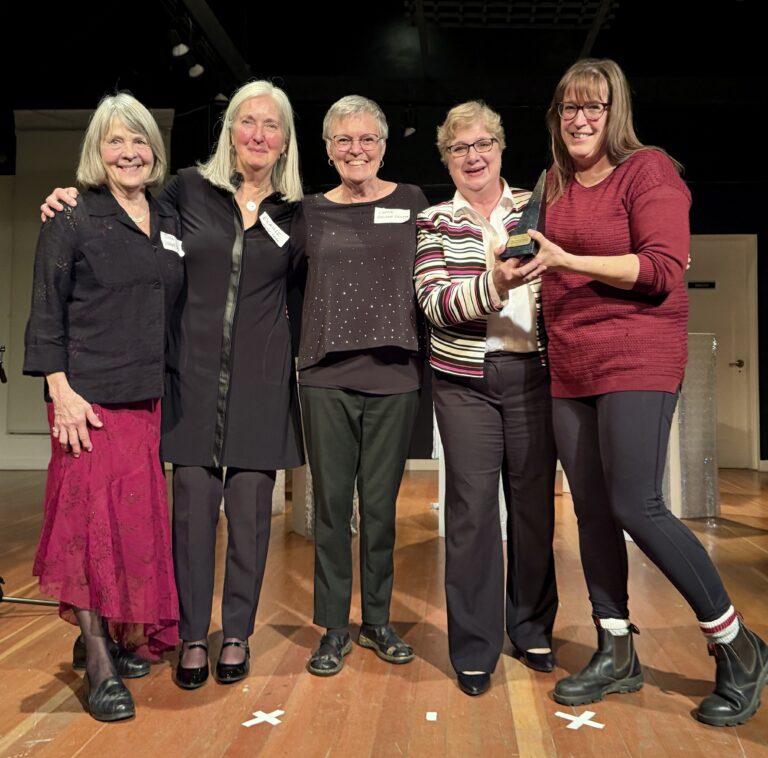
Posing for the Business of the Year award photo are Windsor Plywood’s Mike Stefancsik, Jessica Harkema and Adam Geddes with sponsor rep Robert Steinbach of Country Grocer. Windsor also won the Cornerstone Award.GISS Improv students Reason Perry, Alil’a Perlux de la I’o and Leelu Mann draw a name for a prize at the Salty Wards, with co-emcee Michael Bean in the background.Accepting the Hand & Land Award from sponsor Razali May of Gallery 8 and Coast Gallery (at right) are Salt Spring Wild Cider owners Gerda Lattey and Michael Lachelt.Lynne Fraser of the Salt Spring Island Visitor Information Centre holds the Tourism & Hospitality Award and Island Ambassador Award.Accepting the Green Business Award from sponsor Mouat’s Trading Co. rep Maria Elsser, right, are Caitlyn Pal and Roy Val Clery of SALT JAR Refillery. Salty Awards emcees Michael Mann, left, and Michael Bean.From left, Caitlyn Pal of SALT JAR Refillery with her Green Business Award, and Fiona and Dave Walls of Sweetwater Distillery, winner of the Emerging Business Award.From left, Mary Kastle and Shannon Cowan of the Salt Spring Island Foundation accept the Community Impact Award from Melissa Hill-Rodrigues, the new manager of the Salt Spring branch of award sponsor Island Savings.
A new proposal for a 35-metre-high telecommunications tower in Ganges brought out impassioned public opposition, but there were few clues from Salt Spring Local Trust Committee on how it plans to ultimately respond.
The installation should improve wireless voice and data service in Ganges and along Fulford-Ganges Road, according to a description submitted by proponent SLI Towers, who seek to erect the tower on Knott Place off Rainbow Road — not for a specific operator, they said, but potentially any or all of them.
“The tower is required to address continually increasing demand for wireless voice and data services as high-quality data and voice services have become essential to local residents,” according to the proposal, adding the location was chosen “as there is a great need for coverage in the area.”
Islanders who turned out to speak at the LTC’s meeting Thursday, Nov. 6 all expressed worries about environmental health issues they said were associated with electromagnetic radiation such towers produce. But for their part, local trustees’ conversations centred on whether the proponent was aware of existing LTC protocol, which calls for First Nations consultation for any new antenna siting.
The protocol — built around Salt Spring’s “Strategy for Antenna Systems” — asks proponents to work with the Islands Trust early in the process to identify known and potential archaeological sites and obtain a list of First Nations rights and title holders; it recommends First Nations consultation early and often, and calls for significant reporting and notice specifically surrounding Indigenous interests nearby.
A resolution directing staff to bring that protocol to the proponent’s attention was the sole formal motion concerning the tower — a preliminary bit of feedback that likely reflects the LTC’s advisory role in the approval process.
“I know the last time we had a [tower] proposal before us, we hadn’t officially adopted our protocol, but that was done,” said trustee Laura Patrick. “Our standing resolution requests an applicant to do a number of items.”
“The standing resolutions say the proponent ‘will’,” noted LTC chair Tim Peterson. “To my view, [the protocol] is sort of the bare minimum that these types of proponents should be required to do in terms of consultation with First Nations.”
Both agreed the LTC wanted to see documentation from SLI Towers that the protocol had been followed; but like municipalities, the Islands Trust has no explicit authority over decisions on the location of telecommunications antenna structures, as that power is reserved by the federal government.
Innovation, Science and Economic Development (ISED) has a consultation process, and local governments typically reply with a statement — either of concurrence or of non-concurrence — to ISED regarding siting and design.
This process recently played out when SLI Towers approached North Cowichan’s municipal council regarding a similar 35-metre tower it plans in Crofton; that council voted to send a statement of concurrence in August.
On Salt Spring, ISED approved construction of a tower for Rogers Telecommunications on Channel Ridge in 2023, over what had become opposition from the LTC; trustees had rescinded a statement of concurrence for that project and tried unsuccessfully to trigger a dispute resolution process.
“We certainly heard from members of the public,” said Peterson Thursday. “But when dealing with federal regulators, to simply state ‘we don’t want it anywhere’ is not well received; there may be some opportunity to identify better sites.”
The nearest relevant tower, according to SLI Towers’ application, is the Channel Ridge monopole, now shared by Rogers and Telus; the report briefly discussed “co-location opportunities,” referencing smaller rooftop towers in Ganges and Fulford Harbour, but noted the two 49- and 65-metre towers on Mount Tuam were not close enough to enhance coverage near Ganges, nor to provide “coverage speeds residents have come to trust and expect.”
SLI Towers characterizes itself as a proponent of such infrastructure on behalf of “all national carriers and wireless internet providers.” Its parent company, Steward Logistics, noted five years in the “new site acquisition, amending and extension agreements, municipal and land use approvals, site planning and project management” industry on its website, and that in that time it executed over 200 new tower and rooftop agreements for its clients “with a 98 per cent success rate.” The company lists offices in Etobicoke, Ont. and Palm Beach, Fla.
Officials voted to expand the first phase of public engagement on Salt Spring’s Official Community Plan (OCP) review, a $40,000 budget addition to augment an undertaking one trustee said needed to be wide-reaching and inclusive — but also aligned with formal process.
Salt Spring’s OCP is one of the foundational documents guiding land use and development, meant to broadly represent a “shared vision for the future,” according to the Islands Trust. The review aims to discover whether islanders think it needs changes to address emerging issues — specifically, for this review, housing affordability, climate change and environmental protection.
The review’s timeline won’t be set back by the additional engagement, according to representatives from consulting firm McElhanney Ltd., which envisioned the expansion running alongside development of draft language for possible OCP changes. That team said it had so far engaged some 600 people through a 40-day campaign that saw 468 online surveys completed — including many that were filled out by hand and entered later, according to Sandra Borton, who presented the consultant’s report to the LTC Thursday, Nov. 6.
But there were hiccups.
“There were challenges, really a range of things,” said Borton. “The ultimate outcome of that is that we don’t feel that the data likely reflects the full breadth and diversity of the perspectives from community members.”
Those issues ranged from staffing shortages related to labour actions — and the Canada Post strike — to what consultants said was a recurring problem of just a few islanders dominating their “pop-up” events.
“Despite efforts to redirect these folks and make space for everyone, the dynamic created an environment that discouraged participation of others,” read the report, “particularly [the] intended audience of underrepresented groups.”
Salt Spring Island trustee Laura Patrick echoed consultants’ concerns over communication between the Islands Trust and local advocacy groups. Patrick noted, for example, that one of those groups had collected petition signatures characterizing the OCP review as planning “major changes” — despite Patrick’s assertions there were no changes yet proposed. And Transition Salt Spring (TSS) efforts to coalesce islanders’ priorities early, through its Common Ground Consensus, might have also caused a mix-up; the consultant’s report said that TSS’ outreach had been perceived by some as part of the official process, leading to confusion among residents and a significant number of “similar or identical” letters being submitted through unofficial channels, according to the report.
Acknowledging all those individual and group efforts, Patrick said the positive sign was that so many islanders really cared about the process. The challenge going forward, she said, was for trustees to learn ways to be “better at working with the community voice.”
“We really want to keep community groups engaged, but we need to make sure it’s coordinated in line with our work,” said Patrick. “We need to establish clear communication channels between ourselves and the community-led groups — if they’re going to be out there collecting information, let’s help them, provide some guidance.”
Borton said the expanded engagement would likely include “enhanced” social media, advertisements in local print media and community posters and flyers — alongside on-the-ground work using those enthusiastic islanders and local organizations as a resource.
“Mobilizing those ‘community champions’ and on-island networks,” said Borton. “Really utilizing the folks we know are interested, and keen on the process.”
Reached at press time, TSS board member Bryan Young said the group was glad to hear that the engagement will be expanded.
“There’s been a lot of work that’s gone on with this, and credit to trustee Patrick for pushing toward a ‘gold standard’ for public engagement,” said Young. “I’m excited, and we stand ready to have further input into this process.”
In response to a question from trustees, project manager Kevin Brooks said despite feeling they might have their place later in the process, he generally didn’t support town halls as part of engagement — and he recommended against using them for communication or consultation.
“Town halls — and we also heard this from our conversations on the island — tend to create conflict,” said Brooks, “and an aggressive approach to conversations that can often deter participation. Our goal with the way that we do engagement is to create low-barrier forms of participation that allow anybody to be able to participate.”
Patrick noted that if the review prompted suggestions for changes to the OCP, there would be a public hearing regardless.
“We’re not trying to remove town halls,” said Patrick. “If we do our job right, when we get to the public hearing, there should be crickets in the audience; we should have been anticipating and responding to what we were expecting to hear.”
The supplemental phase of engagement will take place during six weeks in November and into December, hopefully producing a summary report, Borton said. Two further cycles of presenting and listening for information will follow, with workshops then to develop a draft OCP outline in the spring.
Patrick reiterated that every step going forward must be not only public, but well-publicized — at the end of the day, she said, “there is mistrust.”
“People think we’ve been secretly talking in the back room about our plan to triple the population of the island,” said Patrick. “It’s vitally important that our process be transparent, inclusive and formal.”
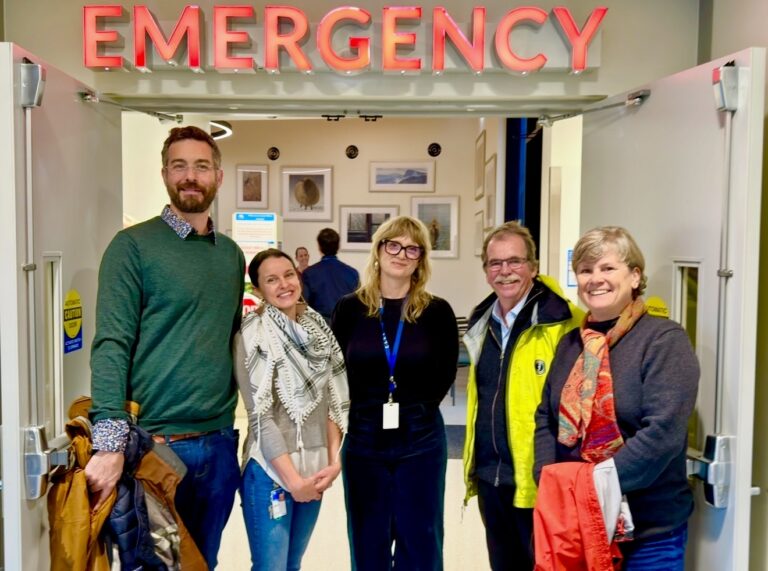
The MLA for the riding that includes Salt Spring once again toured the island with a provincial minister in tow — this time visiting different healthcare settings with Mid Island-Pacific Rim MLA and Minister of Health Josie Osborne.
Arriving on an early ferry Saturday, Nov. 1, Osborne is the second B.C. cabinet member to visit Salt Spring in the last three weeks. Saanich North and the Islands MLA Rob Botterell had previously arranged a similar visit from Housing and Municipal Affairs Minister Christine Boyle on Oct. 16.
Botterell and Osborne spent the day learning more about the healthcare challenges facing Salt Spring, shepherded by Lady Minto Hospital Foundation (LMHF) executive director Eric Jacobsen and a host of other frontline providers and community members.
Osborne said it was rare for her to be able to spend nearly a full day in a single community, and felt as a result she left with a much stronger understanding of Salt Spring’s challenges than she arrived with.
“I also have to say I am so inspired by how deeply committed and caring people are on this island,” said Osborne. “It is so obvious that people are looking out for each other.”
After the minister and MLA were collected from a rainy landing at Fulford, their first stop was the Heartwood House healthcare staff housing project on Bittancourt Road. Jacobsen said the foundation would be welcoming its first healthcare workers transitioning into the community there in the new year.
The next stop was Lady Minto Hospital and a tour of both the new emergency department and the aging Extended Care Unit there. As a prior mayor of Tofino, Jacobsen joked, Osborne “knew a little about 1950s-era hospitals.”
“But importantly, she also really understands the constraints and operational challenges in rural and remote communities,” said Jacobsen, adding that they also visited Greenwoods to present the broader scope of long-term care on Salt Spring — and where it could be improved.
“I think we recognize a desire for modernization, renewal and co-location — evolving into a ‘campus of care’ surrounding the hospital,” said Jacobsen. “That’s the vision.”
After that the group visited the Salt Spring Island Health Centre. Just last month, the Island Community Clinic Society (ICCS) and LMHF announced joint plans to attract — and retain — family doctors and primary care health workers by transforming the existing centre into a non-profit team-based model.
Jacobsen said one of the complexities for proponents was that it isn’t quite envisioned as a typical community health centre model, so the project wasn’t a “perfect fit” for existing programs at the ministry level. He said Osborne committed to helping LMHF and ICCS convene with her staff to sort out where the project could “plug in” to provincial resources.
“We talked a lot today about the need to expand the clinic,” said Osborne. “About what a community-led clinic looks like, where you obviously have the support of the ministry and Island Health but it’s run by a community-based nonprofit that understands the unique needs of the island.”
Botterell said that despite challenges, the island’s “healthcare ecosystem” was being developed in a grassroots, innovative and integrated way. He called the visit “energizing,” and said he ended the day hopeful for the new model being planned.
“And the other good thing is, we’ve got a site,” chuckled Botterell. “And there’s good progress being made in terms of working to get the approvals needed to get to work on that site.”
The clinic expansion is part of a broader project planned by the Gulf Islands Seniors Residence Association (GISRA), which is undertaking a rezoning process through the Islands Trust that could deliver space for additional healthcare practitioners alongside 50 new units of affordable housing. Osborne said that sort of integrated approach was in step with the province’s direction to work toward solving complex issues from several directions at once.
“It’s more than just delivering health care,” said Osborne.
“It’s about housing, it’s about child care; it’s about recruiting and hosting entire families [of those medical professionals] who choose to move to Salt Spring.”
Osborne said the next step would involve going back to the ministry and developing those “points of connection” to support Salt Spring’s healthcare needs — and ensure they were aligned with provincial planning.
“I feel encouraged by everything I saw today, and people that I met, and how hard people are working on community-based solutions for healthcare,” said Osborne. “It takes everybody at the table together, so it’s going to be Island Health and the Ministry of Health and the [South Island] Division of Family Practice, the doctors and the foundation and the community groups.”
“There’s a lot of work to do, but after today and through our discussions, I think we can really see the path forward,” said Botterell, “and I’ll continue to work with Josie to do our part provincially to make that happen.”
For the first time in more than a decade of counting, a Salt Spring nonprofit’s data suggests that the population comprising the island’s most vulnerable residents may be shrinking.
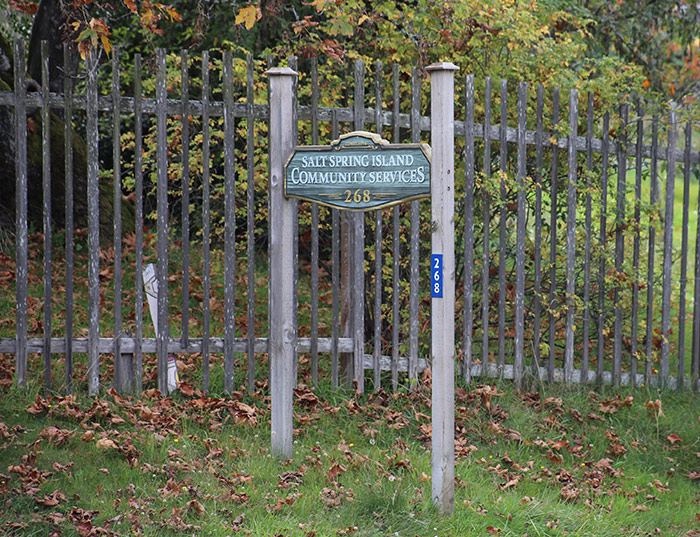
Island Community Services (ICS), formerly Salt Spring Island Community Services, released numbers from its 2025 Point-in-Time (PiT) count of the homeless population, finding 47 “sheltered” and 90 “unsheltered” people, totalling 137 — the lowest number of people experiencing homelessness counted on the island since 2018, according to the nonprofit.
While this year’s March 20 count suggests a roughly 17 per cent decrease from 2023 — the first time numbers have fallen since ICS began its count — the nonprofit warned that number still exceeded available shelter accommodation on Salt Spring. ICS operates Salt Spring’s Emergency Shelter, which has a year-round capacity of 30 people and as many as 40 through the Extreme Weather Response Program.
PiT counts are conducted across British Columbia, and are meant to provide a snapshot of people experiencing homelessness; they are generally considered an undercount by the province and ICS, representing only individuals identified during a specific 24-hour period. Provincially funded counts released in October showed eight communities with a decrease in the total number of people identified as experiencing homelessness, and 12 communities with an increase compared to a previous count in 2023.
For the purpose of homeless counts conducted in those communities, a person was defined as experiencing homelessness if they did not have a place of their own where they paid rent and could expect to stay for at least 30 days. Those programs defined “sheltered” as anyone who stayed overnight on the night of the count in homeless shelters, including transition houses for women fleeing violence, and youth safe houses, and people with no fixed address staying temporarily in hospitals, jails or detox facilities.
“Unsheltered” homeless included anyone who stayed outside in alleys, doorways, parkades, parks and vehicles, or people who were staying temporarily at someone else’s place (couch surfing) and/or those using homelessness services.
ICS, which conducts its count independently, has in previous years defined sheltered as “living in emergency or transitional situations” and unsheltered as living in “tents, vehicles, derelict boats and other temporary and makeshift shelter situations.” This year, ICS’ definitions aligned with those for provincially funded communities. ICS does not release its methodology.
According to ICS’ annual report from its September AGM, among the “unsheltered” population, 62 reported sleeping in a car, boat or RV; 18 said they slept in a tent or on the street, with the rest reporting “couch surfing” or sleeping in shacks or sheds.
Michael King Marshall, devoted husband, father, uncle, grandfather, friend, and educator, died peacefully at home on October 20th, following his 85th birthday celebration and the epic Blue Jays’ World Series qualifying win against the Mariners. He is survived by his loving wife Anne of 60 years; his children Melanie (Pete), Tony (Chantalle), and David (Kirsten); his eight grandchildren, Wyatt, Dayton, Ana-Sofia, Dani, Indigo, Cypress, Jade, and Diego; his sister Dawn; his two nephews Chris (Carmen) and Tim (Reina), and his beloved cats, Hunter and Georgie.
Mike was born and raised in Montreal with his elder sister Dawn, and after completing his BSc at McGill, he left home and those he loved most, to “search through education and life experience, for his tomorrows”.
In 1961 while working as a fire spotter, he met Anne Smith working in a Banff camera shop. They exchanged letters for several years while Mike studied medicine in Edmonton. Realizing his family’s tradition of a career in medicine wasn’t for him, and missing Anne, he returned to the coast where they were married in 1965.
The late 60’s were “homesteading years”, hand building a log cabin north of Smithers BC. Anne and Mike were known as “that carefree, good-looking young couple” with the kayak strapped to roof of their convertible MGA. In 1970, a year after the birth of their daughter Melanie, they decided that life with a new baby would be easier with running water and relocated for work in Massett, BC. In 1971, while Mike worked as Vice-Principal of Elizabeth Fisher and Belmont Fisher Secondary Schools in Victoria, their son Tony was born. In 1974, after their son David was born, Mike moved the family to Michigan where he pursued his PhD.
In 1976, the family moved to Lillooet, where Mike was hired as the Secondary School Principal. The year following, a new district role brought Mike and family to Kelowna where they remained until the early 80’s. The sound of Mike’s typewriter and country music filled those evenings, as he continued to research and write his dissertation.
In 1982, after many moves and family trips piling into the camper, the Marshalls’ landed on Salt Spring Island where Mike became Superintendent of Schools. School District #64 emerged provincially as a “lighthouse district” influenced in large part, by Mike’s commitment to supporting and empowering innovation.
In 1996, Mike stepped down from his district role to pursue one of his greatest passions – working in the classroom again, becoming the Principal at Pender Islands School.
In 2000, Mike retired from his principalship and unexpectedly, the following summer, suffered a life-changing stroke.
Over the next 25 years, he moved through the seasonal rhythms of life with incredible grace, humour, kindness, patience, and gratitude. Family was everything to Mike, and his life shifted from a very public realm to a private one. When he wasn’t enjoying the Mexican sun, he was happiest with his cats and a beer in hand in his south-facing pumphouse; big double doors opened wide to St. Mary Lake, letting the warm sun pour in. This was his “thought cathedral” – a private, timeless sanctuary.
Mike’s advice to us all remains: “Go out there and make a difference. But in each thing you do, or say in making that difference, preview your action through the lens of Truthfulness, Fairness, Goodness, and Kindness. History records the accomplishments of many motivated, capable, and intelligent individuals who made a difference, but gives a special place to those who made that difference in an honest, fair and caring way. What the world needs… what our country needs, and what every really worthwhile enterprise needs, are leaders who understand and live by this code.”
A Celebration of Mike’s Life will be planned and communicated by the family at a future date.