
Home Blog Page 323

Phoenix breakfast program thrives

0

Phoenix Elementary School students are starting every day right thanks to community members who stepped up to keep the school’s breakfast program running amidst the pandemic.

Donations of funds by local businesses and nonprofit organizations have meant that a healthy hot breakfast can be served to all 40 students in the school, every morning of the year. And, participation by local community partners has meant meals can be safely made and distributed without adding to COVID-19 risks. 

The program may not have run this year if not for a concerted effort to make it work. It was in fact initially cancelled in September as school principal Dan Sparanese was forced to make tough decisions around school safety plans.

Calico Chang, a public health nurse who became the healthy schools lead for School District 64 in September, learned the breakfast program was being cancelled through school parents, including parent advisory committee chair Hannah Daneswood. Chang and Daneswood were determined to look “outside the box” to get the program back.

“With food security and learning in mind we knew how important it was to provide kids with this option: future investment, in a nutshell,” Chang said.

The program is vitally important to students in need, but it has also become an integral component in building the small school’s sense of community. The organizers initially created the program to include all students so that no one would feel singled out. It quickly became an enjoyable and important start to the day for everyone. 

As Chang explained, PAC fundraising had formerly funded the program and it was run by the school’s long-time educational assistant Susan Garside and some parent volunteers. Students would also help prep in the school’s kitchen. 

With COVID-19 risks to consider, Sparanese wanted to avoid putting staff at risk by handling dishes and also wanted to limit children congregating and sharing food. 

However, need for the program had not evaporated, and likely only grew.

“The 2015 Census shows the average income of Salt Spring Island families is $10,000 less than the national average, Vital Stats estimates groceries are 10 per cent more costly, and rental increases are staggering, if one can find housing,” Chang explained.

“This trifecta leaves families with little choice in how they can provide. COVID-19 has created lengthy lines and families with little time are less inclined to shop for healthy food.”

Chang and Daneswood brainstormed a plan to meet Sparanese’s concerns by using off-site kitchens to prepare grab-and-go breakfasts so kids could eat outside as soon as they arrived. 

“This idea fulfilled everyone’s requirements. We just needed money and people,” Chang  recalled.

Their appeal to the community this fall netted some great new partnerships and extended some important existing ones. In the past, Jenny and Jason Coles from Barb’s Bakery donated food once a week, and Country Grocer donated funds every month. Both businesses have continued to lend this support to the program. With Barb’s taking care of Wednesday’s breakfast, new partner Mila Besiata from the Salt Spring Wok Company committed to making hot breakfasts for the school on Mondays, Tuesdays and Thursdays. 

A Salt Spring Foundation grant of $7,500 plus $1,000 in COVID emergency funding from the organization helped get the program off the ground, along with a generous donation from Hayward’s Funeral Services. The Salt Spring Baptist Church also contributed and the Lions Cub has funded the school’s fruits and veggies program, which brings down meal costs.

Parent volunteers pick up and deliver the meals to students outside the school every morning. 

“It has been a hit. I’ve heard of kids who were dragging their feet, not wanting to go to school, and are now psyched to get in the car in anticipation of their breakfast sandwich,” Chang said.

The organizers now have enough funding to cover the full school year but are already planning for next September’s needs. Anyone can donate and help sustain the program.  Breakfasts cost $3 per child, so $100 can provide 33 meals for local kids and $1,000 can provide 333 meals. Donations can be made to SD64, attention Breakfast Program, and tax receipts are available.

Rural designation campaign for islands revisited

0

Advocates are retreading old ground on their mission to have Salt Spring and the Southern Gulf Islands recognized as rural communities and become eligible for multiple grants and programs currently denied to them for being part of the Capital Regional District. 

Saanich North and the Islands MLA Adam Olsen raised the issue again at the British Columbia Legislature during question period on Dec. 10, addressing newly appointed Minister of Jobs, Economic Recovery and Innovation, Ravi Kahlon. Kahlon said he would be briefed by his deputy minister about the matter and invited Olsen to meet with him to discuss it sometime after that. Olsen suggested that instead of meeting, a new order in council could be drafted and signed right there.

“I appreciate the invitation to have another conversation. The reality is for southern Gulf Islands communities and Salt Spring Island, they have been conversing about this with this government, and I have been conversing about it, for three and a half years. The advocacy has been going on for more than seven years,” Olsen responded. “The idea that these communities in the southern Gulf Islands are anything but rural … to think that we would have to be continuing the conversation about whether these islands are rural is absurd.”

Olsen explained to the Legislature not having rural designation means the CRD’s island communities have been excluded from applying for broadband access and will most likely also miss new funding for mental health and addictions treatment announced last week. 

Those are just the latest examples of provincial and federal programs that are available only to rural communities. And as Olsen pointed out, the province changed the designation for the CRD’s Juan de Fuca electoral area just before the fall election was called. Juan de Fuca happens to be in Premier John Horgan’s riding. It can now apply for infrastructure and project grants from the Island Coastal Economic Trust, a multi-million dollar granting fund that Salt Spring and the Southern Gulf Islands have been excluded from.

“The reality is, without this designation, these island communities do not have access to grants that they rightfully deserve,” Olsen said. “These communities are tourism-based communities that have been hit so hard by COVID. They are in and are having an existential crisis, right now, this moment.”

Getting the classification changed at both provincial and federal levels has been a high priority for the Salt Spring Community Economic Development Commission. Chair Francine Carlin has been advocating for the move since she first joined the commission in 2016. 

“The decision by Premier Horgan to reward Juan de Fuca, his riding, with inclusion in ICET is outrageous,” Carlin said. “Now after years of meetings, letters and advocacy calling for all the CRD electoral areas  — Salt Spring, Southern Gulf Islands and Juan de Fuca — to be designated rural and for ICET inclusion, we are once again faced with a minister who is inexperienced and has to be ‘re-educated’ about this inequity. Now time is wasting and our ability to access necessary COVID recovery resources in a timely manner is out of reach.”

Olsen has urged all concerned constituents from Galiano, Mayne, Pender, Salt Spring and Saturna islands to send letters requesting rural designation to the new minister at JTT.Minister@gov.bc.ca, and to copy him at Adam.Olsen.MLA@leg.bc.ca

COVID-time limericks book released

Humans have a strange gift in their ability to find humour in even the most dire circumstances, but putting together the world’s toughest challenge with one of its most irreverent art forms may seem like a stretch.

According to masterclass.com, a limerick is “a five-line poem that consists of a single stanza, an AABBA rhyme scheme, and whose subject is a short, pithy tale or description. Most limericks are comedic, some are downright crude, and nearly all are trivial in nature.”

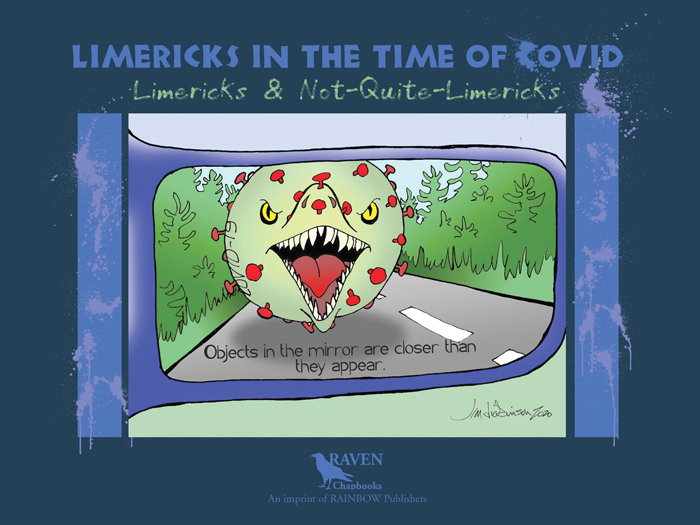
Subjecting a COVID-19 situation rife with terrifying health and financial implications, anxiety and loneliness to a form meant to be silly could therefore feel like the wrong way to go. That’s until you pick up a copy of Limericks in the Time of COVID. The smart new book created through a partnership of ArtSpring, the Salt Spring Public Library and the Salt Spring Foundation has a way of lifting one’s spirits while bringing home truths of this pandemic year at the same time. And it just may foretell the long-term revival of an under-appreciated poetic form, with 78 unique submissions included.

“This is the first time we’ve done something like this: asked for art submissions and then overseen the creation of a book,” said ArtSpring’s artistic and executive director Cicela Månsson, who sparked the idea for the project. “There’s just so many people from the community who participated. I guess it was a way of making light of a difficult situation for everybody.”

The book, which will raise money for the Salt Spring Foundation’s COVID-19 Emergency Preparedness and Relief Fund, is indeed the product of many partners coming together for a common cause. While all submissions received were included in the book, there was also a contest element judged by writers Diana Hayes, Chris Humphreys and Kathy Page. Hayes, who publishes Raven Chapbooks, also helped create the book with designer Patricia Walker. Artwork was contributed by islanders Jim Dickinson, Susan Benson and Michael Whitfield, and photographed for production by Seth Berkowitz. The book was printed on-island by Contour Graphics and Bob Weeden contributed the forward.

Submissions were opened to people across the province during the summer, although many of the responses came from Salt Spring. Winners in the youth and adult categories were Shawn Yee and Lis Muise respectively, while Michael Oliver and Rosamund Dupuy were highly regarded adult runners up.

Hayes said each of the judges had a slightly different approach to their assessments, and brought different long-lists to the table. She was personally a stickler for staying true to form, although not all the entries did that precisely, which is why the book’s subtitle is “Limericks and Not-Quite-Limericks.”

In the end, though, the three judges were happy with their top three picks.

“Limericks are all about light-heartedness and having fun, and often a little risqué. People really dove into it,” Hayes said. 

“I think a few of us were wondering just how risqué the submissions would get, and we were surprised the risqué ones were kind of limited,” Månsson confessed. 

She noted the Salt Spring Public Library hosted a Zoom session where some of those were created, as participants egged each other on in a fun and creative on-the-spot challenge.

The collection in fact runs the gamut from cheeky to clever to somewhat melancholy. Some of the contributors are real wordsmiths who make the most of the form while managing to include keywords such as pandemic, 2020 and even Fluevog in their rhymes. 

The standard limerick opener that goes “There once was a person from somewhere” interestingly inspired more than one person to choose Vesuvius for that place name. Many of the verses stick to the messaging around mask wearing. There are also references to public figures reviled (Donald Trump) and respected (Dr. Bonnie Henry). 

Månsson said the team was hoping to get a statement from Henry to include in the book but weren’t able to reach her. They intend to send her a copy in any case.

“Hopefully she’ll get a little giggle out of it,” Månsson said.

The book itself was designed to reflect the limerick’s breezy form, cut short like some cartoon collections and nicely spaced with just two poems per page. 

“You can create a mood in designing a book. It was a really fun project,” Hayes said. “I think it’s something the community will be really proud of and excited about. And I think this will be a bit of a collector’s item. It’s our first pandemic, our first limerick collection.”

ArtSpring covered the cost of printing the books, which came in at $15 a piece. The books are available until Dec. 17 on the Salt Spring Foundation’s website under “Give Now” for the minimum at-cost price. Ideally, ArtSpring will recoup its costs and there will also be added donations going to the foundation’s emergency fund.

Copies will also be available at Salt Spring Books. In that case customers will be charged the base $15 and are asked to make their donation directly to the foundation.

Viewpoint: Caring for others is crucial

0

By DAVID J. RAPPORT

Salt Spring is a caring community. So caring for others in COVID-19 times should come easy here, even if one does not believe that COVID-19 is real or presents any danger to our community.

Just think of it for a moment. Admittedly, it is inconvenient to wear a mask in public and keep physical distance from others. But regardless of one’s beliefs, it is the caring thing to do. It is a small effort that can go a long way to ease anxiety among those who do believe that we are in the midst of a global pandemic that has now reached our community and can prove deadly for both the elderly as well as for anyone with pre-existing health conditions, regardless of age.

Those who deny that COVID-19 is real may need to hear the sad stories in the media about fellow Canadians who have caught it — and the stories of those who have watched their loved ones die from it.  But even if you remain convinced it’s not real, out of concern for fellow islanders who do believe it is, one needs to be compassionate: no matter your age, wear a mask and keep physical distance (indoors and out) to make others feel safe.

And for those who do believe COVID-19 is real, but are tempted to lower their guard because there is light at the end of the tunnel with vaccines on their way, think again. 

For now, the fact is that COVID-19 has been identified on island, and one can safely assume that there are carriers in our midst who are asymptomatic and thus do not know that they are positive for COVID-19. A vaccine “on the way” is of no help today if you should come down with COVID-19. A vaccine “on the way” has been of no help to many dozens of Canadians dying from COVID-19 every day as the prevalence of the virus resurges across the country. 

Until a significant number of islanders are vaccinated — and it will likely take many months and perhaps up to a year from now before everyone who wants the vaccine will be vaccinated — there is only one prudent thing to do:   be ever more watchful as cases ramp up throughout the province and may well ramp up on island as well. This means continuing to be aware, rigorously and at all times, that close contact with anyone not in your immediate household is a risk to all. Wearing a mask in all public places and keeping physical distance is a small sacrifice but a big sign of caring for others — and it may well serve to save lives, including the lives of those one is closest to.

The writer was formerly an honorary professor in the Faculty of Medicine at Western University and a co-founder of its program in Ecosystem Health. He has served as an international consultant on pandemics and pandemic planning to various UN agencies.

Editorial: Supporting community when it comes to gift-giving

0

Few aspects of life have been spared the impacts of the coronavirus pandemic so far in 2020, and the holiday season can now be added to that list.

Provincial health orders to celebrate in person with no one besides immediate household members and to limit travel for “essential” purposes only is making one traditional activity — gift buying and giving — unlike any of years past. 

For island businesses that rely on a healthy economy and people willing to spend their money on Christmas gifts, the restrictions can work two ways. While fewer people might be travelling off island to shop, post office volumes suggest that activity is being replaced by online shopping. 

Islanders have shown imagination, resilience and generosity when it comes to supporting each other during the pandemic. Earlier this year, a Salt Spring Island Foundation special COVID-19 fund collected more than $200,000 in a short period of time, and some other charitable campaigns have also seen high donation levels. 

The Island Comeback program, a COVID-19 response initiative of the Rural Islands Economic Partnership, has seen a growing number of businesses on islands up and down the coast sign on to its online marketplace for gift certificates. The Farm Stand Light Up and Tour on Salt Spring is another creative way to gather Christmas gifts and goodies. 

Just like fighting the pandemic requires every person to do their part, helping local retailers, restaurant owners, artisans and health practitioners survive these challenging times also demands conscious effort. Instead of shopping through Amazon, buying gift certificates for restaurants, shops and services, or visiting local stores and studios will keep money in our community. We can even simply promise a post-pandemic meal out with friends or loved ones. 

Local not-for-profit societies have also been hit hard by the pandemic this year as regular in-person fundraisers could not be held. Donations can be made to charitable groups or one of the land conservation campaigns underway in the name of a gift recipient.

Christmas 2020 might not have the same festive feel we’re all accustomed to, but if we take the time to see what’s offered locally and help our friends and neighbours while we’re at it, it could be the start of something even better for Christmases to come.

Mischief charges pending in window-smashing incident

0

Another small business located in Ganges Alley has suffered damage due to ongoing problems associated with Centennial Park.

The main window at Strong River Studios was smashed out early Monday evening, not long after an altercation that involved several people in the park between around 3:30 and 4 p.m. 

According to a Salt Spring RCMP media release, RCMP officers responded to two incidents in Centennial Park within a few hours of each other. The first incident was reported as a possible fight involving two men. RCMP members arrived on scene and separated the combatants. It was determined that the best resolution was to separate the two. One man was given a ride from the scene by police to another location of their request. The man agreed to stay away from the area, and said he would cause no further concerns.

RCMP say approximately two hours later another incident was reported near Centennial Park. This time it was reported that a window of a local business had been broken.

An RCMP member who was on scene saw two men arguing on the sidewalk. The police officer easily identified one of the men as the same man driven from the scene earlier, who had agreed to not return. Witnesses on scene identified this man as having thrown an item through the business window, shattering it.

“This is an unfortunate and unnecessary incident,” said Sgt. Clive Seabrook, Salt Spring RCMP detachment commander. “This man was given a ride to another location by the police, told to avoid the area and instead he decided to return, causing a scene and breaking a window.”

The Salt Spring man was arrested without incident and transported to the local RCMP detachment. He now faces charges of mischief under $5,000, and is scheduled to appear in Ganges court in March of 2021.

The man was released on conditions not to attend Centennial Park.

Other incidents in the area in the past several months included a violent attack on the owner of the Harbour Food Market on Nov. 4, and feces spread on nearby Beachside premises and windows broken at two Ganges Alley restaurants during the summer. Business owners say there have been incidents of people in the park drinking, doing drugs and being violent on a near daily basis over the past year.

According to Marta McKeever, whose husband Edward runs the Strong River Studios design firm specializing in decorative finishing arts, there is a complex social situation unravelling in the park and far too little in the way of support services.

“The homeless community needs safe shelter (not just during night time) with access to internet and toilet facilities, as well as easier access to mental health and substance abuse services,” McKeever posted to Facebook and shared with the Driftwood. “Instead they are met with shop keepers like us who have had enough of the violence and chaos outside of our places of business and next to the playground where our kids are too scared to play. 

“It’s absolute bedlam out here but it’s not about ‘us and them.’ It’s a leadership issue and a safety issue for everyone involved and it’s up to our community to come up with a peaceful solution, I guess.” 

Osisi Boutique owner Jennifer Lannan is another local business owner in the Ganges Alley complex. She has repeatedly sought action from local authorities such as the RCMP and the Capital Regional District. 

Lannan was already trying to get help from police on Monday afternoon when tensions escalated into a fight.

“People in the park were high as kites and had been drinking for hours on end and having mental breakdowns with yelling and screaming. That is why I called,” Lannan told the Driftwood.

Lannan wrote to Salt Spring’s CRD director Gary Holman the following day. 

“I’m emailing to inform you that the situation in the park is deplorable and must change. I have all the same things to say to you as many of us have in the past,” Lannan said, before listing a number of questions she wanted answered.

Included in Lannan’s list were questions on why there have been so few bylaw enforcement patrols of the park in recent weeks, why local government has not followed through on requests to clean up the park, and why business owners are expected to manage the situation by reporting incidents, when these are “constant and perpetual.”

CRD bylaw enforcement personnel and RCMP had collaborated this summer to step up enforcement efforts against unruly behaviour in Centennial Park.

Holman said he has been in regular communication with CRD Bylaw Enforcement head Don Brown about the situation. Salt Spring’s CRD budget for 2021 will include the third annual increase for bylaw enforcement. Holman has also committed to organizing a meeting between CRD, RCMP and local business owners before the end of the year.

Holman said some of the root causes of the situation — mental health and addictions, lack of affordable housing — are largely due to federal and provincial government failures.

“Local governments are left holding a very big bag, which is ultimately the responsibility of senior government,” Holman said, adding some programs are now slowly starting to take effect under the B.C. NDP government.

“The best we can do in the short term, I think, is increase presence in the park and make it clear bylaws and laws will be enforced.”

Seabrook, who was only recently posted to Salt Spring, said RCMP is continuing regular patrols of the park. He has been talking with neighbouring shop keepers about their concerns and has also spoken with the people using the park about expectations.

“I have been meeting with various groups and organizations to see where the RCMP can assist with finding longer-term solutions. I am optimistic that a solution can be found,” Seabrook said.

WAKELYN, Phyllis Gertrude

0

PHYLLIS GERTRUDE WAKELYN
June 12, 1931 – December 2, 2020

Phyllis was born in Victoria June 12, 1931. Phyllis grew up there and attended Oak Bay High from which she graduated in 1949 where she was on the girls’ basketball team and was Grade 12 Class Rep.

Phyllis attended Victoria College in 1950 before going into nursing training at the Vancouver General Hospital School of Nursing. Upon graduation, Phyllis returned home to work at Royal Jubilee Hospital from 1953 to 1955. During that time Phyllis met Jim Whittome of Duncan and they married in 1955. Phyllis relocated to Duncan, worked at the King’s Daughters Hospital in 1955-56 before transitioning to life as a wife and mother raising 4 children born between 1956 and 1965. Phyllis served as PTA president, Cowichan Music Festival volunteer, Cowichan Valley Athletic Club president and member of the Cowichan District Hospital Board, eventually becoming that Board’s first ever woman Chair and served 5 consecutive terms in that capacity. As Chair, Phyllis broke ground on the extended care facility known as Cairnsmore Place that stands there today. Phyllis’s volunteerism took her to the presidency of the British Columbia Health Association and British Columbia’s representative to the Canadian Hospital Association board by 1978. That year Phyllis was appointed by the Minister of Health as Vice Chair of the Advisory Committee on Medical Manpower. In 1982 Phyllis was appointed an Honourary Member of the BCHA and served as Chair of the Victoria General Hospital Foundation Board.

Phyllis and Jim’s marriage ended in the late ‘70s and in 1980 Phyllis married David Bolton and became a parent to 3 more young adults. In the 1980s, Phyllis, in addition to her volunteer work, added a professional career as a real estate agent and, in time, achieved broker status.

In the early ‘90s, Phyllis and David transitioned to Salt Spring Island. Phyllis remained active as a realtor with Creek House Realty (later Pemberton Holmes). By then, grandchildren populated Phyllis’s life and she reveled in joining the kids in exploring the rocky shoreline and tidepools below the house and feeding the wildlife that wandered onto the property. Phyllis was active in the Salt Spring community, as a member of the Greenwoods Board of Directors, the Artspring Board, the Southern Gulf Islands Community Health Advisory Committee to VIHA, and the Salt Spring Health Committee, and headed up Save Our Surgery (Lady Minto Hospital). Phyllis lost her beloved David in 2010 but continued to live life undeterred and enjoying a wide circle of close friends on Salt Spring, all of whom were very special to her. If you went into Ganges, she seemed to know everyone. Phyllis was a Raging Granny and was a member of the Salt Spring Sneakers Running Club where she was “Rookie of the Year” in 2014 and won numerous events in her age category. Phyllis finally retired from real estate but continued to keep active and was a dedicated supporter of nature, wildlife and environmental causes, among just a few. In the last year Phyllis finally and reluctantly said goodbye to Salt Spring and relocated to Duncan to be nearer to family.

Phyllis was a breast cancer survivor and as tough and resilient as any woman we could ever know. She was more than a wife, mother, sister, daughter, grandmother. Phyllis Gertrude Wakelyn lived a life of accomplishment and achievement few could match and her memory will be cherished forever.

Phyllis’s family would like to thank the staff at Cowichan Hospice House for their kind and compassionate care during Phyllis’s last days. Their caring was a comfort to us. Due to the pandemic, a celebration of Phyllis’s remarkable life will take place at a point in the future when it is safe to gather.

First COVID vaccine due to arrive in Island Health in new year

0

British Columbia health officials have announced that COVID vaccines will start to become available in limited numbers next week at two distribution centres in the Vancouver Coastal and Fraser health regions, with expansion to all regions including Island Health expected by early January.

“As we approach the winter solstice coming up, the longest night of the year, there is light ahead. And that light is shining a little brighter today,” provincial health officer Dr. Bonnie Henry said on Wednesday.

Speaking at a press conference along with Health Minister Adrian Dix and Immunize BC Operations Centre director Dr. Ross Brown, Henry was visibly excited by the news she had to share and the hope for widespread community immunization next spring. The program will start in a small-scale, targeted manner, however, due to vaccine supply limitations.

Henry said the limited doses available next week mean only the highest risk people will be vaccinated, according to a program set out by the National Advisory Committee on Immunization and agreed upon by authorities across Canada. This means frontline health-care workers first and then people living in long-term care facilities.

“We know the lives that are being taken and affected most are seniors and elders in long-term care and assisted living. In addition, we have to protect our strained health-care system so all of us can get the care we need, when we need it,” Henry said.  

While the roll-out will start with just one vaccine approved so far, Canada has purchase orders with seven different manufacturers. Henry said the types of people who can receive the vaccine and number of doses available will continue to increase through the winter. She expects around 380,000 people will be immunized by the end of March.

The province will at first receive just four trays of the vaccine made by Pfizer, which is the first to be approved in Canada, with 975 doses on each tray. Because this vaccine requires constant cooling at temperatures of -70 to -80 degrees Celsius, at first people will have to come to where the vaccine is stored. 

Moderna, whose vaccine is expected to be approved next, has less stringent cooling requirements and can be refrigerated for several days. This will allow health authorities to transport it to communities of need.

Henry said that after Dec. 14 there will be tens of thousands of doses on the way and the province will add an additional seven distribution sites, increasing that to 30 sites in January. The next tier of risk to be vaccinated will include teachers and essential workers in other fields than health, people over the age of 80, remote and vulnerable First Nations communities and people living in high-risk situations for transmission, such as homeless shelters.

“We have enough vaccine that we expect to receive between now and the end of March to cover those key populations. We do expect by the end of March and going into the spring there will be more vaccine products and more of the vaccines available to more rapidly spread out to people in the community,” Henry said.

Pfizer and Moderna both created their products as a new type of messenger RNA vaccine, which use synthetic genetic material. Henry said they have the advantage of being easy to produce in large quantities, but have not been tested on people under age 16, pregnant women, or people with compromised immune systems. The more traditional vaccines that are now in the approval stages will be safe for those people.

Henry said she believes by the end of March or early April, distribution of the vaccine can take place through more traditional means such as pharmacies and public health clinics. 

“Right now we don’t have enough vaccine to slow transmission across the province so our focus is to protect those who are most at risk,” she said.

Island’s Climate Action Network launched

1

BY BRYAN YOUNG

Have you ever had a party where everyone invited came? That was the scene on Nov. 30 when the Community Alliance hosted a special online meeting with Transition Salt Spring (TSS) Society featuring key findings from the soon-to-be-released Salt Spring Island Climate Action Plan 2.0. 

CAP 2.0 is the product of more than 18 months of work on the part of a team of more than 30 volunteers, including feedback from 2,000 islanders and 50 stakeholders. The plan has more than 250 recommendations on what we need to do on Salt Spring to reduce emissions by 50 per cent by 2030, and help keep our community and natural systems resilient in the face of climate change. 

To kick start the release of the plan, we invited over 50 stakeholders representing key agencies, local government, business, institutions and island-based non-profits to hear CAP 2.0’s key conclusions. The group also received an invitation to join TSS’ brand new Climate Action Network to collaborate in developing the initiatives we need to have a safe and resilient future as our climate changes. 

TSS delivered an overview of the climate risks Salt Spring faces over the next 80 years, illustrating a future with zero frost days, a 25 per cent increase in days with rain over 20 mm, and average summer highs over 30°C.  

All this bodes poorly for climate change impacts like infestations of pests (which will survive our California-like winters), erratic spring pollination of our island’s fruit trees, longer and deeper periods of drought, and — Salt Spring’s greatest climate change risk — forest fires.  

While professional scientists on the CAP team developed the forecasts, we included in the presentation fictional but plausible headlines from a Driftwood of 2080 to make the data more relatable.  

“Douglas-fir beetle: Years of frost-free winters decimating forests – Maxwell PP sees highest infestation after tragic 2032 Burgoyne fire” blared one headline. “Rainstorm fall-out: Residents rely on Coast Guard barge.” “No end in sight after collapse of Musgrave and Dubois roads” blared another.  

Sadly, headlines like these are far from exaggerations because these types of events have already begun to occur. A hotter future with more storms and heavy rains will simply accelerate the processes driving these events.  

Another change already underway is sea level risk. By 2080, our seas will be one metre higher than they are today. At the meeting, we showed sea level risk maps for three island locations generated by scientists and mapping specialists.   

Attendees heard that by 2080, higher sea levels will begin to flood parts of Ganges. Combine that with king tides and an additional storm surge, and flooding throughout Ganges is very likely, with water flooding to just past the public library.  

Scores of businesses and pieces of infrastructure — from Mouat’s and Thrifty’s, to our library and the wastewater treatment plant — could all be affected, with big and expensive consequences. 

Think of the costs to our homes and public infrastructure if we don’t act now. Some may balk at the costs of proactive preparation, but the future costs in lives, damage and hits to our economy will be far greater if we kick this can further down the road.  

There are payoffs for taking action on climate change, aside from long-term fiscal savings. Acting now gives us time to generate “co-benefits” for the many climate change adaptation actions we will need to take. 

Again, take Ganges village as an example. Plan proactively for the people who are likely coming to Salt Spring in the next several decades, and we have time to not only better protect vulnerable parts of the village but also build a better village. This could see residents in a mix of new affordable and market rate housing in an attractive, protected village core. This leads to saving valuable forested lands from clearing so that their trees can continue to absorb carbon out of the atmosphere into their mass and the surrounding soil. 

If we break through barriers to using treated rainwater and grey water for domestic use, we have the makings of a climate solution with multiples of these co-benefits. And with additional people in our village, we could also create a bigger market for shops and services useful year-round to residents — not to mention year-round jobs.

The next question is: How do we get there? At the online meeting, every breakout group praised the value of collaboration — particularly on an issue like climate change, which, like forest fires, doesn’t respect institutional borders.   

Repeatedly, representatives from the breakout groups reported many shared concerns and identified opportunities for collaboration. In one discussion, a representative of a leading organization in our community spoke of the need to reduce emissions in an area that also carries with it high financial costs. By the end of the breakout, representatives from other organizations provided valuable information on funding aimed at solving the very problem that was voiced, and offered to collaborate.  

This provided the prospect of a classic win-win for emissions reductions and tightening public budgets. The evening ended with the vast majority of attendees seeing the value of climate action collaboration, and keen to participate in the network’s next meeting.

After the release of CAP 2.0 early in the new year, TSS will begin working with islanders on what they can do to tackle climate change, and with members of the network to determine collaborative projects with a high potential to deliver early wins.  

In the meantime, TSS just launched its One Cool Island campaign, starting with an appeal for $10,000 by New Year’s Eve to support the launch of the Climate Action Network and public engagement on climate action in 2021.

To become a donor and sign up for Transition Salt Spring’s newsletter, go to transitionsaltspring.com. 

The writer is a TSS board member and a co-author of the forthcoming Climate Action Plan 2.0. 

Christmas With Scrooge appears online in 2020

By SUE NEWMAN

Newman Family Productions 

Ready, Scrooge? Lights! Camera! Action! 

That’s right! This year Christmas with Scrooge is a movie! 

Ray and Virginia Newman’s musical adaptation of Charles Dickens’ A Christmas Carol has been around for a long time. It’s been a beloved off-and-on Salt Spring tradition since 1971! My dad Ray Newman called it a “cast of thousands” with our “friends, neighbours, or even your relatives” performing, and truly over the years we very likely have included at least a thousand community members. 

The many faces of Christmas with Scrooge on Salt Spring present something like a little museum. Generations of islanders have either found themselves onstage, backstage or in the audience, appreciating the goodwill and the closeness of a caring community, recognizing the need for personal and social change here, and on the broader stage of world issues, through the messages in Dickens’ timeless story. How fortunate Ray and Virginia were to tap into that story as they were finding their place on their new island home all those years ago. (They also wrote a musical history of Salt Spring; their dream to fit in was strong.) 

After a hiatus of 11 years, Christmas with Scrooge was remounted in 2017. A whole bunch of island theatre artists from “the old days” as well as a whole bunch of new ones brought the show back to life at ArtSpring. A key component has been the talents of the amazing pianist, Karen Gail, who had transcribed Virginia’s pencilled notes and has continued to bring Ray and Virginia Newman’s charming and glorious music back to life. As a result, a decision was made to make a run for it. A five-year plan was initiated, with productions planned annually, culminating in the 50th anniversary production in 2021. What a fun build-up! We did two years at ArtSpring, and planned for three more, immersing ourselves in theatre “in the round” as we did at Fulford Hall last year. 

In this exceptional year we weren’t able to present a live show and requests came for an online screening of a historical production. Always a theatrical event, Christmas with Scrooge certainly wasn’t designed for film. The shows have always been filmed and archived, however, for our casts and crews to view. We even have some reel-to-reel tapes from before video and digital technologies. With permissions and thumbs up from all involved, and with the expertise of Living Water Media, Newman Family Productions is delighted to offer a Vimeo screening of the 2017 production throughout December, and look forward to seeing you “live and in person” next year for our 50th anniversary. 

Please join us from the comfort of your living rooms. Pour a glass of holiday cheer or a nice hot cuppa, and sit back and enjoy Christmas with Scrooge. 

We are asking for donations for current and ongoing expenses via GoFundMe. 

Access to the online screening is available by email at saltspringscrooge@gmail.com