Home Blog Page 34

Fulford-Ganges Road line painting planned for Nov. 6

0

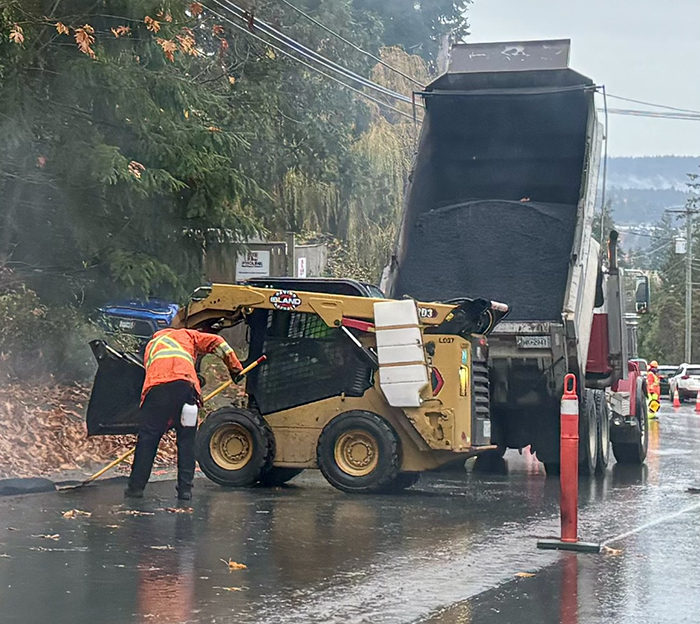
If weather allows it — and that’s a big “if,” contractors agreed — Salt Spring commuters this time next week will see smooth asphalt and fresh striping paint on the island, this time covering the full length of the year-long Fulford-Ganges Road project.

On Monday, Nov. 3, the last layer of asphalt will be laid at the road’s intersection with Seaview Avenue, according to Northridge Excavating Ltd. project manager Bob Mitchell, adding that if weather held, that final piece would be followed by fresh paint from Seaview to Cranberry Road.

“We’re up at the end of it now,” said Mitchell Friday, Oct. 31. “On Thursday [Nov. 6], weather permitting, we will have two line-painting crews who should be able to complete all pavement markings in one day.”

Those crews will likely snarl traffic Nov. 6, he added, but with the same meteorological caveats laid out before, that should mark the end of big disruptions for Salt Spring’s busiest road — although there will continue to be small traffic zones in different places in the coming weeks.

“When you get to the end of a big job, there are always little details,” said Mitchell. “After the paving’s down, the lines are painted and the signs are up, we’ll be here taking care of those finishing touches.”

See the Nov. 5 issue of the Driftwood and this website for a more detailed story about the project.

Clinic expansion drive launched

0

More than half a million dollars has already been raised toward a $3.5-million project that will dramatically improve the availability of primary care on Salt Spring — and a partnership between one of the island’s newest healthcare advocates and one of its oldest aims to expand on that initiative.

On Friday, Oct. 24, the Island Community Clinic Society (ICCS) and the Lady Minto Hospital Foundation (LMHF) announced a collaborative response to the critical shortage of family doctors and primary care health workers on Salt Spring: attracting and retaining practitioners by transforming the existing Salt Spring Island Health Centre into a non-profit team-based community health centre, backed by the land-owning Gulf Islands Seniors Residence Associations’s commitment to long-term tenure.

“Since arriving on Salt Spring, I’ve watched our physician-to-population ratio decline due to two major barriers: insufficient clinic space and an outdated model,” said Dr. Christopher Applewhaite, ICCS chair, “that forces doctors to juggle admin, HR and accounting to operate a clinic.”

Applewhaite said physicians are practising beyond their core training into areas like social work, and that by expanding the centre’s facilities and shifting to a professionally managed clinic, things will improve for doctors and patients.

“Our vision is to make Salt Spring a flagship for modern primary care in B.C.,” he said. 

Organizers said an expanded clinic would also relieve pressure on Lady Minto Hospital — by diverting non-emergency visits and increasing the pool of physicians available to staff the Emergency Department.

“Everyone deserves primary care,” said LMHF executive director Eric Jacobsen. “Prevention and early support aren’t luxuries — they are the foundation of a healthy community.”

Team-based community health centres — where physicians, nurse practitioners, nurses, social workers and mental health clinicians work together under one roof — are recognized by the B.C. Ministry of Health as the province’s preferred model, he said, for improving access, continuity and patient outcomes — and that structure also helps recruitment efforts, as new practitioners can join an established clinic rather than have to build an independent business from the ground up.

“Expanding primary care isn’t just about improving the health system, it’s about supporting our neighbours, friends and families in real and tangible ways,” said Jacobsen. “Our goal is simple: the right care, available when people need it most. This expansion is the single most powerful step we can take toward that commitment.”

Organizers said funding from both the Salt Spring Island Foundation and the LMHF has secured the funds to hire an executive director to lead the next phase of development in the coming year. ICCS said it had also invested in business planning and model-of-care design, drawing on successful examples from other communities — including Whistler 360 — and adapting them to Salt Spring Island’s unique needs.

A rezoning application for affordable housing at the Kings Lane property awaits third reading from Salt Spring’s Local Trust Committee, and if advanced would also lift current restrictions to expand the number of practitioners allowed.

Funding for 11 full-time-equivalent primary healthcare positions has been earmarked by the provincial government for Salt Spring Island through the primary care network of the South Island Division of Family Practice. 

The LMHF Primary Care Fund has raised $600,000 so far to advance the $3.5-million expansion, according to the foundation. For information on how to contribute, visit ladymintofoundation.com/projects/primarycare.

Trust mulls $12-million budget

0

When the third Saturday in October rolls around next year, voters may see a record-high number of new names on their Islands Trust ballots — and it’s likely that election will have come on the heels of a record-high Islands Trust budget.

While technically neither current trustees nor potential candidates need to make a final decision until 36 days before election day — set for Oct. 17, 2026 — the committee tasked with financial planning for the land use authority has to make its spending recommendations far sooner. Trustees on the Financial Planning Committee (FPC) met Wednesday, Oct. 22 to take their first long look at next year’s draft budget, finding a bottom line of nearly $12 million that reflects an 11.5 per cent tax hike on most islands — 33.8 per cent, if you own property on Bowen Island.

Those increases — Bowen Island municipal trustee Judith Gedye called her island’s draft number “heart-stopping” — are larger than a projected 6.7 per cent increase in planned spending, an incongruity financial and employee services director Julia Mobbs laid at the feet of reduced revenue from external sources, like grants and investment income, and internal funding, like surplus and reserve transfers. Those are projected to come in next year 43 per cent and 58 per cent lower, respectively.

“When we have [that reduction], it’s felt the same way as an increase in expenses,” said Mobbs. “That’s why we have some additional pressures for tax burden in the budget.”

Those numbers aren’t set in stone; staff offered a first-look set of potential reductions that could lower spending by almost three per cent. FPC members so far indicated they would be sending modest recommendations to Trust Council. 

“All the other committees get to have fun and create projects and build the organization,” chuckled Denman Island trustee David Graham. “And this committee has the duty of slashing everything — trying to reduce the amount of taxes being asked of the people that live on these beautiful islands.”

“We’ve got fixed costs, and we’ve got all of our wish lists,” said Gedye. “I don’t know if we can merrily go along with $12 million. It’s a very hard discussion that we have to have.”

The FPC forwarded a now-familiar recommendation to reduce the number of in-person Trust Council meetings — this time suggesting that the body hold just two of them face-to-face. There are four currently scheduled, plus a fifth meeting planned as part of the process of onboarding new trustees after the election. The proposed budget for all five is $135,000, with one already planned as a virtual meeting; each in-person meeting should be budgeted at $30,000, according to a staff report. 

The committee also voted to recommend Trust Council not advance several projects that aren’t supported by staff resources in the budget, including Galiano Island’s targeted OCP review and any such new minor projects — at least until staffing levels within the regional planning team were at least at 75 per cent.

It also narrowly voted to ask the Islands Trust Conservancy board whether it could put a portion of its private donations toward supporting any of that body’s 2026/27 budget requests — specifically noting a $1.15-million anonymous gift it received this summer.

And trustees are preparing for a higher-than-typical number of representatives on Islands Trust Council not seeking another term — possibly more than half, according to Lasqueti Island trustee Tim Peterson. 

Peterson was responding to a related budget line item: new laptop computers, both for incoming trustees and for others with machines that have been damaged or are reaching end-of-life. That business case calls for $32,400 to cover 15 new “commercial grade” laptops — $1,660 each to purchase and $500 apiece for Microsoft Office 2024 licences, according to a staff report. That total includes support and device tracking to help trustees manage what has become a significant electronic workload, and facilitate meetings held remotely. 

“My rough assessment, based on discussions with trustees, is that we’re probably going to have a very significant turnover of trustees come next election,” said Peterson. “To me, the question is, in fact, is 15 enough?”

There are 26 trustees serving terms across the Islands Trust area; more than 15 deciding not to seek another term would be well above recent years’ turnover numbers. Last term’s election saw 12 new trustees seated in 2022, along with 11 incumbents and three former trustees confirmed as either elected or acclaimed. In both 2018 and 2014, 13 election winners were new to the Islands Trust.  

Determining the scope or reasoning behind potential high turnover is difficult this far from the election, although publicly expressed moments of frustration among trustees this term have been seemingly more common than in years past, particularly — although not exclusively — among those first elected in 2022. But no trustees have officially announced intentions one way or another. Salt Spring trustee Jamie Harris did say during a particularly animated portion of that island’s June Local Trust Committee meeting he was “not running again,” but has not repeated the remark.

New for this election-year budget is a proposed $32,000 to support holding in-person first meetings of each of the four standing committees and to facilitate training early in the new term, covering topics like meeting procedures and standards of conduct.

“I can’t believe I’m saying this, because I’ve been trying to get our in-person meetings reduced this whole term,” said Graham, “but in this particular case, this [may be] the first year for a very large number of first-time trustees; they need as many opportunities as they can get.”

For the election itself, Mobbs said staff were also anticipating a 50 per cent increase in the cost of holding it, specifically in what’s paid through contracts to regional districts who administer elections in the Trust area. The current budget shows $237,000 in spending for the election, including $212,103 for those regional district contracts, $10,293 in pre-election communications — such as elections advertising and non-resident notice mailings — and $3,500 in professional photographs of new trustees for the Islands Trust’s website post-election. 

Fire chief says lithium-ion battery fires preventable

0

Salt Spring’s fire chief says an early-morning Fulford fire last month might have been prevented, and that islanders can improve their own safety through better practices storing and charging small lithium-ion batteries.

In a report to fire district trustees Monday, Oct. 20, Salt Spring Island Fire Rescue Chief Jamie Holmes said firefighters responding to the Sept. 9 blaze — and the homeowners — were fortunate, in that both a neighbour and a firefighter who lived nearby were able to get some water into the house through an exterior window, dousing most of the flames before they spread.

Working smoke alarms had already successfully warned the residents, he said, who were able to exit the building with their pets and call 911.

But after fire crews cleared the heavy smoke from the building, they discovered the fire began at a lithium battery and quickly spread to cardboard and paper stored nearby.

“An electric scooter bike was charging, through multiple chargers and a few octopuses and other extension cords,” said Holmes. “The lithium-ion battery itself had taken off, caught the scooter on fire, which then caught the recycling on fire and started to spread throughout the lower floor of the house.”

Holmes said the number of battery fires across B.C. and Canada has been growing, almost entirely due to improper charging, care or dispoal methods.

“We’re seeing huge spikes in these fires as the batteries become commonplace in our everyday lives,” said Holmes. 

He said it is critical to use the correct charger for each battery, to ensure the charging units are CSA approved and to avoid replacing any electrical components with “knockoff” parts. Equally important is disposal, he added, as the batteries become increasingly unstable with age.

“A lot of times you’ll have old cell phones sitting in a drawer, and they rattle around and bang on each other — and as the batteries deteriorate, they can combust,” he said. “Or your cordless power tools that end up sitting in the garage getting older and older; and a lot of times they just stay plugged in, even though they’re not really holding a charge anymore. It’s important to dispose of them in a safe manner.”

“Between disposing of them safely when they’re at end-of-life, and only using CSA-approved batteries and chargers,” said Holmes, “following just those two things you will probably get rid of the high 90-percentile of fires that we’re seeing.”

Editorial: Full measure

0

It turns out water meters, relatably, start picking up on less of what’s going by them as they get older.

The North Salt Spring Waterworks District (NSSWD) is embarking upon a project to replace more than 1,800 meters in its system over the next three years, in part to address a potentially significant under-reporting of water, thanks to ever-aging devices that are now often 20 years past their expiration date.

And in a system as large as the North Salt Spring Waterworks District — which delivers well above 100 million gallons to homes and businesses each year, from Southey Point to Cusheon Lake — what is reportedly a 10 to 15 per cent unaccounted-for portion of water through its pipes represents a potentially huge loss of capacity: as much as 15 million gallons, by our math, to say nothing of lost revenue for the district.

Being able to count these gallons flowing by doesn’t magically produce any more of them; it’s as important as ever to be thoughtful with water use on our island. Thankfully that job will get a little easier for NSSWD customers, as the district is making our data available to us so we can keep as close an eye as we care to on how much of a difference our various water-saving efforts might be making. 

The closest to “magic” we might see from the new meters is that leaks will almost certainly be spotted sooner. In 2022, one Salt Spring homeowner was stuck with a $29,000 water bill from a wintertime leak that lost more than 865,000 gallons of water over nearly two months — a worst-case scenario that wasn’t noticed until the meter was manually read.

We were happy to hear that the district is taking steps to ensure all that collected data — as hopefully uninteresting to nefarious parties as water usage numbers might be — is being held responsibly. 

Meanwhile, there’s no consumption data to protect for Fulford Water Service system customers — there are fewer than 100 of them — notably the “last holdouts,” as one trustee put it, to deliver residential water on Salt Spring without meters altogether. Fulford operates on a flat-rate billing structure. But that district’s five-year plan this year quietly laid out buying and installing residential water meters under “future projects for 2027-2030,” so those days may be numbered.

The first batch of meters will start going in before the New Year, and within the next three everyone who receives a NSSWD bill will be able to watch every drop. 

Viewpoint: Remove pyrocentric pines 

0

By RICK LAING

As the autumn weather descends upon us, I start to think about forest fires and what can be done over the winter to reduce the risk of wildfire in our 20-acre forest.

The Wilkie Way area was first logged in the late 1960s, about a dozen years before we purchased our land, and we marvel at how it has transformed itself into the thriving Coastal Douglas Fir ecosystem of today. 

Over the decades, I have learned a lot and helped a bit, removing hundreds of dead trees under 10 inches in diameter (larger dead fir and cedar become woodpecker wildlife trees) and using them for firewood, biochar or leaving them close to the forest floor to build soil and humus. Letting in the sunlight allows arbutus, broadleaved trees and undergrowth, mosses and wildflowers to flourish, but too much light overheats the forest floor and allows invasives and grasses to move in. 

However, the logging disruption 60 years ago was also favourable for the growth of lodgepole pine trees, the most widespread conifer in B.C., and we have dozens that now stand at 80 feet tall and waiting for fire. Unlike firs, pines are a pyrocentric tree. When they experience drought they close their stomata, retain their water and produce terpenoids, a natural flammable substance. Tree scientist, Harriet Rix in her brilliant 2025 book The Genius of Trees – How they Mastered the Elements and Shaped the World describes how trees have shaped fires for millions of years. A quote from ecologist Oliver Rackham, “Trees and other plants are not flammable by misfortune but by adaptation.”  

Many people hike the #2 trail on Mount Erskine Nature Reserve, but few would notice that the trees from about the midway point to the peak viewpoint are, I would estimate, 50 to 80 per cent lodgepole pine. That area would have been old-growth fir but was logged after the Second World War and probably burned, which would work to the advantage of the pines, and now with our hotter and dryer summers, has created a preferred habitat for pines instead of the native CDF forest, which was not pyrocentric, up there. 

Interestingly, eucalyptus, a pyrocentric tree on steroids, has become the dominant tree of Australia (80 per cent) largely due to Aboriginal peoples clearing the encroaching rainforest and native oaks with fire. Eucalyptus grows fast, burns hard, is poisonous and lowers the water table to kill neighbouring trees, but because of its economic value as fibre, it, along with pine, are the most commonly planted forestry trees worldwide. Controlled burns do work in some forests (the Redwoods) but are ineffective and downright dangerous in many others, particularly in a world with a warming climate.

In our forest, I cut all pine saplings and, with care, drop the mature ones for firewood and hope other people will consider doing the same.

Dance, concert and exhibit on tap

Submitted by ArtSpring

It’s a busy time of year at ArtSpring! We are hurtling into November with a packed schedule that includes a raucous Halloween Community Dance, a concert by an international and multi-genre string quartet and a deeply moving gallery exhibition that shines a spotlight on veterans with local ties. As the winter rains begin to pour, we invite our community to join us as we fill these longer nights with art, music and connection.

Halloween Dance 

Saturday, Nov. 1, 6 to 9 p.m.

Why wear your costume for only one night? On Nov. 1, ArtSpring is the place to go to keep the holiday spirit(s) alive. StageCoach Theatre School, Salt Spring Arts Council and ArtSpring’s Roundtable Committee are thrilled to be hosting a Halloween Community Dance guaranteed to keep the spooky times rolling.

The music kicks off with Shelder the Electric Clamfish warming up the crowd with eclectic art-folk tunes that emanate “deep-sea folk punk energy.” Then, eight-piece rock powerhouse Local Motion takes over to belt out blues and rock n’ roll essentials from legendary bands like Led Zeppelin, Janis Joplin, and Aretha Franklin — plus a few Halloweeny hits — and dance us into the night.

Come ready for a night of Halloween hijinks, including a costume contest, trick-or-treats for the kids and a creepy craft table led by the Salt Spring Arts Council’s Crafting Connections initiative. The GISS Renaissance Studies class will also be on hand, keeping partygoers fed at the concession counter. Entrance is by donation.

88 Strings: Crossover 

Tuesday, Nov. 4, 7:30 to 9:30 p.m.

In 88 Strings: Crossover, Canadian quartet 88 Strings creates an intercultural fusion of sound. Pulling together traditional Chinese, Persian and Western plucked instruments, the group takes audiences on musical adventures that transcend geography and genre, seamlessly pairing classical and world music to immerse audiences in what has been called “plucked string heaven.”

The quartet consists of Chinese-Canadian musician Joy Yeh on the harp, Chinese-Canadian musician Dailin Hsieh on the guzheng, Canadian musician John Oliver on guitar and Iranian-Canadian musician Ali Ramzi on the tar and setar. Formed as an initiative of the Vancouver Inter-cultural Orchestra, 88 Strings has an eclectic repertoire that includes new music by Canadian composers, unique arrangements of traditional songs from Asian and Persian heritage and special arrangements of classical music from around the world.

88 Strings: Crossover  is  part of the ArtSpring Presents series. 

What These Eyes Have Seen: Witness to War 

Wednesday, Nov. 5 through Wednesday, Nov. 12

ArtSpring’s Roundtable Committee partners with local filmmaker and photographer Alan Bibby to present With What These Eyes Have Seen – Witness to War, a powerful display that spotlights veterans with strong ties to Salt Spring. With this exhibition, Bibby offers a chance to reflect on the weight of witnessing conflict and the price veterans continue to pay even a lifetime after the last shot has been fired. 

This is a follow-up to last year’s exhibition, in which Bibby curated large colour portraits of veterans that he took over the course of 14 Remembrance Days on Salt Spring Island. This year’s collection features new portraits, rare archival family photographs and a compelling collection of historic artifacts and memorabilia contributed by local families and community members. 

The exhibition officially launches on Thursday, Nov. 6 at 6 p.m. with an evening of storytelling and connection. Veterans and their families are especially invited to share memories and reflections. 

Lastly, on Nov. 9 at 7 p.m., come to the gallery for a special evening of locally produced documentary short films and live music. This unique night of remembrance features performances from Valdy and guest artists to honour our veterans.

‘Bling’ volunteers work hard for upcoming sale

0

One of Salt Spring’s favourite annual fundraisers is just around the corner, which means as you read this story, all hands are on deck getting mountains of used books and jewellery ready for sale at the Farmers’ Institute. 

This year’s Books & Bling Salt Spring Literacy (SSL) event runs Friday through Sunday, Nov. 7 to 9, with a SSL members’ preview on the evening of Thursday, Nov. 6. Donations can be brought to the Farmers’ Institute on Friday, Saturday, Sunday, Oct. 31, Nov. 1 and 2, from 10 a.m. to 2 p.m. 

Last Thursday most members of the Bling team were deeply immersed in a pricing session, which saw numerous items laid out on the table and suggested prices bandied about, with as much information as possible about each piece shared in the process. If something didn’t sell at a certain level last year, lowering the price was discussed.

Nancy Gerrish heads the Bling committee and is also a SSL board member. She explained how the first thing committee members do when sorting through donations is to take out any gold, silver or special pieces valued at more than $40 for the “black velvet table.” Bags of earrings, rings, necklaces and bracelets are then created, and each item priced. 

“Because silver has gone up so much in price, the starting point is weight, and then you add on things like ‘how intricate is the design?’ And then, ‘are there any stones as part of that piece?’” she said. 

Prices for 925 (North American labelling), sterling and Mexican silver are looked up and used accordingly. 

“So that just gives you a sense that we do a lot of comparatives,” said Gerrish.

“It’s a long process, but we have really good results,” said Ann Matheson, who is in her second year on the committee. “We’ve had a lot of good donations this year.”

Wendy Vine has volunteered with the Bling part of the fundraiser since its inception 10 years ago. The event was initiated by former SSL board member Pat Campbell, who had witnessed the popularity of a used jewellery sale at a U.S. literacy event she attended. The book sale had already been running for several years at that point.

Gerrish said Vine spends many hours cleaning the jewellery — including tarnished silver pieces — and looking up comparable items on sites such as Etsy and eBay to get a sense of their value. 

“Haunting” jewellery stores and galleries to get pricing information is also done for research purposes, she said, and as much information as possible is provided for special pieces.

Jenny Meyer is a volunteer who repairs damaged items, or takes them apart for beading supplies if a repair cannot be done. Gerrish notes that the sale has a huge number of beads this year, in part due to a former jewellery maker’s donations.

Meyer is also somewhat of a children’s jewellery expert, developed over her time as a volunteer, and an entire table is now devoted to bling for younger shoppers. 

“Jenny said it started out as a bowl with things priced at 25 cents,” said Gerrish, adding that the range is now from a quarter to $4. “It’s a fun table, and the kids and parents make a beeline for it.” 

“Most of the women have been involved in the jewellery sale for many years,” said Cheryl Roehlig, who has been the Books & Bling coordinator for four events now. “So year after year, you gain a little bit more knowledge of what is sellable, especially with the designer pieces. There’s a dedication here that doesn’t just last for one event, it’s over a series of years, which goes for the books as well.”

Roehlig said SSL is extremely grateful to the many volunteers who participate in Books & Bling, as well as the sponsors. More volunteers are always welcomed. See saltspringliteracy.org/books-and-bling for sign-up info. People wanting to donate books to the sale should first read the list of criteria in the same spot. 

SSL Society memberships may be purchased at the door of the Nov. 6 preview event. 

Meter replacement project begins

0

Salt Spring Island’s water-wise residents will soon be able to view the fruits of their low-flow lifestyles on their phones and computers.

Thanks to securing a better-than-predicted deal from suppliers — and through shifting some fund allocations to take advantage of it — the largest water meter replacement project in Salt Spring’s history will now take three years, rather than four, according to North Salt Spring Waterworks District (NSSWD) staff, and is starting almost right away. The first 300 of what will eventually be more than 1,800 new meters will begin going in this year, as the NSSWD board voted Thursday, Oct. 23 to approve spending roughly $200,000 to make it happen. 

The eventual system-wide upgrade is about more than just satisfying water-use enthusiasts, according to director of operations Ryan Moray. Until now, staff have only replaced meters as they completely failed, or at a customer’s request, but there are problems with older meters remaining in service longer than the industry-recommended 20-year replacement interval, he said. As they age, most meters tend to start under-registering how much water flows through them — by as much as 15 per cent in some cases, according to a staff report, which adds up. 

“The new meters have the ability for the customer to be able to create a portal,” said Moray, “whereby they can log in and see their consumption, or be alerted to a continual flow — like a leak.” 

Once the new devices and the software to manage them are in place, NSSWD customers will be able to continually monitor that consumption on phones, tablets and computers. Those sorts of web-based charts, graphs and other tools should encourage more thoughtful water use, Moray said, and the data will help the district better understand where water is going.

“They’ll provide increased read frequencies,” said Moray. “We’ll have readings bounce in several times a day, versus every two months going out and reading them.”

Every year, that in-person meter-reading had been adding up to over 1,000 hours of labour all on its own, according to financial officer Tammy Lannan — the equivalent of about half a full-time employee.

“Roughly it costs us about $45,000 every year just to manually read meters and enter them in,” said Lannan. “So there’s a huge cost savings and time savings when moving [to automated meter reading].”

The most “senior” meters and those connected to the highest-use customers, such as bulk meters at stratas, will be first in line for replacement, according to staff.

“We know we have a few customers that are keen to get on the list right away,” said chief administrative officer Mark Boysen. “They have old meters, and we talk to them a lot — because they have challenges on their system.”

Boysen added staff would be working to ensure the consumption data collected would stay with the district — held on Canadian servers.

“I think we have some keen water-savers who will actually be excited to check out their water consumption, seeing how they’re doing in the summertime,” said Boysen. 

‘Really big’ fireworks show planned

0

Back in 1968, an after-dusk chorus of sirens from Ganges’ fire hall was the signal for islanders that Salt Spring’s first firefighter-run Halloween fireworks display was about to start.

It was an admittedly last-minute affair, according to contemporary reports in the Driftwood, making that year’s large turnout of “youngsters” all the more remarkable. By the next year, local fire crews decided to serve up hot dogs after the show ended, keeping the festive spirit alive a little later. 

The rest, as they say, is history; and now, after 57 years, the traditional event will be held at the original Fire Hall No.1 for what is likely the final time as firefighters plan to move into their new hall by next year. It’s a moment coloured with more than a little nostalgia, particularly for the Salt Spring Island Fire Fighters’ Association (SSIFFA), who in partnership with the fire protection district have brought islanders this well-loved community event with care — and in tremendous safety — for decades.

It’s also a great excuse to make it the biggest show yet, according to SSIFFA president David Demner. 

“I guess this year feels a little bit different,” said Demner, “so we’re looking at having a bit of a sendoff. We have around 200 fireworks we’re shooting off, and some of those cakes have like 100 shots inside them. It should be really big.”

It may seem a simple enough task to set off fireworks from the Harbour Authority’s Breakwater Dock, but it’s a well-organized and highly certified group of professionals running the show. Active-duty firefighters get training through the federal government’s Explosives Regulatory Division, first becoming certified as fireworks display assistants and then as supervisors.

“Then we’re coordinating with the Harbour Authority and the Coast Guard,” said Demner. “RCMSAR patrolling, making sure there’s no seaplanes at the dock. The nice thing is that we’ve been doing it for a while — at least 30 years — so we have everything well documented.”

The association starts planning early, with a subcommittee specifically meeting to plan for Halloween — from getting permits and insurance to budgeting fireworks purchases funded by firefighters’ contributions and a receipt box at Country Grocer.

“Fireworks people don’t exactly deliver to Salt Spring,” chuckled Demner. “Fortunately, one of our members has a boat.”

Long-time attendees might remember displays being staged from the entrance to Centennial Park — and, for that matter, firefighters helping manage bonfires where the Thrifty’s parking lot now sits. But attitudes on safety have evolved a bit, Demner said, as have regulations.

“We need a certain setback where there’s nothing flammable,” said Demner. “The dock is really the only place on Salt Spring where we can do it.”

Demner said both the association and the fire district want to send the message that fireworks are best left to professionals — and they believe the better the show is, the fewer people will be reckless with explosives on what is statistically a very dangerous night for injuries. Encouraging both fire safety and personal safety is a big goal for both organizations — and seeing how much the community enjoys the show is a bonus.

“We love being a part of everyone having fun in all their Halloween costumes,” said Demner. “You know, because I’m so focused on the fireworks, I get to enjoy it mostly after, when we’re giving out the hot dogs and hot chocolates.”

Demner said the best way islanders could help out is to just come and join the event — the more the merrier.

“Show up and be happy,” he said. “Bring your kids in their costumes. It really makes it all worthwhile.”

The 2025 Halloween fireworks display is scheduled to begin at 7:30 p.m.