Home Blog Page 342

Lady Minto Hospital Medical Staff Association COVID-19 Update

First, a big thank you to the community for trying so hard over the long weekend to follow the rules, even though the rules can definitely put a damper on having fun.

Unfortunately, nothing changes: we need to stay the course with washing hands, social distancing and wearing masks when we can not maintain a six-foot distance. This is the way we all need to function for the foreseeable future.

Messages about school reopening in just a few short weeks are causing both anxiety and relief. There is still much to sort out to make school a safe environment for students and staff, and we will need to be patient as our education and health leaders work together to sort this out.

Family physician offices and our Lady Minto emergency department are currently very busy, in part due to the accommodations in place for COVID. Please be advised that patients with non-urgent issues might have to wait to be seen.

Islanders share love of iNaturalist site

0

It’s well known that the Gulf Islands are an ultra-rich area for biodiversity, but for most people it’s daunting to identify the plants or creatures they see while out walking in their neighbourhood or on a trail.

That’s when it would be great to have a Shazam music identification app equivalent for flora and fauna. While the iNaturalist app requires more effort than pointing a smartphone at a mystery specimen of lizard or purple flower, it is the next best thing.

The iNaturalist website and mobile app lets people post photos of native plants and animals — from mosses to grasses and moths to squirrels — either to simply share them with others or to get help with their identification. The site also creates a database of what species are found where and hosts special projects launched by its users.

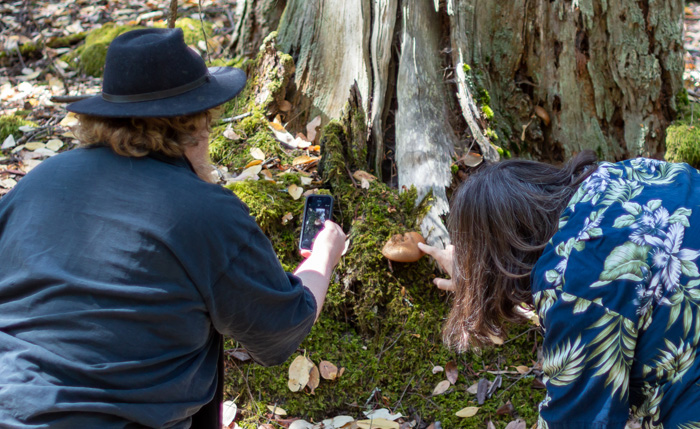
Juli Mallett and Corvi Zeman are two active Salt Spring iNaturalist fans who were initially drawn to the site because of their interest in fungi.

“Around the start of last year my partner and I started using it because we’ve been into sort of amateur mycology for a number of years,” said Mallett. “When we moved here we started really making an effort to keep track of what we’d seen and where we’d seen it and that sort of thing and there were in particular some things we were finding on our property and around our home that were kind of interesting and unusual.”

They stumbled across iNaturalist and found it an easy way to keep track of all kinds of plants and to get help in identifying some of them. Both Mallett and Zeman have done work in ecology but are “citizen scientists”; not biologists or scientists like many iNaturalist users.

Zeman initiated a Fungi of Salt Spring Island group on the site, which automatically collects all of the mushroom and other fungi posts from the island. It now has hundreds of observations attached to it, and Zeman also writes a “fungus of the month” column there.

“It’s really kind of a neat thing,” Mallett said.

“We live in one of the most diverse regions for fungi in the world,” she added. “If you look at people who are doing serious mycology field work there is sort of a cluster of areas where they go — Central American cloud forest, south-east Asia and the Pacific Northwest.”

The couple previously lived for a long time in Olympia, Wash., which has a substantial mycology community.

Mallett said a maxim that gets thrown around in ecology is that “Wherever you look the most is where you find the most,” so that thorough exploration of one’s nearby surroundings is likely to provide exciting natural discoveries.

“Every time I go for a half-hour walk there is something new to see,” she said.

Plants have been tagged on Salt Spring by 364 different people on iNaturalist, but probably only six people regularly use it. Mallett would love to see more participation by islanders. 

Right now some orchids of the platanthera genus, which are pollinated by moths at night, are in bloom. That has seen Mallett and Zeman outside at midnight on their hands and knees taking in the flower’s distinct smell of cloves.

Diana Thompson is a biologist who has used iNaturalist to create a project called Salt Spring Island Biodiversity, which captures all observations made on the island. As of Monday it included 5,099 observations of 1,194 species. She invites others to join iNaturalist and contribute as there are still hundreds of species not captured.

Thompson hopes her site will join up with a much larger Biodiversity of the Salish Sea project in the future. She was asked to initiate the Salt Spring version by Andrew Simon, who she says “has done an amazing job with Biodiversity Galiano Island.”

She also participated in International Moth Week from July 18-24 through iNaturalist.

Thompson agrees that “iNaturalist at its best is a great tool for everyone to use, and there are so many things that citizen scientists find that we would never know about without this site.”

She cautions that if people find something rare they should make the location “obscured” when they post it.

See iNaturalist.org for more details.

Maxwell water plant design decision deferred

0

North Salt Spring Waterworks District trustees once again tabled a decision on commissioning a preliminary design for the Maxwell Lake water treatment plant when they met on July 30 at Community Gospel Chapel.

A staff report and request for decision on the subject was originally presented at the May 28 trustees’ meeting, with a Kerr Wood Leidal (KWL) feasibility study the basis of a recommendation to proceed with the design of a dissolved air flotation plant. That same technology was used for the successful St. Mary Lake plant project completed last year.

At last month’s meeting the board heard a presentation from Irfan Gehlen, who is the principal and water supply and treatment sector leader for KWL. Gehlen detailed the Maxwell Lake feasibility study process and the costs of three different technologies explored. The DAF plant was determined to have the lowest capital and 25-year lifecycle costs.

“Mr. Gehlen advised that if the board wants to consider treatment options other than the three examined in the feasibility study, the scope of the feasibility study should be expanded to examine those additional options,” said acting district manager Meghan McKee in a report presented at Thursday’s meeting. 

To give trustees more leeway, McKee had added “expanding the scope of a feasibility study to include other treatment options” to her report as an alternative action for trustees to consider.

Back in May, NSSWD trustee Sandra Ungerson had pressed for “alternate technologies” to be considered, while not able to provide specifics when asked for them by NSSWD staff. Other trustees agreed that the DAF option should not necessarily be accepted without the door being left open for even more possibilities to be considered.

At last Thursday’s meeting, NSSWD chair Michael McAllister again expressed a desire for some flexibility in the process.

“If someone has an innovative approach, we would be remiss in not looking at it,” he said. “I don’t think we need to go back to the feasibility study to include other treatment options. That’s my view. We have the [KWL] report. They are recommending DAF, and I think that will almost certainly be what we get. But to put a line in an RFP that says ‘Creative alternatives will be considered’ is not a bad thing.”

McAllister had made the same suggestion at the May 28 meeting.

Trustee Gary Gagne said he didn’t think the district had to panic about making a decision and especially if costs could be shared with other levels of government following the results of the Salt Spring Island Water Optimization Study currently being undertaken by the Capital Regional District as the lead agency.  A contract for the study was awarded last year to Innova Strategy Group. Results of that study could lead to the NSSWD becoming part of the CRD and thus eligible for federal-provincial infrastructure grants to help fund a new treatment plant or other projects.

“All of these processes require time and money and my feeling is once we’ve settled the governance issue then we know where we stand,” said Gagne. 

Ron Stepaniuk, acting operations manager and past district manager, suggested otherwise.

“I think we have to be cautious about dragging our feet in the hopes of something that may not happen,” said Stepaniuk. “We still have an obligation to provide that water. If there’s a question or uncomfortableness or uncertainty about the breadth of the feasibility study I strongly recommend that you identify or ask for a scope of work to identify some other processes to be included in that feasibility study.”

For more on this story and other NSSWD news, see the Aug. 5, 2020 issue of the Gulf Islands Driftwood newspaper, or subscribe online.

Allegories rise from butterfly mosaic at school

By ROBIN JENKINSON

Driftwood Contributor

Artist Luba Polouvytnova is always looking for ways to beautify our community.

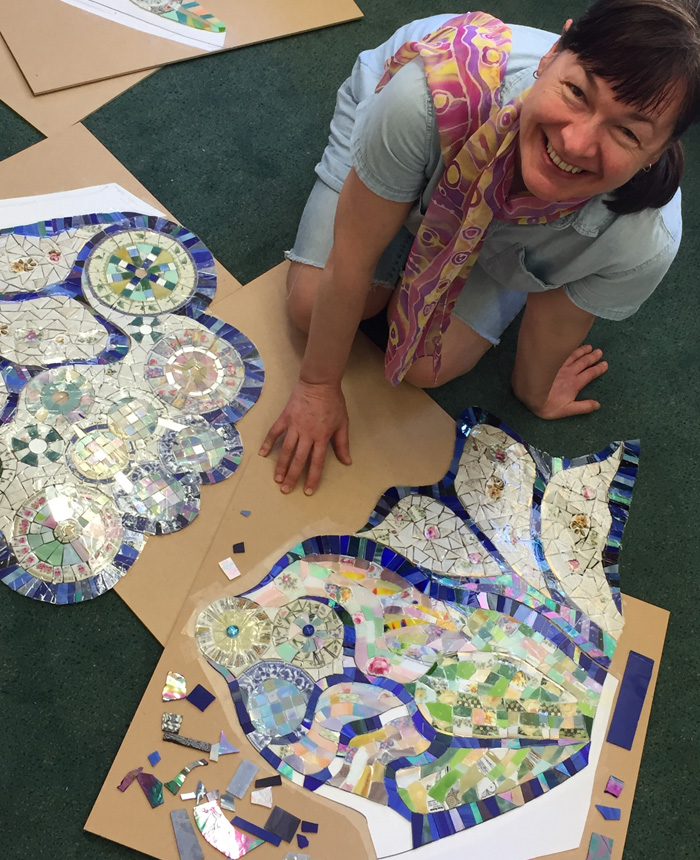
Now, she is coordinating a collaborative mosaic installation among 20 families to up-cycle old crockery, used mirrors and stained glass scraps into a glittering set of giant butterfly wings. This butterfly will wrap around a projecting corner on the Salt Spring Elementary playground, complementing four smaller butterfly mosaic circles created for Earth Day 2018 by school families under her guidance.

This community art project was designed to help people feel connected in these difficult times through shared creativity, and the butterfly design plays with many analogies. For example, on the invitation to participate, Polouvytnova wrote: “During this time of isolation, we can focus our individual energies on a common vision of creating something beautiful for years to come, like caterpillars in our cozy cocoons waiting for the time to emerge together as butterflies.”

This past May, she offered several outdoor, socially distanced introductory lessons about how to make mosaic shapes, then each family who attended was given a small collection of selected plates and glass, along with nippers to cut them. The wing designs incorporate circles with a range of diameters, from three through seven inches, which were assigned to individuals depending on their ages and skill levels, from kindergarteners to adults who’d already taken Polouvytnova’s mosaic courses. Once people completed and delivered their circles to her studio, they could pick out more complicated shapes with corresponding collections of china-ware and coloured glass. Dazzling wings are slowly emerging, and the plan is to install the butterfly at the school in late August.

Why butterflies now? Given Polouvytnova’s heritage, could it be related to an old-fashioned Russian word for butterfly, dushechka, which refers to “little souls” storied to belong to predecessors living on as butterflies? It is nice to imagine grandparent spirits watching over the children in the form of collective art created from their old china sets. Or, could it relate to a hopeful metamorphosis underway in response to COVID-19 and climate change, led by “imaginal cell” people who dream of living lighter, in greater harmony with Earth’s systems? For, as Richard Bach wrote: “What the caterpillar calls the end of the world, the master calls a butterfly.”

For more information about Polouvytnova workshops, see www.makemoreartstudio.com.

Viewpoint: We’re our brother’s keepers

By TOBY FOUKS

I am writing in response to K. Otto’s “Contrary mask advice” in the July 29 edition of the Driftwood. Anything about face masks catches my eye since from probably early in April I have sewn approximately 300 of them.

Someone very close to me was an early victim of COVID-19, so perhaps I have been more aware than most of its power to kill. At first the experts at the World Health Organization and elsewhere said masks would be of no use and not to bother. I thought about that, believed it for a short while, and then I noted that those cultures that were used to people wearing face masks appeared to be doing much better than we were at controlling the pandemic. I concluded that there was really no downside to wearing a face mask, and possibly a substantial upside. At that time I started making face masks, first to donate to Community Services and then to sell them in order to raise money for our food bank and latterly the coupon program for the Tuesday Farmers’ Market.

K. Otto — and I am borrowing words and phrases from Otto’s letter — is absolutely correct that a mask that is used and re-used, put down on contaminated surfaces and used again, not washed, or not washed properly … can act as a petri dish for pathogens. I am completely convinced by these words. This is an extreme case, of course, perhaps so extreme as not to be worth consideration. As well, if there is so much concern about cloth face masks, then disposable ones are readily available and in some situations are provided free of charge.

Otto continues to say that if the mask is worn for an extended period of time and/or during physical exertion the wearer can frequently experience dizziness, headaches, fatigue, and occasional fainting. Again, completely convincing. Breathability is very important and that is why children under the age of two should not wear them. I can imagine no reason for wearing one when jogging or chopping wood or playing tennis or taking part in other strenuous activities at a distance from others. Why would one impede breathing even a little in those situations?

What I don’t understand is what any of this has to do with someone who has no type of debilitating respiratory problem putting on a cloth mask before entering Country Grocer or Thrifty Foods or another of our open businesses and leaving it on for the short period in which he or she is shopping in order to protect others. As a matter of fact, people with compromised respiratory systems are unlikely to be shopping in public anyway.

The cashiers at Thrifty Foods and Country Grocer have the protection of plexiglass barriers so we can see their smiles. It is true they can’t see ours if we are wearing a face mask, but we can compensate with a few cheerful words.

If K. Otto thinks it’s a great offence against individual rights to insist that people don a face mask in indoor spaces then I’d like to say that people who are unprepared to make a small effort on behalf of the health of others bring to mind the question “Am I my brother’s keeper?”

The answer is yes, we have to be each other’s keepers, brothers and sisters, if we care about the community in which we live.

Editorial: School plan needs more details

0

Education Minister Rob Fleming’s announcement last week that schools would be fully open in September took some people by surprise.

Teacher reps, for example, had been part of a steering committee and working groups about what education would look like this fall, but were not expecting the July 29 pronouncement.

It makes sense to provide as much notice as possible of schooling plans, of course, and the first day of a new school year — Sept. 8 — is not that far away. Still, what a school day will look like during what is called Stage Two of the Five Stages Framework raises as many questions as it answers.

B.C. took a dry run at opening schools in June, with attendance not being mandatory and in-class teaching offered only a few days per week. Approximately 30 per cent of the province’s students used that option. (It should be noted that in-school teaching had also been given to children of essential service workers earlier in the pandemic, something that was not widely publicized.)

In deciding to reopen schools full-time, the province wisely took lessons from the June experience, various studies and from countries that have resumed at-school learning in recent months. The consensus seems to be that the benefits of in-person schooling to youth, families and society outweigh the risks. As the education ministry states and other entities confirm, key to the issue is “the fact that children are at a much lower risk of developing and transmitting COVID-19.”

By instituting public health measures that most people are now comfortable with, and other policies that should not be hard to accept — and barring a dramatic change in B.C.’s transmission rates — the decision to reopen schools is certainly the correct one.

Still, families, teachers, administrators and support staff are understandably worried about how schooling during COVID will unfold on the ground. The education ministry and local school district must be open to considering all suggestions from their partners in order to provide the best and safest return to school this fall.

Hiroshima Day event on Thursday

The annual Hiroshima Day Gathering at the Peace Park/Heiwa Garden will take place on Thursday, Aug. 6 from 5 p.m.

This year is the 75th anniversary of the nuclear bombing of Hiroshima and Nagasaki. The largest bell of the Peace Tower in Ottawa will be rung 75 times to commemorate the bombings on Aug. 6 and 9 in 1945. People are encouraged to bring a bell or gong to ring at the Salt Spring event.

Organized by Jan Slakov, this year’s gathering will feature singer-songwriter Sue Newman and folk-world-jazz vocalist Susan Cogan. A moment of silence, songs, memories and stories for peace will be shared among the participants.  

Interested people are welcome to come at 4 p.m. to help with garden upkeep.

WINTER, Frances Jane Fleetwood (Hardie)

Frances Jane Fleetwood
Winter (Hardie)
1939 – 2020

Jane Winter (Hardie) passed away peacefully on August 8, 2020 at Lady Minto Hospital on Salt Spring Island, BC from her struggle with Alzheimer’s Disease, at the age of 81.

She will be remembered by her husband of 59 years, Jeremy, her son Ian (Debra), her daughter Erica, grandchildren Mitchell and Griffin, sister Sheila (Ernie) Hoen, and her many close friends. She was predeceased on Saltspring Island by her parents Leslie (’84) and Molly (’99) Hardie.

Jane was born in Victoria, BC and spent early childhood summers at Rainbow Beach on Salt Spring Island, where she first met Jeremy. Jane earned a Bachelor of Education from the University of British Columbia. She and Jeremy were married in Victoria in May 1961 and raised their family in Winnipeg, where she continued to pursue her career in education, eventually becoming chairman of her local school board. In 1995, after a few years’ stopover in Edmonton, Jane and Jeremy moved permanently to Saltspring Island. Janie immersed herself quickly in the community, joining the Saltspring Singers, playing bridge, taking long walks, attending book club, and most of all, enjoying time with her wonderful friends. She was a keen gardener and cook and loved her daily ocean swims from the rock beneath her home on Duck Bay.

She will be missed by many. A service will be held during more relaxed times when family can be present. In lieu of flowers, donations may be made to The Alzheimer Society of BC or Lady Minto Hospital.

WICHMANN, Nina

Nina Wichmann
September 16, 1921 – August 1, 2020

Nina died peacefully under the gentle care of Greenwoods care aids and nurses.

She emigrated to Canada from Estonia, where she met and married her husband. They arrived to live in Fulford Harbour in 1968, where she remained living independently until she was 95 years old.

Nina was a member of the local Historical Society and Salt Spring Island Hiking Group. She was a loved member of her community. Every Christmas, she would gather all Orchard Road neighbours for a get together, preparing food and colourful abundant cookies a month or two ahead of time.

Nina loved dogs, gardening, reading and swimming at Stowell Lake. She was well known in the community for all the walking she did.

Nina is survived by 2 daughters and a grandson, the apple of her eye.

HINGSTON, Gale

Gale Hingston
April 5, 1950 – August 4, 2020

Nana of Ciara, Owen, Brenna, Isla and Emma; Mother of Lianna, Adrian and Melissa; Wife of Charles; Friend and role-model to us all.
Gale was a sweet, genuine, kind and caring person. She opened her arms and her heart to everyone she met, loving easily and openly. Her courage, strength and bravery were clearly evident and she had such beauty and grace. She was full of love and provided unconditional acceptance and support. She was quiet, patient, dedicated, conscientious and consistent. She was our rock.
Gale had a zest for life. She was playful and creative in so many ways. People around her took delight in every moment she shared. Her interests were diverse and she approached learning with focus. She was a graceful dancer and a talented artist. She was a free-spirited adventurer and a ‘mountain goat’ hiker, absorbing herself in the nature and experiences that surrounded her. Her work on our family home and garden made it so warm and welcoming. She created our ‘Island Home’.

She left us too soon. Her beautiful soul and young spirit will live on. Her joyful laugh, her radiant smile, and her bright blue eyes will always be remembered.

She leaves a legacy of love, compassion and community. Thank you for your support, thoughts, prayers and care. Love, Charles, Lianna, Adrian, and Melissa Hingston.