Home Blog Page 365

Siblings mark 10-year transplant anniversary

0

April is organ transplant awareness month in British Columbia, a time of year when BC Transplant redoubles its efforts to convey how a simple decision on one person’s part can have life-saving impact on others.

While the focus is usually on increasing the number of people who register as organ donors in the event of death, gifts from living donors are also possible in some cases. This coming April will be a time of heightened awareness and gratitude for the Levy family, who will be celebrating the 10-year anniversary of a living donor kidney transplant between siblings Barb and Michael on March 29.

The anniversary coming in the midst of the COVID-19 crisis offers some interesting parallels for the Levys. In 2010 Michael was being forced to dramatically change his way of life, slow down and stay away from people.

“It’s very reminiscent of 10 years ago. I was in the hospital in Vancouver and Barb was recovering at home with Mom. People were bringing pre-made meals and coming to do the recycling and the garbage. It’s really interesting because it’s spring. It’s the same time of year. It’s actually nice to shut down a bit in terms of interactions, but go outside and enjoy the natural environment.”

“We’re just extremely fortunate to be here on the island where nature is so accessible. It just helps everybody to calm their nerves,” Barb added.

While everyone in the community is learning how to adapt to a radical shift in reality, this is something Michael has undergone several times. The first perhaps came when his health started to collapse as a complication of Alport syndrome, a genetic condition which can attack kidney function among other things. An avid hiker, rock climber and kayaker, Michael had to first give up his former activities and then rely on dialysis to clean the toxins from his blood. The invasive, time-consuming procedure allows the body to function but does not offer much in terms of wellbeing or quality of life.

Barb’s decision to offer her younger brother one of her kidneys and the good news that they were a suitable match offered a vastly different experience for Michael, who will be 52 this June. After his initial recovery from the surgery he was feeling so good, in fact, that he went out and bought a guide to the West Coast Trail and made plans to do the hike the following year. He soon realized that was unrealistic and that his expectations were too high.

“It’s just such a difference from pre-transplant to post. You feel invincible and then it wears off. It took a few years to reconcile to that because I did have a gradual run-down of energy. It just meant finding a new balance, finding limits and not resenting anything,” Michael said. “It’s been 10 years of major adjustment, but for the most part freedom. No more dialysis, no more special diets, no more health running down every day and getting worse. It’s so much better than pre-transplant.”

Barbara’s recovery time was much less intense but the experience also led to a transformation. Michael sold his business  — The Fritz Movie Theatre — after the surgery and returned to photography, including a new exploration of digital techniques. As he moved through that world and began upgrading his equipment, Barb became the beneficiary.

“It’s been fantastic,” she said. “By getting the practice in and using the professional gear and software, I’ve been really able to progress as a multimedia artist.”

Her mixture of images and poetry has led to a regular page called Rhen’s Poetry in Aqua magazine, and a book which she’s had printed as a proof. The next step is to find a publisher or a patron.

The transplant is a treatment and not a cure for the underlying syndrome, which means Michael still faces chronic fatigue and other issues. He’s also on a lifelong medication regime, which often results in side effects. With the necessary change in lifestyle he has stepped back from his commercial photography work and previous focus on publishing books and is now enjoying a more leisurely exploration of fine art possibilities. Having a functioning kidney has also allowed the siblings to stay on Salt Spring and care for their aging mother together more effectively; without it they would all have had to move to a centre with more supports.

“I feel really grateful we have this treatment available, and I had such an incredible transplant team,” Michael said.

In addition to continuing care from his nephrologist, he also goes to Lady Minto Hospital once a month for blood work and has found a strong connection there as well.

“It’s like having an extended family,” he said.

For anyone who might be thinking about donating a kidney to someone in need or wondering if they should register to donate organs and tissue after death, the Levys are full of encouragement.

“It’s a wonderful thing to do as a human being, without too much stress. It’s so life-affirming,” Barb said.

“It will change someone’s life profoundly. It will be a rebirth,” Michael explained. “There’s no doubt without Barb’s gift my life would have been infinitely worse. If someone’s ever considering giving an organ, tell them ‘150 per cent yes.’”

Federal government mandates 14-day isolation period with Quarantine Act powers

0

The federal government has gotten serious about ensuring people self-isolate after returning from destinations outside of Canada.

On Wednesday, Health Minister Patty Hajdu announced an emergency order under the Quarantine Act that requires any person entering Canada by air, sea or land to self-isolate for 14 days, whether or not they have symptoms of COVID-19.

“The number of cases of COVID-19 is increasing daily -– both at home and globally. Earlier this month, we asked travellers entering Canada to self-isolate for 14 days to prevent the spread of COVID-19 in Canada,” said Hajdu. “To protect the health and safety of returning Canadians and those who are around them, we are strengthening our measures at the border. Travellers returning to Canada will be subject to a mandatory 14-day self-isolation under the Quarantine Act.”

The penalties for violating the order are immense: Maximum penalties include a fine of up to $750,000 and/or imprisonment for six months. Further, a person who causes a risk of imminent death or serious bodily harm to another person while wilfully or recklessly contravening the Quarantine Act or its regulations could be liable for a fine of up to a million dollars or to imprisonment of up to three years, or to both. Spot checks will be conducted by federal government officials to verify compliance. 

As well, people displaying symptoms of COVID-19 after arriving in Canada may not use public transportation to travel to their place of isolation. They also may not isolate in a place where they will be in contact with vulnerable people, such as seniors and individuals with underlying health conditions.

In B.C., 48 new confirmed COVID-19 cases were announced on Wednesday, for a total of 659 cases. Of that number, 183 people are fully recovered, 64 people are in hospital (and 26 of those in intensive care). Fifty-five health-care workers have contracted the virus. Fourteen people have died. Several long-term-care residences for seniors have confirmed COVID-19 cases. All of them are on the Lower Mainland.

Provincial health officer Dr. Bonnie Henry said the health ministry will be providing an estimate of the actual number of COVID-19 cases in the province — not just those that have been confirmed by testing — during the Friday morning press briefing at 10 a.m.

March 25 Lady Minto Hospital Medical Staff Association COVID-19 Update

March 25 message from the Lady Minto Hospital Medical Staff Association:

Over the last week or so, we have focused on what individuals can do to prevent transmission of COVID, how to access care, etc. Today we would like to recognize the stress and anxiety that this virus has caused in the community. Many of us have friends, family members, and neighbours who have lost their jobs. Our Island is highly reliant on tourism for income. Small business owners and their employees are worried about how to feed their families, pay rent or mortgages, and other basics. 

If you’re feeling anxious about the virus — about finances, the economy, or how to cope while staying at home — please take a look at some of the resources provided below. The federal and provincial governments are working to create a financial safety net for those who need it most during the pandemic.

Please remember that compassion is one of our community’s greatest strengths. Help one another from afar, be kind, and we will get through this.

RESOURCES:

If you are experiencing any respiratory symptoms, please call 811 or use the self-assessment tool, available online or as an mobile app, here: https://bc.thrive.health/

If you are anxious or depressed and need to talk to someone, please call the BC Crisis Centre at 1-800-784-2433 or 310-6789 (no area code needed). You can also chat online with a support person by linking here: https://crisiscentre.bc.ca/

Federal resources, including applications for EI, small business subsidies, and the new emergency response benefit, can be found by linking from this page: https://www.canada.ca/en/department-finance/economic-response-plan.html

The Province has a comprehensive set of resources and information, which can all be linked to from their dedicated COVID-19 site: https://www2.gov.bc.ca/gov/content/safety/emergency-preparedness-response-recovery/covid-19-provincial-support

 School District 64 answers FAQs on COVID-19’s impact on our education system here: https://sd64.bc.ca/frequently-asked-questions-during-covid-19/

 There are many good resources for keeping ourselves busy and entertained while we keep our distance from others. Here is one to start with, particularly good if you have children in the house: https://www.elsa-support.co.uk/coronavirus-14-day-self-isolation-activities/?fbclid=IwAR1O6Ow9GnH7BDsxTGKk5_ozX3PyV6DbzRU2anGWkcYdY9GcQPrrDSWJohg

Finally, we ask again that you please continue to self-isolate and practice strict social distancing. It is the only known way to curb the spread of COVID-19. If every individual takes these measures, we will hopefully return to a state of normalcy sooner than if we don’t.


Michael Ableman: Thinking Like an Island

By MICHAEL ABLEMAN

Every spring for the last 43 years I have followed the same routine.

I turn under green manure crops, spread compost, prepare fields, and direct seed and transplant. The seeds and small plants that go into the ground are the product of months and sometimes years of propagation work. The compost is made throughout the prior season, and the complex crop rotation and field plans are the result of a winter of careful thinking and consideration. The soils are built and improved over decades.  Before the first seed gets planted, many months and thousands of dollars have already been invested into a professional endeavour that requires decades to develop and perfect.

This spring is different. I am going through all the same motions as I always have, but this time for the first time, I have no idea how the results of my labour, the food that will surely ripen, will make it into the homes and the bellies of all those on the island and beyond that we have supplied for the last 20 years. I am not alone; every farmer everywhere is struggling with the same concerns.

The Saturday market is now temporarily closed, the Tuesday market is still in question, and the restaurants on the island and in Victoria and Vancouver that we sell to are shuttered. I support every and any effort to stem the spread of this disease, but as the weeks progress there will be food to harvest and people who need it. Would it not be safer, with strict protocols in place, to purchase food directly from local farms in an outdoor space, than food from inside a store that has travelled long distances and been handled by many anonymous hands?

Vancouver’s winter market remains open and California, which now has one of the strictest lockdowns of any place in North America, has kept its farmers markets open, seeing those markets not as a social gathering space but as an essential service.

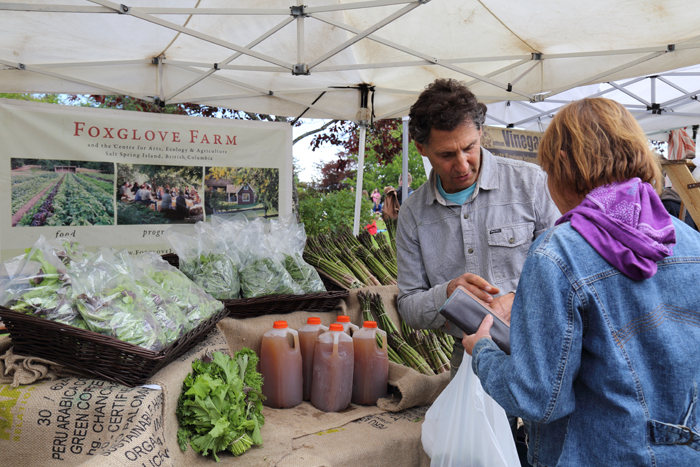
Most of my farming colleagues on the island continue to put in the long hours to do the work we love and plant food for the community. Many of us ask ourselves a simple question: how can we safely and most responsibly feed our community? Some farmers are providing food boxes on a subscription basis, others are selling to their immediate neighbours, at Foxglove Farm we are offering both home delivery and a “drive-through” pick-up option at our farm.

None of us knows for sure how long this crisis will last, but we do know we all have to eat, and now more than ever we all need to eat well. There have been significant efforts made on the island to create a strong local food system, with the Tuesday market, recent work on updating the area farm plan and many more.

It may be that the current crisis is providing us with an opportunity to create a food system that truly reflects who we are, where we live, and the reality that we may no longer be able to rely on the industrial food system that still supplies the majority of our food. We live on an island. We are now being asked to think like one.

The financial impacts of this crisis will go on long after the disease has diminished. This year there may be more members of our community who simply cannot afford to access fresh food. The responsibility for this, for making sure that everyone has a place at the table, belongs to all of us, not just the tiny percentage of our island population we call farmers. This too can be an opportunity.

Each morning I walk my fields observing, making lists, checking newly planted crops. These walks reveal new leaves unfurling, soil lifting and cracking to expose green pea knuckles, flower jackets slipping off freshly formed fuzzy apple babies, small fleeting gifts like drops of dew on taut squeaky cabbages reflecting the light of the world. But my heart and mind are also consumed by the suffering I see around me, by the internal collision between our human dilemma and the audible sigh of relief I can hear from our Mother Earth as the world pauses, and the constant assault, extraction and pollution, the grabbing and grasping, have been forced to just stop.   

We may feel paralyzed when faced with the enormity of our modern dilemma, but we have enormous power in and around the places where we live. This is our time to come back home, to support all those who are re-imagining and replanting our island — one seed, one farm, one meal, one individual at a time.

Michael Ableman is an island farmer and author.

MLA Adam Olsen: Community resiliency encouraging

By ADAM OLSEN

SAANICH NORTH & ISLANDS MLA

COVID-19, or the novel coronavirus, is spreading quickly. We are in a state of shock as we see the impact of this virus globally and as businesses and institutions continue to announce suspension of operations and indefinite closures.

Dr. Bonnie Henry, British Columbia Provincial Health Officer, and the Minister of Health Adrian Dix, have been exemplary in the handling of this crisis. It’s important that everyone in our community follow their recommendations to help stop the growth of this virus. For the most up-to-date information about COVID-19, please visit http://covid-19.bccdc.ca.  

As a result of their recommendations we have closed our constituency office to walk-in traffic. Our team is working from home and will be available by email (Adam.Olsen.MLA@leg.bc.ca) and by phone (250-655-5600). We will continue to process casework as usual and advocate on behalf of everyone in Saanich North and the Islands.  

I’m very concerned for the health and well-being of everyone in our community, especially those who are at the greatest risk and for those whose income or business is affected by the closures. I’m working hard as your MLA to advocate for solutions that meet your needs, especially for those hit hardest by this crisis.

It’s encouraging to see the many examples of community resiliency, where residents and local businesses are helping their neighbours. People are finding ways to support each other by creating new networks to help those who are unable to get groceries or medications, and people isolating themselves at home to protect friends and community members from potential harm.

The challenges we are facing are unprecedented and there is critical work being done by governments of all levels to address the immediate needs in our communities. The announcements of financial support from the federal government are a positive step in providing relief for people and businesses that are feeling significant financial impacts.

This is really just the initial phase of efforts to address this social and economic crisis. There will be more announcements made about relief programs, including from the provincial government. It’s important that we not only provide the immediate support that is needed but that we also address the structural issues that have left many individuals and businesses so vulnerable.

I will have more to share soon about how the provincial government is planning to support British Columbians. My colleague Sonia Furstenau and I will continue to work on behalf of our constituents, and all British Columbians, to bring forward ideas, policies and best practices to government, while also playing our important role as an opposition party to ensure transparency and accountability.  

We are in unprecedented times, and we are all going to face challenges over the weeks and months ahead. It is essential that our path through this crisis and beyond is one that is marked by kindness, compassion, and empathy.  

Skeena Queen struggles after refit return

0

Ferry passengers travelling between Fulford Harbour and Swartz Bay have been getting used to a new version of the route’s regular vessel since the Skeena Queen returned from its mid-life upgrade on March 13, but the boat has been plagued by issues in recent days.

Today (March 25), the Skeena is out of service so that the ship’s crew and technicians can adjust and trial new equipment on the vessel. It is being replaced by the Bowen Queen on the regular schedule.

On the evening of Thursday, March 19, the Queen of Cumberland had to be brought in for the last run of the day, with a resulting delay, and then the Bowen Queen started sailings the next morning.

The Skeena Queen was removed from service on Oct. 28 to undergo its mid-life upgrade, which BC Ferries says was necessary to provide required maintenance on the ship. It was built in 1997 and needed work to provide another 20 years of safe and reliable service.

Enhancing the customer experience was another consideration.

“We heard from customers about some areas on the ship that needed improvement, and we took that feedback into account during the upgrade,” said Brian Anderson, BC Ferries’ vice-president of strategy and community engagement.

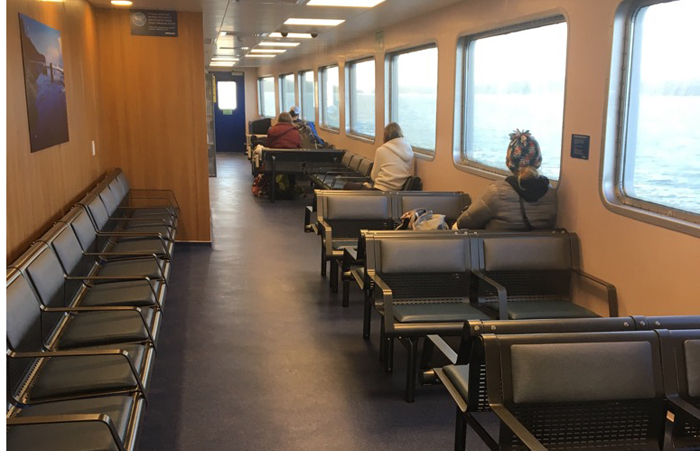
Customers will notice new furniture in the passenger lounges as well as additional exterior benches that will provide seating for travellers to take in the view in the warm summer months. One of the lounges was also converted to provide cafeteria-style seating with tables.

The ship now has air conditioning and washroom areas have been expanded so they are no longer single stalls. The navigation, communication and electrical systems were improved to enhance safety and reliability.

While its transfer onto the route last fall was a bit rough in terms of timing and overloads, many passengers had grown to appreciate the replacement vessel Queen of Cumberland for its extra comforts. Salt Spring Island Ferry Advisory Committee chair Harold Swierenga notes the Skeena’s upgrade will provide some extra comforts, and returns the single-deck loading scenario that is beneficial during busier seasons.

“While passengers may miss the popular lounge and cafe on the Queen of Cumberland, we look forward to experiencing the upgraded and improved amenities on the Skeena Queen,” Swierenga said. “On the whole, the return of the efficient Skeena Queen to Fulford Harbour will be warmly welcomed.”

Raffi shares Dylan-esque song

In uncertain times old friends are invaluable, and so are words that can guide us to the right actions without giving up hope on the bigger picture.

Salt Spring resident Raffi Cavoukian is a reliable resource for all of the above. There are now a couple of generations of “Beluga grads” who grew up with Raffi’s children’s music, meaning he has friends of all ages across the globe. A new song that he’s released speaks to his own roots as a folk singer while sharing some important messages and lightening the mood around the COVID-19 pandemic, all at the same time.

Cavoukian said the song Dylan Sings Quarantine started with just the first verse, which popped into his head one morning and emerged in the style of early Bob Dylan, with a little help from his ukulele. He posted the clip to Twitter and was surprised many people thought the actual Dylan was singing the lyrics that go along the lines of “Quarantine, quarantine. We gave our life to quarantine. One day we’ll get it back.”

Reinforcing the messaging coming from public health officials in a fun and accessible way is more than just a whimsy for the singer, who is also a well-known advocate for social justice through his children’s foundation and its focus on child-honouring. He carries a sense of responsibility at all times, but especially now.

“I’m doing my part and I think we all can play a part,” Cavoukian said. “It’s a very serious situation. It’s very serious here in Canada but we seem to be ahead of the curve compared to our neighbours to the south, who seem to be in for a rough time. My heart goes out to the afflicted.”

Dylan Sings Quarantine can be found on YouTube.

For more on this story, see the March 25, 2020 issue of the Gulf Islands Driftwood newspaper, or subscribe online.

Nobody Asked Me But: Pandemic can be licked if we all pull together

0

You all remember Nostradamus, the 16th-century French astrologer, physician and seer into the future. Among his many prophesies, he is credited with predicting the French Revolution, the Great Fire of London, the UK floods, and the collapse of the World Trade Centre. Of course, he also foretold the coming of the Antichrist and warned the world that the future blonde bombshell, Madonna, was actually the whore of Babylon, but the jury is still out on those last two predictions. He definitely blew it on his prognostications on “the Great War of 2002” and the capture of Rome by the Albanians, but let’s give him a couple of mulligans (“takeovers” in golfing parlance) on those.

The genius of Nostradamus lies in his brilliant tactic of making sure that his predictions could either be verified or debunked only centuries after he no longer walked the earth. The same, I’m afraid, cannot be said about any prediction one can make regarding today’s virus epidemic threat to the planet.

By the time you read this blog, the future may already be upon us. Or maybe not. At this point, nobody really knows.

What’s fuelling this global uncertainty is the novel Coronavirus pandemic (aka COVID-19). It’s quite possible that within the next few days or weeks we will discover whether it’s a whole bunch of hooey that will blow over like so many other “scares” that have come before (remember Y2K?), or it is indeed marking the beginning of the end.

The resulting mass hysteria is manifesting itself by consumer frenzy-buying across the nation and probably throughout the globe. Big-box stores are seeing their stock wiped out as shoppers load up their mammoth carts with supplies they hope will see them through the oncoming crisis.

The top three products being stockpiled by gluttonous hoarders are hand sanitizers, face masks and toilet paper. The run on hand sanitizers stems from the belief that the virus is being passed to a new host through surface to surface contact to the hand and then from the hand to the face where it can easily penetrate the body’s defences. The face masks, even the preferred N95 models, apparently do little to protect the wearer from picking up the virus (except that it probably keeps one from touching the lower part of the face), but it does stop someone who is already infected from spreading it through sneezing or coughing. As for the toilet paper, well . . . I suppose it keeps doing what it’s supposed to do, COVID-19 or not.

It’s possible that I might be missing something when it comes to the stockpiling of toilet paper. Perhaps people are loading up on 48-roll cartons of the commodity at their local Costco or Walmart for a completely different reason. Imagine glue-gunning the rolls together to create a “Michelin Man” suit of cellulose armour, which would be instrumental in keeping others from penetrating your safe zone of an acceptable three to six social distancing feet away. This could even bring back jousting.

What is it with all this hand-washing business? Health expert will have you believe that you can beat the virus if you wash your hands with soap and water as many times as you possibly can throughout the day. Assuming you don’t develop a Lady Macbeth complex as a result, you are also advised to make each hand wash last for at least 20 seconds, or the time it takes to sing “happy birthday” twice (unless you are singing it to Esteban Julio Ricardo Montoya de la Rosa Ramirez, in which case once may suffice).

Nobody seems to be advising exactly how many times you should be washing your hands in a day. Is it every hour? Every 10 minutes? Every time you touch something (other than your face)? At this rate, probably the things you should be touching the least are the taps and faucets of any bathroom sink. Perhaps the ultimate form of self-isolation and social distancing is restricting your living space to your own shower stall and/or bathtub.

And then there’s the issue of not touching your face. Have you ever counted how many times you bring your hand up to an itchy nose or eye or how often you rub your lips and mouth? How are you supposed to control these subconscious actions? I suppose you could try wearing those plastic cone-shaped collars that vets put on dogs to keep them from licking and scratching at stitches or mangy skin, but you would probably do more harm to yourself from violent eruptions of laughter every time you saw yourself in a mirror.

There’s nothing like a world in crisis to bring out the irony in our lives. You may have heard that the French shrine at Lourdes, famed for providing its alleged curative and healing waters to thousands of sick and crippled visitors every year, has shut down as a result of the pandemic. As a viable alternative to the usual medicinal properties at Lourdes, the sanctuary is advising sick pilgrims “to pray more.” Even in North America, Catholic churches are restricting the manner in which bread and wine (representing the body and blood of Jesus Christ) are being administered during Holy Communion. It seems that the risk of spreading the viral infection is crossing over from the material to the spiritual world.

So get a grip! Stop wringing your hands in desperation and keep washing them (if you haven’t washed all the skin off by now). Ignore the picture in your mind of those tiny COVID-19 viruses doubling over in laughter at your attempts to fight off the plague with soap and water. It seems so benign an action, but it just might work.

Nobody asked me, but how about trying not to think about the reeling global economy and your impending “near-debt experience.” Keep your social distance and self-isolate as much as possible. If we all pull together, we can lick this pandemic and get back to what we were doing before all this came down the tube. Dealing with climate change.

I’m sure Nostradamus probably saw this coming.

Editorial: Everyone must stay home

0

Driftwood columnist and island performer Shilo Zylbergold once penned a song called If You Love This Island, Please Don’t Come.

While it was a tongue-in-cheek ditty that discouraged tourism to Salt Spring Island in general, it could be brought out again as local leaders seek to keep COVID-19 at bay on the islands.

Visitors are usually much appreciated, of course, since so many residents rely hugely on their economic contributions at local stores, restaurants, accommodations and the Saturday and Tuesday markets. But with travel understandably being curtailed around the world, restrictions need to apply locally as well.

Both Islands Trust chair Peter Luckham and the two electoral area directors who represent the Gulf Islands in the Capital Regional District — Gary Holman and Dave Howe — made public pleas in the past few days for people from “away” to not visit. Even individuals with second homes on the Gulf and all Trust-area islands are being asked to not visit.

As Lady Minto Hospital doctors have also stated, it cannot be stressed enough that the many people returning to the islands from time spent overseas, in the U.S. or Mexico must self-isolate for 14 days.

Health Minister Adrian Dix has stated numerous times that the province needs everyone to adhere to restrictions 100 per cent, whether that’s in maintaining the two-metre distance between yourself and others, suspending regular social activities, staying home if you are sick and self-isolating for 14 days after returning home from travelling. How well citizens adhere to the guidelines — some of which can be enforced by peace officers — now and in coming weeks will determine the outcome of the disease’s progression and how well we have “flattened the curve.”

Every time a local worker, from those in retail to health-care to the ferry system, is forced to interact with a customer, their risk of contracting COVID-19 increases.

While many local businesses have instituted changes in how customers are dealt with and by increasing cleaning protocols to reduce the risk of transmission, the only surefire way for everyone to stay safe is to stay home.

March 24 Lady Minto Hospital Medical Staff Association Covid-19 Update

From the Lady Minto Hospital Medical Staff Association, March 24, 2020: 

This is a surreal and strange time for all of us. Going for a walk or looking out at the water, everything looks the same as always. However, all over the world, including here in B.C., people are dying, and intensive care units are filling up. 

We hear that people are losing patience with the social distancing measures which are being asked of you. You may be feeling frustrated by the limitations of not being able to meet with friends, or just don’t feel you are at risk. Please remember that social distancing and hand washing are the only preventive measures that have been proven to work for the pandemic. We are pleading with you to stick with it! 

The longer people don’t comply with social distancing, the longer we’ll have to do it.

On Salt Spring we are in a period of relative calm and we hope it stays this way. Please remember that all of our local family doctors’ offices are open. They are taking phone appointments and will arrange to see those who need to be seen in person. So please call your doctor’s office if you need care.

Many elderly and ill patients have asked about advance care planning at this time. This is a good opportunity to have a discussion with your physician about goals of care and end of life care.