Home Blog Page 370

Viewpont: Abandon TUP Bylaw 471

By MAXINE LEICHTER

Our elected Local Trust Committee is considering an ill-advised and harmful bylaw that would create a gigantic loophole poised to negate our current zoning rules.

Bylaw 471 would allow trustees now — and likely forever — to issue an unlimited number of temporary use permits for an unlimited number of suites, cottages, trailers, tiny homes and other wheeled residences for full-time occupancy almost everywhere on the island, including parklands.   

In reality, “temporary” almost always means “permanent.” My experience, based on 16 years of watching Salt Spring Island local government, has shown that trustees are unlikely to remove people from their homes and that privileges once granted are rarely withdrawn.

Bylaw 471 relies on neighbours to object to applications for additional residences in locations or under circumstances that are problematic. But people are reluctant to object for fear of offending their neighbours and they should not be put in that position.

Proposed Bylaw 471 places the trustees in the inevitable position of making decisions with long-term impact for Salt Spring on a case-by-case basis rather than depending upon analysis, planning and vision.

Our official community plan requires that growth be tailored to our island’s carrying capacity. By making decisions on a case-by-case basis, cumulative effects are rarely considered. There is not even data available to evaluate the adequacy of services such as hospital space, doctors, road maintenance, ferry capacity, power and water supply . . . and the list goes on.

The Islands Trust has not been empowered by the province to provide affordable housing, or any services. The Capital Regional District is the agency that provides services. In fact, right now over 200 units of affordable and seniors housing are under construction in Ganges through collaborations between the CRD and various non-profit organizations. This is a model that works, not ill-planned, haphazard increased density, dispersed around the island, far from population centres, public transit and other services.

Bylaw 471 has already both a first and second reading and is near to becoming a reality. Hopefully voices will be raised to object to this flawed bylaw! 

Editorial: Equality still elusive for women

0

Women’s lives have improved dramatically in the western world in the past century and especially since International Women’s Day was instituted as March 8 by the United Nations in 1977.

But a look at statistics reveals that gender parity is still a long way from being achieved by any measure in Canada. For example, Canadian women earn only 84 cents for every dollar earned by their male counterparts, putting our country at 31st spot out of 36 Organization for Economic Cooperation and Development countries in that category.

Today, Canada’s House of Commons consists of only 29 per cent women MPs, and the Northwest Territories is the only territory or province with a female premier.

And statistics related to violence against women are alarming. According to the Canadian Femicide Observatory for Justice and Accountability, rates of partner and domestic homicide have declined in Canada over the past 30 years, which is good news. But still, 118 women and girls were murdered in Canada in the first 11 months of 2019. Fifty-seven per cent of those were killed by their intimate partners. Indigenous and racialized women are at greatest risk of being killed in Canada.

International Women’s Day serves to keep those sorts of facts in the spotlight, while also honouring women who have worked and continue to work to change them.

On Salt Spring, trailblazing Canadian women were featured in films shown by local organizations over the weekend. On March 8 at ArtSpring, SWOVA and IWAV teamed up to screen The Gender Lady: The Fabulous Dr. May Cohen, a documentary about a pioneer in the women’s health field, followed by a wide-ranging panel and audience discussion. The day before at the library, the local chapter of the Canadian Federation of University Women and the library co-sponsored 20th Century Gals, a “docudramedy” by island resident Sylvia Spring that looks at a century of progress and roadblocks for Canadian women as they’ve attempted to achieve equality in politics, the workplace, family responsibilities and sexuality.

Conversations that occur on International Women’s Day remind everyone that “equality” is still elusive and that much work needs to be done — by people of all genders — which makes it a vital day in the Canadian calendar.

HICKS, Sue Ann (nee Leigh-Spencer)

Sue Ann Hicks (née LEIGH-SPENCER)

Sue Hicks passed away peacefully February 27, 2020 on Salt Spring Island, BC, in the company of her family and friend Peter Jones and assisted by the excellent staff at Lady Minto Hospital. She was 72. Sue was clear, resolute, and thankful to have control of her life to the end, despite her incurable cancer.

Sue moved to Salt Spring Island from Winnipeg less than five years ago after the death of her husband of 48 years, Dave Hicks. She dove into her new life and community lending her practical and efficient organization skills to such projects as expanding the Meadowbrook seniors’ facility, coordinating volunteers for SSNAP (Salt Spring National Art Prize), improving the experience at the Salt Spring Island Golf Club, and much more. Her passionate support for others, insight, clarity, and strength made her many close friends. Her playful sense of humor and effortless fashion sense charmingly complemented her pragmatism.

Sue was born and raised in Winnipeg where she completed her Bachelor of Nursing at the University of Manitoba and later completed her Masters of Environmental Studies (Health Planning) at York University in Toronto. She began her career as a Public Health Nurse for the City of Winnipeg and rose to become Associate Deputy Minister of Health for the Government of Manitoba. In addition to her busy professional life in Winnipeg, Sue also worked tirelessly in the community for such organizations as the Royal Winnipeg Ballet (two terms as Board director), Deer Lodge Hospital, and the Pan American Games.

Sue was a leading expert in public health planning and program implementation and spoke, wrote, and consulted on the subject nationally and internationally and was widely recognized. She was ultimately awarded the Canadian Public Health Association Certificate of Merit in 2009. She continued to consult privately until her retirement in 2019.

Sue Hicks will be deeply missed by her many friends on Salt Spring Island, and in Winnipeg, Tucson, and elsewhere. She is survived by her sister, Sally Leigh-Spencer (Brian Thacker) of Duncan, BC; her brother, Peter Leigh-Spencer (Marjorie) of Edmonton, AB; her brother-in-law, Dennis Watkins (Michelle) of Brentwood Bay, BC and a wide extended family of beloved cousins, nieces and nephews. Sue comes from a long history of family from Salt Spring Island; her parents (Ann and Frank Leigh-Spencer) and her paternal grandparents (Helen and Leigh Leigh-Spencer).

A Celebration of Life will be held on May 24, 2020 at 3:00 pm at Gallery 8 on Salt Spring Island. Those who wish to remember Sue in a special way, may make a gift in her memory to Lady Minto Hospital Foundation, Ganges, Salt Spring Island, BC.

OLCHOWECKI, Alex

ALEX OLCHOWECKI
May 13, 1928 – March 2. 2020

Alex died peacefully in Lady Minto hospital following hip surgery at the Royal Jubilee. He was born in Sandilands, Manitoba, the seventh of eight children. He is survived by his wife of 59 years, Victoria
(Mosquin), nieces and nephews. Alex was predeceased by his father Jacob, mother Frances (Monastyrski), five brothers, Peter, Paul, Roman, Sam, Michael, and two sisters, Helen Beyak and Jean Stark.

Sandilands, where Alex attended the one-room school from grades one to eight, is a small village on the C.N. railroad line to the USA. He knew the woods, climbed jack pines, picked wild berries and mushrooms. In winter, with his older brothers, provided rabbit and venison. He attended the local one-room school for grades one to eight, and continued high school in Ste. Anne, Teulon and, in 1946, St. Andrews College in Winnipeg. After cutting pulpwood in bush camps of Ontario and two years plying the Great Lakes shipping iron ore on the Algorail, he decided to go to Edmonton. There, pouring concrete for the city’s curbs, and being on unemployment insurance led him to try long distance trucking. He loved driving the Kenworths and the trips gave him opportunity for quick visits to relatives and friends scattered across Ontario and Manitoba.

At age thirty, he decided to go to university and applied to the U of Alberta. However, he was short his grade twelve English and denied entrance. Application to the U of Manitoba was accepted and he attended summer school there, taking two courses. Here he met Victoria, who was working on her B.A. They married two years later. Al continued trucking for two years and they moved to Manitoba for Al to begin his Science degree. He received his Ph.D. in Mycology in 1972 and stayed with the Botany Department, teaching various courses, including photography, until his retirement from the Faculty of Science in 1993.

The Sandilands Forest Reserve was a favourite destination for mushrooms, photography and picnicking with friends on the old family homestead. He was delighted, one year, to say he had filled the trunk of the car with morels. Travels to other countries always included visits to Botanical Gardens. As a member of the British Mycological Society, there was the pleasure of roaming the countryside with forays to Italy, Majorca, Spain and Portugal. Al was an adventurous cook, barbecued a great steak, and made noodles for the Sunday chicken soup. He loved New Orleans jazz, his many cameras, small radios, and good tools.

He moved to Salt Spring in September of 1993 looking for shorter winters and a longer tomato growing season. The Garden Club introduced winter vegetables and slugs. Al joined the Farmers Institute and over the years valued the Tuesday mornings working on the buildings and grounds. He was pleased to offer his tools: he had many and often more than one. He could not resist a bargain.

Following the independence of Ukraine, travel was possible and several trips connected him with relatives. He was pleased to be able to support some of them through medicine, the priesthood, computer science and law. Throughout his life, Al maintained friendships and stayed connected with family. To Victoria, he was a best friend and a loving husband.

Cremation has taken place. A Celebration of Life will be held at 2:00 on Wednesday, April 8, at Fulford Seniors, south side of Fulford Hall. Internment will be in Winnipeg at a later date. Donations in his memory may be made to a charity of choice. Thanks to the nurses at Lady Minto and to Dr. Beaver for their wonderful care.

Making the case for a fifth West Coast season

By JOHN NEVILLE 

The eight weeks before March 21 are like a prespring, a fifth season. These conditions arise between Victoria, across the Salish Sea to the Lower Mainland and include the Gulf and San Juan islands. Similar conditions exist in the far south-west of England, Ireland and the area around Melbourne, Australia.

On Jan. 24, I decided to check out our yard. The weather forecast for the day was rain, wind and a temperature of 9ºC — good so far. The garden was bright green. The daffodils were up about eight centimetres, snow drops and crocus about six cm, and there were flower buds on some of the rhododendrons and forsythia. (The flowers of the forsythia are sometimes referred to as “little golden bells.”)

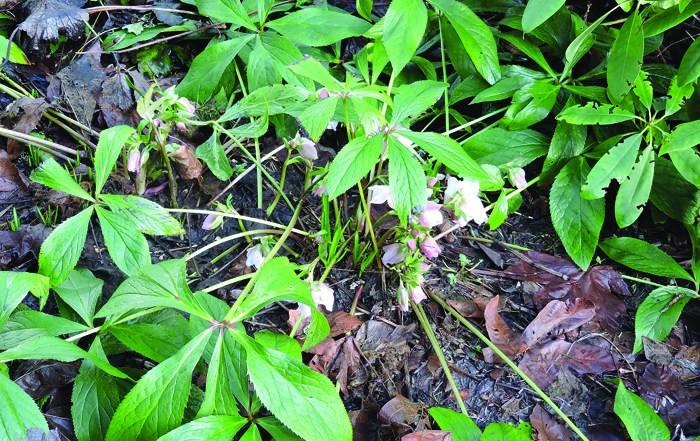
The real harbingers of prespring are the stunning light pink, cup-shaped hellebores, (Helleborus X hybridus), with their lustrous evergreen leaves. They thrive in our wet woodland as long as they enjoy a southerly, partly sunny exposure. These plants originate in Mediterranean countries.

There have been some subtle changes in bird activity during the last week. For six days, two male house finch have been in full song. The Canada geese are no longer in flocks but have divided into noisy pairs and are checking out real estate. I’ve heard the gull-like calls of our local mating bald eagles and nest re-construction is underway. The persistent buzzing around our heads, gentle tapping vocal sounds and bright gorget announce the reproductive season for the friendly Anna’s hummingbirds.

A simple measure of prespring, increasing sunshine, temperature and light, is when the seed consumption at our bird feeder drops by about 25 per cent. This is probably due to the softening of the ground and an increased availability of insects, worms and other food sources.

On Jan. 28, returning rough-winged and barn swallows were reported from Lindholm Road Pond, on the Galloping Goose Trail in Metchosin.

On Jan. 31, the temperature climbed to 12ºC. Then, on Feb. 2, the drooping white bells of the snowdrops unfolded! This was followed by another wonder of springtime, on Feb. 11, when the yellow-gold bloom of daffodils trumpeted the changing season.

About one hour before dawn on Feb. 14, the Canada geese were already busy along the shoreline. It was clear and a brisk temperature for walking. As the sky lightened, a spotted towhee gave his territorial trilled song and a robin sang a few bars of his “cheer-up cheerily” song. It was a good way to start Valentine’s Day.

On Feb. 17, a neighbour emailed to describe the new, bright, blood-red feathers on the head of the local red-breasted sapsucker. Plumage is starting to change on the wintering water fowl as well. Someone on bcvibirds reported his first account of the song of a skylark, high above his grassy territory at the airport.

On the 19th, it was a clear evening, with a quarter moon and bright starlight. We went out to do our 20th Nocturnal Owl Survey. At Ruckle Park, close to sea level, there were 30 or more Pacific tree frogs advertising loudly. Four Canada geese and a Barrow’s goldeneye flew along the shoreline. We counted five mule deer, one saw-whet, one western screech and three great horned owls. Two of the latter flew past us only 20 metres away! The male and female were calling back and forth with close attention to each other. It definitely was a beautiful romantic night out.

Two days later there was the bloom of plum blossom on Salt Spring. The same weekend there were reports of flowering crocus and cherry blossom brightening the Victoria landscape. On the 28th of February I heard the musical trill of the dark-eyed junco for the first time. It’s like a tiny bell being rung very rapidly. 

If I have given the impression that the sun is always shining, that’s not really true. It’s often wet and rainy and keeps me indoors.

Does Canada have a fifth season? What do you think?

Improv champions to defend national title

Gulf Islands Secondary School’s senior improv team is gearing up for another run at the national championship after winning the Vancouver Island regional competition in February.

As the 2019 Canadian Improv Games champions and winners of the silver medal in 2018, core members Calla Adubofour-poku, Kahlila Ball, Josephine Gaffney and Amelia McCluskey will have one last opportunity to show their skills in Ottawa before they graduate in June. They are joined by new teammate Owen Goertz, a multi-instrumentalist whose musical skills help enhance the more traditional improv techniques.

Coach Jason Donaldson observed that GISS has made it to Ottawa and returned with a medal each year for the previous three national games, with the school’s first championship win in 2017. The team’s narrative has changed from 2008, the first time GISS went to the nationals, and even over the past few years. Getting through to the final round in 2020 will require great play in the moment and different strategizing beforehand.

“We’re no longer the scrappy underdogs coming from a small school in the Gulf Islands to compete with these urban teams. We’re now the returning champions,” Donaldson observed. “That means the psychology of how we’re going in and how I need to prepare them also changes.”

Vancouver Island is a stronghold of improv talent, and winning the regional title is not a given. In fact, GISS has earned its berth to the nationals more than once by winning the “wild card” video submission rather than the Vancouver Island cup. This year things were looking dicey at first: core member Kahlila Ball was too ill to compete during the first round of the weekend-long tournament, which took place in Courtenay Feb. 14-16.

Donaldson noted the team is already on the small side even without losing a member.

“We just hoped we could squeak through the first rounds without Kahlila and that she could make it to the finals,” he said. Since the team scored well but was almost tied in points after the first two rounds, doing a non-verbal event they had never tried before in the third round was a risky proposition, but one that ultimately worked.

“It was crazy-making to see if the risk would pay off,” Donaldson said. “If you roll the dice like that you will either get a one or a six — if you don’t roll it you can only ever get a four or a five. So it was really great to see it rewarded.”

Then in the final round with Ball back in place, GISS played a style event that scored exceptionally high and won them the cup.

“Making it out of the Vancouver Island region is as competitive as any night of preliminary play at the national tournament. The teams at our finals were phenomenal and we’re really hoping Ladysmith, who came in second, wins the wild card this year,” Donaldson said. (The Ladysmith team was in fact announced as the wild card winner after the interview took place.)

Just as meaningful as the win, for the coach, was seeing his team’s core members receive the Spirit of the Games Award. The honour is meant for just one person, but this time the judges could not single out any of the individual girls and felt compelled to share it between all four of them.

“It was really heart-warming to be acknowledged by the judges and the whole community for what the girls bring to the spirit of the games,” Donaldson said.

The national improv games take place May 11-14 this year. The trip involves a weeklong immersion in all things improv, with workshops in addition to the competitions. The students also take advantage of other educational opportunities while in Ottawa with visits to Parliament, national museums, galleries and other sites.

The team is now starting to get a major fundraising drive underway to help finance the trip. Several key sponsors and philanthropists have already committed funds to get the ball rolling. The team has also lined up work-trades including cleaning up furniture from the weekend’s film festival, bagging groceries at Country Grocer and adopting seniors through the Salt Spring Lions program. A series of fundraising performances will take place around the Gulf Islands in April, culminating with a full improv revue at Mahon Hall on April 24. Donaldson hopes that show will include all local groups practising the art form, from children at Stagecoach Theatre School to junior teams to an adult’s fun group.

Donations can be made to the team’s GoFundMe campaign under Send GISS to Ottawa 2020.

Ganges space secured for laundromat

0

Efforts to bring laundromat services back to Ganges have finally reached the spin cycle.

The Wagon Wheel Housing Society, which took on the lost laundromat cause after Mrs. Clean closed four years ago, has signed a lease on downtown Ganges premises as of March 1.

“It’s a miracle,” said society chair and spokesperson Cherie Geauvreau. “We made the impossible possible.”

The 982-square-foot space that once housed Orca Electronics at 162 Fulford-Ganges Rd. will be home to several washers and dryers that are as water- and energy-efficient as possible, plus a public shower facility and a soap exchange, where a variety of products can be purchased in reusable containers. A large outdoor water storage tank will be part of the operation, which helped earn North Salt Spring Waterworks District approval for the project. 

“When it is something good and right, you just stick with it and it will happen,” said Geauvreau.

The housing society had investigated a variety of potential locations since the first meeting held on the topic in October of 2016, but each one posed insurmountable challenges. Use of a portable unit was among the options pursued.

Geauvreau is thrilled with the solid support the project has received so far, starting with assistance from Hardal Management Inc., which has provided rent-free access to the space for the first three months. Another individual is contributing $500 per month towards rental costs for the first year. 

Although the society only has about $45,000 of the estimated $180,000 needed to cover all costs in the bank, Geauvreau is confident funds will be forthcoming for the social enterprise one way or another and that it will be open by June.

Salt Spring’s Wilco Construction is the project manager.

“And we’ve had offers [to help] from plumbers, electricians and painters already,” she said.

Geauvreau thanked the society’s board and other core volunteers for putting in an estimated 2,000 hours of work towards the project.

Ron Cooke, Michael and Helga Bagnell, Adiel Pantoja, Tim and Elaine Hunt, Kylie Coates, Shamana Ali, Jim and Carol Helset, Jewel Eldstrom, Inga Michaelson and Darryl Martin have contributed hugely, she said.

Once the facility is up and running and making money, profits will be directed towards affordable housing efforts, and ideally a “wagon wheel” communal housing concept.

People can celebrate the laundromat project and donate to it at a fundraising dance set for Lions Hall this Friday, March 6 from 6 to 8:30 p.m. Ruwazdano Marimba Band is performing for the cause, and there will also be an art and silent auction.

For those unable to attend, cheques for the project can be mailed to Salt Spring Island Community Services with “Laundromat” in the memo line. Charitable tax receipts will be issued by SSICS.

As well, a GoFundMe page with a $40,000 goal is set up at: https://ca.gofundme.com/f/laundromat-on-salt-spring.

“It’s our laundromat and it needs your support,” said Geauvreau.

Serious planning needed to address climate change

By MEROR KRAYENHOFF

So we’ve accepted that there is a climate emergency and we need to plan for the things that will change around here. What might those things be?

More extreme weather

• Fire: Burns combustible homes, electrical poles, and vast swaths of forest.

• Flooding:  Rains so heavy (two inches per hour) that nowhere is immune. This will result in extensive damage to homes, roads, and properties prone to slippage. Ganges Harbour and Fulford Harbour turn brown with the soil eroded from the island. Water supplies become contaminated.

• Wind: We’ve already had a precursor of what’s to come. Trees and power lines come down, sometimes on homes. Roads become impassable. Homes go without power and water for extended periods.

• Extreme temperatures — mostly hotter:  It was not long ago that air conditioning was unthinkable for Salt Spring Island.

• Rising ocean levels: At forecasted rise, the foreshore will be at ArtSpring and Windsor, thereby flooding most of downtown Ganges, including the sewage treatment plant, Centennial Park, and the road connecting north Salt Spring and south Salt Spring.

Less stable economies

• It will be harder to transport raw materials and finished goods around the world.

• It will be more difficult to manufacture goods when faced with climate disruptions.

• Buying something off-island will entail lots of complications. Supplies will be limited.

Less reliable ferries

• Our lifeline to off-island supplies of food, building supplies and agricultural products will become increasingly unreliable due to frequent cancellations due to weather. Ferry wharves may need to be rebuilt due to rising ocean levels. If the economy suffers enough, ferries to the Gulf Islands may no longer be considered essential.

Worse roads

• Isabella, North End, Stewart, Morningside and Walker’s Hook roads have all washed out in the last couple of decades. There will be more to come as rains get heavier, retention of water is less due to fewer trees, and culverts turn out to be undersized. The current inadequate maintenance of our roads shows that municipality or not, the appetite for maintaining roads that service few taxpayers is low. Long roads to remote areas will be less serviced.

Environmental refugees

• Tens of millions of Americans will need to relocate and none of them are heading south. They will be looking for gated communities that have plenty of water. Salt Spring fits the bill. The notion that we will be able to control how many people live here is unreasonable and not possible to execute. If this island remains desirable, they will come, and they will come in droves.

• If one accepts the fact that our population is likely to swell way beyond our forecast 20,000 people, then what can we do now to prepare for that influx?

Local political instability

• Consider that it costs far more to service remote lots than village lots, and yet we all pay the same for power, water, roads, ambulance, fire, police, telephone and cable. In the face of reductions and disruptions in service, that inequity will become pressing, and potentially divisive and volatile. As our villages get inundated with environmental refugees, our community’s inclusiveness character will be challenged. We are already seeing the beginning of this.

Possible solutions that we can begin to implement ASAP

• Housing: Require that all new housing be resilient to fire, flooding, high winds and extreme temperatures. We already have that technology. Not so hard, but it takes a Salt Spring governance that is able to implement/require such measures. Also begin to transition all remote homes to be self reliant.

• Water: More difficult is anticipating the vastly increased demand on our water. It is well understood that we don’t have a water supply problem, only a water storage problem.  So, we must begin to require water storage in all new buildings, and we must begin to decommission the long water lines with few customers like the Southey Point line.  (Those customers need to be supported in this transition to rainwater harvesting.) We have an urban water distribution model applied to a rural Salt Spring. In the city there is 33 feet of tax-paid common line between every home. On Salt Spring it can be 3,300 feet of common line between homes. Maintenance of such is beyond reasonable and is proving unworkable. The urban water distribution model needs to be phased out so that only our villages have it. Over time we support the complete transition of homes that are away from centralized water, to sovereign rainwater harvesting.

Electricity: Electrical distribution by overhead lines is the most difficult. Again, we need to decentralize so that only the villages have Hydro power, and that power is underground (like in Europe). Rural properties are on solar and wind. This will take time and public support, but what we end up with are island homes that are comfortable and resilient in the face of the changing weather.

We can also begin to tap Salt Spring micro-hydro potential. Water coming down from Maxwell Lake builds up such pressure in the pipes that frequent pressure reducing is required to dissipate the energy. Water coming down from Rosemurgie Lake has plenty of hydro potential, at least in winter. There are also several other potential microhydro locations. This is a hilly and rainy (in winter) island that has significant microhydro potential.

• Food: Food sovereignty will become increasingly important, as the ferries become less reliable and our traditional off-island food suppliers have difficulty producing sufficient food due to climate change.

• Refugees: A program whereby newcomers can contribute to creating food sovereignty or Seventh Generation (7G) infrastructure in exchange for very modest but healthy starter homes (e.g. 100 – 200 square feet in size).

• Governance: The scale of the climate emergency requires a response of matching scale. The necessary urgency of our response requires that we have a climate emergency person or body able to make climate solutions happen. This climate emergency person or body must be able to expedite and overcome all our current Salt Spring decentralized silo government objections. As Bill McKibben says: Winning the climate war slowly is the same as losing.

• Timing. We can wait until it is an all-consuming emergency, when other communities are also struggling due to their lack of preparedness, or we can begin the transition while we have a mostly intact infrastructure. Most important is to have a Salt Spring governance that can implement climate preparedness measures for without such, all we have is a wish list. The climate emergency response triage must have the improvement in our ability to govern ourselves at the top of the list.

P.S. For those who think being responsible for one’s own electricity, water and sewage is impossible, they need only look to the Living Building Challenge (LBC). SIREWALL (sirewall.com) has worked on both residential and commercial LBC projects. The most inspiring LBC project is the Bullitt Center (http://www.bullittcenter.org/vision/message-from-denis-hayes/) in downtown Seattle. It is six stories tall and not connected to Seattle power, water or sewage. It is designed to last 200 years, has a mortgage, is making the payments and making a small profit.

The writer is the founder of SIREWALL Inc. and a longtime Salt Spring resident.

GISS friends reunite in Colorado

0

A group of friends who graduated from Gulf Islands Secondary School in the early 1980s were recently reunited during a trip to Colorado Springs, Colo.

Derek Walker, who lives in Colorado, was visiting Trevor Tamboline in Los Angeles when they wondered how they could have a reunion of their best buddies from high school.

As Tamboline explains, that’s when Walker pointed out that the NHL was having an outdoor “heritage game” between the Colorado Avalanche and the Los Angeles Kings in Colorado Springs on Feb. 15. 

So they called up Arnie Hengstler (living in Duncan), Rob Holmes (Salt Spring), Glenn Sollitt (Qualicum Beach), Bruce Hume (White Rock) and Johnny Villadsen (Salt Spring) to propose a get-together centred around the game.

“They are the best friends anyone on the planet could have,” said Tamboline. “Every single one of them.”

The group was a bit conspicuous at the NHL game, wearing things like red-plaid mackinaw-type jackets, Team Canada jerseys, and various types of headgear that blared their native land. Then there was the garb worn by Hengstler. He had commandeered a purple, pink and white suit jacket and pants with a snowflake and a deer pattern, just like one worn by Don Cherry of Hockey Night in Canada fame (or infamy).

“A friend who I ref basketball with here in Duncan had the suit and he was kind enough to lend it to me,” said Hengstler.

He walked around the whole stadium concourse wearing the suit. Some people got the joke and asked to have their photo taken with the Cherry look-alike. But of course Hockey Night in Canada is not a fixture in the U.S., so the connection wouldn’t have necessarily been made.

“Thank God we weren’t in Canada because he would have been mobbed,” said Tamboline.

The actual hockey game saw the Kings win by a 3-1 score. But the event garnered more attention for its poor traffic logistics, which saw some people wait in their vehicles for hours before being able to park and then see what was left of the game at the Air Force Academy’s Falcon Stadium. Fortunately, the GISS contingent went to the game early for fun activities, such as playing caps in the snowy parking lot.

Walker and his wife Beth were generous hosts to the large contingent.

“They really made us all feel welcome, and well fed,” said Tamboline.

The visitors also got to take in some sights like the Garden of the Gods in Colorado Springs.

“What a great time we had,” said Hengstler. “It was five days of constant laughs and reminiscing.”

“My face is still sore from laughing,” added Tamboline. “We thought it would be the time of our lives. It was better.”

All group members graduated in 1981, except Sollitt, who was in the  1982 class. They all played sports growing up together, and everyone except Villadsen was on the first GISS senior boys basketball team to be called the Scorpions. Before 1981, the school did not have a mascot. That team was also the first GISS basketball team to reach provincial championships, then at the single-A level.

According to a Driftwood story from March 4, 1981, other team members were  Kevin Kline, l.arry Spence, Clay Riley, Ross McFadyen and Tom Tranter.

With the Air Force Falcon mascot, from left, Trevor Tamboline, Derek Walker, Grapes (Arnie Hengstler), Rob Holmes, Bruce Hume, Glenn Sollitt, Mack Walker, Johnny Villadsen.
A fan recognizes a Canadian celebrity when he sees one at the Air Force Academy’s Falcon Stadium!
In the bleachers at the hockey game, from left, Derek Walker, Mack Walker, Rob Holmes, Grapes Hengstler, Bruce Hume, Trevor Tamboline, Glenn Sollitt and Johnny Villadsen.
Seen in Colorado Springs, Colo.: the one and only Don Cherry!
At the Colorado Springs NHL Heritage Classic between the Los Angeles Kings and the Colorado Avalanche on Feb. 15.
Meeting at the Denver airport are, from left, Johnny Villadsen, Derek Walker, Arnie Hengstler, Bruce Hume, Rob Holmes, Trevor Tamboline. (Glenn Sollitt, the seventh member of the group, had to come a day later.)
At the Garden of the Gods in Colorado are, from left, Arnie Hengstler, Bruce Hume, Derek Walker, Trevor Tamboline, Rob Holmes and Johnny Villadsen.

Editorial: Soap stars

0

It’s a miracle.”

An ecstatic Cherie Geauvreau of the Wagon Wheel Housing Society kept repeating those words while sharing the latest news of efforts to return public laundromat and shower services to Salt Spring Island. 

It does seem somewhat miraculous that a complex problem like creating a service that required central space at a realistic price, access to water and substantial start-up funds could be solved on our island. That is especially so because too often the needs of the less fortunate fall to the bottom of priority lists and if no easy fix to a problem is found they can end up being forgotten.

A place for people who cannot afford to own a washing machine or do not have one in their rented space is a basic amenity of a civilized society. Ditto for a place to shower or bathe. Lack of cleanliness is a public health issue that has been painfully obvious on Salt Spring in recent years.

While exact numbers are not known, the Wagon Wheel Housing Society at one point estimated more than 200 individuals or families were in need of laundromat services. Going off-island to do laundry, paying a private service, washing clothes in bathtubs and buckets, or throwing away clothes and buying second-hand replacements instead of washing them are some ways that islanders have coped with the lack of service. Limited access to laundry and shower facilities has at least been available for a few people at Salt Spring Community Services.

Kudos should be showered on all individuals and organizations that stepped up to ensure this essential project can go ahead, and especially the Wagon Wheel Housing Society, which persisted despite the roadblocks.

But island-wide cleanliness is not yet assured. At least $100,000 is still needed to get the doors of the laundromat open and the washing machines humming. Many individuals have already contributed to the cause, but more funds are needed, and the sooner they are in hand the sooner the facility will be open.

Community Services has agreed to be a project partner and provide charitable tax receipts for donations made to laundromat/shower coffers. The Ruwadzano Marimba Band has offered to donate proceeds of its annual dance set for Lions Hall this Friday, March 6. An art auction and silent auction is also part of the evening. Donation tins are set out in several public places and a GoFundMe page is in operation.

In order to assure dignity and cleanliness for all, this is a project that deserves everyone’s support.