
Home Blog Page 377

Yukon artist works on Salt Spring

Whitehorse-based artist Joyce Majiski captivated Salt Spring islanders who attended her recent artist talk at Mahon Hall, in which she described her current project called Song of the Whale.

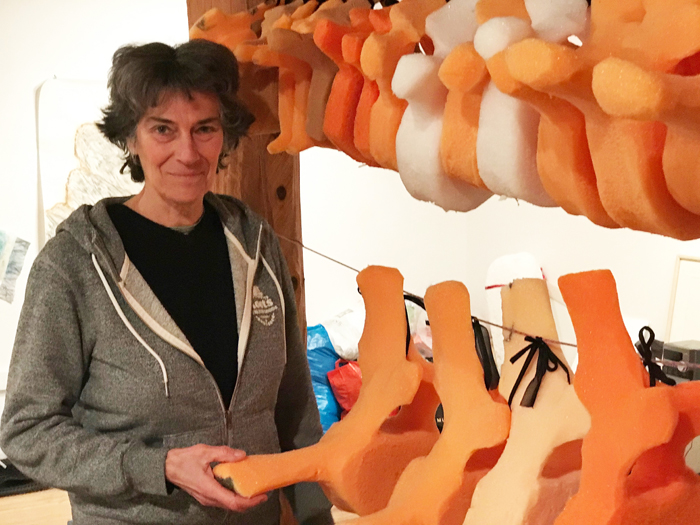
Majiski is on the island through April for the Salt Spring Arts Council’s Artist in Residence Program, and while here she’s sculpting a 30-foot-long replica of a humpback whale skeleton out of salvaged styrofoam and plastics. Those who missed her talk on Jan. 23 — and those who attended but want to see more in person — will have the opportunity during an open studio this Friday, Jan. 31 from 10 a.m. to 4 p.m. at The Point.

Song of the Whale is a multimedia installation slated for a three-month exhibition at the Yukon Arts Centre. Majiski, who worked for 20 years as a biologist and a wilderness guide, often addresses environmental themes in her artwork. 

Majiski has lived in the Yukon since 1984 but often travels to other parts of the world. Song of the Whale has its roots in a series of residencies that Majiski set up while touring a previous body of work overseas. At that point she had been working on “the idea of north” for around five years when a water theme started to take hold. 

Reflections on sand and water that started in the Moroccan desert continued during a follow-up residency in southern Spain, where Majiski contemplated a collaboration with the ocean itself. While she abandoned the idea of having the tide leave its mark physically on paper, she still wanted to document the way the sea changes the shoreline. She did drawings, took photos and spent hours walking the beach every day. The connection to plastic waste in the ocean and the devastating impact on wildlife soon followed. 

Majiski is carving the foam into the whale’s skeletal pieces, modelled on an actual humpback skeleton that belongs to the Beatty Biodiversity Museum and is stored on Salt Spring by Mike deRoos and Michi Main of Cetacea Contracting, a company that specializes in marine mammal skeleton articulation. 

Carving has become simpler since Majiski has teamed up with a friend with a bandsaw who can cut the foam to the basic rib shapes, which she can then work down to finer detail with a precision knife. The fluted vertebrae are more challenging, and it can take up to two days to complete each one. 

The skin itself will be a transparent fabric made from ironing pieces of flexible plastic together. Majiski is also creating a school of herring out of clear and coloured plastics, which are either ironed or sewn together, depending on the melting properties.

The work will be suspended from the ceiling with two projectors coming in from different angles to bounce light off the reflective top surface. A recorded soundscape will contribute to the immersive experience. 

“I’ve got a composer friend helping me compose a conversation between the whales and the sea and humanity,” Majiski said, noting this will incorporate sounds from tanker traffic and underwater sonic hammering as well as the whales themselves.

For her Salt Spring residency Majiski has brought along some pieces from earlier bodies of work such as North of Myth — inspired by circumpolar travels that included a residency aboard a three-masted tall ship out of Svalbard, Norway — as well as Tales From the Tideline. Open studio days at The Point continue on March 20 and April 24.

Some of this work will be included in the SSAC exhibition Against the Current, which shows at Mahon Hall Feb. 14-23. Majiski will be also offering an arts council workshop on how to make a mixed-media accordion book on Feb. 22 and 23. 

For more on this story, see the Jan. 29, 2020 issue of the Gulf Islands Driftwood newspaper, or subscribe online.

Juncos plentiful in Christmas bird count

0

Verified numbers for the annual Christmas Bird Count on Salt Spring are in, revealing the dark-eyed junco and chestnut-backed chickadee as the two most commonly spotted species. 

Volunteers who went out to count birds for the 31st annual event on Dec. 15, 2019 tallied 1,202 junco sightings in total, followed by 902 chestnut-backed chickadees. The next two most numerous species were the Canada goose (759) and the bufflehead (664). 

Tim Marchant, who coordinated the island’s bird count for many years and still compiles the data, reported that overall, the 2019 numbers were less than seen in the past.

“For three years running now, we are on the low side of our average for the total count,” Marchant said. “This year we tallied 10,885 birds, while the average for the past 10 years is 12,849.”

Marchant suggested the 2019 result may be due to the number of counters (104) being around 10 per cent lower than usual. 

“The average count per observer remains, very roughly and with huge individual variation, 100 [birds per person].”

Some variations on individual birds spotted include 20-year highs for a number of water species, including the Pacific loon, horned grebe, Brandt’s cormorant, Barrow’s goldeneye and the black oystercatcher. Also seeing 20-year highs were land-based species downy woodpecker, hairy woodpecker, white-crowned sparrow and red-winged blackbird. Most surprising perhaps was the increase in American goldfinch sightings from zero in the previous three years to 40 in 2019.

Marchant notes Anna’s hummingbirds stabilized at 130 to 170 each year for the past several years, after increasing from zero in 2004 to 100-plus in 2012. There were actually 186 counted in 2019. 

In contrast, fewer robins (432) and cedar waxwings (two) were seen, with numbers “way off” their highs of 2013. Marchant suggested a low fruit crop in 2019 may have been the reason. 

Salt Spring’s Christmas Bird Count is done in conjunction with citizen science initiatives taking place all over North America around the Christmas season. Tallies from different subzones on the island are incorporated into the official data sets of counts based in North Saanich, the Cowichan Valley, Pender Island and Galiano Island.

For more on this story, see the Jan. 29, 2020 issue of the Gulf Islands Driftwood newspaper, or subscribe online.

Embrace fitness through running or walking

By Susan Gordon

Why do we run? What makes us lace up a pair of sneakers and head out the door for a workout? Everyone has a different list of reasons as to why aerobic exercise holds an attraction.

We are fortunate to live in a climate that encourages outdoor activities all year round. The benefits of exercise and increased fitness are now widely supported by medical professionals too. If you have been read the “riot act” by your doctor, or have decided on your own that being fitter will make you feel better, you’re not alone.

The question is often, “Where to start?” With a group, a trainer, or an online learn-to-run program? 

Your personal style of learning and motivation is something you’ll want to contemplate when considering whether or not to incorporate running or walking into your life. 

Some people are more consistent when they know a group of runners or walkers have a specific starting time and place, and they are committed to adhering to the dynamics of that group.

Other people prefer to self-motivate and are able to direct themselves through a program, or reach a particular level of fitness and confidence before joining up with a group or coach.

With most running clubs, there is a mix of group and private workouts. If you decide to connect with a group, speak to the coach or long-time members and determine if your current level of activity and fitness gels with the scheduled workouts and pace groups. In most cases, even beginners will be pleasantly surprised to learn how welcoming and friendly a group of runners can be. If you feel intimidated or lack confidence, be sure to share your thoughts with the coach or long-time members of the club.

Everyone had to start somewhere, so you can be certain that you will be supported by members of the group who tend to run at your pace. They  can help you learn how to manage your program and will help you feel comfortable with one or more of the weekly workouts.

Staying motivated is critically important to a running or walking program, so the last thing you want is to overdo a workout by going too far or too fast, or feeling as though you are going to be left behind by others.

Don’t ever feel like it’s “too late” for you either. I began running competitively at age 48, following a lengthy career as a professional horse trainer. There were a few things I learned the hard way at the start, which is what helps me work with others, especially Masters (age 35+) and Grand Masters (age 55+) who might be contemplating a running or walking program.

Next week, I’ll let you know what motivated me to start running, and how a few beginner mistakes almost foiled my first attempt at a 5K race. 

Meanwhile, maybe you’d like to step outdoors for a nice walk, a few laps around the track, or a hike on one of Salt Spring’s beautiful trails or pathways. Stay relaxed, breathe deeply, and walk or run with tremendous gratitude for your mobility. My motto is “begin where you’re at, and the rest will follow.” 

Editor’s note: In addition to writing a column about running, Susan Gordon will also be providing results from and information about various races involving Salt Spring athletes. 

 Susan has been a Salt Spring resident since 2012, and a competitive runner since 2008. She is an NCCP-trained endurance coach, and member of BC Athletics, as well as the Salt Spring Sneakers. 

She currently holds the B.C. Seniors Games meet records for W55-59 at the 800m, 1500m and 5000m distances, and the B.C. 1500m Racewalk record for W55-59. In 2018 she won the B.C. road race championships at the 5K, 10K and half-marathon, and the 8K championship in 2019. 

Viewpoint: OCP principle not heeded

0

By Frants Attorp

With regard to the proposed Vortex development at the site of the former Fulford Inn (17 commercial guest accommodation units, a restaurant and associated facilities), the public should be aware that the Local Trust Committee, in granting a variance to decrease septic setback distances from Soule Creek and Fulford Harbour, did not heed the recommendation of Trust staff.

“Staff do not support this variance request and consider it to be contrary to land use bylaw and OCP provisions for water quality protection,” the staff report states. Here is the rationale: “Adjacent to a fish-bearing stream. Adjacent to a sensitive estuarine ecosystem. Projected to be subject to climate change-induced flooding. Presence of recorded archaeological site.”

Trust bylaw regulations require a minimum septic setback of 30 metres, which is a safety margin based on scientific research. The variance now allows a setback of just 10 metres from Soule Creek and 26 metres from the harbour.

The CRD’s Coastal Sea Level Rise Risk Assessment Report projects that the majority of the lot where the Fulford Inn was situated, including all of the road in front, will eventually be covered by sea water. Other climate change hazards include increased wave action and slope instability.

Additionally, the Trust’s senior freshwater specialist says the site is at risk of a “potentially tidal dominated groundwater table” and warns that groundwater diversion, if necessary, could pose unknown risks to the receiving environment.

In contrast to these concerns, the applicant is claiming that ground discharge from the septic system “could improve water status in the riparian area adjacent to Soule Creek or the estuary as well as adding to base stream flow.” One can only wonder if cleaners, pharmaceuticals and other chemicals will be among the improvements.

The LTC chose the least restrictive of Trust staff’s three alternatives, which is to approve the variance but require monitoring of the sewage disposal system for the first five years. The other two options were to deny the permit (forcing a revised septic plan), or ask for more information in the form of a hydrology report and a professional biologist report.

The applicant has applied to the CRD to have the site included in the Fulford Water Service Area. A capacity study is required “to determine the impact on the Fulford Water System and capability of Weston Lake to provide water through the dry season.”

Given the commercial zoning, some type of commercial development is to be expected. But an examination of the details shows that the proposal is extremely complex, largely because the property is so close to sea level and deeply embedded in the water environment. Regardless of how well-designed the septic system is, it will be rendered useless if the entire site is flooded during a tidal surge. Flooding does not have to come across the road, but could occur from behind as sea water is forced up Fulford Creek.

Many questions arise, such as: Who is looking out for the marine life in and around Fulford Harbour? How, in a rapidly changing world, can anyone predict if Weston Lake will be able to meet future water demands for a significantly expanded network of users? And, above all, why have trustees not adopted “the precautionary principle” as specified in our OCP?

Editorial: Water tax thirst

0

When it comes to funding for the Salt Spring Island Watershed Protection Alliance, it appears the body’s cup runneth over. 

SSIWPA is an Islands Trust-led multi-agency group that coordinates activities to help protect and improve the island’s water resources. It has found itself with surplus funds accumulated over the past few years and especially from this past year.

SSIWPA already has the amount of money it proposes to spend in 2020-21: Some $79,000 sits in reserves and a $75,000 budget has been put forward. The Salt Spring Local Trust Committee could, though, recommend to Islands Trust Council that up to $98,500 — the amount Salt Spring property owners paid the past few years — be requisitioned this year as well.  

Last week Salt Spring trustees Laura Patrick and Peter Grove found themselves arguing for different options when it comes to  providing Salt Spring Island Watershed Protection Alliance funding for the next year. Grove said he feels no further funds are needed. Patrick, who chairs SSIWPA, isn’t so sure. She said she wants a definite ruling on what the tax funds could be spent on. 

When SSIWPA’s originating bylaw was created in 2013, the message from the Islands Trust couldn’t have been clearer: SSIWPA funds can only be used for “coordination” of policies and strategies that help protect island watersheds, not spent on activities themselves. It has been argued by some people over the years that actual project work is what really needs funding.

SSIWPA’s purpose has been questioned more than once since its inception, but it has proven useful in bringing together water-related expertise, and by spearheading research and studies that might not otherwise have been done.

But until the Islands Trust, LTC and SSIWPA have a definite idea about how further SSIWPA funds might be spent, they should not expect another full year’s worth of funds from island taxpayers. To keep a pot of reserve funds growing just because doing so is allowed is not responsible behaviour by any government body. 

Right now the Islands Trust website has a user-friendly public survey about its proposed budget. It’s an ideal place to express opinions about Trust expenditures and priorities, including the SSIWPA situation. 

Forgotten treasures outgrow the junk drawer

0

There’s nothing like hanging a brand new calendar up on the wall to get me in the mood for organizing and decluttering. The year 2019 is over, thank goodness, and it’s time to put a little order into my life.

What better place to start than the much maligned yet aptly named “junk drawer” (the name is often preceded by some expletive). Every home has at least one of these. Ours is part of a wooden cart which sits at the end of our tiled kitchen counter.

Like most junk drawers, ours is stuffed to the gills with all sorts of clutter that makes it virtually impossible to pull the drawer open without yanking the handle off. Once open, I am immediately attacked by a Gordian Knot of twist ties, in a variety of lengths and colours, which have tangled themselves together into a mass large enough to challenge the Great Pacific Garbage Patch. Some of these twist ties date back to the last millennium and may well have held together vegetables that have since gone extinct.

After sorting through the twist ties and removing all but about a dozen of them which I leave bundled together with a rubber band, I realize I’m going to need a major dose of stimulant to keep me on task. Once properly revitalized with caffeine and a special cookie, I return to my organizational objective. The drawer spews out its little forgotten treasures and I place them in separate piles on the lid of our firewood box. Rubber bands over here and paper clips over there. I toss a stack of old post-it notes and a clump of outdated ferry schedules into the “burn” pile. Now it’s just a matter of splitting up the remaining mix of dead batteries, copper pennies, marbles, loose string, dryer lint, thumb tacks, push pins, screws, bolts, nuts, washers and a few indeterminate pills that had landed on the floor on their way from the bottle to the palm of my hand (who knows how they entered the junk drawer!) That just leaves a couple of expired licence tags from long-gone dogs who are now fetching balls up in the sky, shopping lists that never made it out the door, and what was probably an important receipt but is now virtually useless because the printing on it has faded to zero.

Finally, I just need to refill the drawer with a few samples of each category of junk, stash the rest in a big cardboard box (which I will keep somewhere else on the off-chance that there may come a time when I will need that tiny spring from a dried out ball point pen for a science project with the grandkids). 

There, that wasn’t so hard. Why did it take me so long to get around to it? It took only . . . WHAT? Three hours!? Maybe lining up all the twist ties so they were straight and parallel to each other might have pushed the job into overtime. Never mind. Now to organize the fridge magnets.

Let me first make perfectly clear that keeping food cold is actually our refrigerator’s secondary purpose. Its main objective is to provide as much metal surface as possible to which we can stick fridge magnets. Some of the magnets are pretty little adornments such as lady bugs, butterflies, and leaping frogs. Others hold up slogans and aphorisms like “don’t worry, be happy” or “never lend your car to anyone you have given birth to.” Covering the front and sides of our fridge we have postcards bearing photographs of Bob Marley, Che Guevara, Frida Kahlo and Albert Einstein (who when asked what weapons would be used to fight World War 3, replied that he did not know but he was certain which weapons would be used for World War 4: sticks and stones).

That’s only the beginning. Our magnets also support pamphlets for environmental causes, bumper stickers for political parties that no longer exist, recipes for dishes with ingredients our digestive systems are now intolerant to, as well as a temporary occupancy permit from 1996 (it never was removed from the fridge even after we finally passed inspection in 2004).

Wait, there’s more. A notice encouraging us to get out to vote “yes” for the swimming pool (or should I say “aquatic centre”) referendum. A revised Easter weekend sailing schedule for the long-departed Bowen Queen ferry. Tucked into one of the top side corners of the fridge is a poster inviting us to the 1985 New Year’s Eve dance at the Vesuvius Inn with Club Mongo.

Of course, there are a multitude of class photos of the children when they were still in elementary school now vying for prominent position with more recent pictures of the grandchildren. Add to that their early “stick people” crayon drawings and some paper cutout snowflakes (the grandkids will probably be in med school by the time we consider taking these down).

One last sweep and off go the ubiquitous Cuban grandmother sitting on a bench smoking a honking big hand-rolled cigar, as well as the notice warning me to disconnect my computer before the calendar clicks over to Y2K.

Okay. That takes care of the junk drawer and the fridge magnets. What next? I guess I could go through the VHS tapes (for which we no longer have a working video-tape player) and organize them into alphabetical order. Or maybe my time would be better spent sorting through the stack of CDs leaning precariously to one side on grandma’s old dresser, so I can reunite each one with the case it came in. 

Then again, I could pull out all those half-full jars at the back of the lower shelves of the refrigerator to see if any of them are not growing a green mouldy biology experiment, and therefore could spend some more time in the fridge. No, that sounds too scary and should be attempted only when there is a qualified HAZMAT team waiting outside the front door.

Nobody asked me, but even the thought of this continued organization is getting me hungry. Time for a piece of toast to quell the appetite. Oh look, one more slice of bread left in the bread bag. Now, what to do with the twist tie? Guess I’ll just throw it into the junk drawer. I’m sure I’ll get around to dealing with it soon.

ZZZs All Round For Old Boys At Finlayson

By FRASER HOPE

Driftwood contributor

Where to start? Old Boys senior management has been fighting to restore and boost team morale after an “autem mensis lanuarii” after the winter break. Eat your heart out Your Majesty! Your “annus horribilis” has nothing on what the Old Boys have had to endure.

The break is a time to heal the body and mind and prepare for the final push to the end of the season, but energies have been directed to countering the rumours and “fake news” circulating the community and world-wide since that fateful announcement on Jan. 8.

Digital staff of the Old Boys FC (now a registered trademark worldwide) and the Driftwood have been verifying the authenticity of a multitude of announcements that have associated the club with the travails of the Duke and Duchess of Sussex.

In no particular order with assistance from our digital partners in Langley, Virginia and Cheltenham, Gloucestershire, reporter Fraser Hope and editorial staff can now vouch that the following items have been confirmed as fake news. Twedexit: manager Graham Tweddle is not moving to the Big Island (not Vancouver Island) of Hawai’i to take up a position with the proposed new NSL franchise, although two trademarks have been registered: Aloha Mushy Pudding and Aloha Yorkshire Pudding.

Also, Old Boys FC PLC is not investing in the purchase of Newcastle United along with Middle Eastern sovereign funds; neither investing in opening a discount store in the vacant Slegg Field(s) nor building an indoor artificial soccer field.

Prince Harry was never offered the position of Patron of the Club. H&M Royal Red Socks are not sold on the SussexRoyal.com website. The Duchess was never approached to serve at the Lady Minto Thrift Shop as a Boutique Rack consultant. There is no evidence that several Old Boys are related to royalty (The Six Degrees of Separation, Frigyes Karinthy, 1929). The Salt Spring Island Scottish Country Dance Club did not have two tickets set aside for VIP guests and a special demonstration dance of Harry’s (Marie’s) Wedding had not been added to the Burns Night Dance at Fulford Hall.

Our digital partners have narrowed the location of the dark-web site to somewhere south of Old Divide Road in the 653 end of the island. It seems the site is on the move constantly and it is suggested that it may be masquerading as a vintage VW Kampeerwagen. There has been a suggestion that the White House had set up the Old Boys FC PLC as a distraction for the public to take MSM attention away from the impeachment hearings in Washington, D.C.

So it was with some trepidation that a group of players waited anxiously for the sight of the player-manager in the parking lot at the Fulford ferry terminal on Jan. 26. A collective sigh of relief greeted the sight of sunburned scalp and legs, and All Was Right With the World. Tweddle pronounced the team news of 13 committed Old Boys for the game with Zgoda 48s at Finlayson and all boarded the Queen of Slumberland in fine fettle.

Still, the events of the previous weeks dominated the conversation and tactics; fitness reports took second place. Focusing on the game was made more difficult as members of the public kept circulating close to the team lounge with friends and children whispering covertly, “It’s Them! I’m sure it’s Them” for the entire journey.

Given their physical and mental fragility, the Old Boys opted for an enhanced warm-up session at the field instead of selfies at the gates of Milles Fleurs in Deep Cove.

The game kicked off under blue skies and one could sense the calming relief of “at last we are back to Old Boys ‘reality.’” Tactics to counter injuries, lack of fitness and the wide open prairie space of Finlayson turf field had been agreed on. To “keep possession” would be the name of the game. It seemed that the tags were working with the Old Boys dominating possession and camping in Zgoda’s end with only occasional breakouts by the home team. Scott Howe was prominent in this first phase of the match with powerful, decisive defensive work and marauding raids forward in support of the strikers. Unfortunately, what opportunities that came the way of the Old Boys lacked the power and oomph to break the scoreline.  

Toward the last 15 minutes of the half, Zgoda began to pressure the Old Boys and were it not for desperate defence and timely interventions by Donny Brown, Howe and the magnificent goalkeeping of Richard Steel, Old Boys could have been two or three goals down at the break.

Not much tactical discussion took place at the half as most attacked the stash of dark chocolate digestive biscuits, granola bars and mini Cokes that Nick, our resident Victoria team player, provided. Needless to say, reporter Hope was most appreciative of the McVities — his favourite biscuit!

“Reality” had returned with the Old Boys’ passing efforts missing the red jersey players and Zgoda providing most of the opportunities. Steel made four or five saves and frustrated the Zgoda team. Frustration was also building up in the Old Boys ranks with Ben Cooper tussling repeatedly with Zgoda opponents. After a second tête à tête with the referee after a full forward roll on the turf, Cooper listened intently as he tried to finger-comb the black rubber turf particles from his hair. The referee finally decided that after a third incident Cooperman should be sent to the “sin bin” for 10 minutes.

With Steel keeping Zgoda at bay, the Old Boys once more found hidden reserves of stamina and made several attacks. Mike Davis, lacking end-of-game power, had his shot easily gathered by the goalkeeper. Mark Aston deflected a shot off the cross bar and Martin Thorn’s first-time shot found the keeper’s arms and was the closest to scoring. With the sun disappearing behind the gathering clouds it seemed a fitting end to the first game after the winter break: a zero zero tie!

Post-game analysis consensus was that the Man of the Match should be Richard Steel for Old Boys and Old Man Gdansk for Zgoda. MVPs were also awarded to Scott Haggis Howe and Donny Brown, with special mention to Nick Mai for his chocky digestives.

The team soft drinks cooler did show a variety of new brands, suspicious given the last few weeks’ happenings, but fizzy pop for one of our dedicated fans who celebrated a retirement from the workforce was celebrated by all. The return journey on the Slumberland once again explored the possibility of a campaign to keep the most congenial ship on the Fulford run.

Old Boys FC face Centaurs 48s at Finlayson at noon on Sunday, Feb. 2.

Disclaimer: As regular readers are aware, fact and fiction are often difficult to differentiate in Old Boys FC reports and any statement should be taken with a large grain of rock salt.

All-female team powers next Theatre Alive show

Highly respected playwright Caryl Churchill will get Salt Spring exposure on Feb. 5 when Theatre Alive presents a staged reading of her 2016 work Escaped Alone.

In a switch from the reading series’ first event in January — featuring the classic Victorian comedy of errors, The Importance of Being Earnest — this time producer Chris Humphreys is bringing audiences a modern masterpiece. The Guardian gave Escaped Alone five out of five stars after its London premiere four years ago, while the New York Times noted Churchill “is regarded by many as the most dazzling inventive living dramatists in the English language.”

“No one in theatre these days is better at exploding and reassembling traditional modes of language and storytelling,” the Times said when Escaped Alone moved onto Broadway.

For a play that is driven by a powerful cast of older women, Humphreys has located an equally intriguing creative force as the director to interpret this material. Bren Walker is an acoustical designer with a background in theatre who has lived on Salt Spring for three years, and promises to bring a unique perspective to the material.

Walker grew up in a working poor family in Cleveland, Ohio, with seven people surviving the $18,000 per year her parents earned as a bricklayer and a domestic. Though poor, education was valued. Walker’s mother was a big believer in public libraries, which helped foster an early love of reading.

“If you can’t afford a lot of toys, a book is just as good, or even better,” Walker observed.

The early interest was further developed when Walker’s sister, just 13 months older than her, went to school. Their mother gave Walker all the same school work to ease the pain of being left behind, which meant she was actually ahead when she went to school herself — and she stayed that way. She wound up getting a scholarship to Harvard, where she went intending to focus on chemical engineering.

It was during her time at Harvard that Walker discovered the theatre through a survey class on Shakespeare with a professor named Marjorie Garver. That semester happened to focus on Shakespeare’s histories, namely Richard II.

“I was just blown away by how she revealed what the language was really about, as opposed to just being about the plot,” said Walker.

She immediately took a turn away from science into studying theatre arts, despite the expectations placed on a smart young woman of colour.

“If you show you’re good at science then the more people want to see you go into that arena, because of the lack of balance and diversity, so I was very much pushed toward chemistry and mathematics,” Walker explained. “And I loved it, but once I got this exposure to theatre, all bets were off, and I realized the experience of being at that particular college, for me anyway, was not about what I was going to go do with my career. It was about understanding my humanity. And I found the path of understanding who I was as a person through theatre.”

Once her university years were over, though, theatre did not occur to Walker as a viable way to make a living, so she went into the music industry. During the 1990s she worked for AM Records, Island Records and Virgin as a talent scout and record producer. In the late ‘90s Walker transitioned into the tech industry, teaching herself code, working on apps and websites and launching e-commerce businesses.

“It was an interesting time period and it was a lot of fun, but Silicon Valley was not for me,” said Walker, who quickly picked up on the insidious underlying nature of social media and its relationship to manipulation.

Her latest transformation was to acoustic design, working with a firm in Chicago designing spaces such as concert halls, theatres and large worship centres so that sound works for the users. As she mostly works with arts clients, Walker’s current path marries all sides of her interests: physics and technology plus music and theatre.

Though Walker has not connected to her theatre roots for over 30 years, her varied career may prove the perfect combination of skills to jump back in with Escaped Alone.

“It’s like a reawakening in some ways. I just turned 54 in December, so to do it at this time in my life, I feel like I could do 20 years or more,” she said. “And to bring what I know now to the table is just so much more vast than what I knew as a 22-year-old.”

Churchill’s play is set in the present period with notes of a looming dystopic future. Its all-too contemporary concerns are expressed through the both funny and dark conversations of four senior women over a series of summer afternoons in the garden. Walker is already planning sound design that will cue audience members on the shifting dates through the neighbourhood’s ambient noise.

She’s also excited about the chance to work with the four local actors who will read the parts. Mary Lowery, Debbi Toole and Lynda Jensen make up the original group of friends, while Vera Algoet is Mrs. Jarrett, the nosy neighbour who soon joins them. This character is the vehicle for taking the audience away from the realist aspect, as she steps out of the action to make a series of bizarre prophesies about societal and environmental collapse to come.

Walker noted that Churchill’s writing mimics the way conversation naturally goes, with its many interruptions and shifts in direction. As a staged reading, the audience will be given even more opportunity to take note of those shifts in tack, and the nuances created by layers of thought.

Acknowledging she’s had what seems to be a charmed working life, Walker counts the opportunity to direct for Theatre Alive as one more gift.

“I’m blessed to be able to live here and to travel to do my work, and to be living somewhere that can handle this play; to have actors that can handle it and an audience that can handle it,” Walker said.

Escaped Alone shows at 7 p.m. at Mahon Hall on Feb. 5.

Tickets are at the door or through theatrealive2020@gmail.com.

BUCKLEY, Meg Kelvin

2

Meg Kelvin Buckley
January 3, 1931 ~ January 12, 2020

Meg lived a full and inspiring life. Born in the south of England to Leigh and Edith Jennings, Meg was the oldest of four children and grew up during WWII. She studied at King’s College in London to become a registered nurse. Meg married Geoffrey Buckley and emigrated to Port Alberni BC in 1956 where she first became interested in pottery. She moved to Vancouver and raised her daughter Anne on her own, working as a nurse as she transitioned into full-time potting.

In the 1970’s Meg was part of a cooperative pottery studio and store, Tansar Crafts, on 4th Ave. It was an expressive and free time in the Vancouver arts scene. In 1973 Meg met Tony Maidstone which was the beginning of a loving partnership that lasted decades. Part of the back to the land movement at the time, Meg and Tony moved to Saltspring Island in 1980. Together they created the simple country life they loved and Meg built a large gas fired kiln and pottery studio.

Although trained in BC, she was strongly influenced by the UK Bernard Leach tradition: functional and simple hand-thrown pottery for everyday use. After 50 years of potting, Meg retired at the age of 80. She died at 89 with her family by her side.

Meg will be missed by her daughter Anne Buckley and grandson Aidan Buckley of Saltspring Island, sisters June and Jennifer, brother Bill and their families in England, and her many good friends.

We are grateful to Dr Paula Ryan, Dr Tanya Berrang, the amazing nurses at Lady Minto Hospital, Sandi Muller and the caring staff at Heritage Place and all caregivers who helped Meg. Meg often expressed her wonder that she was living in this magical place and living a life she truly loved. A celebration of life will be announced at a future date. Please donate to the Saltspring Island SPCA in memory of Meg. https://spca.bc.ca/donations/salt-spring-island/

GARSIDE, Kathleen M

0

Kathleen M. Garside
Feb. 28, 1920 – JAN. 9, 2020

It is with great sadness to announce the passing of Kathleen M. Garside at the age of 99. Kathleen passed away peacefully at Lady Minto Extended Care just shy of her 100th birthday.

Kathleen was born in Wimbledon, Surrey, England on February 28, 1920.  She worked in London throughout the war years & met her future husband Fred Garside at a local dance. Kathleen immigrated to Canada as a warbride in 1945. Her Canadian life began on a small farm near Colfax, Saskatchewan. The family later moved to Weyburn & then on to Regina in 1949. She worked as a stenographer for most of her working life.

Kay was one of the founding members & secretary of the Saskatchewan War Brides Assoc. which played an important part of her life and took her to many War Bride reunions across Canada. In her retirement years, Kay volunteered for 30 years at the Pasqua Hospital (Grey Nuns), Disabled Veterans Hospital, and Regina Village Seniors Home in Regina. Kay moved to the west coast in 2013 to be closer to family which proved to be a wonderful decision.

Kathleen will be dearly missed by her son Mike Garside (Susan), son-in-law Ken Ruehlen, grandchildren – Kirby Garside, Stuart Garside (Justine), Linda Brousseau (Dave), Colleen Velho (Tony) & great grandchildren-McKinley Garside, Jennifer Brousseau, Kendra Brousseau, Avery Velho & Liam Velho. Kathleen will also be forever missed by a Regina neighbour & dear friend Carol Roberts.

Kathleen was predeceased by her husband Fred Garside in 1989 & daughter Sheila Ruehlen in 2011.
Heartfelt thanks go to the special staff at Lady Minto Hospital in extended care, acute care, physiotherapists & to Dr. Ron Reznick.

A funeral service & tea will be held for Kathleen at St. Cecelia Catholic Church in Regina on May 7, 2020. In lieu of flowers, please direct donations to The BC Cancer Foundation.