TOM BERGERUD
November 11, 1930 – November 27, 2019
Tom grew up in Minneapolis, a keen Eagle Scout, canoeist, and birder. As a teenager, he hitchhiked across the mid-west to California on a birding trip. After graduating with a BSc from Oregon State, he married his first wife Wynona. He spent ten years as a game biologist in Newfoundland, during which he pursued an MSc degree from University of Wisconsin. He then moved west to UBC where he produced his PhD thesis on caribou population dynamics – his true passion, followed by an assistant professorship at UVic.
In 1969, Tom fell in love with Salt Spring, gradually settling at Isabella Point with his family, and retiring from teaching duties but retaining research grants and contracts to continue to study caribou mainly in Labrador, Ontario and BC. Throughout his career he also studied moose, beaver, ptarmigan, blue grouse, and ruffed grouse.
Tom was predeceased by his daughter Wendy (Bill). He leaves behind his wife Heather Butler, sister Mary and brother Lee, sons Daniel (Ellen), Michael (Watsana), Brett, Cody (Zoe), and Ryder; and grandchildren Corey, Sam, Daniel, Quinn, and Sarah.
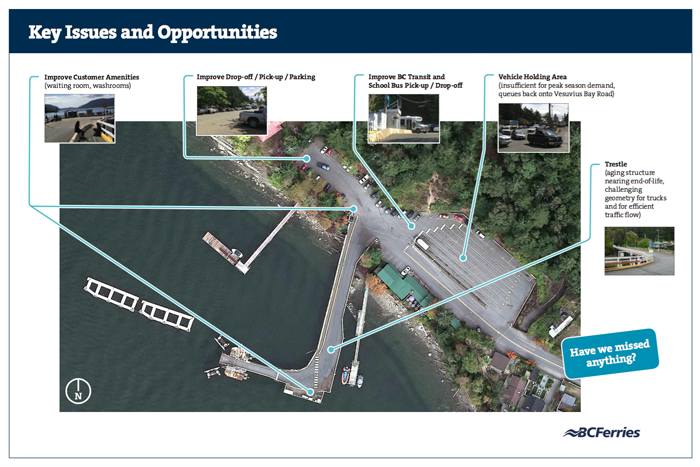
Members of the public have their chance to help shape the development of the Vesuvius ferry terminal, with consultation materials and draft concepts now available on the BC Ferries website.
The corporation’s terminal development team has been working with the Salt Spring Ferry Advisory Committee and stakeholders to identify key issues and opportunities at both the Vesuvius and Crofton terminals since the spring of 2019.
BC Ferries presented two draft ideas for Vesuvius to the FAC and to a closed stakeholders’ session earlier this month. According to the public engagement materials, the final plan will likely involve a combination of elements from both options, rather than endorsing one or the other as drafted.
As presented, both options would increase parking on the terminal site and extend the holding space for vehicles waiting to board onto the trestle, similar to what is done now in Crofton.
In both concepts the trestle would be rebuilt to decrease the grade, and would be curved to eliminate the current right-angle turn that is difficult for commercial trucks to manage.
Option one would accommodate 70 standard vehicles combined in the holding area and trestle, and provide 38 additional parking stalls. Option two would take out some of the steep bank at the edge of the holding area, increasing the space to permit 79 vehicles waiting to load and 52 parking spaces. This option also has traffic leaving the ferry from the left side of the trestle, switching the usual lane direction that Canadian drivers are used to operating under to allow more parking on the trestle itself.
Both options include room for two bus stops, as well as a waiting room with washrooms. Option one puts the waiting room on the hill side of the compound between the current parking and holding areas, while option two puts it on the water side adjacent to the top of the trestle.
Opportunity for public feedback on terminal concepts for Crofton was closed on Nov. 15. A Phase 2 Engagement Summary is expected to be posted to the website in December, with a terminal development plan to be completed in 2020.
For more on this story, see the Nov. 27, 2019 issue of the Gulf Islands Driftwood newspaper, or subscribe online.
Construction has begun on the Centennial Park playground, with new playground equipment expected to arrive next week.
The old structures have been removed and crews are awaiting the delivery of new ones. In the meantime, the construction process has begun with site excavation and a new cement retaining wall to contain the play surface.
“The new playground will make use of natural materials like wood, rocks and rope,” said project manager Elizabeth FitzZaland. “Play features will include swings, a jungle climbing dome and a toddler parkour course. The metal rocking horse will be re-installed and the grassy hills will stay.”
Plans include the installation of a slide that will use the existing grassy berm, with the addition of some natural log steps. Wooden benches will also be installed near the younger children’s play area for parents.
Salt Spring Island parks and recreation manager Dan Ovington added that one of the new features will be a drainage system “so that the playground can be used year round and [will] no longer flood.”
Installation of the new equipment is scheduled for the first week in December, to be completed in time for the school holiday. The CRD will be holding a soft launch of the playground in mid-December to welcome families to the new facility. Additional landscaping will occur in the new year. An official launch of the completed playground planned for the 2020 Easter long weekend.
The playground update was the second phase of the Centennial Park master plan. The first phase was the construction of a new washroom and drainage system under the park. Planning had been underway for much of the past year, and included public consultation in the spring. Funding to the tune of $100,000 for the playground structure was provided by the Salt Spring Island Lions’ Club.
“The next phase is to address the uneven parking lot and front promenade as well as direct flow out of the market onto the sidewalk and not into the Harbour Authority’s parking lot as it currently does,” Ovington said.
He explained that funding for that phase has been allocated for 2020, but that work would not begin until after the market season is finished next year.
A farmer who has been working the land within Ruckle Provincial Park for close to 30 years will get another 20 years at the project with the operating lease for Ruckle Farm awarded to Mike Lane.
When the 529-acre Ruckle Provincial Park was created in 1974, the 82-acre farm property and three heritage homes were reserved for living members of the Ruckle family, who first homesteaded the land in the early 1870s. That area was handed over to BC Parks’ management when the last remaining family member, Helen Ruckle, died.
A request for proposals for the farm’s management and operation was issued in June 2018.
The B.C. Ministry of Environment confirmed last week that Lane Agricultural Management Ltd. was the successful candidate. The news will be a relief to community members who rallied for Lane and his wife Marjorie to remain on site.
“There was a lot of support from the community. It was great to receive that from them,” Lane said.
Lane’s company has operated the farm for the past year under permit with BC Parks, and did so for approximately 24 years previously under the direct management of the Ruckle family. The new 20-year lease will begin Jan. 1, 2021.
According to the request for proposals, BC Parks wished the operating area “to evolve and to be used in a way that maintains the integrity of the property while functioning in a financially sustainable way that benefits the park and park visitors.”
Lane said he hopes to increase production of the food crops (not including livestock), but otherwise the farm will be very much business as usual. They may also host a few more events such as weddings and reunions.
Ruckle Farm’s contribution to local agriculture is well known to the community and to visitors to the Salt Spring Fall Fair, where Lane’s sheep dog demonstrations are a mainstay of the annual weekend’s activities. The farm is often represented in the exhibition section as well — in 2019 they took home the high aggregate trophies for vegetables and field crops, plus best family garden exhibit.
Visitors to Ruckle Provincial Park also enjoy the experience of going through the oldest active working farm in the province, even if they may have to slow down to avoid free-ranging sheep and turkeys. The farm is also home to an annual farming heritage day.
A well-loved tradition in island theatre returns this year with a new venue and new presentation style, making the 2019 run of Christmas with Scrooge at Fulford Hall an experience not to miss.
Opening Friday, Dec. 13 for a run of eight dates, the immersive musical theatre event by Newman Family Productions will feature an all-new “in the round” staging sure to enhance the connection between audience members and performers.
“It’s very exciting and creative,” said company lead Sue Newman. “There’s a very different kind of blocking that has to work in a very natural way, and for audiences it’s a more intimate way of watching and listening to a story.”
Christmas with Scrooge is known for involving nearly as many community members on stage and behind the scenes as can fit into the audience. Even with a slightly exaggerated “cast of thousands,” though, Scrooge is also known for its high quality of entertainment. Year after year it leaves audiences embracing the Christmas spirit with almost as much fervour as the title character after his amazing transformation.
The play began life in 1971 as Christmas Madness, a short musical adaptation of the classic Dickens story A Christmas Carol. Island newcomers Ray and Virginia Newman created the company and involved their three children partly as an avenue to build community in their new home. The play developed and expanded through many repeat presentations thereafter.
When Virginia died in 2013 at age 90 (Ray having preceded her in 1999), it seemed an era had passed. The company had stopped staging Scrooge after its 20th run in 2007. But after multiple requests from the community, Newman Family Productions committed to at least one more five-year run, to end with the 50th anniversary extravaganza in 2021.
Lack of availability at ArtSpring brings the show to Fulford Hall this year, which led in turn to the innovative “in the round” staging decision. For a show that started out playing island venues such as Central, Mahon and Fulford halls, the change is more than just an opportunity to switch things up.
The shows runs Dec. 13, 14 and 18 to 21 at 7 p.m., with matinee performances at 2 p.m. on Dec. 15 and 22. Audiences are urged to arrive early to soak in the festive Victorian environment.
Tickets are available at Salt Spring Books.
For more on this story, see the Nov. 27, 2019 issue of the Gulf Islands Driftwood newspaper, or subscribe online.
Local governments across the country have declared “climate emergencies” in the past six months, including the Capital Regional District and the Islands Trust.
The Gulf Islands Board of Education is talking today (Nov. 27) at its committee meeting about making a declaration. The Salt Spring Local Trust Committee was also set to discuss making climate change a top priority at its Nov. 26 meeting.
But many citizens are asking themselves if such declarations have any meaning beyond being a symbolic gesture or seeing a couple of electric vehicles added to the corporate fleet. What kind of action is both required and feasible in order to plug the hole in the dam of climate change impacts?
In trying to answer that question locally, volunteers are taking a leadership role — as is often the case on Salt Spring — in trying to develop an action-oriented plan. island. (Some government involvement exists through funding and in-kind support,and CRD and Trust officials are ex-officio committee members.)
This isn’t the first time that volunteers largely stepped up to put the spotlight on climate change. A group called the Earth Festival Society first got the ball rolling way back in 2003 to undertake the Salt Spring Island Energy Strategy and the resulting Climate Action Plan, which was released in 2011. Its stated aim was “to support a reduction of at least 15 per cent in greenhouse gas emissions by 2015; at least 40 per cent by 2020 and at least 85 per cent by 2050 based upon 2007 data.”
As a new group of islanders sets out to create another climate action plan, with the aim of reducing GHGs by 50 per cent by the year 2030, it seems obvious that an evaluation of the document created eight years ago should be part of the process. How close did we come to meeting the targets set out in the 2011 plan? What unforeseen challenges arose during and after the plan’s completion?
For the 2019-20 project, an online “eDemocracy” platform will be used to facilitate input gathering, and a casual brunch discussion about the new climate action plan is set for this Saturday, Nov. 30 from 10 a.m. to noon at Gulf Islands Secondary School. It’s sure to be a lively morning that will benefit from as many motivated participants as possible.
You may have recently heard or read about James Rickards’ bestselling book The Death of Money, describing the collapse of global currency and how it would bring down the world financial system. This week’s Nobody Asked Me But . . . column has nothing whatsoever to do with this particular topic.
No, the subject I wish to dissect here is the death of cash. You remember cash, don’t you? Whether you know it as bucks, coinage, scratch, scrip, dough, bread, lettuce, green, smackers, moolah, samoleons, or dead presidents, I’m sure you recognize that it is something you can hold in your hand and exchange for something you want.
Just think of all the adages and aphorisms that cash has given the English language. Will future generations have a clue as to what you mean when you say the buck stops here? How much is a penny for your thoughts worth? What in tarnation are you referencing with heads I win, tails you lose? Is it a good thing when someone tries to nickel and dime you? Should you give somebody your two cents worth? What exactly does it mean when you want to cash in?
I believe it was the great circus mogul P.T. Barnum who is credited with the quote, “Nobody ever lost a dollar by underestimating the taste of the American public.” Would it have worked if he had used the word “bitcoin” instead of dollar? If you are like me, you probably would like to know what exactly is a bitcoin? A Google search comes up with “bitcoin, often described as a cryptocurrency, a virtual currency or a digital currency — is a type of money that is completely virtual . . . This makes it possible to trace the history of bitcoins to stop people from spending coins they do not own, making copies or undoing transactions.” That makes about as much sense as the assembly directions enclosed inside the packaging of IKEA furniture.
What would be more useful is to know whether you can flip a bitcoin and have it come up heads or tails. Will bitcoins jingle in your virtual pockets? Can you use one to make a call from a payphone? (Whatever that is.) Will it substitute for a screwdriver if you need to open up the battery compartment of your grandkid’s Thomas the Tank Engine talking book?
Let’s take a look at the pros and cons of using cash versus other forms of exchange for transactions. For one thing, cash doesn’t run out of batteries. It can also be used during natural disasters when there is no power. Even if it devalues to a fraction of its worth, it can still be used as fire-starter to help keep you warm. Another advantage to cash is that it doesn’t identify you or give away information about you that you may not want to share (other than the fact that you can afford to buy that overpriced and never to be used fondue set, say). You don’t have to download an app or pay exorbitant transaction fees for the convenience of not having to carry a wad of cash with you. Mind you, you are still forced to carry around with you 22 other credit, debit and shopper points cards just in case you find an incredible deal that isn’t on your shopping list.
Although 85 per cent of the world’s retail purchases still rely on cash, non-cash transactions are rising at a rate of 11 per cent annually. As recently as 2017, Forex Bonuses trading site listed Canada and Sweden as the top two cashless countries, with only approximately 20 per cent of transactions involving cash.
I’m one of those 20 per cent. I’m the dinosaur who still always carries cash with me. Bills in one pocket and coins in the other. I’m the geezer in front of you at the Country Grocer checkout who not only pays in cash but insists on fishing out coins from deep down a side pocket so that he can pay the exact amount without having to force the cashier to make change for a larger bill. It sounds something like this: “I know I’ve got the right change here somewhere. Let’s see, 20 dollars and 40 cents, eh? Okay, here’s a 20. Now there’s a dime. Another dime. Oops, that’s my dental floss. Now there’s a quarter. How much have we got now? Too much? No, no. No need to give me a nickel change. Give me back that dime and I know I’ve got a nickel down there somewhere. Just hold my car keys and my pocket knife and I’ll find it in no time.”
Sound familiar? In the meantime, you and the 12 shoppers behind you are frustrated to just about the boiling point while I’m checking the date on that last nickel to make sure it’s not a collector’s coin worth thousands of dollars.
The drawbacks to having real money in your purse or pockets? For one thing, cash has to be stored and protected. Once it is lost or stolen, there’s little or no chance that it will be returned to you. Another problem that most of us are forced to learn eventually is that once it is spent, you have to somehow get more. This may mean a trip to your financial institution to make a withdrawal, or failing that, you might have to actually go out and earn more of the stuff.
Another argument against cash is that it’s not exactly convenient for making large transactions like coming up with the down payment for a house, for instance. Unless your aim is to do a little money laundering for some nefarious business dealings, you would probably need to back up a Brink’s truck filled to the gills with 50-dollar bills if you wanted to invest in some Salt Spring real estate with some cold, hard cash.
Nobody asked me, but with the younger generation opting for PayPal, e-transfers, cryptocurrencies and mobile apps, there will probably come a time when nobody will want to take my two cents worth (especially if the global financial system does come crashing down). If I’m still around then, you can be sure I’ll still be reaching way down into my pocket and paying with something that still has value. Dental floss.
Many thanks to all those people who’ve been writing in the past few weeks, attempting to alert islanders to this vague CRD Bylaw 4325 being promoted by Gary Holman and friends in Ganges.
The law’s preamble states:
A.) Under the Local Government Act a regional district may operate any service the regional board considers necessary and desirable.
B.) The Capital Regional District may provide assistance for the purpose of benefitting the community or any aspect of the community.
The bylaw goes on to give the CRD the authority to largely duplicate services we’re already paying other levels of government to provide. It also opens the door to many ill-defined other services/needs which can be included later in this vaguely worded document.
Somehow I don’t see this tax bite being held at the cup of coffee levels as promoters have suggested.
Some of you may have noticed that on Salt Spring many of our existing laws are completely ignored with impunity by officials when it suits them. Or that our laws can be easily amended later without requiring a public vote.
I recently attended the CRD office to get a few copies of the bylaw for my household and was refused. CRD staff has been instructed to only give out one copy per person.
That’s a nice way to keep the numbers down. Screw the shut-ins, non-computer friendly residents and those who are absent or don’t read the Driftwood. They have no idea this process is even happening.
Those of you like myself who aren’t up to speed should know this Bylaw 4325 has already received three readings. All that is required for passage is your inattention.
In my opinion, this law is just the tip of a very big wedge. The CRD and friends have written themselves a blank cheque and signed your name to it. They are now standing at the teller’s wicket hoping you’ll be too uninformed, busy or distracted to act.
Don’t think because you’re a renter you’ll exempt from these costs. Some of the unacknowledged factors making housing unaffordable are the local government’s imposed services, fees and taxes.
Another concern I have is that even if you do vote, your response will be taken off Island to be controlled by the CRD, who have created and stand to profit from this law. How would we know if their count is even legitimate?
Your vote — the elector response form — has to be in the CRD office in Victoria by Dec. 9, according to the law. It can also be returned to the CRD office on McPhillips Avenue in Ganges.
This story originally ran as a three-part series in the Driftwood from Nov. 6 – 20, 2019.
Plant-based, biodegradable and compostable plastics have been marketed as ways to continue plastic use in an environmentally-friendly way.
A plant-based fork after months in an industrial composter.
Many plastic items make it through to the other side.
Jack Vanderbasch shows a “green” plastic bag that did not compost.
Most of the remnants end up in a landfill.
Coast Environmental composting facility in Chemainus.
Plastic is baled and transported from Salt Spring to the lower-mainland.
Kristen Battle sorts a week’s worth of plastic at the writer’s home.
Two months worth of plastic to be recycled from Nina Raginsky’s home.
Raginsky uses almost no plastic to store her food.
Bulk goods are stored in jars at Raginsky’s home.
Words to live by. Nina Raginsky’s motto.
Elisa Rathje shows her plastic-free shopping equipment.
Jars used to store tea at the Rathje home.
“I really like how beautiful things are when there’s no plastic,” Rathje said.
Part One: The broken promise of green plastics
Plant-based, biodegradable and compostable plastics have been marketed as ways to continue plastic use in an environmentally-friendly way.
“Would you like a fork with your food?”
She smiled as she handed me my takeout box holding a piece of chocolate cake I purchased at an event on Salt Spring Island. “It’s compostable, so you don’t have to feel bad.”
In the server’s outstretched hand was a plastic fork with the word “compostable” embossed on the handle. Next to the table was a waste disposal station, complete with a bin for compostables. Inside was mainly discarded food amongst cardboard food trays, plastic cups, forks and knives.
Compostable plastics represent the promise of a future where we’ve fixed all of the problems associated with plastic without having to break our addiction to single-use items. I was told that I didn’t have to feel bad about using that fork. However, I couldn’t help but feel like it was all too good to be true.
When people think of compostables, they think about materials that will rot and disappear, magically turning into soil within a few months. In that way, compostable plastics are not what they seem. Compostable plastics have been touted as being part of the “solution” to waste for a long time. However, they are not the panacea they’ve been made out to be.
Some clarification in terms is needed, as the plastics we are discussing are often confusing, even for the professionals who deal with them on a daily basis.
Bio-based plastics, biodegradable plastics and compostable plastics are all completely different things, and act in very different ways after they are disposed of. Bio-based plastics are conventional plastics that are made from biological ingredients like plant starch, as opposed to petrochemical ingredients. In B.C., bio-based plastics are recyclable, according to Recycle BC spokesperson David Lefebvre, as they are essentially the same as conventional plastics.
Many plastic items make it through to the other side.
“Biodegradable” and “compostable” are similar terms. Biodegradable means a product will be broken down into harmless particles. However, there is no time period attached to the designation, and the biodegradation process can lead to microplastics being integrated into the environment.
Compostable products need to be certified by organizations like ASTM International. They need to fit very specific standards and must degrade in an industrial facility within a specific time frame, one that is similar to other compostable items like food waste. Compostable plastics cannot leave harmful residue, and they must break down entirely into harmless particles within that time frame. Compostable products will have a certification label attached. Anything that does not have a label is not compostable.
“There’s all of these different terms that are being used, and a lot of people don’t necessarily have a great understanding of what each of those terms mean. If they don’t understand how to differentiate them, then they definitely won’t understand how they might impact the system or how we might be able to process them,” said Lefebvre.
Jack Vanderbasch, manager of the Coast Environmental composting facility in Chemainus, agrees: “That’s the pain in our asses. It’s the misconception between biodegradable and compostable,” he said as we walked through the parking lot at the facility.
Coast Environmental takes in about 30 tons of compostable materials from green bins and local businesses per day and turns it into usable compost for resale. Vanderbasch was happy to invite me on a tour of his facility, saying that it really wouldn’t sink in unless I got a first-hand look.
Central to the operation are two tented composting buildings. The first is where compost is placed in aerated piles to break down. The piles are aerated through use of a computer system and after 43 days are moved into a second tent for curing. After curing for four months, the compost is ready for resale. The compost is tested at all stages to ensure it meets health standards set out by the province. Before going to market, it goes through a sorting machine that separates out the larger pieces, which are sent through the system again. This pile is what Vanderbasch really wanted to show me.
Coast Environmental composting facility in Chemainus.
“After it’s screened, this is all the oversized bits that come out,” he explained as we walked over. “It’s pretty much garbage, but we’ll put it though again. It’ll go through three or four times just to make sure we get as much wood product out as we can, because it’s compostable.”
What looked like a mound of blackened wood towered at least two metres over my head. Vanderbasch reached into the pile and pulled out a plastic fork. After four months of being composted at extremely high temperatures, the fork looked no different than the one I was given with my piece of cake and told not to feel bad about.
“This one says ‘made from plant-based product.’ That’s probably been in there for four months,” Vanderbasch said. “When they put the wording on there that it’s made from plant starch . . . it’s still plastic.”
As I looked at the pile, more and more plastic popped out at me. Plastic dog-waste bags, onion bags, wax-coated juice cartons, chip bags, all looking like the day they were made. Vanderbasch said that most of the wood material would be composted after a few more cycles, but eventually this pile would end up in the landfill.
“The temperatures that we get to are 90 degrees Celsius. That’s boiling water,” he said. “When it gets to that temperature, you’d think it would compost. A lot of the stuff we take disappears. It composts, it does what it’s supposed to do. Those forks will not disappear. I don’t know what the answer is.”
Vanderbasch has been trying to spread the word that plastics like these should be avoided, since the ambiguous terms make people think that everything can be composted. While some things do disappear into compost, the vast majority of the plastics he receives are in there because of a misunderstanding.
“I started going to the schools and doing seminars,” he said. “I figure the way I’m going to get to the parents is through the children. I was telling nine or 10 year olds if they see their parents putting stuff and plastic in the green bin, to tell them they can’t do that. It’s their planet.”
Most of the remnants end up in a landfill.
Provincially, there is currently no regulation that defines compostable plastics. The Ministry of Environment and Climate Change Strategy is working to include compostable plastics following ASTM standards as they update their Organic Matter Recycling Regulations. When the update comes, there could be a future for this kind of material in B.C. Compostable, bioplastics and biodegradable plastics do only make up around one per cent of the total plastic market, according to Lefebvre. But that amount is growing, and all of that plastic will need to go somewhere.
Industrial composting facilities, combined with education and regulations, may provide a solution to the compostable plastics problem for most people. However, where does that leave communities like those in the Gulf Islands, without direct access to such facilities?
Part Two: Sorting it out, a look into local solutions
Plastic is baled and transported from Salt Spring to a processing facility.
I try to make it to the recycle depot at least once per week. The night before, my wife Kristen and I sit in the kitchen and sort through the week’s worth of recycling.
We try to avoid sending things to the landfill, and we also maintain a backyard composter for food scraps. Every week, as the piles of various kinds of recyclables get higher and higher, the plastics end up dwarfing the rest.
The Salt Spring Recycling Depot is operated by Salt Spring Community Services under a longstanding contract with the Capital Regional District. It is also part of the Recycle BC program. Recycle BC coordinates all consumer-based packaging and paper recycling in the province, operating on a “producer responsibility model.” Producers and distributors pay into the system, based on the amount of packaging they bring into the province.
“More than 1,200 producers are obligated under the legislation and are members of the Recycle BC program,” explained Recycle BC spokesperson David Lefebvre. “Every single one of those has to report to us and tell us how much of each individual material they’re putting into the marketplace. From that, we look at the costs of managing those materials, the revenues we get from marketing them. Then we’re able to set a fee rate based on each individual material.”
Plastic is compressed using these machines, then sent to a facility in the Lower Mainland.
All materials, including various kinds of plastics, are distributed to central locations in the province. Plastics are sent to a company called Merlin Plastics based in the Lower Mainland. Merlin breaks down the material into the raw materials for the plastic industry, which re-uses them to make new plastic products. Only a small portion of the plastics collected in the province are sent overseas to a factory making picture frames in China. Recycle BC’s goal is to build a closed-loop system in the province to ensure all of the materials under its mandate are entirely recycled here.
Recycle BC‘s program is established based on definitions set out by the provincial government. Bio-based plastics are designed to be a part of that system. However, compostable and biodegradable plastics are not.
“If you look at your traditional compostable plastic fork, that item is actually not part of the Recycle BC program at this time. It’s not a regulated or mandated item and it does not form part of the packaging and paper that we collect. That would be considered a single-use item,” explained Lefebvre.
“Plastics that are deemed compostable can present a challenge in terms of their recyclability, and they can have a negative impact on the overall quality of the material that we recycle if they enter into the stream,” he added.
Recycle BC follows regulations set out by the provincial government. As of right now, compostable plastics do not have a government-mandated definition and, as such, the recycling industry does not know what to do with them. The government has been working on a single-use plastic plan that will help determine how these materials can be recycled, and how they can fit into the existing regimen. Until that time, there is not much that recyclers can do with the stuff.
Lefebvre explained that the compostable plastics that do end up in the stream get turned into a fuel that can be used in place of coal. While this kind of thing lessens our resource extraction, it is still a single-use solution and it produces a hydrocarbon-based fuel that emits greenhouse gases when burned.
So when a customer orders a drink served in a compostable plastic cup on Salt Spring, what are they supposed to do with their garbage? Right now, there is no good answer.
Michelle Mech is a member of Plastic Free Salt Spring and has worked to develop plastic action plans for politicians and local causes. Mech has become exasperated with the state of things on the island, and has reached the point where it makes more sense to her to use single-use plastics than their compostable alternatives.
“If you were to get a compostable cup on Salt Spring there is nowhere for it to go,” she said, adding that compostable plastics are “worse than plastics, because at least plastics can be recycled.”
Mech has been looking into ways to reduce plastic consumption on the island. She has spoken with local grocery stores, consulting on how and if to switch to compostables. Unfortunately, she describes it as a “chicken-and-egg” situation. Grocery stores here get their food waste shipped off-island to an industrial composting facility. Mech explained that one truck comes to the island per week to pick up a shipment.
“The once-a-week truck is full,” she said. “They would only send another truck if we can get it full or close to full again.”
“Compostables would be great if they could be sent to an industrial composter, but otherwise they’re not good,” she added, speaking about whether or not grocery stores should convert their packaging to compostable plastics. “It broke my heart to tell them to go back to plastic. I hate plastic.”
In 2015, the Capital Regional District banned organics from the Hartland Landfill, and since then companies have had to turn to the private sector for compost disposal.
Residents sort their recycling by type, which helps streamline processing.
The idea of building an industrial composter on Salt Spring has been floated for years but it has not yet happened. Based on a lack of viable options for compostable plastics, islanders have little choice when it comes to disposing of the materials. Until the provincial government comes out with its regulations and definitions, Recycle BC’s hands are tied. However, Lefebvre told me that after the regulations are public, Recycle BC should be able to integrate the plastics into their system, and have manufacturers pay the cost of recycling them.
“The challenge we have right now is that there’s no recycling solution for those materials,” he said. “The Organic Matter Recycling Regulations will hopefully provide some standards, which will then hopefully point the way towards a solution.”
Other organizations are working to solve the problem as well. The CRD is undertaking community consultation for its new Solid Waste Management Plan, which includes 15 strategies to help improve the services, including increasing organic diversion and processing capacity. An open house will be held on Salt Spring on Nov. 28 at Meaden Hall from 2 until 6 p.m. The public comment period is open until Dec. 1.
Recycling as an industry is based on a closed-loop model, or circular economy, where things that get put into the system are re-used to maintain it. While the system helps reduce raw material extraction and keeps single-use items from being wasted, a few problems do exist. Recycle BC only looks at residential recycling, not commercial. Also, items like compostable plastics can fall through the cracks in the system. A true closed-loop would ensure that nothing is wasted, and they cannot guarantee everything brought in to the province ends up in the recycling stream. Yet, Mech and Lefebvre both think this is the best option we have right now.
“If you’re looking at it from a circular economy lens, being able to recycle plastic effectively like we are here in B.C. is an environmental outcome that is beneficial,” Lefebvre said.
Mech agreed, to a point, saying that “if they’re handled correctly and we can make a circular economy out of them in the interim as we get to a more waste-free state they’re okay.”
However, as I loaded my recycling into the car for the weekly drop off, I saw a bio-based fork sitting on top of the plastics pile. I couldn’t help but wonder, why do we need so much plastic anyway?
Part Three: Finding an Alternative, Single-use solution lies outside of plastics
Bulk goods are stored in jars at Nina Raginsky’s home.
Imagine living without a garbage can.
Most of us probably couldn’t. I know it would be hard for me to do. Most of our homes have a can under the sink in the kitchen, one in each bathroom and one in each bedroom. Elisa Rathje got rid of hers 10 years ago.
“What I found was when I had a garbage can, I thought like it,” she told me as she was giving me a tour of her plastic- and waste-free north-end Salt Spring home. “I looked at things as though they were garbage.”
Her family’s home looks like it has gone back in time. Jars of spices, tea, coffee, grain and other staples line the shelves, a pantry filled with preserves and other scratch-made goodies have been put up for the winter ahead, and a flour mill is clamped to the counter surface. Ducks and chickens roam freely outside among the bamboo trees. They are also waiting for a big order of squash to come in, and that will sit on the porch for the winter. Rathje and her daughters dress in clothes made from natural fibres to lessen the amount of plastic they use. Even their bathroom is without plastic, with a sheet of linen for a shower curtain and refillable containers for soap and shampoo.
Elisa Rathje and her plastic-free shopping bags.
Despite their apparent banishment of synthetic polymers from their home, the Rathjes are not perfectly waste-free.
“I don’t love the term ‘zero waste,’ because it’s part of a system,” she said. “When I started buying in bulk I was shocked about how even they wrap plastic around a pallet. You get your things delivered, and it’s covered in plastic at the outset. Or with jars, you think you’re buying jars with metal lids, but it’s covered in plastic.”
Some of the problems Rathje mentioned were lids from milk jugs, butter wrappers and the dust that accumulates in their home. I asked Rathje about recycling, since the closed-loop consumer recycling system in B.C. is relatively environmentally neutral. Besides the time it takes to dispose of everything at the recycling depot (the Rathjes are car-free), to them, recycling should be considered a last resort rather than the first and only option.
“It’s difficult for us to see the huge amount of resources it takes to make these things. It’s just so normalized,” she said. “Any time we can just reduce the whole flow in the system is better.”
Embedded energy is the measure of the materials needed to create something. Think about how much it costs to buy a plastic fork. In some situations, it costs absolutely nothing to the average consumer, since they are handed out for free at the point of sale. Bags of bulk plastic cutlery are available for a few dollars each, with around 50 forks per pack.
What then is the cost of making a plastic fork? That question is a bit harder to answer. A typical plastic fork is made from polypropylene, which is injection moulded into the rigid shape. A database of carbon and energy used in the production of everyday materials created by former University of Bath researcher Craig Jones states that polypropylene, when it is injection moulded, uses 4.49 kg of carbon dioxideto create one kilogram of material. It also uses 15 kWh of energy to create that one kilogram of plastic. That is without counting the transportation energy, additives, colourants or packaging of the final product. Bio-based plastics do not require the extraction of oil as a base material, but plant-based alternatives do require farmland, pesticides, energy and transportation, and are often used only for a short period of time like their synthetic cousins. For comparison, plastics in general use 3.31 kg of CO2 per kilogram. Nylon, which makes up most synthetic textile fibres, uses 9.14 kg of CO2 per kilo, and high-density polyethylene, which is used to make most packaging, uses 2.52 kg of CO2 per kilo.
Researchers from the University of Pittsburgh found in 2010 that during the manufacturing process, green and bio-based plastics generally were worse for the environment than synthetically derived ones. The research team attributed agricultural fertilizers, pesticides, land use and chemical processing to the large impact of the plant-based products. However, once manufactured, the bio-based plastics were much more eco-friendly than their synthetic counterparts.
Plastic is a relatively new invention, and it is possible to store food without them.
If plastics of all kinds take this much work to create, and are generally thrown out after their first use, I wondered: Why bother to use them at all?
Plastic is a relatively recent invention. The late 19th century saw multiple polymers developed, and in 1907 the first fully synthetic plastic was created.
When Nina Raginsky, a retired photographer living on Salt Spring Island, was growing up, there was almost no such thing as plastic. She was born in 1941, the same year polyethylene terephthalate (PET, the plastic used in plastic water bottles and eventually synthesized by bacteria into bio-based plastic) was invented. As plastics took off in the post-war years, Raginsky was early to resist the trend.
“I don’t know why I didn’t want plastic,” she said. “All of a sudden there was a plethora of it, because everybody wanted it. It’s so recent . . . I raised my daughter with no plastic. She couldn’t have plastic dolls or anything. She’s 40-something now. Even before then I had no plastic.”
She did, however, concede to using small amounts of plastic in the early days.
“I had a bakelite telephone,” she remembered.
Raginsky’s home is much like the Rathjes’. Her furniture all dates back to the 1960s or earlier, and she would much rather fix something than throw it away to buy a new one. She excitedly showed me a towel imprinted with a saying that would become her motto: ‘use it up, wear it out, make it do, or do without.’
Jars of spices, tea, coffee, grain and other staples line the shelves, a pantry filled with preserves and other scratch-made goodies have been put up for the winter ahead.
“It’s like the art of making do,” she explained.
Looking around the room, it was clear that it truly was the art of making do. As I had noticed at the Rathje home, things made without plastic simply looked better than plastic alternatives. A collection of plastic-free containers looks clean, orderly and beautiful. Replace those items with plastics and it looks like garbage. Both Rathje and Raginsky said that the move away from plastics forced them to look more at quality, since nothing could be purchased to simply throw away.
“I really like how beautiful things are when there’s no plastic. It’s an instant shift. Things are nicer looking without plastic,” Rathje said. “What you did before [was buy a good quality boot] and resole it and keep it going for your whole life. That would be nice. I would happily commit to something. I’ve been wearing my coat for 11 or 12 years. Now I look at it and think ‘I would buy that vintage.’”
“Why don’t you bring your own fork? We all used to do that, back in the ‘60s,” Raginsky agreed.
I am not at the point where I can live without a garbage can. I am working on it, though. I bring a travel mug with me when I want a coffee, I buy whole foods when I can, I recycle what plastics I use, and I avoid compostable plastics, since I can’t deal with them appropriately where I live.
I usually carry my own cutlery around with me too, except for the night described at the beginning of this series when I was given a supposedly “compostable” fork . . . that wasn’t.
Most pre-match discussion last Sunday revolved around important matters that were of consequence for the residents of Salt Spring.
Would they ever come to terms with the “Queen of Slumberland“ and the “Quititsa,”or whatever it is called in more polite conversations? Can we believe an Island Health study that shows residents of the other four Southern Gulf Islands have fewer mental health problems than Salt Springers, attributing the difference to the ambience and conviviality of the vastly superior passenger lounges of the Queen of Slumberland, as compared to the Skeena Queen’s more sterile utilitarian set-up?
The Old Boys would love the opportunity to have some input into the Skeena’s mid-life refit so as to have a private members-only Old Boys Lounge but with the opportunity to still mingle with the hoi poloi (of course I mean our friends, neighbours and colleagues).
On a more sporting note it appears the sock-inspired victory at the GISS Fortress last week has allowed manager Graham Tweddle’s jacket to be a little more secure than it’s previous shoogly-peg position. So far he has avoided the ignominy of Pochettino, who was summarily dismissed and replaced by Mourinho at Spurs. Old Boys and their fan base dodged a bullet there! Can you imagine the Special One coping with the fan abuse from some of the Old Boys’ more vociferous followers?
During the past week some Old Boys, jealous of David Toynbee’s front-page coverage in the Driftwood, were looking for various ways to be carried like royalty from the field of battle and give a royal wave to the masses in the home-team stands. It was only when Toynbee hobbled to the reserved-for-dignitaries area in the main Rainbow Road stand wearing his Das Boot (1981 film) did they change their plans after hearing the extent of his injuries. As one of the leading contenders for The Golden Boot Award he will need all his skill and his elbows to make a run for the trophy when he returns, hopefully after the midwinter break. Toynbee’s “Das Boot” is a fitting metaphor for the Old Boys, who like the U-Boat crew “must contend with tense conflicts and long stretches of confined boredom.”
Last week there were more balls than Old Boys at the warm-up, but this week, astonishingly, the Centaurs arrived with more players than the home team squad could deploy. Fans and team management had wondered which Centaurs would turn up: men or beasts? The only other note of concern was the absence of a second assistant referee to run the far-away touchline. The referee warned both teams that he would not call any offside in that half, to the consternation of all.
The Old Boys were still unclear if they should play Tik Tok or Tiki Taki tactics, but straight from the whistle it became abundantly clear that the 15-second slow- motion app was their tactic of choice, or should that be tactic of chaos? But a certain amount of self-inflicted pressure saw the Old Boys gird their loins and stride majestically down the right wing with Rainer Funk releasing Mike McCormick for a chance at an opening goal. Funk had a great opportunity from a free kick but almost disturbed customers in Windsor Plywood’s yard with his shot. Mike Davies and a Centaur defender had a clash of heads, which according to game rules must be halted. Davies had to be subbed! (Betty, he is fine, just a bit jangled and maybe still recovering from playing 92+ minutes in the previous week’s game.)
Using his speed, Ben Cooper tracked down a Centaur breakaway, averting an attempt on goal. Cooper also came to the rescue when he deflected a powerful shot that gave goalkeeper Richard Steel some difficulty. Then Cooper made a run from his own defensive third into the Centaur penalty box, but the build-up of lactic acid in the legs meant he was easily bundled off the ball to cries of “penalty” from the crowded stands. No penalty was called.
There seemed to an atmosphere of chaos in the team’s actions, maybe as result of the usual diamond formation being disrupted due to injuries and absences. The press box likened it to the televised impeachment hearings on C-SPAN lacking “pizzaz.”
The only remotely entertaining action came from Mark Aston, who was using his recent emergency kayak-rolling classes in the pool to good advantage. He would roll over at the slightest contact and dramatically appeal on his knees to the referee. He self-subbed before the ref had time to get his yellow card out for Aston’s “yapping.”
Funk got himself in a right funk and missed a Golden Boot Award chance with the net gaping, but managed to hook it past the post. Donny Brown decided now was the time to stamp his contribution on the game, but saw the Centaur make a great save to keep the scoreline at 0-0 as the half ended.
Half-time tactical discussions were non-existent and so the second half started much as the first half with a change to Wimbledon long-ball tactics with the big guy, Mike McCormick, up front. With little support from the midfield and short of their other main striker, Toynbee, chances on goal were far and few between. It seemed that the Old Boys had just been “cancelled:” disappeared from fans on Twitter and social media apps, Instagram, What’sApp (What’sUp more likely) and Tinder (maybe not Tinder!}. Even Tik Tok fans had stopped their Old Boy memes. Too slow even for slow-motion video?
Old Boys were in the wars. Dave Eadie had to leave the field — unaided, it should be noted — with a calf injury, and Dennis Shaw was struggling to find his early-season fitness. Back to the gangways instead of the elevator, Dennis. Even iron man Cooper was felled by a vicious close-range bullet to the nose, but up he popped back into the fray. The team’s medical staff were concerned that the second concussion may have cancelled out the first and would only act if he managed a third for his first “concussion hat trick.”
With Old Boys down to 10 men, Shaw bravely volunteered to return to the field, saying he “could not just stand about doing nothing” to help. A wag in the stands said, “You will not look out of place!” Ouch! But that fairly describes the state of the game as it stood as the minutes dwindled down to full time.
Cooper lit the blue touch paper and took off, and like many a firework it zig zagged across, up and down the field, but fizzled with no support up front. Not to be discouraged, he took a fast dribble, made a pass and streaked through the defence, looking for a return pass, but he was inadvertently tripped by a Centaur defender and went flying through the air with the greatest of ease. Fans in the bleachers held up cards — 9.9, 9.8, 9.9 and a 10 — in admiration for his ballet-like performance.
With no more rocket fuel in Cooper and everyone looking at the seconds tick off on the stadium clock, the referee brought down a veil to the proceeding with a 0-0 final score. It was a fair result with the Old Boys spurning enough chances to win and both goalkeepers performing to keep the score-sheet clean.
Post-game analysis was very muted with no one willing to blame or take the blame for a lacklustre performance. “There is a point when it becomes pointless!” Finally, some spoke up, indicating they had forgotten their “lucky” socks and everyone gave sighs of relief as the power of the socks had been interrupted. Still unbeaten at Fortress GISS!
In after-game conversations it was discovered the Centaurs had emailed out for volunteers to play the Old Boys as a counter-attraction to the Grey Cup final in Calgary. They offered free ferry tickets and their choice of tisanes or soft drinks in the Queen of Slumberland’s Tisanerie and it seemed to have worked, with a manager and four substitutes as well as 11 on the field of play.
Old Boys leave the comfort of Fortress GISS to play Cordova Bay 48s at Lochside turf field at 2 p.m. on Sunday, Dec. 1. Old Boys PR will send out emails reminding players of essential dress code items. It’s the socks!