PitchFork Social’s second to last concert of the season runs this Saturday, Sept. 7 when the Americana duo Honey Dewdrops comes to Fulford Hall.
Laura Wortman and Kagey Parrish have roots in the Appalachian mountains but now live in urban Baltimore. With gorgeous vocal harmonies and a versatile musical set-up that includes clawhammer banjo, acoustic guitars, mandolin and occasional harmonica, the Honey Dewdrops treat listeners to a raft of memorable, beautifully performed songs blending folk and acoustic Americana with a hint of bluegrass.
The duo has released five albums, with the most recent one being Anyone Can See.
As Baltimore Magazine says, “The Honey Dewdrops fill their fifth album with heart, and their sincere, stripped-down songwriting is just the kind of music we need more of. This music is sweet to the ears, easy on the heart, and will stick in your mind for some time to come.”
Saturday’s concert begins at 7:30 p.m. Doors open at 6 p.m. with pre-show dinner and beverages available for purchase.
Ian A. Sturgess
LCdr (RCN Ret’d) OMM
April 10, 1929-August 28, 2019
Ian was born in Newton Le Willows UK. He attended Manchester Grammar school, and then on to Southampton School of Navigation. Ian spent a short time in the British merchant navy before immigrating to Canada in 1953. Dad met mom on a blind date, and promptly advised her by the third time …“I am going to court you to the alter” – that wedding took place Remembrance Day 1954. Ian worked for the Canadian Pacific Railway (CPR) for a time before leaving to join the Canadian Navy from June 1959 to May 1976. During his time in the navy he was “on loan” to the province to Master the replica of the SS Beaver for the 1967/68 Centennial Celebrations (one of the highlights of his career). Ian also enjoyed his time as Master of the hydrofoil HMCS Bras d’Or (the fastest unarmed war ship in the world at that time) ending May 1972.
In January 1976 he was awarded the Order of Military Merit (OMM) by then Governor General Jules Léger. After retiring from the Navy, Ian worked as Master for a short time on the Pandora ll research vessel with The Institute of Ocean Sciences in Pat Bay. He moved the family to Salt Spring Island to work as a Master with BC Ferries. After Ian retired from BC Ferries in 1986, he taught navigation at Camosun College, and was a Master with the Oak Bay Marine Group up in Langara. Ian finally stopped working on the sea and began valiant efforts to be a farmer. With his index finger pointing, and telling those in the field “he would have their guts for a necktie”, a farmer he was not. Ian was one of the fortunate ones to live a long life (living in extended care for almost 3yrs) with the last 8 months a steady decline. Dad’s end came quickly; with a change in his breathing and mom by his side, it all stopped, quietly and peacefully – no stress; you couldn’t ask for better.
The family would like to thank Dr. Butcher for all his medical care, the Care Aids and Nurses in the Extended Care Unit and hospital – your care for our father/husband was a comfort and blessing. To Jenny Pickering, you kept me (Cydney) in order and we loved that it was you with mom and dad at the end. Thank you also to Christie at Haywards Funeral home for your support and guidance. Dad leaves his wife of almost 65 years June Sturgess, his son Leigh (wife Julie), son Jeffrey(wife Susan), daughter Cydney (husband Don), grandsons Jason and Aaryn Funk, Zackery Sturgess, step granddaughters Tami Funk, Ashley McNaughton, and step grandson Wally Funk and their families. There will be no funeral service at dad’s request. The family will have a private burial at sea. Bye Sturge!
John P. Urichuck
TOAD
April 29, 1950 – August 16, 2019
We lost our dear friend TOAD, on Friday, August 16 at 6pm due to medical complications from lymphoma.
TOAD was an adventurous man, born in Montreal, QC.
He worked hard in his early years with his brothers and sisters in their mother’s bakery. He later moved and spent many years travelling the golden triangle, e.g. candy trail in the Middle East.
TOAD decided to settle down on Salt Spring Island, creating an amazing network of friends and the adventurous life of an artisan gypsy.
He was skilled at foraging and bartering, always tried to make a trade. His garlic, wines, fresh veggies, and amazing meals will be missed.
TOAD would make your days interesting and leave you smiling, and maybe with a wet dog licked cheek if you were lucky.
TOAD will be fondly remembered by his cherished cat Beauty, close friends and family.
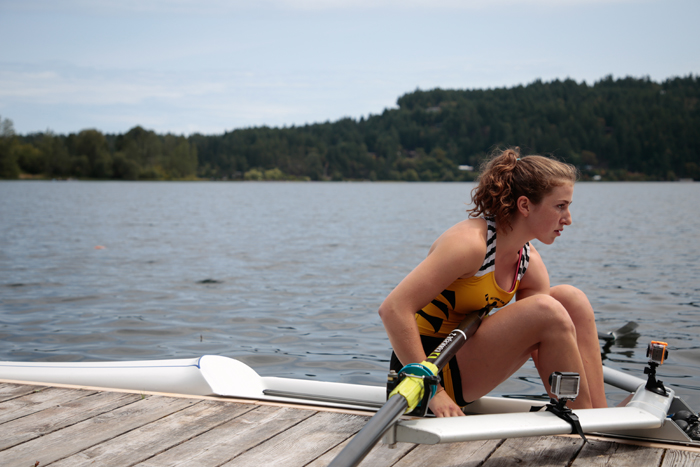
She continues rowing with the Brock University rowing team.
Reynolds has the potential to reach the Olympic podium in the next 4 to 8 years
She has been working with NextGen, a Rowing Canada initiative to help young athletes.
“No matter how much pain I’m in, I am still going to be able to finish the race.”
Reynolds spends almost all of her time training.
Coach Stacy Mitchell works with Reynolds through the summer. Reynolds still competes for Salt Spring.
Running and cycling are her summer cross-training methods.
Bonnie Reynolds was nowhere to be found.
The team from Salt Spring was competing in the 2018 Canadian Secondary School Rowing Association’s national competition in St. Catharines, Ont. when Reynolds, one of the senior girls on the team, disappeared somewhere on Henley Island. The small island holds nothing but the St. Catharines Rowing Club, and a small grove of trees. Eventually, with help from team members, coach Stacy Mitchell was able to track Reynolds down.
“She kept disappearing,” Mitchell said. “I was like ‘where the hell is she?’ I was getting stressed because of the timing. All the girls were saying, ‘Oh she’s over there in the trees.’ There’s one tree on Henley Island, and there’s Bonnie, underneath the tree.”
Reynolds grew up on Salt Spring, amongst the trees. She never considered sports to be an avenue for her; her interests lay elsewhere. Her goal was always to get an education that would help her work to protect the environment in a meaningful way. She is starting her second year as a political science major at Brock University in St. Catharines, with the goal of eventually going into environmental law.
She is also training to be at the top of a sport, with hopes of representing Canada at the Olympics.
“I didn’t see this as being my future at all, honestly,” Reynolds said while at home on the island this summer. “I saw myself pursuing political science, and pursuing environmental law after my undergrad, but I didn’t actually see doing sport in the picture. Finding myself here is mind-blowing.”
As a way to keep active in high school, Reynolds took to rowing. She describes herself as having long limbs and a good aerobic capacity, which translates well to rowing. As soon as she got on the water, her potential as a rower was evident. Her performance at that national competition in 2018 was enough for the representatives from Brock to spot her skills. She was offered a place on their rowing team, and moved to Ontario at the beginning of the 2018 fall semester to start training.
It wasn’t long after she started at Brock that she realized she had the potential to reach the pinnacle of the sport. By November, she took part in Rowing Canada’s NextGen scouting program, qualifying for the program with her two-kilometre indoor rowing score. NextGen is a pre-Olympic scouting program that identifies athletes with the potential to stand on the podium for Canada. It looks at athletes who are four to eight years out, and gives them special training and attention as they are groomed to the elite level.
“It means that she gets more support from the Rowing Canada coaches when she’s at Brock, and she gets things like physiotherapy,” Mitchell explained. “Her training is a bit more intensive so she meets the standards that are in place. Then she gets to do things like the national rowing regatta, the speed orders and the tryouts . . . It’s a higher level of support through it, and it means that her practices and potential are quite high.”
Reynolds does not get time off. In the fall season. Her alarm rouses her at 4 a.m. for water training. After hours on the water, she is off to classes. Training continues in the gym with weights in the evenings before it starts over again.
“Usually it’s still dark out,” Reynolds said. “A lot of times we train under the moonlight. We’re in this dark course. We have to put lights on the end of the boats so we don’t crash into each other.”
Winter training involves hours on the indoor rowing machine, as well as cross training in the gym. Her summer schedule has her on St. Mary Lake nearly every day, with running, weights and cycling as cross training.
“In rowing you can’t really take a break because you lose your fitness so quickly,” she explained. “When you’re already at an elite status, as soon as you take a couple days off your fitness drops. There’s not really a break. There’s downtime, but not a break.”
At the elite level of the sport, rowing becomes more than a competition of who can row the fastest. It is more about who can endure the most pain. Pain of that intensity was not something Reynolds had experienced before competing at university. During high school, she saw fleeting moments of pain, but never really understood what it meant until she trained for hours on the stationary rower one day.
“I was competing with another girl from Brock beside me, as well as all the other lightweight women in the room, but we were ahead by quite a lot. We were pacing each other, and by the time I reached 800 metres left to go, I started sprinting. I experienced more pain than I ever have in my life,” she said.
“My legs seized from the lactic acid. I couldn’t even finish, I was just going with my arms. Thankfully, I had enough of a lead that I still got silver, but I think what that experience taught me was that no matter how much pain I’m in, I am still going to be able to finish the race.”
Reynolds looks to meditation as a way to get through the pain. She finds it easiest to think of the pain as a form of adrenalin, and to use it as motivation to get to the finish faster.
“When you’re going to a race, it is inevitable that you’re going to experience more pain than you ever have doing anything else. You really have to get into the mindset that you’re strong enough to handle the pain, and that the pain doesn’t scare you,” she said. “If you’re strong enough to tell yourself that the pain will all be over once you’re done and that it’s worth it to go through the pain in the moment, then you can be successful. That is what success is in rowing.”
Though Reynolds is training under the auspices of Brock University over the fall and winter months, Mitchell said that the rower will still be representing her hometown at competitions and tryouts.
“She almost didn’t go to Brock, because there were not enough trees,” said Mitchell.
“She’s a Salt Spring rower. They give her back to me for all the championships, which is really nice,” she added. “I think what they recognize in Canada is that it makes a big difference for the smaller clubs . . . It means a lot to actually represent the club that you came from. Bonnie’s pretty Salt Spring-based. She loves it here.”
Seventy-five years ago this week, a Royal Canadian Air Force plane was lost off Saint-Malo, France with all seven crew members on board.
The Aug. 31, 1944 bombing raid marked the end of a month-long Allied campaign to wrest the island of Cézembre away from occupying German forces. The Halifax “If Any” was piloted by James Ralph Beveridge and was one of 170 aircraft participating in the raid. Though the crew was ultimately declared dead, the plane was never recovered and the men’s true fate unknown in Canada — until this year.
It’s late but welcome closure for Salt Spring’s Brian Pharis, whose grandmother never gave up hope her son George Pharis, the rear gunner, had somehow survived the crash.
“She thought he might come back,” Pharis said. “She thought he might be in a POW camp and that after the war he might have gone travelling. So she just waited, but of course he never came back.”
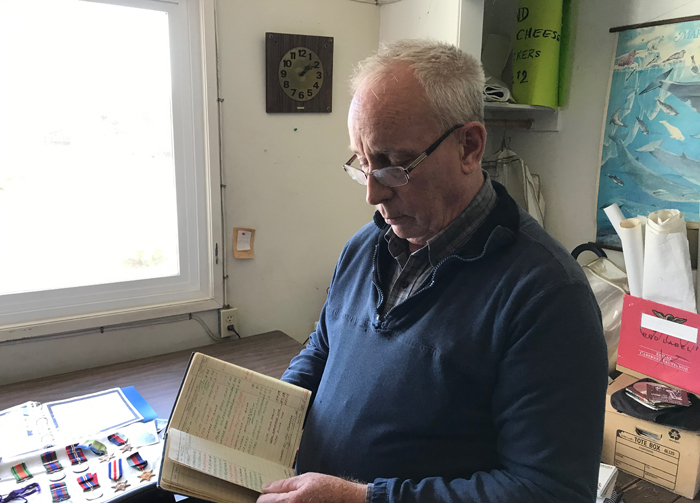
The family had already lost a son whose plane had crashed in November 1943. Pharis has the medals awarded to his father and each of his two uncles who didn’t survive the war.
Another British Columbian related to the lost crew is Debi Smith, whose second cousin Laurence Stanley Guernsey was on the plane. Smith has an interest in family history and had created family trees for the entire If Any crew and posted them on Ancestry.ca. Someone who saw that site notified her this spring the plane had been located at last. It turns out the plane’s wreck age had been the subject of an ongoing search that dates back 20 years.
Smith came to visit Salt Spring in July while she was in the area, having located Pharis through Canada 411 while looking for B.C. connections to the plane. She has also contacted a family in Ontario who were related to Beveridge, and a woman in her 90s who lost a brother.
“As we do this research, the story for me personally is seeing how many people were impacted and how traumatic it was,” Smith said.
Diver Olivier Brichet is part of L’Association Bretonne du Souvenir Aérien 39/45. ABSA [Brittany’s Federation of Aerial Memory] describes itself as a group of aviation enthusiasts of the 1939-45 period that aims to establish the complete list of air losses for the Brittany region. The association has gathered testimonies from people who lived through the Second World War to inform its work.
Brichet had received a list of planes lost at sea off Saint-Malo in the early 1990s and started his search for the If Any soon after. The nearby island of Cézembre had been the last German stronghold in the region to resist the Allied Forces’ summer-long Normandy Campaign of 1944.
“We go on the ground in search of crash sites, collect pieces of aircraft to reconstruct the history of their missions and their crews. We organize ceremonies to pay tribute to the Allied crews fallen on the ground of our departments,” the website states in French.
Brichet had received a list of planes lost at sea off Saint-Malo in the early 1990s and started his search for the If Any soon after. The nearby island of Cézembre had been the last German stronghold in the region to resist the Allied Forces’ summer-long Normandy Campaign of 1944.
“For the Americans, the destruction of this position is essential so that they can use the ports of Granville, Cancale and Saint-Malo for the transport of equipment and supplies that are vital to them,” Brichet writes in his account of the find.
The date Aug. 31, 1944 marked a definitive attack, with 165 Halifax planes from RCAF Group 6 and five Mosquito Pathfinders deployed to bomb the island. The If Any was part of the Porcupine Squadron, based at the Skipton-on-Swale field, North Yorkshire.
The recently released citizens of Saint-Malo were massed on the beach to watch the attack from across the bay, providing ample witness accounts in later years. According to those accounts, the If Any had just dropped its bombs when it was hit and started to rapidly lose altitude. The aircraft was too low for the crew to parachute, so Beveridge and his co-pilot decide to attempt a landing. The plane suddenly hit the surface of the water and then quickly sunk.
Numerous witnesses flocked to the beach to collect the possible survivors, but no bodies living or dead were found. Brichet spoke to eight of the people who were there after he made a call out to witnesses in 1998.
“It is very moving to read these letters written by seniors who were teenagers at the time. All have seen the bomber fall into the sea; however the versions diverge,” Brichet reports.
Brichet and fellow diver Thierry Trotin settled on a fairly large search area for their dives, covering a rectangle of one by two kilometres. Their attempts to scan the area by sonar turned up nothing. They would complete more than 40 dives in the span of 20 years.
Finally, in June 2018, they had a tip from a diver from Madagascar about the location of a three-blade propeller. The team located the artifact, found it did belong to a Halifax plane, and re-oriented from there. Several dives later in July 2018, they discovered a piece of isolated wing, and then discovered other debris, including the four engines. Trotin formally identified the aircraft by finding a “tacky shirt” characteristic of the Bristol Hercules engines that fitted the Halifax.
Brichet and Trotin shared their discovery with Rolland Mazurié de Garenne, the president of the Souvenir Français de Saint-Malo, and contacted the Canadian Embassy to find the families of the missing crew.
“It’s just too bad that my grandmother never got that information,” Pharis said. “She died 20 years ago, but she was always hoping. She never gave up hope.”
Salt Spring’s Pride Festival features a diverse range of activities and events this year, with a special evening to kick things off taking place at ArtSpring this Tuesday, Sept. 3.
The family-friendly event runs from 6 to 9 p.m. with entrance by donation and refreshments available for purchase. Participants will hear inspiring words to open the 2019 festival, more about what’s to come during the week, and a special announcement about what’s in the works for Pride 2020.
Miranda Caterer, the 2019 Pride coordinator for Diverse and Inclusive Salt Spring Island, said many new and inclusive events are being incorporated into the week’s activities.
“We’re hoping that many families will come out Tuesday,” Caterer said. “I think there will be lots for inspiration.”
A queer artists’ exhibit will be on view in the ArtSpring lobby, with art made by members of Salt Spring’s LGBTQ2SIA+ community. Members of the public can follow the example and get creative in several ways Tuesday night. A sign-making station will provide the opportunity to create signs for Saturday’s parade. Materials are provided, so ideas are all that’s needed. Everyone can also contribute to a large community banner that will be marched at the front of the parade this year.
The Art Jam allows creative types to bring their artwork into a space that is invigorating and inspiring, or to draw upon the evening’s discussions for inspiration. Participants are encouraged to bring anything they’d like to work with. Basic materials will be provided.
The evening will be capped with a Pride-themed theatrical performance and talk-back on the ArtSpring stage featuring a staged reading of An Interrogation Story in One-Act. The mock trial by island playwright Wendy Judith Cutler explores family dynamics, hetero-normativity, sexism, feminism and the complexities of living radically different from one’s biological family. The play will be preceded by Bedroom Confrontation, a short scene in which parents confront a daughter about her lesbianism. Lisa Dahling, Kevin Wilkie, Barbara Slater and Corrie Hope Furst perform. Audience discussion will follow, facilitated by Robert Birch.
A pull-out Pride guide with the full schedule of events will be published in next week’s Driftwood. The program offers everything from the spiritual to the frivolous and fun.
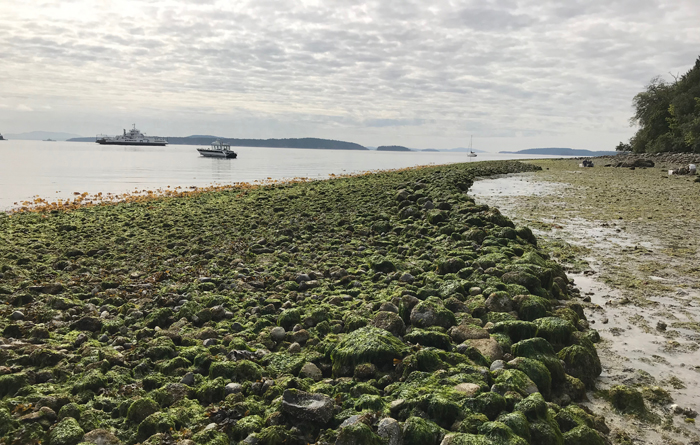
The clam garden wall located southeast of the Ruby Alton Nature Reserve, which stretches 800 metres long by 20 metres wide but is only visible during the lowest tides of the year.
Volunteers Kelda Logan and Noah Logan sift through a 25X25-cm cube of beach material to aid a Parks Canada bivalve survey near the end of Fulford Harbour.
Members of the public rolled up their pant legs and got their feet wet earlier this summer to participate in Parks Canada bivalve surveys taking place in and around the Gulf Islands National Parks Reserve.
Stretching nearly a kilometre in length parallel to the beach below Roland Road is a gently sloping, seaweed-covered rock structure. Visible only during the lowest tides, it forms a wide curb that boxes in a long strip of foreshore. When you know what you’re looking at, it’s immediately clear this is a constructed form. But without that knowledge, it would be possible to mistake it for a natural agglomeration of stones tossed up by the waves.
Nathan Cardinal, manager of resource conservation at Gulf Islands National Parks Reserve, said Indigenous clam gardens were virtually unknown to mainstream science until around a decade ago, although they can be found from the San Juan Islands up to Alaska. Carbon dating suggests the Fulford clam garden is at least 1,700 years old and one located just across Fulford Harbour at Russell Island is at least 1,000 years old. They are likely much older, and could have been actively managed for thousands of years.
Cardinal explained that clams naturally grow in just a narrow part of the intertidal area. By building the rock wall, First Nation inhabitants changed the shape of the beach and increased the optimal shellfish habitat. Stewardship practices such as aerating the beach also contributed. The protected area and artificial reef provided habitat for other food sources such as invertebrates.
“To take that action, First Nations people had to understand the tides, they had to understand currents and the local clam populations. It really speaks to First Nations knowledge of the ecosystem even way back then,” Cardinal said.
Clams were a major food source for non-Indigenous islanders who lived on Salt Spring during the Great Depression, such as Ruby Alton, whose former home is just up the beach. (She bequeathed her property to the community as a nature reserve through the Islands Trust Conservancy.) Even before that, colonial rules banned Indigenous people from accessing their former beach territories, and so clam gardens were left untended for many decades.
Parks Canada’s five-year project is a collaboration with the Hul’q’umi’num and WSÁNEC First Nations to revive clam gardens in the Gulf Islands National Park Reserve. Under First Nations guidance, the forgotten clam gardens have become active sites involving youth and elders from 10 different nations. Many research facilities and universities in Canada and the United States have also participated.
“It’s been a process where it’s become a real place of learning for everyone, and a real way of moving forward with reconciliation,” Cardinal said, noting Parks Canada acknowledges that First Nations partners are the experts, and tries to work in a respectful and culturally appropriate manner.
The Fulford clam garden wall has now been restored along half its length, partly as an experiment on ecosystem health. Parks Canada surveys seek to find the difference between how clams are faring in the restored garden area compared to the unrestored section, and compared to other park reserve beaches without any traditional structures.
The monitoring work involves randomly marking 25-by-25-cm plots on the beach and digging down 25 centimetres in 48 locations to uncover the clams below. Parks Canada counts, identifies and measures the clams before placing them back in the sand.
Cardinal said Parks Canada is talking with its Indigenous partners about what they would like to see happen in the long-term. The agency will also analyze all the data collected and try to provide some recommendations to inform a new intertidal shellfish management plan.
For more on this story, see the August 28, 2019 issue of the Gulf Islands Driftwood newspaper, or subscribe online.
The Dead Boats Disposal Society is continuing to clear coastal inlets and beaches of abandoned boats, with a work program targeting Pender Island completed last Wednesday.
Salt Spring-based society founder John Roe reported that through the federal Abandoned Boats Program, Salish Sea Industrial Services removed nine boats and extra marine debris from the area, including locations at Bedwell Harbour, Port Browning, Montague Harbour and Hawkins Island.
“It was a great day on Pender Island, with lots of people expressing their gratitude,” Roe said. “Many advisors on Pender assisted in inventories and finding owners.”
Around 100 vessels have been identified and approved for removal from the region. The society has created community inventories and also relies on tips from the public about problem boats. Most of the vessels Roe surveys have either sunk or smashed up on the beach and are slowly polluting the environment.
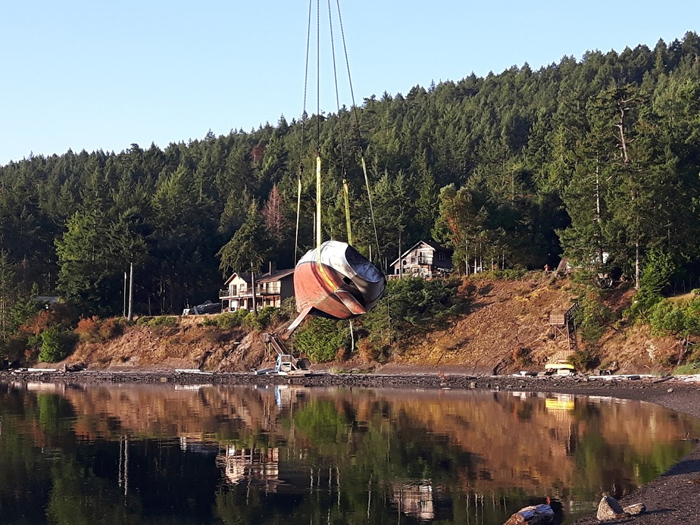
Boat owners who can be identified can sign over authority to have their abandoned vessel removed. If the boat’s owner cannot be identified, the society must issue a 30-day notice and make an application for removal with Transport Canada. Once the boat is removed with a barge and crane, it is tested for contaminants, dismantled and sent to landfills.
Roe attended the Capital Regional District Board meeting on Aug. 14 to give an update on the project and advocate for additional support, while director Ben Isitt introduced two motions related to ocean and shoreline health that were ultimately approved at the meeting. The first directs staff to explore potential improvements to local regulations, policies and programs, using the University of Victoria Environmental Law Centre’s report Cleaning Up CRD Waterways and Beaches as a reference.
The second motion asks staff to report back on the financial implications, potential partnerships and feasibility of mapping sunken vessels in select areas of the region. Suggested Salt Spring locations are Fulford Harbour and Burgoyne Bay, as well as Vancouver Island’s Sooke Basin, Esquimalt Harbour, Victoria Harbour, Gorge Waterway, Oak Bay, Cadboro Bay and Brentwood Bay.
Isitt explained the motion stemmed from an ongoing partnership between the Dead Boats Disposal Society and the CRD to make use of the federal funding for abandoned boats. Isitt acknowledged some directors might feel the matter of wrecked boats is best left to the federal government, but said he thought that would be a mistake.
“When you look at the results we’ve gotten in the last two years, when the CRD decided to take a small step outside our jurisdiction, the action we’ve gotten playing that coordinating function is amazing: 100 vessels dealt with,” Isitt said. “And so I don’t think we want to lose all of the momentum, all of the partnerships, by winding up the program when we deal with the vessels on the surface.”
Isitt added he did not support CRD money going toward sunken vessel removal, but did feel data gathering and coordination was an appropriate community contribution.
Roe spoke in favour of the mapping in a delegation to the board. He noted the Dead Boats Disposal Society has been doing its own mapping and data collection but could really use help with more getting information.
The provincial government has also been working on the issue within its areas of jurisdiction. It is currently exploring ways to prevent vessels from being abandoned in the first place and to find recycling solutions to keep salvaged marine debris out of landfills.
For more on this story, see the August 28, 2019 issue of the Gulf Islands Driftwood newspaper, or subscribe online.
Eco-minded food vendors on Salt Spring are increasingly turning to compostable containers and utensils to serve their products, but the end-game for such packaging may not have the intended result.
Yuki Shibata recently opened community discussion on the topic, after feeling frustrated about options at the Tuesday and Saturday markets in Centennial Park. Shibata and her husband serve organic vegan, gluten-free and hemp foods at both markets from their Vital Kitchen booth.
“Ever since we started our business we have heard numerous complaints from our customers that there are no public compostable garbage bins nearby,” Shibata told the Driftwood. “I completely agree . . . Even though we try our best to be environmentally friendly, our food and eco-containers are thrown into the regular garbage bin. Something is wrong with this picture.”
The terms under which the markets are permitted to use the Capital Regional District park require that users provide their own waste and recycling collection. Many food vendors, like the Shibatas, do provide receptacles and encourage customers to bring their waste back. However, none of the vendors have seating at their stalls. People who bring their food into the park to eat may not be willing to trek back with their empty containers.
Compostable packaging that goes into the garbage bin and hence the landfill defeats most of the purpose. It may replace non-biodegradable plastics, but degrades slowly in the anaerobic conditions and produces methane while it does. But compostable plastic packaging can’t be deposited in regular plastic recycling bins (either flexible or rigid). Diverting organic materials into compost could be one solution.
Salt Spring’s CRD director Gary Holman said he would be interested in speaking to parks and recreation manager Dan Ovington and Rob Pingle, manager of the Saturday and Tuesday markets, about the possibilities.
A Driftwood survey of local food trucks in 2016 found that most owners had already switched over to compostable products. Alex Lyons of Al’s Gourmet Falafel and Fries was a forerunner, and has eliminated single-use plastics almost entirely by this point. (He’s currently working on getting rid of water bottles, the last product.)
Lyons supplies a recycling bin and compost bin for customers who eat at his Rainbow Road location and takes the waste home to process. He said he would be willing to pay from $20 to $40 a week to facilitate compostables being collected and sorted at the market.
“I would love to see something happen there, because we’ve got to get away from plastics,” Lyons said, adding, “The number of garbage bags they collect on a Saturday is astonishing.”
Peri Lavender of Salt Spring Apple Co. said she would also be interested in on-site composting collection for market vendors. Although her business doesn’t produce much in terms of food waste or containers, she does take home and sort any waste collected.
Having public receptacles in the park seems more difficult to manage, though, especially if PARC would expect market vendors to fund the service.
She suggested the market advisory group could add composting to their fall meeting agenda to start the conversation. In the meantime, vendors could initiate a more assertive campaign asking customers to bring their containers back to the purchase point.
“Then we would know if that’s working and what might be possible from there.”
For more on this story, see the August 28, 2019 issue of the Gulf Islands Driftwood newspaper, or subscribe online.
A few years ago, I joined a group of people wanting to create a beautiful spectacle to celebrate the southern resident orca pod who inhabit our Salish Sea, and Orca Soundings was born.
As activists, artists and concerned citizens, we were tired of what seemed like unending bad news and wanted instead to call attention to the beauty, grace and intelligence of these giant kin who inhabit the sea we also call home. And so we created 78 orca sculptures; representing the then 78 living southern resident killer whales. Others were far more involved than me as I was deep in production on a film. Still, I was matched with the orca named Princess Angeline and my twin daughters with her daughter Kiki.
But now, Princess Angeline is presumed dead. The cause of death is starvation due to growing marine traffic, pollution and a diminishment of the chinook salmon she relied on. Kiki is still alive, though was observed showing signs of starvation. Her L-pod hasn’t appeared in the Salish Sea this summer and generally there’s a scarcity of southern resident sightings.
Princess Angeline was a matriarch, whose offspring would have travelled with her for decades to come within a social network most humans long for but never find. Her loss is a cultural, social, familial and educational loss for her pod and her species. But her loss is also our loss. Princess Angeline’s namesake was the daughter of Chief Seattle who lived from 1820 to 1896. I can only imagine the life she lived looking at a wrinkled old image of her taken later in her life. I do know she was buried in a coffin the shape of a canoe.
A decade ago, in some strange way, I might have felt Princess Angeline’s death was in part my failure. Could I have done more? But I’ve woken up to how our economic system offloads responsibility for its destruction onto individuals while dismissing the intrinsic value of life and the planet. I’ll keep fighting of course. But I understand my real power comes in joining with others to defeat the life-destroying dimensions of 21st-century extractive hyper-capitalism. That’s the system that created the tar sands and continues to approve the Trans Mountain pipeline expansion. And it’s too powerful to take on except in large numbers.
It won’t take an oil spill in the Salish Sea to decimate more orcas. The proposed Trans Mountain pipeline expansion intended to transport bitumen from the tar sands to the West Coast will increase tanker traffic and disrupt the southern residents ability to use sonar to communicate and forage for food. According to the Raincoast Conservation Foundation, “the approval of the Trans Mountain pipeline expansion sanctions the probable extinction of southern resident killer whales.” And that’s why I’ve no doubt the two Princess Angelines would want us to join forces against the system that would allow that to happen.
When we do, we might be lucky enough to catch a glimpse of them out on the Salish Sea fighting right alongside us, with one in a canoe.