Home Blog Page 400

Editorial: Organic solution

0

How to tackle waste effectively is a problem that’s increasingly paramount for governments all over the world.

Plastic is one nightmare whose epic portions are just starting to be realized. Recent scientific studies have reported finding micro-plastic fibres at the furthest reaches of the planet, from the deepest ocean trenches to the inside of icebergs to rainclouds, which have been sending the material back to earth over the Pyrenees and the Rocky Mountains.

In an effort to avoid choking the Earth’s living systems under this toxic layer, many conscientious people are trying to move away from plastic packaging and one-off uses altogether. But so-called biodegradable plastics and other compostable materials don’t magically return to the earth without the correct processing. Paper materials that are sealed in a plastic garbage bag and buried in a landfill are not entering the cycle as a returnable resource.

Food waste is another problem if trapped in the landfill, producing methane gas as it slowly decays. That’s one reason why the Capital Regional District officially banned kitchen scraps from the Hartland Road landfill in January 2015.

Practically, the CRD has been slow to offer solutions on dealing with the organic and compostable waste it wishes to divert. A request from Salt Spring market vendors to help deal with the problem at Centennial Park, for example, was initially met with a producer-responsibility reply.

Many Salt Spring vendors are attempting to deal with the waste packaging their food products are served in, and are now looking into how a group organics collection depot might work. That is commendable, but an overall cultural shift also needs to include local government. Just as the CRD offers separated bins for garbage and recycling in the park, there should be an option for compostable materials such as biodegradable cardboard dishes, coffee cups and napkins. People are more likely to do the right thing when it’s made easy for them.

An obstacle to this type of collection, no doubt, is where to deposit it afterward. Local government needs to be actively engaged with that question as well.

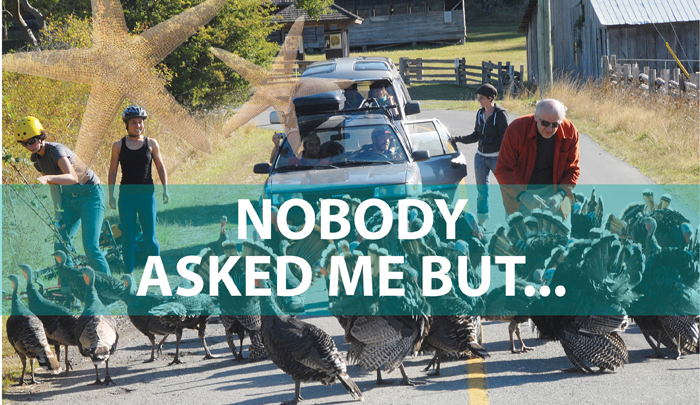
Nobody Asked Me But: Chewing the fat on food, diet and allergies

0

Food. There’s no getting away from it. It’s a necessity of life.

Here on Salt Spring, however, it’s not just food that we find essential. There is no social occasion, book club get together, or even innocent grocery store encounter that does not at some point veer off into a serious dissertation on the subject of what we should or should not be eating. Without food as the topic of conversation, we would be lost and adrift without a paddle with nothing left to talk about.

Want a good example? Recently a perfect stranger approached me in the Thrifty’s parking lot. “Celery juice,” she said. “Use a blender. Two cups a day. Every day.” She gave me a wink, and without another word it was adios. Just like that.

Here’s some food for thought. Almost all talk about food revolves around allergies (foods you should avoid), dieting (foods you should avoid) and cleansing fasts (avoiding food, period). Gluten-free diets, for instance, which restrict the intake of all products containing wheat, rye, barley and sometimes oats, have become so mainstream in our island culture that my friend, Bevan, claims he has to carry a shaker of gluten with him whenever he attends a community potluck.

Let’s really sink our teeth into some of these diets and restrictions. First and foremost are food allergies, some of which can be life-threatening. Peanut oil, for instance has been known to cause an anaphylactic shock reaction (impaired breathing, swelling in the throat, a sudden drop in blood pressure, fainting and dizziness) in six out of every thousand people in North America. Other foods, such as tree nuts, dairy, wheat and even garlic can have equally serious consequences when ingested by those who are allergy prone. Personally, I have a nagging allergic reaction to mangoes, which makes me break out in hives that turn into open skin lesions taking weeks to heal. Had the allergy culprit been cinnamon buns instead of mangoes, I would probably weigh 30 pounds less than I do.

Despite what many people claim, most food diets are directly associated with weight loss and body image. When you hear the term “dieting,” you immediately think of losing weight. Chew on that thought for a minute. Although so many think of themselves as being overweight, the means for losing poundage seems to be as diverse as the stars in the Milky Way (an excellent chocolate bar, by the way).

Leading the way in food fads today is the Paleo diet. Essentially, this is what your basic caveman ate eons ago (and no, we are not talking about pterodactyl wings dipped in hot stegosaurus sauce). If you are a Paleo aficionado, you are a flesh eater who has eliminated grains, dairy, sugars, potatoes, vegetable oils and processed food from your dinner plate.

Vegans, on the other hand, avoid any food that can run, swim, crawl or fly away from them if they were to meet in an open field or a dark alley. This includes animal products such as eggs, milk and cheese. There is a particular class of vegans called lacto-ovo (this is not a hard-hitting, stay-at-home Finnish defenceman) who also put animal spinoffs such as honey on their no-no list. Another offshoot of the vegan school is the flexitarian class. If you are a flexitarian, you are a flexible vegetarian who allows yourself the occasional juicy T-bone steak amongst your regular beans, carrots and cauliflower.

Both the Weight Watchers and Atkins diets have been known to help reduce significant quantities of body weight. The first does so by counting the number of calories that are being ingested while the second has the same effect by restricting the amount of carbohydrates in one’s food intake. A modification of the Atkins plan, known as the Ketogenic diet, combines low carbs with a high fat diet washed down with tons of water. Proponents claim that, besides making you lose weight, this eating system puts your body into a metabolic state of ketosis where fat turns into ketones in the liver, which supply energy to the brain.

Possibly the strangest sounding diet around these days is one called Low FODMAP, an acronym for Fermented Oligosaccharides, Disaccharides, Monosaccharides And Polyols. This is an elimination diet where you deny your body of certain carbohydrates that aren’t absorbed well by your small intestine and consequently travel to the colon where they are fermented by bacteria. The idea is to reintroduce the exiled foods one by one in order to show whether they are indeed guilty of being the cause of your pain and discomfort. One thing you can be sure of with FODMAP is that practically all the restricted foods will be the ones you enjoy the most and every food that’s okay for you to eat will be one that makes you want to toss your cookies.

Fermentation seems to be a hotly contested issue among foodniks. Everybody knows about beer, wine and cider and is familiar with the arguments for and against these beverages for both health and societal benefits as well as social repercussions. Lesser known concoctions, such as miso (fermented barley, rice or soybeans), kimchi (fermented cabbage and Korean radish), kefir (fermented milk and kefir grains) and kombucha (fermented slightly sweetened green or black tea) have made a severe dent in both the foods we choose to eat and especially those we love to talk about.

When it comes to fermented drinks, we have just touched on the tip of the iceberg. It seems like almost anything can be fermented and someone will claim it promotes a healthy gut and gets rid of ugly warts. You could probably soak your smelly work socks in yeast and sugar, and someone will swear that the resulting product cured them of male pattern baldness.

Nobody asked me, but the next time you run into me in aisle 7 at the grocery store (very likely the cookie section) and the conversation, as it inevitably will, turns to the latest food craze, you can expect to hear this from me: butter tarts, twice a day, every day.

Take a big bite out of that.

Where are the emergency responders?

0

By LINDA STARKE

Climate emergency is in. Climate change is out.

In December 2016, Darebin, near Melbourne in Australia, became the first government to declare a “climate emergency. By Aug. 23 2019, according to climateemergencydeclaration.org, 966 jurisdictions in 18 countries had passed declarations on a climate emergency. On June 7, the Parliament in Portugal recognized that the whole country has a climate emergency, and the Canadian Parliament followed suit on June 17.

So if we are in a state of emergency, where are the emergency responders? In addition to the firefighters who battle wildfires and the rescue workers who evacuate flooded cities, we need emergency responders who help the world move rapidly away from fossil fuels and toward renewable sources of energy. They need to respond to the causes of this global emergency, not its negative impacts.

Given the climate emergency facing us and the next generation, some people — prominently, Elizabeth May — have called for the establishment of war cabinets, which could recognize the key role of the new emergency responders. What could a war cabinet do? The experience in the United States during World War II is instructive. Just one month after Pearl Harbor was bombed in December 1941, President Roosevelt announced new arms production goals in his State of the Union address. He called for the production of 45,000 tanks, 60,000 planes, 20,000 anti-aircraft guns and several thousand ships.

The president told auto industry leaders that he would rely heavily on them to reach these goals. They pledged to do what they could in addition to making cars. But Roosevelt knew that would not be enough in this emergency situation. So the sale of new cars was soon banned. Indeed, for nearly three years basically no cars came off production lines in the United States. Residential and highway construction was halted, and driving for pleasure was banned, something that is hard to fathom today.

Roosevelt’s plan succeeded. From the beginning of 1942 through 1944, factories in the United States produced 229,600 aircraft, for example, far more than the president had called for. In a powerful New Republic article about this massive transformation, Bill McKibben of 350.org notes that instead of producing cars, “Pontiac made anti-aircraft guns; Oldsmobile churned out cannons; Studebaker built engines for Flying Fortresses; Nash-Kelvinator produced propellers for British de Havillands; Hudson Motors fabricated wings for Helldivers and P-38 fighters; Buick manufactured tank destroyers; Fisher Body built thousands of M4 Sherman tanks; Cadillac turned out more than 10,000 light tanks. And that was just Detroit — the same sort of industrial mobilization took place all across America.”

Historian Doris Kearns Goodwin describes these developments in No Ordinary Time. One factory went from making spark plugs to producing machine guns. Others switched from stoves to lifeboats, from corsets to grenade belts, from toys to compasses, from pinball machines to armour-piercing shells.

“By war’s end,” McKibben notes, “the government had a dominant position in everything from aircraft manufacturing to synthetic rubber production.”

Of course, no one expects a war cabinet today to impose changes in a nation’s manufacturing sector as drastic as occurred in the United States during World War II — at least not yet. But governments could and should take the lead in the push for renewable energy and in creating an army of new emergency responders: people who will build and install wind turbines, develop increasingly efficient electric cars, improve mass transit programs, install solar panels, make houses and office buildings more efficient . . . The list of what is needed goes on and on.

This is what the Green New Deal is all about: creating millions of jobs as countries transition to renewable energy. We can call them the new emergency responders, dealing with the sources of the emergency, not its effects.

The writer edited books on environment and development for 35 years. She moved to Salt Spring in April 2016.

TENacity exhibit runs at Salt Spring Gallery

A special exhibition at Salt Spring Gallery this month celebrates TENacity, a show that includes all the past and current members who have contributed to the co-operative venture as it heads into its 10th anniversary.

Any island business that achieves that type of longevity is worthy of congratulations, but one that can do so while relying on a disparate and ever-evolving group of members is particularly impressive.

The project started out as the Salt Spring Artists Gallery of Fine Art and opened its doors on McPhillips Avenue on Sept. 17, 2009. Founding members were Sheila Hoen, Samantha Sanderson, Jackie Breault-Spiess, Deirdre Tessman, Donna Horn, Carole James and Allan Sherman. Hoen was the main instigator of the project, having been involved in an artist-run cooperative in south-west Florida for eight years before coming to Salt Spring.

“What we want is not just to sell art but to be a community resource and support artists that don’t already have a profile,” Hoen told the Driftwood in 2009.

Hoen is now the last remaining member from the originating crew, but others have been involved for almost as many years, such as textile artist Ilse Leader — age 93 and still going strong — recycled glass artist Rachel Vadeboncoeur and beaded-jewellery maker Carol Newmeyer.

In recent years, painter/mixed-media artist Lisa Lipsett has played a strong role as the cooperative’s president. Susan Haigh, Paul Robert Bryans, Kuno Egger, Cinda Helm, Allison Brodie and Cheryl Long round out the current roster.

Speaking at Friday’s opening reception, past member and treasurer Leslie DeAthe described how the gallery had gone from being totally unknown to a recognized space that was able to attract ever more artists and buyers. She credited Lipsett with taking the gallery from being “that community co-op that was barely there, just kind of making it, to something that I think is awesome.”

“Honestly for me, the joy is in the community of the art sharing: the artists who are currently here doing their time at the desk, and then the alumni artists and the friends of the alumni artists, our friends and the people in the community. That’s what buoys us all up, and that’s what makes it super fun,” Lipsett said.

The TENacity show includes mini exhibitions and information panels on all the current members in the main room, plus a group exhibition that includes many of the group’s alumni in the back gallery. It’s a great way to get re-acquainted with the broad range of talents that have come through the space, adding their contributions to the collective along the way.

While some artists find their first gallery experience with the cooperative, others are longtime practitioners who find a happy home for their continuing explorations. Haigh, Bryans, Vadeboncoeur and Lipsett are among those who have come in with a strong personal style already developed; time at the gallery seems to have only sharpened their focus or refined their tools. By example, Leader’s past as a fashion designer has married well with more earthy island traditions. Hats and bags knitted in nubbly wool have an organic appeal and chic sensibility. A large-scale wall piece on display that employs felting further reveals how her sensitive eye unites with her hands to showcase nuanced colour relationships and delicious texture.

Others, like Egger, have built on their technical skills to take new risks (as seen in gloriously evolving finishing techniques for his fine ceramics). A self-portrait of Hoen in the back room reveals a classic palette for that artist, with contrasting shades of warm peach and cool purples. Her new pieces in the main room reveal an interesting new direction. Abstracted landscapes showcase remarkable reflected skies in still water, set off by sketchy, jagged lines representing forest forms. 

TENacity runs at the Salt Spring Gallery to Sept. 4.

BERTON, Penny Margaret

Penny Margaret Berton
August 5, 1948 – August 19, 2019

Peacefully on Salt Spring Island after 2 years in remission. As prophesied in “The Secret World of Og”, Penny was destined to take off on adventures. In 1975 she left Toronto to see the world, living for 30 years in Bali where she found her fullest creative expression as a designer and a mother. Penny listened for symbols; islands repeating through generations, mushroom trails, serpentine jewelry and rivers of gold. Finding home became a spiral journey up winding mountain roads back to her roots in Canada. Her refuge for 13 years was Salt Spring Island in a circle of trees and friendships. Penny’s belief in magic and play initiated a movement and continues to manifest through her children. Open to the universe, with her feet planted firmly on the earth, she found joy even during her last days. Predeceased by parents Janet and Pierre, and sister Pamela, she was survived by six siblings, children Elora and Orin, and their spouses Rajiv and Maria. She delighted in her 4 years as grandmother to Nayan and 7 weeks to Nusa. In lieu of flowers, donate to Salt Spring Island Public Library.

DONNELLY, Roger William Henry

Roger William Henry Donnelly
August 14, 2019

And just like that, another old guard from the South End is gone – yet not forgotten. Roger William Henry Donnelly died unexpectedly but peacefully in his sleep at home on August 14th.

Born in London, England on August 2nd, 1945 (the day the War ended) Roger came to Canada with his brother in 1968. After finding their way from Toronto to Salt Spring Island, Roger declared he would never leave and he was right. For 47 years this is where he lived, worked and played. In that time Roger hand-crafted a geodesic dome for his family to call home and put his Carpenter-Joiner trade to good work making magic out of wood for countless Islanders. He designed, built and sailed a catamaran, the junk-rigged Ogis Rose, for many years on the Salish Sea (flying the Jolly Roger, of course!). A community man, although increasingly solitary in his later years, Rog hosted weekly pool nights in his shop for the guys, shared philosophical discussions over beers at the Fulford Inn, and enjoyed playing music with friends. He loved adventures and travel but to him there was no place like home. At the end of the day it was his Reynolds Road property he loved most. Roger grew to know every corner and subtlety of the land, from the way the light looked at a certain time of day to the perfect plot to grow gardens. He had a very green thumb and took delight in feasting on fresh ripe tomatoes. A highly prolific and creative artist, Roger spent hours every day exploring light, colour and texture on canvas. Painting became his thing and mornings at his easel were sacred, brush in hand listening to CBC with his beloved dog at his feet.

Roger always said “How can I miss you if you never leave” but in the end it was he who left far too early. He will be fiercely missed by his faithful 4-legged companion Rose, devoted daughter Trinity and dearly loved grandson Jack. Family members who cleared the path for Roger were his Mum Rose, Dad Ernie and brother Eric. He leaves behind his brother Gareth (NZ), loving sister Catherine and sister-in-law Pamela, and their Families. Losing Roger touches many people’s hearts including his cherished friend, Trinity’s mum Christine and her four older children, grand and great grandchildren. And life would not have been complete without dear friends and neighbours like Garry & Bly, and Roger’s buddy Stuart.

To thine own self be true. Rog was in tune with the present moment and made contentment his priority. If we are to adopt anything from the way he lived his life it is to question our intentions by asking “Now why would I want to do that?” and to always keep it simple, sunshine.

The Family wishes to thank Christie and her team at Hayward’s, the first responders who came to help, and Cowichan Valley Crematorium for their compassionate service, and is grateful for the TLC that Jordan, MJ, Jekka and Lisa brought to the situation. To pay tribute to Roger’s life, please join the extended Donnelly clan for an informal Retrospective at Beaver Point Hall on the afternoon of September 29th from 1-4 pm.

JARMAN, Vilma

Vilma Jarman
July 29, 2019

It is with deep sadness that we announce the passing of our Stepmother Vilma Jarman on July 29th 2019. Vilma was predeceased by her husband of 43 years Dr. Earnest Jarman.

Vilma was born in Colombo Ceylon, and trained as a Registered Nurse and Midwife at St. Margaret’s Hospital in Epping Essex England in 1961. Vilma moved to Canada in the late 1960’s working at the Lady Minto Hospital on Salt Spring Island and for many years with her husband in his medical office.

Thank you to the wonderful staff at Braehaven, Lady Minto Hospital and to Dr. Reznick.

Funeral Mass will be at 10:30 on Saturday September 7th 2019 followed by a reception at Our Lady of Grace Church.

Donations can be made to the Lady Minto Hospital.

Body recovered near Ganges Harbour

0

The BC Coroners Service is investigating the death of a young woman whose body was discovered near Ganges Harbour Tuesday afternoon.

The matter is not considered suspicious.

RCMP, Salt Spring Fire Rescue and BC Ambulance were initially called to the area of Moby’s Pub  at 12:30 p.m. on Aug. 20 for a cardiac arrest. Salt Spring Fire Chief Arjuna George said firefighters who arrived immediately handed the matter over to RCMP.

The coroners’ office confirmed Wednesday they are in the very early stages of a fact-finding investigation regarding a female in her late 20s. The investigation will aim to determine how, where, when and by what means she came to her death.

According to the BC Coroners Service webpage, all deaths that are unnatural, unexpected, unexplained or unattended must be reported to a coroner, upon which an investigation is opened. 

Feds update islanders on whales

0

Policy managers and enforcement officers from several federal ministries were at Lions Hall last Wednesday evening to discuss interim measures hoped to stave off the demise of the southern resident killer whale population.

Officials from the Department of Fisheries and Oceans, Transport Canada and Parks Canada talked about the new rules and enforcement resources. The evening program was officiated by Nicole Gallant, DFO’s enforcement operations chief for the Pacific region.

Community meetings were also held on Pender and Saturna islands last week. The Saturna community was prepared in advance and collectively had a long list of questions they wanted answered. Pender’s meeting attracted some 50 to 60 people.

Michelle Sanders, director of Transport Canada’s Clean Water Policy, told the small group of participants on Salt Spring that action was accelerated since the fisheries and environment ministers determined an imminent threat to the SRKW’s survival in April 2018. The 2019 measures were established through an interim order under the Canada Shipping Act and will be evaluated with an eye toward more permanent action.

“We’ll be using this summer to assess how effective this has been . . . [whether] we need another summer to see if this is an effective approach, and then looking at what the regulatory tools are,” Sanders said.

Measures introduced for the Salish Sea in 2019 include some chinook fishery closures, new regulations on vessel distance and the establishment of three interim sanctuary zones where all vessel traffic was prohibited between June 1 and Oct. 31 this year. Sanders acknowledged feedback from the Pender meeting that communication about the rules had not been circulated effectively to visiting boaters, or to locals.

The mandatory distance from all killer whales was established at 400 metres, except for boats that have authorization to get as close as 200 metres to transient killer whales. Exempted boats fly a special purple flag and represent 40 whale watching companies and two nonprofit organizations, Straitwatch and Soundwatch.

Enforcement of vessel distance and boating prohibitions within interim sanctuary zones was addressed by several members of the various teams. A dedicated DFO enforcement unit of three people has been funded and given its own vessel. They will be getting an additional member in September. Parks Canada also received a vessel and funding, and will have five enforcement officers as of September who can patrol the waters within the Gulf Islands National Park Reserve. RCMP who patrol the international marine border provide additional support.

Speaking for the DFO unit, officer Jeff Quigley said his unit has been focused on informing boaters of the regulations. So far those violating the sanctuary zones have been unaware of the rules and compliant when informed. The team is now moving to the issuance of violation notices, Quigley said.

Enforcement officers urged the public to help them by making detailed reports about boaters harassing whales as soon as possible, and to back up with video evidence if at all possible.

Irwin also asked why seal culls aren’t happening, and why more attention isn’t being placed on hatcheries. He said reducing recreational fishing and the new catch and release program had removed good ocean stewards from the water, along with their contributions to the Pacific Salmon Foundation.

Lee Harber of DFO’s marine mammal unit explained that a technical working group dedicated to the issue had discussed multiple options and had tried to balance fishery restrictions as well as they could.

“We’re trying to give every opportunity we can for SRKW to forage in the areas that we think are important to them,” Harber said.

He added more scientific data is being gathered about the chinook salmon stocks, which are likewise in decline, that could help DFO target fishery closures rather than having large static closures.

Questions about using technology to track whale movements and adapt with spot fishery closures led to an interesting discussion of the hydrophone network that DFO is continuing to build, and how that can be linked into other sighting networks and technologies such as underwater gliders. The network currently employs hydrophones equipped with cables. Radio transmitters send info to DFO when whale calls are detected.

Paul Cottrell, who was raised on Salt Spring and is DFO’s marine mammal rescue expert, said the main goal of real time tracking is to protect killer whales in the event of an oil spill, but he noted vessel strike is another real risk for local whales. Once the hydrophone network is more robust and reliable, information would ideally be transmitted to BC Ferries and the Coast Guard’s Marine Communications and Traffic Services, Cottrell said.

Tracking could potentially be used to inform spot fishery closures as well, DFO biologist Elly Chmelnitsky said. She said for now, though, notifications to boaters to leave a sanctuary zone might come too late to help the whales.

For more on this story, see the August 21, 2019 issue of the Gulf Islands Driftwood newspaper, or subscribe online.

CRD looks at Styrofoam options

0

The Capital Regional District Board voted last Wednesday to look into the possibilities for local governments to ban single-use Styrofoam in their jurisdictions.

Styrofoam is accepted at electoral area recycling depots but is not included in the other CRD communities’ curbside recycling program. The board directed staff to explore the implications of drafting a model bylaw that municipalities and other jurisdictions could adopt to ban the product.

Salt Spring director Gary Holman co-sponsored the motion by Saanich councillor Ned Taylor along with Rebecca Mersereau (also of Saanich).

“We thought it was worthwhile for staff to at least look into the implications. That’s all it is at this point,” Holman said.

An attempt to amend the motion to include plastics narrowly failed as being overly complicated. Holman explained that the City of Victoria’s ban on single-use plastics was overturned by the court as a matter of provincial responsibility. The province is currently undertaking public consultation on what direction to take with plastics.

“One reason the amendment was voted down was to wait and see what they do,” Holman said.