
Home Blog Page 406

Viewpoint: Turf plan makes no sense

BY TIM HARVEY

Has a cabal on Salt Spring gone collectively mad? I’m speaking of whomever is behind the environmentally devastating plan to tear up the living, oxygen-producing high school playing field in Ganges to make way for a roughly hectare-sized swath of macro-plastic covered in micro-plastic “infill” that will inevitably spread throughout the local environment.

One hardly knows where to begin. With a climate emergency upon us, how can we reasonably suggest removing the living soil and oxygen-producing field of natural grass to make way for a petrochemical blanket that suffocates the earth with yet another heat-absorbing artificial landscape? Do we care nothing for the marine and terrestrial life, humans included, that will inevitably consume the fake soil infill and shreds of UV-degraded fake grass? Have these champions of plastic pollution ever considered the “heat island” effect of a fake field, which has none of the thermo-regulating properties of a field covered by live vascular plants? And have they considered what a biohazard a plastic field can be after a few games played, found to be associated with antibiotic-resistant Staphylococcus infections? 

How much water does it take to rinse all the body fluids and other sticky messes away? Have the planners read the studies regarding hundreds of tons of net surplus carbon that such a field will deposit into the atmosphere, compared to the surplus of oxygen produced by the current grass field? Above all, have we considered what message a fake field would send to our children about how little we care about the state of the world we leave them?

Proponents of the $2.5-million project  argue that the current field can’t be used outside of a few short weeks due to summer droughts and winter rains. Back when I grew up on this rainy coast, we played rugby during downpours and got muddy from head to toe. Are youth now denied this joy? As for the drier summer months, we are wise to consider what Peter Grove has pointed out before in the Driftwood: there is no shortage of water on Salt Spring, only the challenge of catching it when it falls. Could we not enlarge a nearby pond and install pumps and irrigation lines?

As an alternative, we could simply accept that our natural grass field may not always be as picture-perfect as a putting green. We owe it to our youth to encourage them to play through the seasonal changes in field conditions. If it is high-performance athletics we’re after, consider how a small country like Uruguay manages to compete for World Cup glory. When I lived in Uruguay through a drought so long that it caused a mass die-off of cattle, I saw youth playing avidly on parched fields. Our own very first-world problem with playing on fields considered too wet or too dry for our liking is a mindset that prevents us from competing at the highest levels of international sport.

The bigger issue is that we have passed the point in history when it is acceptable to allow the proliferation of plastic on the scale of a playing field.

This is a project that flies in the face of the social and scientific consensus of our era, and carries a heavy burden on climate, the local environment and future generations.  

Editorial: Turf wars

2

With our community of strong opinions, any project on Salt Spring is bound to face its naysayers.

The recent deal between School District 64 and the Salt Spring Youth Soccer Association to partner on an artificial turf field might seem beyond controversy. According to a feasibility study, the $2.5-million construction project at Gulf Islands Secondary School would be funded by the soccer club at no cost to the district, and would in fact save SD64 $13,000 per year on watering and maintenance costs, even with the district putting aside a share for the field’s eventual replacement.

Having one field open year-round would increase outdoor playing and practice time considerably, avoiding the interminable field closures that coincide exactly with youth soccer’s fall-through-spring season. It would benefit GISS students during the daytime, and open up gym space during the winter to other user groups.

Everything has its price, however, and even the best deal may have unintended side effects. Islanders are voicing opposition based on environmental grounds, as they point to the plastic field’s 12-year maximum lifespan and unproven recycling options.

The unintentional release of microplastics into the ocean is another serious consideration. A Dutch study found that a single artificial turf field can send 70 kg of infill granules per year into nearby water systems.

KIMO, an international association of coastal municipalities that was founded in Denmark, has launched its Pitch In campaign specifically aimed at reducing this microplastic release. Suggestions include using environmentally friendly infill materials that reduce microplastic pollution, installing perimeter barriers, exit grates and other physical infrastructure, and ensuring infill is not lost to surface water drains that drain into watercourses.

The infill material recommended for Salt Spring’s artificial turf field is a less toxic option than recycled rubber tires called TPE. The feasibility report says there is less static cling, so infill is less likely to stick to players’ clothing and shoes.

If SD64 would like to continue its partnership with SSYSA, it should ask for a full environmental impact study by a qualified professional that addresses infill and where exactly the field surface can be recycled, at what cost.

Doing a study may cost more in the short term, but having the best information going forward can only benefit in the long run.

Salt Spring Commons project funding announced

1

Salt Spring Island Community Services, along with the provincial Ministry of Municipal Affairs and Housing and the Capital Regional District, broke ground on the Salt Spring Commons project Tuesday morning.

The project, which has been in the works since 1994, will be built on a two-hectare parcel of land on Bishops Walk Road that is owned by SSICS, and will provide 24 affordable rental homes to people on Salt Spring.

“This project is a testament to the power of a community pulling together,” said SSICS executive director Rob Grant in a press release.

SSICS received provincial funds to the tune of $2.4 million for the project, which was announced by Housing Minister Selina Robinson at the groundbreaking ceremony.

Eight triplex buildings will be constructed on the site, which will include two- and three-bedroom units. Thirty per cent of the homes will be for middle-income families, with annual incomes of up to $60,000. Half of the units will be available to lower income residents, and the remaining 20 per cent will be for low-income families and residents. According to a news release from the ministry, rental rates are projected to be between $570 per month for two-bedroom units and $1,475 for three-bedroom units.

“These are often people who are working, they’re doing their best to raise their families or they’re on a fixed income,” Robinson said. “They’re a part of the community, but getting the kind of secure and safe housing that they need so they can eliminate their stress and make put their energy into their work, volunteering and into their families. We want to make sure they can do that.”

Announced in their 2018 budget, the NDP government plans to build 114,000 homes for British Columbians by 2028. The Salt Spring Commons project was part of the first round of projects to benefit from the Community Housing Fund.

The Community Housing Fund is used to provide housing for families with incomes up to $107,000. The Salt Spring Commons project is for the lower end of that income bracket, with a maximum income of $60,000 per family. 

“We have a 10-year plan because it is going to take 10 years to really deliver on the housing that people need. We know that people are desperate and we know that people need it. We are moving as fast as we can, but it does take time, especially here on the island,” Robinson said.

“We’re working with communities and supporting them to identify how to best deliver on the kind of housing that their community needs,” she added. “Government needs to be able to respond and say ‘Okay, how can we help you get there?’”

Robinson explained that the ministry asked local governments and agencies across the province to prepare ideas for a future call for projects. The recipients will be announced in the spring of 2020. Additional funds and support for Salt Spring Commons were provided by SSICS, the CRD and the Islands Trust.

Construction is expected to begin this fall.

This story has been updated. The original version said the maximum income level per family was $107,000 per household, that number refers to the maximum allowed for the provincial fund. The Salt Spring Commons will have an income cap of $60,000 per household. 

Gallery: Summer solstice shines light on our island

This year’s Day in the Life of Salt Spring Island shoot landed on the summer solstice — June 21 — and the weather was perfect for capturing a phenomenal range of activities taking place that day.

Scheduled events like the first day of the Tour des Iles festival, the launch of a book about island resident Susan Benson, Family Literacy Day at the library and Bullock Lake Farm Pizza Night attracted our many community photographers and Driftwood staff. But most photos are simply of happenings captured while out and about, or those taking place at individuals’ homes and properties. We are so grateful to people who are willing to share glimpses of their lives and what is important to them.

Photographer Stan Garrod gets the gold medal of Day in the Life dedication for being out from 7 a.m. until dusk and shooting more than 1,000 photographs! He of course whittled down his selections to a manageable number and several are published in these pages.

More photos are available on our Instagram feed (@driftwoodnews). The publication is also available in PDF format here.

Thank you to all of our contributors:

A.M. Matte, Alex Harris, Alura Gilbert, Anna Haltrecht, Ashleigh Gionet, Billie Woods, Carmen Elderton, Dave French, Dorothy Irwin, Elehna de Sousa, Elizabeth Nolan, Emma- Louise Elsey, Grant Grayson, Hannah Brown, Jean Gelwicks, Jean Panepinto, John Howe, Julia Gilbert, Kaori Kumagi, Kristine Mayes, Lawrie Neish, Marc Kitteringham, Marcia Jeanne, Margriet Ruurs, Meghan Carr, Myna Lee Johnstone, Patricia Robitaille, Peter Allan, Sandi Muller, Scott Merrick, Shirley Command, Stan Garrod, Susan Gordon, Trish Cannon.

If you want to see friends, family members, groups or events immortalized next year, make a note that the Day in the Life shoot is always sometime near the summer solstice. Please join us!

Gail Sjuberg, Driftwood editor

Safe bike path need stressed

0

A 14-kilometre bike ride should be relatively easy, but the route from Fulford to Ganges can be tricky for unprepared drivers and cyclists due to aging infrastructure and narrow shoulders.

On July 3, a group of 25 riders set out to draw attention to the state of the road, and to raise money for a bike lane.

Kipp Nash is the organizer of the yearly critical mass bike ride called Bike Salt Spring designed to both demonstrate the importance of and raise money for improvements on Fulford-Ganges Road. Nash is an avid cyclist who decided to do something to improve the situation on the island’s thoroughfare.

“There’s just not enough room for the population of Salt Spring to all use the roads safely,” Nash said. “We need to present the need for a bike path on Salt Spring, and awareness that the roads are inadequate for biking.”

Riders met in Fulford at 3 p.m. Bikes ranged from high-end endurance road bikes to off-brand kids bikes without working brakes. The crowd was equally as diverse, with avid cyclists, new riders, people getting back into cycling and a large children’s contingent setting off on the ride. After some introductions and last-minute maintenance, the peloton set off towards Ganges.

The first climb out of Fulford as ferry traffic was unloading immediately proved Nash’s point, as the narrow road and overflow traffic waiting for the ferry made the hill a chokepoint. The group met up again at Fulford Hall to wait for the ferry traffic to subside.

From Fulford Hall to Lee’s Hill, riders stayed fairly bunched up. Traffic noticed the riders, and a line of cars stretched out behind the group, waiting for a chance to pass. The cyclists made slow time up Lee’s Hill, the hardest climb on the route, peaking at 123 metres. Some of the younger cyclists had to stop and walk their bikes up the hill. The group stopped again at the top to regroup.

Riding from this point on was easier, as most of the going was either flat or downhill. The group stuck together riding on the side of the road. Though the asphalt is cracked for most of the way until Ganges, the cyclists were able to bounce over the potholes and cracks without incident. As the riders reached the final hill into Ganges, they formed a large group and took over the entire lane into town to avoid the large potholes and gravel pits that have formed on the side of the road during this stretch.

Nash has chosen his birthday for the yearly critical mass trek. A critical mass ride is a kind of bike ride that uses large numbers of riders to illustrate the need for cycling safety.

“You have the mass of cyclists to go where you want to go without having to worry about traffic,” said Sam FitzZaland, one of Nash’s friends who helped develop the idea. “There’s power in numbers.”

“It’s like birds flocking or fish schooling,” Nash added. “It’s where we all come together and work as one. Necessity is the father of invention. If we don’t demonstrate that it’s a necessity, then it will never come to us . . . If nobody rode [on Fulford-Ganges Road], then there would be no need to develop it.”

In 2018, Nash was diagnosed with a brain tumour. After the community rallied behind him to help his family keep up with expenses while he underwent surgery to have the tumour removed, he felt like he had to give back. As an avid cyclist, Nash was aware of the state of the island’s roads, and thought that working to improve them would be the best way he could repay the community for what they gave him.

“He never knew that [the community] would catch him in the way that [it] did. He knew that he had to give something back to the island,” said Nash’s wife Kate. “When you’re on your bike, you end up stopping more often, you talk to more people, so it seemed like a great way to give back to the community in a tangible way.”

A bike path development on Fulford-Ganges Road has been on the radar of Island Pathways since the organization was established in 1988. Members have been raising funds and lobbying for walking and cycling paths for three decades. Nash donated five dollars for every rider that took part in this year’s ride.

“I think my small-term goal would be to get a pathway from Ganges to Beddis Road, because then people could take Stewart to Fulford and they can be safe at least getting to town,” he said.

“That would be the shortest-term goal. If we could do that as a community, then I think that would at least keep everyone safe, and that’s what it’s all about.”


View this post on Instagram


A post shared by Driftwood News (@driftwoodnews) on

Water service study on the way

0

The North Salt Spring Waterworks District and the Capital Regional District have asked the Minister of Municipal Affairs and Housing to fund a study that will help optimize water delivery on Salt Spring Island.

Two targeted outcomes from the study are to either improve water service delivery on the island while keeping the NSSWD independent, or to create a consolidated service under the control of the CRD. Draft terms of reference for the study were presented at a special meeting at the NSSWD office on Wednesday, July 10. The meeting was scheduled to occur before a CRD Electoral Areas Committee meeting later that morning in Victoria where the committee voted on the same issue. The Electoral Areas Committee also voted to approve the request for funding. 

Due to ongoing water shortages on Salt Spring as well as a NSSWD moratorium on new connections, the CRD and NSSWD recognize that improving the water service and delivery would benefit residents.

The study will look at ways to improve coordination between the public water service providers on the island. It will look at how the different service providers make decisions about services, stakeholder and public views, shared goals as well as the two options listed above.

One theme that was prominent during the 2017 referendum on governance was the need for greater inter-agency collaboration, particularly regarding issues such as the management of water,” said Electoral Area Director for Salt Spring Island Gary Holman,  in a press release.

In addition to the study, work is being done to scope out a potential CRD Drinking Water and Watershed Protection Service for the island.

Similar services exist in the Regional District of Nanaimo and in the Cowichan Valley Regional District.

The two groups submitted a joint application to the ministry for $50,000 in funding to complete the study, which will be undertaken over the coming year. Both options were included in the draft terms of reference because it was felt that they reflected both the CRD’s and the NSSWD’s interests.

NSSWD board chair Michael McAllister said that he supports the funding request “as it may provide valuable information that will help the NSSWD Board of Trustees make a decision in the best interests of its ratepayers.”

If successful, the CRD will choose a consultant to undertake the study this summer, and a detailed project schedule is expected in the fall. The terms of reference timeline has a completion date of spring 2020 for the final report. Once the report is finalized, the results will be passed on to the ministry and NSSWD from the CRD.

This story has been updated. 

Public input invited on gravel mart

2

Salt Spring residents are being invited to give their input on a temporary use permit application that would allow on-site processing and sale of material mined from the Burgoyne Valley.

The Salt Spring Local Trust Committee will consider the Forsyth Farms Gravel Market application at their July 23 meeting. Members of the public are invited to speak to the proposal during the noon town hall session.

The Forsyths received their provincial permit to extract material from their land from the Ministry of Energy, Mines and Petroleum Resources in January of 2017. The family was not aware their business would also require permits from the Salt Spring Local Trust Committee. The first step was getting a soil removal and deposit permit, which the LTC conditionally approved last December. The next step is to permit mechanical screening and sales.

Business owner Michele Forsyth told the Driftwood the situation has been hard on the family, since they feel the community might not understand the mine itself is legal. There is also a financial burden in becoming compliant with Islands Trust bylaws.

“It’s devastating, it’s stressful. It’s causing problems at home,” Forsyth said.

Future treatment of the land, which is part of the Agricultural Land Reserve, is a major issue for the family. Their mining permit included providing a security of $12,500 for future site remediation. Another $11,000 for remediation was ordered by the LTC as a condition of the soil removal and deposit permit, based on the property size in the mine permit.

“We don’t have a ton of time left,” Forsyth said about the mine’s available material. “It’s just a small area and once it’s done we’ll probably turn it back to alfalfa or hay.”

With a July 15 payment deadline coming up, the owners have so far not succeeded in getting the Trust office to drop the cost to reflect the smaller size of the property where disturbance is actually taking place.

“I’m trying my best to figure out how to get some money together,” said Forsyth, who has a lawyer looking at the case. “We’ve already paid $12,500 to the ministry, so why do we have to pay again?”

Islands Trust regional planning manager Stefan Cermak explained Salt Spring’s soil removal and deposit permit is administered according to a bylaw, which is not discretionary, and which was approved by the Ministry of Mines before it was established.

“The Mining Act allows the province of British Columbia to issue mining permits, but that doesn’t make people exempt from local bylaws. The act allows for establishing layers of security for protection of the land,” Cermak said. “Our soil removal and deposit bylaw states that if you get a permit, you are required to supply a security.”

Cermak added the Forsyths are required to get a TUP for the other parts of their business because the soil removal and deposit permit only addresses those specific activities. The crushing and processing of material, and the setting up of a commercial outlet, are land use concerns that require planning.

“If you want to sell the material on your property, then you have to work with your local government agency,” Cermak said.

For more on this story, see the July 10, 2019 issue of the Gulf Islands Driftwood newspaper, or subscribe online.

Writer shares off-grid life

0

Aly Coy’s off-grid cabin is a long way from the Spanish Pyrenees, but for the last five years, her experiences in Europe have been vividly close at hand.

Coy has just finished her first book, titled Unpacked: A Memoir of Checked Baggage, about the five years she spent backpacking and living in Europe. During that time, she got into a relationship with a man and moved into an off-grid community in the mountains of Spain. However, that idyllic life turned dark. Coy felt trapped by her situation and her partner, and not knowing the language was left with nobody to turn to. The book begins with her facing two paths, to take a leap and book a plane ticket back home, or to sign insurance papers and resign herself to another year of living in a toxic relationship.

“I knew there was a story there. I also had to process a lot,” Coy said. “I used that to get it out of my head and onto paper.”

“I couldn’t talk with anyone, nobody really spoke English other than the partner that I was trying to get away from. It was very isolating,” she added. “I felt really stuck, physically and emotionally . . . It was very therapeutic for me to work through some of the things that at the time I didn’t have anyone to talk to about.”

The story covers two timelines, one during her time in the off-grid village in the Pyrenees, and the other looks at how she ended up there. She arrived in Europe in 2008, just as the Canadian dollar went into decline, and suddenly found herself with very little money. Coy recounts times when she did not know how she would get her next meal, when she had to dumpster dive, learn to garden, discover herbal medicine, fall for the wrong people and live on a commune.

“In the book I talk about the unhealthy behaviours that I had. I was experimenting with sex and drugs,” she said. “Here I’m selling soap at the market and going for hikes. I think I work too much, but other than that it’s a lot more of a healthy lifestyle.”

Coy did most of her writing in her off-grid cabin on Salt Spring. The book was finished in a stretch of time between Christmas and New Year’s, when she separated herself from other people in a self-imposed writing retreat. Though most of the island was living “off-grid” at the time because of the windstorm on Dec. 20, Coy hardly noticed. However, going through some of the moments described in the book brought up a different kind of darkness.

“Some of the scenes in the book are the worst moments of my life,” she said. “It feels lighter now that it’s shared . . . So many people already have said that they’ve been in a similar situation, and that a lot of the similarities are there. At the time you feel like you’re totally alone and that nobody has ever been through this, but when you share it in such an honest way, it feels lighter.”

Coy launched her book on Salt Spring in June, and will be touring the country to launch it in different cities. Unpacked is available at local bookstores, at Coy’s stall in the Saturday Market, and online through her website at https://www.barefootdaughter.com/unpacked.

For more on this story, see the July 10, 2019 issue of the Gulf Islands Driftwood newspaper, or subscribe online.

New artist finds ‘Momentum’

Husband and wife team Melanie and Simon Morris will be sharing new work at Salt Spring Gallery this month with a show called Momentum opening Friday, July 12.

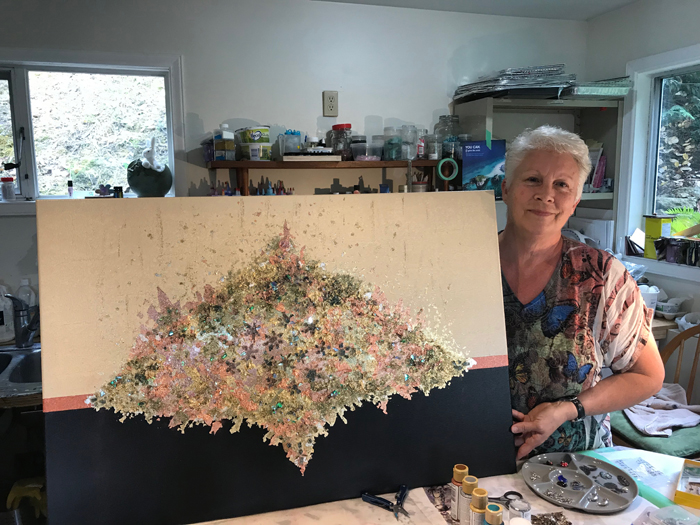
Simon, who is well-known as a sculptor specializing in underwater installations, will be showing some smaller limited-edition bronzes. Melanie is a new artist who has found her passion in acrylic mixed-media painting, and will be premiering a wide variety of work in her first-ever gallery show.

“I always wanted to paint but I never had the time,” Melanie Morris said during a recent visit to her studio.

Morris said she is nervous but even more excited about having her first show.

Getting the chance to exhibit alongside her husband, who has made a career in art, is a nice way to enter the gallery scene.

“Simon has always been a big supporter of my work,” she said. “I have travelled the world with his art, and I just thought it would be a neat experience to have a show together.”

Morris started painting with watercolours around four years ago but found they didn’t produce the effect she was looking for. Then she found acrylics, with their bright hues and ability to combine with added elements, such as underlying lines formed with other media; embedded embellishments like glitter and crystals; and finishing layers such as thick, clear resin.

Morris sometimes favours abstract works produced through the pour-over technique of pigments swirled together. Scenes can be built up to resemble crystalline ocean waters with glittering shores. Others, like the show’s title piece, are left in the abstract, with the composition built on relationships between colour and texture — in this case a dramatic shift from sand to black for the background, with a central assemblage of shimmering gold and coral petals.

Some of her works have a three-dimensional aspect, with flowering tree branches or twisting seaweed fronds built up with medium before being painted. A ripple of seashells  she’s collected from the beach adorns one dreamy blue piece.

“I love texture. I try to get as much texture into my paintings as I can,” Morris said.

Though new to the scene, Morris already has a following on social media and sells much of her work through her MJMorris Art page on Facebook. She also offers frequent workshops at her studio on a variety of different techniques and projects.

Both she and her husband donate part of their sales to environmental causes, and the environment figures both in theme and practice. Morris does not pour any of her leftover paint down the sink. Instead, she dries it on wax paper to create acrylic “skins” which she then uses for other projects. Skins can become elements in new multimedia paintings or be cut into small pieces to use as the underlay in unique earrings.

An opening reception for the show takes place from 5 to 8 p.m. this Friday. The exhibition continues to July 31.

For more on this story, see the July 10, 2019 issue of the Gulf Islands Driftwood newspaper, or subscribe online.

Stingrays race in Campbell River

BY Zander Glatz

Salt Spring Stingrays

Continuing their successful run of performances, the Salt Spring Stingrays competed in Campbell River on the July 6-7 weekend.

Being mid-way through the season, this meet was used to practice and refine different aspects of racing. This included technical skills, such as turns and underwater breakouts, as well as racing strategy, like how to pace or when to make a move on the competition. The group as a whole was effective at applying and learning from this practice as we gradually transition into championship season.

While making these preparations the Stingrays were able to take home an astounding amount of top-three finishes: Zoe Sanchez Wickland (Div. 3 Girls) earned third in the 50m breaststroke; Druehn Pinney (Div. 3 Boys), first in 100m IM, second in 50m freestyle, second in 50m butterfly, first in 50m backstroke, and third in 50m breaststroke; Aiden Otsubo-Papp (Div. 5 Boys), third in 200m IM, third in 50m freestyle, first in 100m backstroke; Zoey Johnson (Div. 6 Girls), first in 200m IM, first in 100m butterfly, first in 50m butterfly, first in 100m backstroke; Seth Crouse (Div. 6 Boys), third in 50m freestyle, third in 100m butterfly, second in 50m butterfly, second in 100m backstroke, second in 100m breaststroke, and third in 100m freestyle; William Rithaler (Div. 6 Boys), third in 100m backstroke, third in 100m breaststroke; Rylan Burnett (Div. 7 Boys), second in 50m freestyle, second in 100m butterfly, third in 50m butterfly.

Congratulations to swimmer of the meet Layla Girodat, who was enthusiastic and punctual the entire weekend. She swam her first ever 100m IM on her own accord. In the races she had already competed in, she improved substantially. For example, she dropped 10 seconds in 50m freestyle, and all of her swims saw major drops in times. These improvements can be attributed to her impeccable attendance and work ethic.

See this week’s Driftwood for the report from the Nanaimo swim meet that occurred the week before.

The Salt Spring Stingrays are getting ready to host our meet this coming weekend that kicks off with an open water race at St. Mary Lake this Friday. Go Stingrays!

For more on this story, see the July 10, 2019 issue of the Gulf Islands Driftwood newspaper, or subscribe online.