Home Blog Page 408

‘Comedy’ brings laughs to Centennial

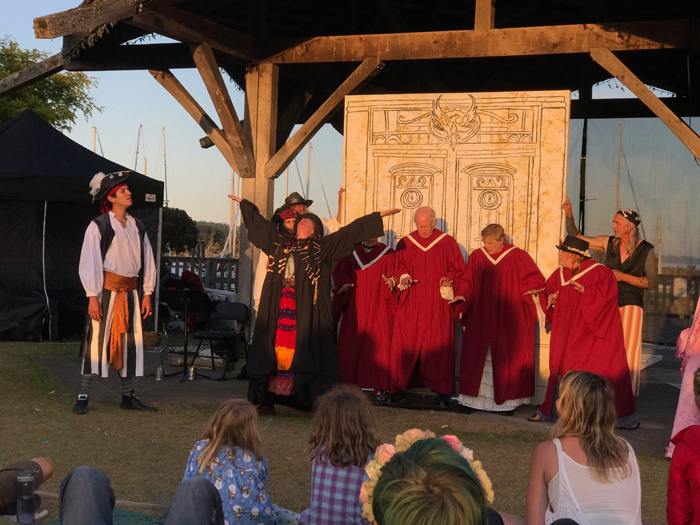
ExitStageLeft Productions has a treat in store for fans of outdoor theatre, with their pirate-themed take on The Comedy of Errors offering a full sensory experience of Shakespeare’s “shortest and silliest play.”

The company’s fourth annual Shakespeare in the Park show has its first-ever staging in Centennial Park, and the move has plenty to recommend it. The built-in grass amphitheatre in front of the gazebo is one obvious advantage. For this particular production, having the harbour as backdrop is also ideal for setting the scene as the Caribbean pirate stronghold of Port Royale.

Director Jeffrey Renn has made a clever move by transporting the play’s setting from the Classical Greek city of Ephesus to its New World shenanigans. The errors on which the comedy rests have to do with two sets of adult male twins who were separated at birth in a shipwreck, sending one Antipholus and his man-servant Dromio to Great Britain and the other set to Cuba. They meet up at last in the latter set’s home in Port Royale, where the arriving men are mistaken for the inhabitants — not only as a pair by the people that live there but even at times by each other.

Since the audience has to buy into the twins’ extreme identical nature for the plot to work but still be able to tell the actors apart in order to follow it, extravagant costuming is a great strategy. Thus sisters Christina Penhale and Sarah Grindler, who have similar features but quite different heights, become mirror image Dromios with their pirate dreadlocks and colourful knickers. The pair exhibits a matching gleeful commitment to their characters, as well, being the main drivers of the comedy with their constant beatings and disgust with masters who have been with them since birth.

Antipholus of Great Britain is played by Peter Hoskins, who has been one to watch since his GISPA days but probably finds his best footing in comedic parts. Hoskins’ natural antic energy suits his befuddled character, who can’t understand why the residents of Port Royale keep treating him as if they know him — even calling him by name and handing over sums of money — and is hilariously unsettled by the roving gang of singing pirates.

The Comedy of Errors returns to Centennial Park for four shows running this Thursday, July 4 through Sunday, July 7 (with the final show a 2 p.m. matinee). Tickets are available at Salt Spring Books or at the gate.

Note: The play is child friendly but there are some suggestive lines and adult language.

For more on this story, see the July 3, 2019 issue of the Gulf Islands Driftwood newspaper, or subscribe online.

Islanders hit the streets

Salt Spring Islanders have been running far afield this spring.

On May 5, Salt Springers were in Vancouver running in the BMO 8K and half-marathon races. In their fourth annual BMO 8K, Ryan Madro finished in 49:39 to claim 45th of 522 in his 25-29 age group, a top 10 per cent finish, while Walt Madro finished in 50:02 for an eighth place of 143 in his 60-64 age group, a top five per cent finish. 

In the half marathon, John Shepherd finished in 1:52:48 for 10th place of 90 in his 65-69 age group, a top 10 per cent finish. Anne Millerd finished in 2:31:48 to claim 53rd of 119 in her 60-64 age group.

On May 26, two Salt Springers were represented in the Envision Financial Run for Water 5K in Abbotsford for the benefit of clean water access in Ethiopia. Michele Severn finished in 40:07, earning her a 13th place of 46 in her 50-54 age group. Jade Greenwood finished in 44:29 for a 30th place of 50 in her 25-29 age group.

On Father’s Day, Eric Ellis ran the Athletics Canada National Half-Marathon Championships in Winnipeg, finishing in 1:48:24.8 for first place of 20 in his 70-74 age group, 332nd of 1,399 men and 414th of 2583 runners overall.

On June 23, Duncan Elsey completed the Scotiabank  Half-Marathon in Vancouver in a personal best time of 1:46:44, which earned him a 41st place of 139 in his 50-54 age group, 605th of 1,717 men and 792nd of all 3,345 finishers.

Marcia Jansen and Marion Young have just returned from Whistler where they did on-course training and attended workshops in preparation for the Whistler full Ironman triathlon competition on July 28.

Editorial: Fire Smart

1

While some rainy days in June allowed wildfire fears to dampen on Salt Spring, the sense of relief is temporary.

No precipitation is anticipated for the next two weeks, putting us back to a more expected summer weather pattern.

The fact that a devastating wildfire has not struck the Gulf Islands in the past few years can only be attributed to heightened fire safety awareness on the part of residents, swift responses by our fire department and provincial government resources on occasions when fires were ignited, and dumb luck.

Minimizing damage to both natural and built environments caused by future wildfires has been on the minds of Salt Spring Fire Protection District officials, among others. Salt Spring Fire Chief Arjuna George recently asked the Salt Spring Local Trust Committee to consider implementing a Wildfire Hazard Development Permit Area. Such a DPA would guide development of future subdivisions to implement FireSmart principles, which include creating “defensible space” around buildings, and mandating fire-resistant roofing and construction materials.

“Specifically, Wildfire Hazard DPA guidelines, as seen in other B.C. jurisdictions, generally intend to reduce fire risk by ensuring adequate setbacks between buildings and the forest edge through use of fire-resistant building materials (e.g. metal roofing, glazed windows) and practices, and by removal of debris or fuels within the defensible space immediately adjacent to structures,” explained George.

Of equal concern is that out-of-control wildfires will destroy significant areas of forest cover and natural amenities of the islands’ unique ecosystem.

For people still not convinced that wildfire is a real danger to Gulf Islanders, or those who want to know what can be done to mitigate the impacts, the Salt Spring Forum’s next speaker is an expert on the topic. Ed Struzik, author of Firestorm: How Wildfire Will Shape Our Future, is at the centre of a discussion at ArtSpring this Sunday night.

As promotional material for Struzik’s book states, “Wildfires can no longer be treated as avoidable events because the risk and dangers are becoming too great and costly.”

Maybe the weather forecasts will be wrong and the islands will have more rainy spells this summer than in recent years. If so, that would be great, as it would give us that much more time to plan for reducing wildfire risk and devastation. 

Electric cars not a panacea

By GARY GAGNE

I attended the last Community Alliance meeting, which was focused on actions to mitigate climate change.

Surprisingly, there were four bicycles parked near the door when I arrived. Often I am the only one who cycles. There were so many people in attendance we were split into three groups of 20 or so. We were then directed to share our personal stories of actions or solutions in dealing with the crisis we currently find ourselves mired in.

With talking stick in hand, I expressed my primary view that we all need to wake up to the reality that we are intimately and inextricably part of nature and that unless this becomes our lived experience so that we care about/for this world as our own body (which it is) we will not resolve this current emergency. I also voiced a few items that I do in my daily living, including riding a bicycle as much as possible (I ride a cargo bike I call my “truck”).  Everyone else in our circle spoke sincerely of various ways they contribute to reducing their GHG emissions with many expressing either owning or wanting to own an electric car.

I was given an opportunity to add a further comment before the break and said that, in my opinion, electric cars are not the solution to our climate crisis. I spent two days recently at a conference on active transportation where I discovered how many countries in Europe and Asia are diverting funds from improving highways for cars to building safe bicycle highways. Folks are now realizing that adding more lanes to freeways does not improve congestion. 

Also it’s a social justice issue. We cannot build an electric car for everyone on the planet.  An electric vehicle needs at least 120 batteries similar to the single one that helps propel my electric-assist bike. Not everyone can even afford an EV in spite of the huge subsidies offered by the government. Even though I had to pay GST and PST to the tune of $400 for a new bicycle I recently purchased, it is still a much much less expensive option as well as a healthier means of transportation.Someone else in our group mentioned that most people he knew who owned an EV also had a second gasoline-fuelled vehicle.

And here, finally, is the punch line. Following my unpopular opinion, someone spoke out about the latest insanity in automobiles. Apparently a lot of high-end fast car manufacturers are beginning production on super fast luxury electric cars that require a magnitude of 10 times the current EV battery needs to drive them at excessive speeds and distances. Added to that questionable logic is the fact that lithium mining, one of the main components of new batteries, is expanding exponentially. Manitoba is beginning to strip mine an area that will rival Alberta’s tar sands in size. And we’ve probably all heard about the plight of children in the Congo being exploited to source a rare component of these batteries. 

I’ve also learned at this recent conference that unless your electricity comes from a renewable source, running these cars from the power grid does not reduce greenhouse gases. Massive hydro electric dams are no longer considered a renewable source of electricity. Got a bicycle, anyone?

The writer is a Salt Spring Island resident.

TATE, Christine Ann

Christine Ann Tate
July 7, 1947 – May 9, 2019

Christine Tate was born and raised in Pt Loma, San Diego where she first developed an interest in nature, colour, light and space.  She continued to develop those life long passions though university arts program where she discovered enamel as an art form.  Through the creation of beautiful spaces in Wilson, WY; Honokaa, HI; Saltspring Island and Victoria, B.C.; and Borrego Springs, CA, she expressed her artistic vision.

A master gardener and “plant lady”; she was passionate about creating incredible gardens and orchestrated years of community garden tours.  As an accomplished outdoors woman; she hiked solo and with friends throughout the west and spent many years kayaking the wild coasts of B.C.  She was avid about protecting wilderness and was a committed letter writer and contributor to many environmental organizations.

A loving and loyal friend, she cultivated beloved relationships and had many friendships lasting over 45 years.  Many of her close connections were made through her appreciation of the process of creativity and design.  She was known for going out of her way to show kindness and thoughtfulness to others by seeking out a special plant or sending a heartfelt card.  She was an incredible mother, immensely dedicated and nurturing to her son and daughter, always going out of her way to provide.  Her two cherished granddaughters had the very best of times with their “TuTu”;  spending hours giggling and cuddling in bed with books, after a day spent at the beach.

She worked incredibly hard on her real estate projects; she cared deeply about providing the best living environment she could for her tenants.  She truly cared about their wellbeing, many of her tenants also becoming her friends.   If she could, she preferred to do renovation work on her own, often she could be found up a ladder sanding and painting.  She became a skilled trades woman over the years.

She was vibrant, tenacious, independent, and strong.  There was so much more to learn from her and more that she had to do in her life; she is so incredibly missed.  She passed away in her beautiful home in the desert that she loved so dearly.

NSSWD denies Summerside refund request

0

The North Salt Spring Waterworks District board has decided against awarding any compensation to the Summerside strata related to meter readings from a unit that’s since been replaced.

The water district’s board of trustees announced their decision at Thursday’s business meeting, explaining they had already spent money to replace the equipment but were still not convinced the previous meter was faulty.

“Considering the $10,000 cost incurred in order to replace the meter in question, at this time we’re directing staff not to take further action,” said district financial officer Ken Roggeman.

Summerside strata council member Jack Braak said the council noticed water bills seemed high a couple of years back and undertook several measures in attempts to discover any problem, including testing water lines during the middle of the night, doing individual toilet leak tests and looking at the complex’s pool usage.

“We originally thought it could be the pool. It has a meter of its own but it’s not a big user — less than what one unit uses each day,” Braak explained.

Finding no significant leaks or problems, the council determined the meter must be at fault. They campaigned to have it replaced, which NSSWD agreed to last August. Registered water use at the strata dropped by 40 per cent immediately after the new meter was installed.

“I’m disappointed in the process. I’m disappointed that waterworks didn’t check to see what we tried first to make sure the problem wasn’t something beside the meter,” Braak said after Thursday’s meeting.

Since the Capital Regional District charges local sewage rates based on water usage from September through April, the strata believes they have probably also made a significant overpayment for their Ganges Sewer connection. Summerside residents have been paying an annual fee of more than $1,400 per unit, but discovered another condo complex in the area was charged just over $500 per unit.

Speaking during Thursday’s NSSWD board meeting, the district’s environmental manager Meghan McKee said the difference in usage recorded after the meter’s replacement did not necessarily mean the old unit was faulty.

“After reviewing many technical documents … there is a very large body of research on water meters under-registering, which happens commonly when they get old. There is virtually no information on meters over-registering,” she said.

McKee explained the only way that type of meter can over-register is if the gears malfunction so that multiple numbers get turned at a time, but that would result in the readings being “orders of magnitude higher,” which would have been noticed.

“Furthermore, it is the opinion of the board that it’s more likely that given the concern over high water consumption and the high water bill, that the residents of the Summerside became more aware of their water use,” McKee said.

Braak said the council reported being concerned about high water bills during their annual general meeting in February 2018. Unfortunately, the old meter was damaged when it was removed and therefore cannot be examined to see if a malfunction occurred.

Board of trustees chair Michael McAllister told the Summerside representatives they could appeal the decision to the Inspector of Municipalities. As of Monday the council had not yet made a decision on whether to move forward.

Islanders request forestry action

0

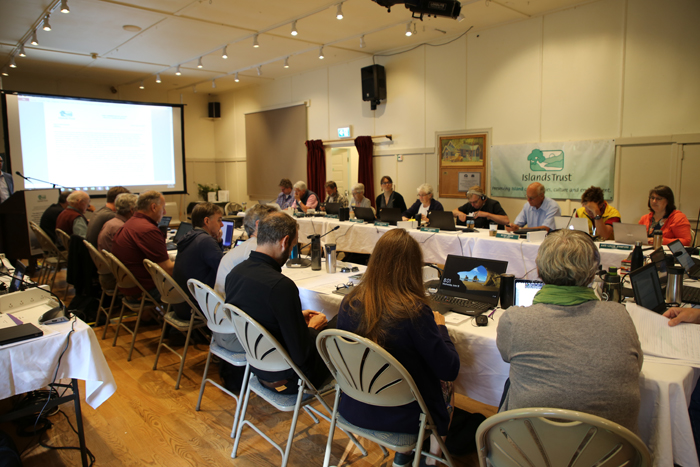
Gulf Islands residents made their way to Galiano Island from Salt Spring and Gabriola last Wednesday to ask Islands Trust Council to do more to stop clear-cutting and protect forest cover.

Two delegations made presentations to council on June 19. A group from Salt Spring represented by Susan Hannon addressed the ongoing dispute that started with a 45-acre property on Beddis Road being cleared of its mature forest. The property is split-zoned Agricultural and Residential.

“We’re calling on the Islands Trust to take action on all of the islands to stop clear-cutting on private lands not zoned for forestry. The tools are available; please use them,” Hannon said. “We applaud islands such as Galiano that have enacted regulations to protect our forests, and we urge Trust Council to enact consistent policies against clear-cutting across the entire Trust area.”

While the Salt Spring Local Trust Committee and Trust legal opinion have maintained the local government body has no ability to order logging work be stopped, Hannon referred to a response letter sent to concerned islanders by Jessica Brooks, executive director of the Planning and Land Use Management Branch under the Ministry of Municipal Affairs and Housing.

Brooks wrote that she was sympathetic to islanders’ concerns but said the matter was not in provincial jurisdiction.

A Driftwood request for more information from the Ministry of Municipal Affairs and Housing supports the Islands Trust’s position that it is powerless to intervene at present.

The ministry response states the Islands Trust has the ability to establish development permit areas in official community plans and to develop guidelines that would limit tree cutting in those areas. The Local Government Act also gives the Islands Trust the ability to establish tree-cutting bylaws that apply to areas it considers subject to flooding, erosion, land slip or avalanche.

“Unlike municipalities, however, Islands Trust does not have the ability to regulate, prohibit or impose requirements generally in relation to trees outside of the two situations mentioned above,” the ministry email explains, adding, “At this time, the province isn’t considering amending the Local Government Act in relation to tree cutting.”

Tree cutting is currently limited in some development permit areas on Salt Spring, including hazardous slopes, riparian areas and heritage village sites.

A second delegation presented to Trust Council on the forestry issue last week came from Susan Yates, who was representing the Gulf Islands Alliance and is a former Gabriola Island trustee. Yates spoke about the need to protect and restore carbon sinks and the primary mandate of the Islands Trust to preserve and protect the natural environment.

Yates explained the Gulf Islands Alliance exists to support the Trust’s mandate and its work. She said the organization understands the Trust does not have sufficient regulatory powers when it comes to tree-cutting, “except in very rare circumstances as a development permit area.”

“We request Trust Council to ask the appropriate ministry to regulate logging in the Trust Area in a manner that supports the Islands Trust policy and mandate, or to grant the Islands Trust the regulatory tools needed to control forestry activities in the Trust Area,” Yates said.

“The thing is, if the Trust had even just minimal regulatory control over logging, their preserve and protect mandate would actually mean something,” she added after the meeting.

For more on this story, see the June 26, 2019 issue of the Gulf Islands Driftwood newspaper, or subscribe online.

Students unveil First Nations map for island

0

Students from Salt Spring Elementary School presented a map outlining the Indigenous history of Salt Spring Island through place names at the library on June 20.

The map, which is available online, includes four Indigenous locations on the island that were visited by the Grade 3/4 Owl Class. The class visited Southey Point (P’q’unup), Ganges (Shiya’hwt), Burgoyne Bay (Xwaaqw’um) and the Tsawout reserve at Fulford Harbour (Hwune’nuts) to get a sense of place and understanding of the First Nations people of the area. With the help of archaeologist Chris Arnett, the students were able to learn about the Hul’qumi’num language, history and culture on the island.

Each field trip taught the students about a new facet of Indigenous life on the island. During the trip to Southey Point, the students learned of the cautionary tale of the Wild Woman of the Woods. They learned about the First Nations village at Ganges, as well as the history of the Grace Islet burial site. In Burgoyne Bay the students were taught how storytelling was a part of Hul’qumi’num culture, and worked on a collaborative retelling of a First Nations fable. 

Student Macey Cox said that her favourite part of the experience was “going to Fulford, hiking and learning about the people who lived there.”

By mapping out their field trips, the students were able to foster a sense of place and relate that to their learning.

“It was a great way to display our learning journey and to give the evidence of our learning. Since it was very much place-based, it was all about exploring the island, so it started with a map and understanding what our island looked like and how there were connections,” said teacher Katharine Byers. “It gives them a depth of understanding, appreciation and perspective. It was very useful for them to be out there on location to make it really real.”

Byers and fellow teacher Linda McDaniel were able to weave the lessons in to various subjects in their class. The students started the project with a letter-writing campaign in their English language arts class to help raise money for the various field trips they would take over the course of the year.

“As an elementary school teacher, you get to teach all of the subjects, so you can weave it all together and make it meaningful,” Byers said.

Byers explained that more First Nations sites on the island will be added to the map in future years, and that it is intended to be a long-standing document showing the history and importance of the First Nations people on Salt Spring.

The map will be made available to the public on the Salt Spring Archives website. Physical copies, printed with funding from the Salt Spring Island Foundation of Youth, are available at the visitors’ centre in Ganges.

For more on this story, see the June 26, 2019 issue of the Gulf Islands Driftwood newspaper, or subscribe online.

Highway maintenance contract to change

0

Highway maintenance in the Gulf Islands will no longer be conducted by Mainroad South Island Contracting after the contract between the Ministry of Transportation and Infrastructure and the company expires at the end of September.

Emcon Services Inc. will be the new highway maintenance company for the south island service area effective Sept. 30. The area includes the Gulf Islands, and extends from Victoria in the south to Crofton Road on Vancouver Island. The previous contract had been in place since 2004. Contracts are for a 10-year term, with the option for a five-year extension. Twenty-six road service areas in the province went to tender in 2018 and 2019. One service area was posted in 2015, and one will come to tender in 2021.

Ministry of Transportation and Infrastructure chief engineer Ian Pilkington explained that by going out to tender periodically, the ministry can ensure it is getting good value for the taxpayers’ dollars.

“It is an open procurement process that is based 70 per cent on price, 30 per cent on the service proposal that the proponents must submit to demonstrate that they can do not only maintenance, but can do maintenance specific to the service area they’re looking at,” he said.

Increased maintenance standards are part of the new contracts, most notably with regards to winter maintenance. Contractors will be required to plow highways more quickly and be more proactive with their preventative maintenance and communications.

“These contracts were last tendered in 2003 or 2004, so in the last 15 years there have been changes in technology and also in what the travelling public want to see for maintenance.”

The value of the contract is yet to be announced due to the ongoing provincial procurement process. Pilkington explained that the ministry put an upper cap on the contract at approximately $14 million for the South Island region. The outgoing Mainroad contract was valued at $10,326,383 when it was awarded 15 years ago. Contractors are responsible for the maintenance and upkeep of roads, as well as bridges. They are also contracted to clear snow and ice from road surfaces. Other duties include pothole patching, crack sealing and drainage management.

When the change occurs, current Mainroad staff will be kept on under the successorship portion of the new contracts.

“There’s a requirement in the contract that any contractor taking over an area has to employ any unionized workforce and must honour their collective agreement,” Pilkington said. “All of the unionized workforce, so the workers who drive the vehicles and the plows, anyone who is on the island there . . . The worker staff will stay the same.”

Turnovers also often involve the new contractor purchasing the maintenance yard site, as well as some of the equipment. However, that is discussed between contractors and will be finalized as the turnover date approaches.

Though the new contract has updated standards, they will not be mandatory until that date.

For more on this story, see the June 26, 2019 issue of the Gulf Islands Driftwood newspaper, or subscribe online.

Dodd and Edwards work combines for exhibit

By HELEN MEARS

SPECIAL TO THE DRIFTWOOD

Barbra Edwards’ dedicated and focused explorations of nature continue in a new body of work called “re:ani:mate,” presented along with basketry artist Carol Dodd for Artcraft’s next Showcase Gallery.

Immersing herself in the direct observation of dying flowers results in an abundance of ideas in a variety of media: large oil paintings, small watercolours, photographs and collage, exhibited together and connected by theme, complex colours and inventiveness.

Edwards’ work shows us the grace of nature in life and in states of decay — an ongoing muse for her creative process.

Enigmatic, biomorphic shapes are Edwards’ signature pictorial language, showing up in the large paintings as volumetric, robust forms that hang in front of the viewer, within an esoteric environment.

In contrast, delicate, clear and lyrical watercolours on paper are small, gestural environments, dense with varied mark-making.

Edwards includes photography — a starting place and constant reference in her creative process — capturing fading flowers as “portraits.” Groups of roses, dahlias, tulips show their changing colours, papery surfaces, hardening into shapes that Edwards refers to in her work.

“I visually reanimate my subject by creating a connection between the various media,” she said. “It’s all about where the mood of colour and rhythm of brushstrokes go.”

Capturing images of waning flora and investigating forms and colours in nature is a useful tool: a portal for artistic reincarnation and reinvigoration of a subject that Edwards continues to share her reverence for.

Dodd moved to Salt Spring 20 years ago and was always an avid collector of baskets. Once settled on the island, she joined the “fledgling” basketry guild, making functional, purposeful pieces for her own use from willow and cedar, influenced by “working basketry in Europe” and cedar, “the mainstay material of the West Coast Indigenous communities.”

Participating in re:ani:mate allows Dodd to reinvigorate her process by trying out new materials — lichens, bark, pine cones — and working them into functional and non-functional pieces, expanding her creative process and finding new shapes and inventive ways to incorporate diverse materials.

Re:ani:mate opens at Mahon Hall on Friday, June 28 with a reception from 6 to 8 p.m., and continues to July 24.