Home Blog Page 43

STIBBARDS, Jacalyn Grace

0

September 21, 1954 – August 16, 2025

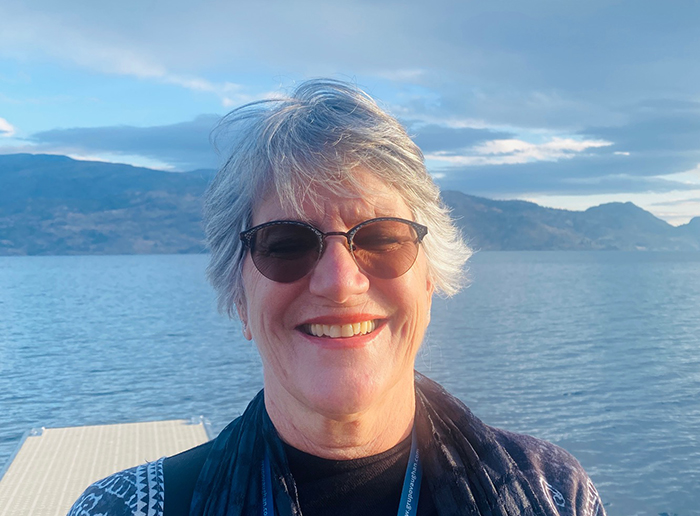
Family and friends of Jackie are mourning her untimely passing at her home on Saltspring Island. She was inspiring, dynamic, and vibrant; and had a heart as big as all outdoors.

Jackie was predeceased by her mother Mary, father Jack, older sister Lynn, and older brother Bill. Other members of the family had gone in fairly recent times: aunts and uncles that she and her siblings were close to. Thankfully, cousins are still here. In addition to a legion of good friends ranging from Vancouver Island to the Nicola Valley and beyond (Australia, Europe) she leaves behind her loving son Dylan(fatherNeil),sistersTracy, Wendy, Audrey, and brother Keith. She was also an enthusiastic and loving stepmom to Neil’s children and grandchildren.

Born in Westlock Alberta, Jackie lived in Quesnel and Fort St. John in her early years before her family moved to Saltspring Island, where she graduated from Gulf Islands Senior Secondary. Moving to Victoria she graduated from UVic’s teacher training/certification program. After earning her Teacher’s Certificate at UVic, Jackie landed her first full-time teaching job at a small school in Burton, a tiny community located on the Arrow Lakes south of Revelstoke. Out in the middle of nowhere, with no friends or relatives anywhere near, she did her best to make the most of it and made a couple of friendships that lasted over time.

While at UVic she met Neil Todd, a manager in the Fish and Wildlife Branch head office in downtown Victoria, and a romance ensued. Jackie and Neil eventually married, settling on Saltspring Island, In 1984, Jackie supported Neil in his decision to leave his government position and he moved to the Nicola Valley to start a contract with the Dept. of Fisheries and Oceans to operate the brand new Spius Creek Salmon Hatchery. Together they formed/incorporated a company, where Jackie showed proficiency in accounting and running a business after she joined Neil. Jackie had remained (temporarily) at home on Saltspring to start up her own business. When she made the move to join Neil in Merritt, she brought with her what was literally a vehicle to introduce herself to the community. For a couple of seasons her Lickety-Split ice cream truck was a summertime fixture at many community outdoor events, ball tournaments, etc. Through that initial exposure she began her community involvement and made lasting friendships. And she and Neil welcomed their baby boy, Dylan, now a pilot. (Jackie was very proud!)

While living in the Nicola Valley, she enrolled at Thompson Rivers University and achieved her Bachelor of Arts degree. Throughout her school years Jackie’s artistic talents had become evident. She had a fine singing voice and this talent, her love of music, and interest in all things artistic led her to the Nicola Valley Community Arts Council. Never shy, possessing impressive energy and an outgoing nature Jackie organized many enjoyable events. She was the Art Gallery Director for a time and curated some great art shows. Jackie spent many fulfilling years in the Arts Council. Her signature achievement was leading the charge to enable acquisition of the community’s grand piano – an asset welcomed by both touring and local musicians.

Jackie was well travelled, by plane, ferry, and car. She enjoyed planning and embarking on adventures near and far. She didn’t hesitate to pop in and visit all her dear friends along her way.

In 2019, Jackie moved to Vancouver Island, where she settled into a small community in Duncan, called Sungoma. She loved it there initially. She joined the Arts community and hosted family and friends on several occasions in her cozy surroundings and on her wide deck. Last April she made the decision to settle on Salt Spring Island. She had family and friends there too and had become involved in the community, singing and volunteering.

Despite her joyful expressions and accomplishments, Jackie had internal struggles over the decades and as time and life wore on they were an overwhelming force that simply wore her out. And eventually, finally, took her.

Jackie, and her vivacious spirit, will be well remembered and greatly missed.

Celebration of Life at Beaver Point Hall, October 15, 2025 at 3:30 PM. If you’d like to, bring a dish to share, but a light snack will be provided.


Editorial: Missing the bus

0

Salt Spring’s Local Community Commission (LCC) hit some bumps in its decision-making road last week, caused by disagreement over how much to increase the limit on taxpayer support for transit.

In July the LCC voted to recommend raising the limit by 78 per cent: from about $500,000 to $900,000. The change would see a residence assessed at $1 million go from potentially paying the Capital Regional District (CRD) $76 per year to $135. CRD Board approval was required.

Last week CRD director Gary Holman, who is one of five LCC members, amended the LCC recommendation to the CRD Board, reducing the hike to 25 per cent. LCC members now feel their authority has been undermined. But Holman points out they did not have that authority: provincial legislation requires CRD director approval of any service’s requisition increase of more than 25 per cent when voters have not been consulted.

Holman is not usurping power from the LCC. They don’t have it in the first place.

And it’s not that Holman doesn’t agree with raising local transit support by 78 per cent; he does. He’s just not comfortable doing so without meaningful public consultation or getting voter approval first. That sentiment is so respectful of his tax-burdened constituents that it’s almost quaint.

While LCC commissioner Brian Webster has previously stated that if islanders aren’t in favour of the increased levy they can vote for other commissioners in the next election, we’d prefer if that choice followed public debate about the issue during the fall 2026 election campaign. Candidates could defend their positions on transit funding, and voters could also be asked via an alternate approval process or referendum to vote on the proposal. Perhaps by then BC Transit and the CRD/LCC will have some data and reasons to justify the demand for such an increase in the near and later future.

Something else important to consider is that changing circumstances from BC Transit have taken the pressure off making a decision now. Transit staff have advised that no system improvements are going to take place on Salt Spring until 2028 at the earliest.

How much local taxpayers pay for a transit system should not be decided by either the LCC or the CRD director. It should be up to those paying the bill, and ideally we will get that choice in conjunction with the 2026 local elections.

Viewpoint: Policy Statement process still not right

0

By JOHN MONEY

Here we go again! Is this the third or fourth round of the draft Islands Trust Policy Statement?

Looking over the latest draft, in my opinion, it remains preoccupied with environmental organizations and First Nations and forgets that the vast majority of taxpayers believe they have a deed to a piece of property and a home and maybe a business such as a farm or a forest management company or a public service company and pay a large bundle of taxes, that, by the way, finance this ongoing saga.

It also neglects the fact that these are 13 diverse, different islands and their communities, each of which has its own official community plan (OCP) and land use bylaws (LUB).

This Policy Statement is yet another attempt at top down management, not bottom up.  People need to realize that this policy statement could have the effect of demanding all of the local OCPs and LUBs to conform to it. A Policy Statement that covers 13 different communities and their bylaws should be full of “You should consider,” not “You shall do.”

I do not blame Victoria planners trying to create a document that will force 13 different communities into cookie cutter plans to greatly simplify their jobs, but they should remember who pays their wages.

I do not blame First Nations for wanting recognition and a place at the table as they have lands and history in the Trust area. But so do the residents and taxpayers that call the Gulf Islands home.

I do blame those local trustees that seem to have forgotten the taxpayers that voted them in and the local bylaws that they are elected to represent on behalf of their communities.

In my opinion this process should start with each local Trust committee (LTC) appointing a local planning committee, not from their pickleball club but from a mix of residents; young people trying to make a living, older people on pensions, business people and local First Nations that live in the community; in other words a good representational balance.

This committee should look at and understand their local bylaws and look at the draft Policy Statement and see if the draft conflicts with the desires of their community.

This process should be completed with community town hall meetings and consensus building, not electronically from Victoria.

After this, LTCs should go back to Victoria armed with this community consensus and fight for it.

I have spent a long lifetime in the Gulf Islands and 21 years as a trustee, six of which I spent on the Executive Committee. I have made my living self-employed in the Gulf Islands.

I sincerely believe through experience that this is the only truly successful way to create land use documents in the Gulf Islands.

The most truly unique amenity on each island is the community and it must remain healthy and respected.

The writer is a former Islands Trust trustee for Saturna Island and Trust Executive Committee member.

Second annual Lunker Derby attracts 100 anglers

0

BY STEVE MARTINDALE

Driftwood Contributor

Local anglers won big prizes on Saturday at the Salt Spring Lunker Derby, a one-day competition to catch the biggest “lunker” or trophy fish. 

Brendan Simmons won the first-place prize of $3,000 for catching the biggest fish of the day, a 22.5-pound Chinook salmon, and Tony Chang won the second-place prize of $1,500 for catching an 18.7 pounder. Colton Archer also won a prize for catching an 11-pound fish, which was closest in weight to a pre-determined mystery weight.

Presented by Moby’s Pub and Cassette Café & Dive Bar, the second annual Lunker Derby was a successful fundraiser involving 100 anglers on 40 boats. Prizes were awarded at a tailgate barbecue on Saturday at Moby’s in cooperation with South End Sausage. 

Victoria-based Nautical Disaster — known as Canada’s most authentic Tragically Hip tribute band — wrapped up the weekend with a post-derby performance at Moby’s on Saturday night, with frontman Ryan LeBlanc bringing the late Gord Downie’s essence to life as the audience sang along to their favourite Tragically Hip’s songs. 

The weekend also featured a silent auction with prizes donated by local businesses and individuals.

In addition to awarding over $28,000 in prizes to the participating anglers, the event raised an estimated $20,000 for local recreation and salmon enhancement.

Proceeds from this year’s derby will be divided between the Salt Spring Island Minor Baseball Association’s efforts to improve the sports fields at the middle school, which will benefit not only local baseball teams but also local soccer leagues, girls’ fast-pitch and adult slo-pitch; and the volunteer-run Island Stream and Salmon Enhancement Society, which has been in operation since 1987, and whose work includes stream and creek rehabilitation and the operation of the Cusheon Creek Hatchery to ensure healthy fish populations for the future.

Calling it “an epic sunny day on the water, featuring plenty of laughs and good times,” event organizer and Moby’s/Cassette owner Mike Jacobsen said, “Thanks to all the anglers for participating and supporting the derby. Collectively we all raised a bunch of money for great initiatives.”

ChiR-FM goes live Sept. 18

0

A long-held vision of a dedicated cadre of community members hits the airwaves on Thursday, Sept. 18 at 9 a.m. as the “switch” will be flipped to bring live radio to the Gulf Islands at 107.9 on the FM dial.

“It’s actually a digital switch in the computer, not a physical lever,” said Gulf Islands Community Radio Society president Damian Inwood in talking to the Driftwood about the launch last week, but that won’t make the moment any less dramatic for those involved.

“It’s pretty exciting,” he said from the station’s location in a portable building on the Salt Spring Island Multi Space property.

The trek to bring a radio station back to Salt Spring after the privately owned CFSI lost its licence in 2015 has been anything but smooth — or short.

“When we applied for the [CRTC] licence in 2018, we never imagined it would be another seven years before we’d actually be able to do it,” he said, noting the Covid pandemic and other unexpected challenges slowed them down.

But Inwood, a retired print journalist, and other volunteers slowly but surely eliminated each physical, bureaucratic and financial obstacle as it arose.

Thursday’s debut show will be cohosted by Inwood and David Crouch, who are the regular weekday morning show hosts: Inwood with a show called Coffee Break on Mondays, Wednesdays and Fridays, and Crouch with Tonic on Tuesdays and Thursdays.

CHiR so far has six other local shows, most of them music related, but with gardening and movie discussion programs as well, and with another six in development. Thirteen syndicated music programs, including Terry David Mulligan’s Tasting Room Radio and CITR’s Saturday Edge, hosted by Steve Edge from the Rogue Folk Club, will also be heard.

“Gradually, as we get more local shows, we’ll start to cut down on those and bring up the local stuff,” he said.

Covering the island’s political meetings and live music events will hopefully be done in future, he said.

Inwood said more local program suggestions are welcomed, including from people on Saturna, Mayne, Galiano and Pender islands. He said the station’s licence stipulates a certain amount of airtime must be filled with people talking, so the more voices heard on the air the better.

People in the island’s south end won’t yet be hearing CHiR because a repeater needs to be installed on Mount Bruce for that to happen, which Inwood hopes will occur by December or January. When that is done, he said, “From our mapping it looks like well over 95 per cent of the island should be covered. So that’s about the best we can do.”

Much-needed financial support has come from Capital Regional District grants, the Legion, Larry Woods and Sue Walker (for whom the broadcast room is named) and other individuals who chose to donate anonymously. Regular income is derived from Saturday sales of vinyl records and CDs in the station building.

While CHiR is currently an all-volunteer effort, Inwood said the society would like to be able to hire a station manager at some point.

For more information or to inquire about joining the radio station program roster, send an email to Inwood at president@gicrs.ca.

Citizens douse Third Sister Island fire

0

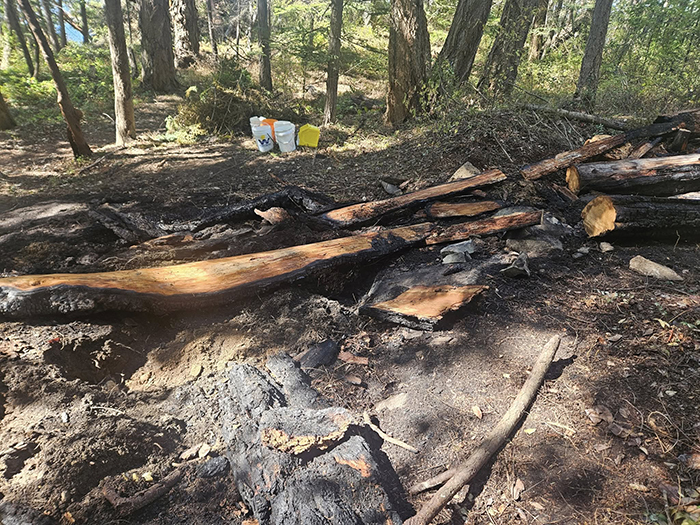
A brush fire on an uninhabited island just 500 metres from Salt Spring Island brought as many as 30 residents — and almost as many boats — to fight it with buckets, shovels and eventually a pump and hose, according to witnesses.

And after several calls for assistance — and hours of hard work by local community members — the blaze that started on Third Sister Island Sunday, Sept. 14 was fully extinguished, according to Salt Spring resident Greg Bellavance, one of the first to attend the fire. Bellavance said flames had been spotted by aircraft and shared online, at which point he and Ian Mott decided to race out of Ganges Harbour by boat to see if they could help.

“We throttled up right after the Coast Guard dock,” said Bellavance. “Next thing you know the RCMP boat is approaching us, waving to me to slow down. I pointed toward the island and said we were attending the fire; he gave me the thumbs up and let us go on.”

Bellavance said when he and Mott arrived they immediately began running buckets of water up from the shoreline and shovelling around what had grown to be a 30-by-10-foot fire near the centre of the small island, home to the popular day-trip destination Chocolate Beach. 

Nearby, he said, were three people — two “passed out” under trees near where the fire was burning, and a third hanging clothes over smouldering branches.

“They had dragged out coals and burning chunks of wood from the main body of a campfire to dry their clothing,” said Bellavance, who said the trio insisted they did not start the fire.

“I was immediately on the phone with 911, [Mott] was on with BC Forestry,” said Bellavance. “I put a call out to a group chat of my friends who are all users of Chocolate Beach — ‘bring buckets and bodies!’ — and they all mobilized.”

Additional help arrived aboard even more private boats, Bellavance said, after a social media post by his wife Kym. Among the large group, he said, was one islander who came out from the Scott Point side — on a paddle board.

“I don’t know who she was, but she was right in there with the pickaxe,” said Bellavance. “A bunch were shovelling, running buckets; one gentleman showed up on a boat with a small fire pump and a whole bunch of hose. It was a community effort.”

Bellavance said after a frustrating 911 call, one of the volunteers ashore was able to reach police directly, and shortly after the RCMP patrol vessel Lindsay arrived at the island.

“I got on the VHF [radio] with them and asked if they could come ashore,” said Bellavance. “Which they did, and they took one guy away; a couple of hours later someone came out with a little tinny and the other two left with their three dogs.”

Messages to RCMP were not returned before press time; any campfire would be in contravention of a strict and nearly province-wide fire ban, in place until the end of October.

Responding to inquiries, Salt Spring Island Fire Rescue (SSIFR) Chief Jamie Holmes said that while assistance for out-of-jurisdiction fires can sometimes be arranged outside the department’s official capacities, SSIFR operations are strictly limited by its letters patent and bylaws. When a fire situation arises outside the district, another authority having jurisdiction needs to request SSIFR’s help; and, Holmes said, they can only respond if a mutual aid agreement is in place or a provincial task number is assigned — and when enough coverage remains in place to fully protect Salt Spring Island.

“Unfortunately, when it comes to response protocols, we don’t have a lot of leeway,” said Holmes. “Sometimes there are ways we can offer support without the actual agency responding, but we can’t respond to just anything we want to.”

Holmes told fire district board members Monday night that SSIFR did contact BC Forest Service but were told their firefighting resources were “tied up on other fires.”

“They said if they had a helicopter in the area it would swing by,” said Holmes. “But I think by the time their resources cleared up, some good citizens had tackled the problem on their own.”

The district has looked into fire boats in the past, according to Holmes, but plans never materialized largely over costs, which would necessarily require not only a commercial vessel but also employing a highly-trained captain and paying for annual skills training and certifications.

“Buying a boat is actually the cheapest part of it,” Holmes said. 

Notably, Sunday was the second impromptu firefighting effort for Bellavance in recent years. During the extremely dry conditions in the summer of 2022, Bellavance contained a brush fire discovered up Mount Maxwell Road with his bobcat until fire trucks arrived.

In the summer of 2003, Ganges Coast Guard transported four of Salt Spring’s volunteer firefighters to Third Sister Island to respond to a small nighttime fire, according to Driftwood reporting.

__________________________

While not everyone who participated in extinguishing the Sept. 14 fire was known, Bellavance was able to pull together the following names to thank for helping, in addition to himself and Ian Mott: Dale Dow, Jeff Whitmore, Trevor Kaye, Nick and Celine Boychuk, Nick Ogilvie, Matt Kerrigan, Tom Miller, Allan Maten (and friend), Garrett O’Dwyer, Jann Helssen, Kim Duchek, Sal and Shauna, Cochise and Ginny, Ernesto, Jill, Chris, Cyrus, Tom, Andrea, personnel on the RCMP Lindsay and anyone forgotten or misspelled.

Holman, LCC clash over transit levy

0

A Capital Regional District (CRD) director’s 11th-hour reduction to a Local Community Commission (LCC) proposal to raise Salt Spring’s tax levy ceiling for transit services has driven a wedge between the island’s elected officials — leading one to walk out.

At the CRD Board meeting Wednesday, Sept. 10, Salt Spring Electoral Area director Gary Holman amended a recommendation from the LCC that had originally laid out a 78 per cent increase in the maximum levy for transit in 2026 to 25 per cent. Holman told board members that while he supported the larger maximum levy, he would not “sign off” on the higher number without explicitly consulting voters; the board defeated a motion to send the bylaw back to the LCC for further discussion, ultimately approving Holman’s amendment.

That decision did not sit well with some LCC members, who met the next day for a discussion on the upcoming budget. LCC member Brian Webster told fellow commissioners that it now felt to him that decisions by the local body “on anything of substance” no longer mattered, because the director could contradict them.

“And garner the support of a majority on the CRD Board to go in a direction contrary to that of the LCC,” said Webster. “So today’s meeting, which is scheduled to deal primarily with the budget, is a sham; on that basis, I’m not prepared to participate any further with this meeting.”

With that, Webster picked up his things and walked out of the room; reached later that day he said he was not yet certain whether he would return to the month’s second scheduled LCC meeting on Sept. 18.

“I don’t know what to do about this,” Webster told the Driftwood. “All I know is that I’m not willing to participate in decision-making unless it really is meaningful decision-making.”

Holman told remaining commissioners Thursday that against the backdrop of a previously-projected 9.7 per cent tax hike for next year’s LCC services becoming more like 11 or 12 per cent — a situation he attributed to an abrupt announcement from BC Transit that its lease fees and related charges would be going up by 20 per cent — he could not support the LCC’s recommendation for a 78 per cent increase in the maximum levy without consulting voters.

“That’s the principle here,” said Holman after Webster left, noting that it would likely take all of that 25 per cent increase to maintain current bus service levels. 

“The ultimate authority, democratically, around budget decisions is not the LCC, it’s not the director — it’s voters,” said Holman. “What I was standing up for was the right of voters to have a say on whether there’d be a huge increase in the maximum levy for transit. I would support it.”

CRD chief administrative officer Ted Robbins explained to that body’s board Wednesday that bylaw recommendations with financial implications exceeding committees’ and commissions’ delegated authority advance to the CRD board for its consideration — at which time directors have the opportunity to amend any such recommendations.

“Ultimately this is a decision of the board, given that it is a bylaw and has a financial matter associated with it,” said Robbins. 

“As was explained to the LCC in July, the process for approving such increases without voter approval is clearly defined in provincial legislation,” Holman clarified, “and requires written consent of the CRD director. I am exercising that consent in a reasonable way to ensure existing transit service levels are maintained in 2026 and beyond, while giving voters the opportunity to decide if they want to improve service levels.”

LCC member Ben Corno said Thursday he was disappointed and felt Holman had violated the “spirit” of the relationship between the commission and director. Corno said he hoped there would be no further amendments to LCC recommendations before the CRD board, and was surprised Holman seemed to think the situation urgent enough to vote against the motion referring the proposal back to the LCC.

“To be clear, this example only demonstrates that when we need the support of the director to affect our bylaws, including the approval of our budgets, we cannot guarantee that we will have that support,” said Corno. “Spending — deciding what to do with the money and staff that we do have — is still within our control.”

Author holds Kickstarter campaign to publish cancer memoir

A Salt Spring author has launched a Kickstarter campaign in order to publish her memoir called An Ocean Between the Waves.

The book tells the story of Terri Potratz’ young-onset rectal cancer diagnosis and how she found a middle path between conventional treatment and alternative therapies.

“Young-onset cancer is on the rise, and when I was diagnosed I didn’t see my experience reflected anywhere,” said Potratz. “This book is my way of adding that perspective, and I hope it will help others feel less alone.”

Potratz needs just 170 people to support the project at the “signed hardcore level” (or $7,500 in total) to enable editing, design and the first print run. The campaign runs until Oct. 7. Search for “Terri Potratz” at kickstarter.com.

“Being diagnosed with cancer while living on a small island comes with some unique challenges,” she said. “Along with limited local infrastructure, there’s the added complexity of ferry schedules, TAP forms and off-island accommodation. I struggled to time my medical appointments around work, and the needs of my two young children. 

“Most islanders are referred to Victoria for treatment, but I chose to go to Vancouver, where I could stay with family to receive daily chemoradiation over five weeks. That meant additional logistics and stress, but also the chance to weave together a broader care plan: oncology at BC Cancer in Vancouver, and my naturopathic oncologist at the Integrated Health Centre in White Rock, who worked in tandem with Madrona Integrative Health on Salt Spring to ensure I could receive mistletoe lectin and frequent Vitamin C IV therapies locally.”

Potratz said she hopes the book will illustrate how islanders can support their health even with rural barriers.

Potratz is also the organizer of the local Paper Covers Rock literary festival — running this year on Oct. 3 and 4 — and is a Salt Spring National Art Prize finalist in the exhibition that opens at Mahon Hall on Sept. 27, running through Oct. 19.

New legal salvo fired in Baker Beach case

0

A new petition before B.C.’s Supreme Court contends Salt Spring’s Local Trust Committee (LTC) has overstepped its authority in crafting development regulations meant in part to protect marine environments — a power lawyers for some property owners say lies exclusively with the government of Canada. 

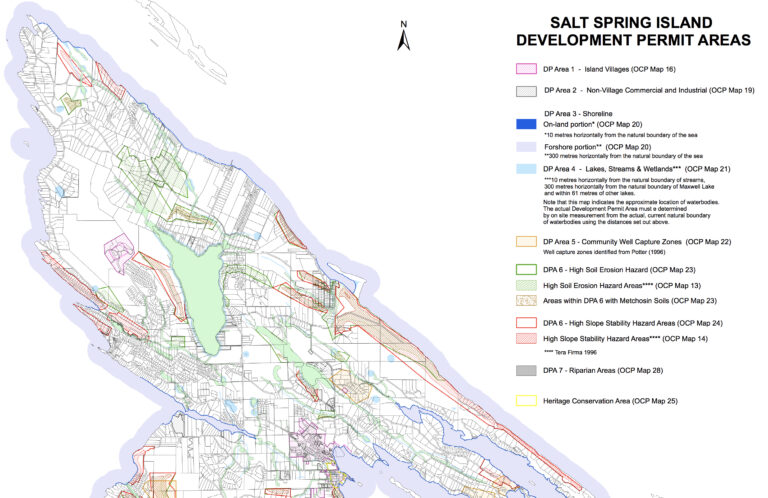
Arguing the LTC’s creation of Development Permit Area (DPA) 3  “Shoreline” within Salt Spring’s Official Community Plan (OCP) should be rendered invalid by the paramountcy of federal law, Baker Beach area homeowners Ethan Wilding, David Demner and Heidi Kuhrt have initiated a petition for judicial review of the LTC’s decision not to issue a permit for a shoreline stabilization project at their waterfront properties.

Alongside an application for a licence of occupation from the Ministry of Water, Land and Resource Stewardship (WLRS) to do work within the Crown land at the shore, the Islands Trust required a permit for the project to proceed, since it lay within DPA-3. 

In the July appeal, consultants for the homeowners addressed an itemized list of staff concerns, warning the beach itself was in danger from the same erosion processes that threatened the proponents’ homes. Ultimately the LTC deferred to its own staff, noting trustees’ lack of specific scientific expertise, and reflecting vocal public sentiment against the proposal.

In the petition filed Aug. 27, lawyers for the property owners characterized both denials as products of “unconstitutional overreach by the Trust Committee, exercising powers over the protection of fish which neither it, nor the Province of British Columbia, possess,” according to petition text. It suggests that federal permission for the project to proceed had already been received from Fisheries and Oceans Canada (DFO) under the Fish and Fish Habitat Protection Program — indicating, lawyers said, federal endorsement for the erosion mitigation effort, in line with both environmental standards and those respecting the rights of First Nations.

When the LTC’s planning services staff rejected the application initially, their concerns were based — at least in large part, according to the petition — on DPA-3 guidelines in Salt Spring’s OCP intended to protect tidal waters and aquatic habitats; DPA-3 extends into the intertidal zone seaward of the “natural boundary” of the ocean.

Lawyers for the property owners argue those guidelines exercise a power that exceeds the statutory authority of the LTC, established under the provincial Islands Trust Act, which, they said, could not empower it to directly regulate marine environments.

“During the July 10th LTC meeting, it became clear that the concern for fish and fish habitat arose primarily within the context of the LTC’s concern over Aboriginal rights to fish or harvest shellfish along Baker Beach,” read the petition. “The Islands Trust Act does not authorize the Trust Committee to enact rules for the protection of fish or fish habitat in tidal waters . . . [and] the impugned portions of the OCP exceed the Trust Committee’s statutory authority. They are invalid and ought to be set aside.”

The petitioners contend that the LTC’s DPA-3 guidelines encroach upon federal jurisdiction, which they say is exclusive over fisheries and fish habitat under Section 91(12) of the Constitution Act, 1867, and the Fisheries Act, emphasizing that federal agencies, particularly DFO, have extensive and detailed regulations, approvals and environmental assessments supporting the project’s compliance, rendering the LTC’s restrictions unconstitutional. 

“As the Trust Committee is a creature of provincial statute, it may not under any circumstance exercise statutory authority not possessed by British Columbia,” read the petition. “By creating the impugned DPA-3 Guidelines for Development in the OCP, the Trust Committee has impermissibly stepped into an area of exclusive federal jurisdiction.” 

The property owners’ petition also took exception with the LTC’s July debate on the appeal, saying trustees seem to have made up their minds before the public meeting — a procedural flaw compounded, according to the petition, by the LTC’s reasoning for rejecting the appeal, which lawyers said failed to address statutory exemptions explicitly granted in the OCP that would allow projects approved by federal agencies like DFO to proceed without requiring separate local permits. 

“Because the project cannot proceed, the petitioners are exposed to real and ongoing risk of irreversible erosion to their respective properties,” read the petition. 

“Ethan, and David and Heidi, continue to face the prospect of their homes slipping into the sea.”

The project proponents had petitioned the court back in May for an order requiring the LTC reach a decision on their application. Reached this week, Salt Spring LTC chair Tim Peterson said trustees would have no comment while the matter remained before the courts.

Indigenous leader Gosnell-Myers at next Forum

0

One of Canada’s most influential and action-oriented Indigenous leaders is the next guest of the Salt Spring Forum.

Ginger Gosnell-Myers is a member of the Nisga’a and Kwakwaka’wakw nations and was the City of Vancouver’s first Indigenous relations manager. According to the Forum, “She played an instrumental role in Vancouver becoming the world’s first official City of Reconciliation and to its Canada 150 celebrations paying homage to Indigenous history and culture.”

Her leadership also led to the city recognizing and implementing 28 of the Truth and Reconciliation Commission’s Calls to Action and its incorporating the United Nations Declaration on the Rights of Indigenous Peoples into all aspects of city planning.

For 20 years Gosnell-Myers has researched the experiences of Indigenous peoples living in urban settings, breaking down common misconceptions about them.

She is currently a fellow at the Morris J. Wosk Centre for Dialogue at Simon Fraser University and is also chair of the Greenpeace Canada board.

The discussion with Gosnell-Myers — titled Urban First Nations: Decolonizing Canada’s Cities — takes place on Thursday, Sept. 18 at 7:30 p.m. at ArtSpring.