
Home Blog Page 433

Viewpoint: New tourist tax not wanted

0

By MARGRIET RUURS

Last week’s Driftwood announced in a story that a new “tourism tax” is on its way.

The Salt Spring Economic Development Commission came up with the ironic idea to levy yet another tax on Salt Spring’s accommodation providers in order to promote tourism.

When we first stayed on the island as visitors, we had a hard time finding accommodations for one night only. When we did, it was $150, and did not include a real breakfast, and this was more than 10 years ago. When we came to live here, we vowed to do better for visitors to the island. We opened Between the Covers Booklovers B&B, with two rooms, a big breakfast, and charged under $100 per night. We have been able to host people from all over the world during the past 10 years.

Last October the provincial government applied five per cent PST to accommodations in addition to GST.

Now it seems a new, local tax is being implemented. When we first heard about this through the Accommodations Group of Salt Spring Island, we and other small accommodation providers voiced grave concerns. The tax, it was explained, would be used to promote tourism. I was pleased to see, in last week’s article, that Pender Islanders were as concerned as we are about yet more promotion of tourism.

Ever since Salt Spring was promoted in publications like the New York Times and Forbes magazine, we have all noticed the increase in numbers flocking to our island. Three sailing waits for ferries, no parking and no available beds have already been the result. In theory it sounds good to promote “shoulder seasons” to visitors.

But, realistically, how many of those summer tourists will come when November rains are pouring down? We are not Tofino or Whistler, nor do we want to be. Most residents are relieved when the tourists leave for a while. How many B&B operators actually want to remain open year round?

As a small, home-based accommodations provider I don’t want to pay another tax, do the associated paperwork or even pass more costs on to visitors. It’s like shooting ourselves in the foot.

When we opened our B&B we joined the Chamber of Commerce (at higher annual membership cost than real estate and retail businesses pay!) as well as the Accommodations Group because we wanted to show solidarity with other local accommodation providers. Meanwhile, there are now about 140 Air BnB providers on the island, many of whom are, most likely, not members of the Chamber of Commerce. And now the Economic Development Commission wants us to pay yet another local tax to help “create a more sustainable tourism environment.”

In our two-room B&B we don’t just provide accommodations to tourists, we often host people visiting family on the island who don’t have extra space to accommodate them. Perhaps instead of charging a new tax to those of us who provide beds to visitors, we should look at taxing the transportation providers who bring boat and plane loads of visitors to the islands.


Editorial: Smoke-free breathing

0

One thing Salt Spring Islanders have oodles of right now is tree branches and other woody debris, following the Dec. 20 windstorm.

While it may be tempting to get rid of every last taunting twig and fir cone as soon as possible by burning them, experts in air quality and environmental issues are advising residents to curb the urge to burn.

People without respiratory-related health concerns may not have noticed, but one day last week an air quality advisory was issued by Island Health and the B.C. environment ministry in the nearby Cowichan Valley. It resulted from a combination of excessive outdoor burning taking place and weather that resulted in a poor “ventilation index” rating. For those with compromised breathing, an official notice was not required. The discomfort was obvious.

While ventilation index considerations apply only to “machine piles” in the Salt Spring Fire Department’s burning bylaws, every property owner who is planning to burn brush outside should ensure they have a burning permit and comply with Open Burning Bylaw 125 regulations. Brush piles are restricted in size and by a number of other factors. To be considerate to their neighbours, people should only burn on days with a “good” ventilation index. The Salt Spring Fire Department website contains up-to-date index information.

But immediate burning does not always have to be only option for dealing with tree debris. A group of islanders with both fire protection and conservation interests has put together some suggestions in our guest column space on page 7 this week, which may be suitable depending on one’s property layout and size.

They range from chipping the wood to building berms, making hügelkultur beds, and biochar. The latter is a workshop topic at Seedy Saturday, which is coming up on Feb. 9. If burning seems to be the only option, the group recommends drying the branches for 30 days and having a small, hot fire of the drier material.

As our population grows and we learn more about the health and environmental impacts of open burning, it makes sense to do as much as possible to minimize contributing to smoky skies.

Legislature allegations shake province

0

The reason that two senior employees of the British Columbia Legislative Assembly have been on administrative leave since November was finally revealed Monday as being the result of alleged fraud expense accounts funds, and misappropriation of funds and goods.

Speaker of the House Darryl Plecas shared a report with the legislative assembly management committee on Jan. 21 charting the reasons he had Sergeant-at-Arms Gary Lenz and Clerk of the House Craig James investigated and eventually escorted out of the house by RCMP last fall.

Saanich North and the Islands MLA Adam Olsen was still digesting the contents of the report on Tuesday morning. What he had read and heard so far convinced him the speaker took appropriate action.

“The Speaker is responsible for managing the administration of the legislature. This is his house,” Olsen said. “To me, he undertook a process that he found was necessary. What he has reported is really quite shocking.”

After meeting in camera on Monday, the committee voted to release the full 76-page report to the public, unveiling an itemized timeline of the concerning behaviour that Plecas witnessed firsthand. James and Lenz have denied the allegations, stating they are confident time will prove them to be “completely false and untrue.”

Much of the behaviour described by Plecas allegedly took place on business visits that Lenz and James arranged to places like the U.K. and China. As he recounts, not much actual business took place, but the officials stayed in expensive hotels and had a good time. Plecas alleges that Lenz and James bought gifts and personal items they later charged as expenses. Some personal vacation days were assigned travel costs and meals that were actually provided were expensed.

Plecas says there were also attempts back in Victoria to have him authorize large benefit payments. Truckloads of alcohol and a wood-splitting machine charged to the legislature were alleged by other staffers to have wound up at James’ home.

“Some of the events discussed below involve payments or liabilities worth hundreds of thousands of dollars. Other amounts … may appear small in isolation, but their cumulative effect is substantial,” Plecas argues in his report. “As a pattern repeated over the nearly two-year period for which expenses documentation has been reviewed, collectively they amount to, at a minimum, many tens of thousands of dollars of public money, and potentially significantly more.”

Olsen said he will not speculate whether the culture of entitlement outlined in Plecas’ report might stretch beyond the two senior officers named. One thing that has become apparent to him, though, is the importance of having a House Speaker who is not connected to a particular party.

“The Speaker operates as an instrument of the government party for the most part,” Olsen explained. “If the Speaker is independent you get a different kind of leadership from that office. They’re not just trying to protect the party interests.”

“That to me is astounding, that in B.C. politics the public interest is always the last thing the political class considers,” Olsen added.

In addition to releasing the report, the all-party legislative committee voted to have an independent audit of legislature spending and to review its work practices and culture. A separate RCMP investigation into Lenz and James’ actions is also underway.

Olsen said that while he will not be inserting himself into the process as it unfolds, he will be assertive on finding ways to improve democracy and to ensure the public interest always comes first.

“I think it would be not a bad development for British Columbia to ask a broader question about political independence,” Olsen said.”I think it’s important for us to be having this conversation.”

Farmers fight CRD policy shift on livestock compensation

0

The Capital Regional District has stepped back from a proposal to eliminate compensation for livestock killed by rogue dogs but will continue to explore the possibility for communities to opt in or out of the arrangement.

Last September, the CRD’s board of directors directed staff to bring forward bylaw amendments to eliminate future compensation claims for six participating communities, including the three electoral areas. The board discussed the results at their Jan. 9 meeting, with a staff report firmly recommending amendment of the Dog Regulation and Impounding Bylaw.

While Juan de Fuca electoral area director Mike Hicks had championed the change, citing frustration that his electors might pay into claims for other farmers, he withdrew the motion after hearing from farmers in the region.

Staff were asked instead to come back with another report on the possibility of segregating the service by community. Hicks later said he supported a service that all CRD member communities would pay into.

Salt Spring director Gary Holman said he does not support any kind of loss of compensation for his electoral area.

“I have no intention of changing the policy. It’s been infrequently used but the conversations I’ve had with the farming community indicate it’s still useful,” Holman told the Driftwood. “It’s still an important element of supporting farming in the Gulf Islands and on Salt Spring, and I agree with that.”

B.C.’s Local Government Act makes it possible for municipalities and regional districts to enact livestock compensation bylaws, but it does not require them to do so, and many other communities have  chosen not to.

“We are fortunate in that way but we are also an area where a lot of agriculture is close to suburban and urban areas,” said Barbara Johnstone Grimmer, who is currently raising 200 sheep on Pender Island and is a past president of the B.C. Sheep Federation. “People are encouraged to visit our trails and parks and the population explodes with people coming over with their dogs from urban areas. So I think [compensation] should be a shared cost through all the CRD.”

Saturna Island farmer and Inter Island Sheep Breeders Association president Jacques Campbell feels that separating the service would do nothing except add to administration costs. A border collie named Meg from Campbell Farm was the very first dog to gets its licence in the CRD when the bylaw went into effect in 1980.

“I have four dogs now and I’ve been paying for it ever since. I consider it my insurance policy,” Campbell said.

According to the Jan. 9 staff report, dog licensing fees are inadequate to fund livestock compensation. The report notes the last two claims have been high — $2,043.75 and $4,500, respectively — and there are further costs incurred by the investigation process. There is no specific budget for livestock compensation and no maximum limit to be paid out per year or per claim, although there is an individual limit of 75 per cent of the value of an animal, up to $750.

“Since this function was introduced, livestock insurance has become widely available, which often includes coverage for home and contents, farm products and other damage,” the report states.

At the same time, the total number of claims made is relatively low, with just 10 in the past 15 years of service. The CRD only pays compensation when livestock deaths can be attributed to dogs and the farmer does not know the dogs or who they belong to. When the dogs can be identified, it’s up to the farmer to seek compensation from the owner.

Salt Spring’s Windrush Farm focuses on heritage breeds, raising both heritage turkeys and rare Cotswold sheep. For sheep of that value, the CRD’s $750 maximum would not recompense the real value of the animal, but it would be better than nothing.

“I would be very disappointed if the CRD eliminated this compensation because I don’t think there’s a good alternative,” owner Margaret Thomson said.

For more on this story, see the Jan. 16, 2019issue of the Gulf Islands Driftwood newspaper, or subscribe online.

Common sense urged around burning on poor ventilation days

0

Stagnant air and low winds have made perfect conditions for fog build up in the Gulf Islands, but the fog is not the only thing that is hanging around.

The lack of wind has also affected smoke from brush piles and wood stoves in the area.

Environment Canada’s Ventilation Index is a measure of the atmospheric turbulence and low level winds. It is used to determine how quickly smoke and other air particles are dispersed in a given area. Ventilation Indexes are measured in 25 areas of the province. Though Salt Spring bylaws say that the index is applied only to machine piles, the Salt Spring Island Fire Department recommends using common sense when deciding whether or not to burn smaller hand piles on non-venting days.

“If you’re burning a bunch of wet stuff with neighbours right beside you, it would be better to do it on a day where it’ll vent better,” said Salt Spring Fire Rescue Lt. Ken Akerman. “If you can get a good hot fire going and there’s no smoke then it’s not a problem either . . . We don’t want people burning and smoking out their neighbours.”

The regulations set out by the Venting Index legally apply only to land clearing or machine piles. Burning is only allowed on days where the ventilation category is “Good,” and when the forecast category for the next day is either “Fair” or “Good.” However, the index is also a good indicator of how smoke from smaller fires will act.

“The venting index doesn’t apply to yard burns, it’s only for machine piles,” Akerman said. “We’re complaint driven, so we’re going to go check out the complaints and determine whether we feel it’s a problem or not . . . If that happens we do go check it out and either request for them to put it out or educate them on better ways to do it, no matter if it’s a venting day or a non-venting day. It’s not just about the one person burning, it’s about everybody.”

Although it is not forest fire season, the air quality can still be affected by smoke. On Jan. 14, the Ministry of the Environment and Island Health issued an Air Quality Advisory for the Cowichan Valley due to the conditions. The advisory was lifted on Jan. 15, but burning restrictions remained in place until midnight on the 15th. Air quality is expected to improve later in the week as wetter weather moves into the region. The advisory did not affect Salt Spring or the Gulf Islands.

The Ministry of the Environment recommends disposing of waste through other means before resorting to burning. Recommendations include recycling, composting yard trimmings and mulching woody debris. They also suggest avoiding wet material in both outdoor and indoor fire places, burning only during good venting conditions, and only burning material that has been dried for at least six months.

Information about the current Ventilation Index can be found at the Salt Spring Fire Department website.

GISS visual art gets interactive at Mahon Hall

Gulf Islands Secondary School’s visual arts students have created an immersive and interactive art environment at Mahon Hall, where this week visitors can see the results of the creative process as explored by 65 different participants.

Under the guidance of this semester’s teacher, Emily Goodden, students have delved not only into their studio process but into all aspects involved in creating a group exhibit. Their learning experience in the school’s art room has included zine making, silk-screen printing and button making as well as making wearable art out of found materials, ceramic mask-making and more traditional drawing and painting techniques.

With the help of visiting artists and community mentors, they have also learned to create an exhibition space that draws in the viewer. Following the example of contemporary artists such as Colette Urban and Patrick Cruz, their strategies include laying paintings on the floor, staging an inviting environment using their test fabric as tenting, and displaying masks on rods for an uncanny eye-level view, to name a few.

The show was produced in partnership with the Salt Spring Arts Council. Additional support came from artist Melissa Searcy, Richard Steel on exhibition installation, Sue Earle on beginner’s sewing, David Borrowman on photographing artworks and Jane MacKenzie as SSAC co-ordinator/liaison.

The show continues from 10 a.m. to 5 p.m. through Friday, Jan. 18 and ends with a closing party and fashion show featuring the wearable art, live music by students and food from 7 to 9:30 p.m.

Strikers face Sooke in semi-final game at home

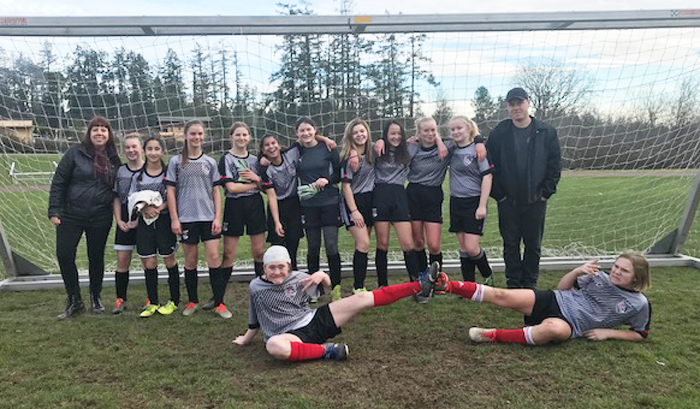
Salt Spring United’s U14 girls soccer team will play in a semi-final game in front of a home crowd this Saturday, Jan. 19.

The Salt Spring Strikers will host a Sooke team — one of its biggest rivals — at Portlock Park beginning at 12:30 p.m.

The Strikers currently sit in second place in league standings and would qualify for the finals in February with a win on Saturday. Islanders are encouraged to come out and cheer the girls on to victory.

The Strikers are coached by Chris Jason.

Blowdown a windfall for forest research

0

A University of British Columbia researcher is using windfall from the Dec. 20 windstorm to further her research into the history of wildfires on Salt Spring Island.

While old-growth trees can be a wealth of information about the history of climate change and wildfires for a given area, taking samples usually ends up killing the tree. However, the recent windstorm has provided researchers with an opportunity to obtain samples and valuable insights from the fallen trees.

“These big old trees are so rare that we don’t want to be cutting into them for this type of project,” said lead researcher Tara Martin. “When I started to notice that several big ones fell in our area, I thought it was a good opportunity to put out a wider call.”

First Nations peoples traditionally used fire to promote food and other resources. The oldest trees on the island will often have scars or remnants of those fires. However, the last 150 years have seen fewer fires and any fires have been actively suppressed.

“When we combine fire suppression with post-logging regrowth — most of our forests are second-growth forests with the exception of these few big old giants — we get structurally a very different looking forest,” she said.

Martin said that Garry oak meadow ecosystems were more prevalent on the island before fire suppression. These ecosystems have been replaced by stands of Douglas-fir growth, particularly in deeper soil areas.

“The [samples] can tell us about how we might want to manage our forests in the future if we’re interested in plant diversity and maintaining biodiversity,” Martin said. “They can also tell us about minimizing fire risk in terms of what our forest should look like to minimize fire risk in terms of risk to property and human life.”

Martin is asking for anyone who might have a tree that fits the criteria to contact her. The trees need to be older than 250 years old, which can be difficult to determine. She is looking for samples of the tree rings cut at a height of about 1.5 metres. For her research, she also needs information about where the tree grew.

Those who have a potential tree on their property are asked to contact Martin at tara.martin@ubc.ca. Martin can also help identify trees that might be usable.

For more on this story, see the Jan. 16, 2019 issue of the Gulf Islands Driftwood newspaper, or subscribe online.

Radio society submits licence application

0

Salt Spring Island may have been without a radio station for the past three and a half years, but a non-profit society working to re-establish the service hopes the silence will be broken in the not-too-distant future.

The Gulf Islands Community Radio Society recently submitted its application for a licence to the Canadian Radio Telecommunications Commission.

“It’s very exciting,” said GICRS president Damian Inwood. “We’ve really passed a milestone now, after three years of hard work to get the application in to the CRTC.”

Inwood said it could take a year for the licence to be approved, and society members may have to attend a hearing in Ottawa as part of the process. Some existing stations on Vancouver Island and the Lower Mainland have the right to object if they feel a Salt Spring-based station could interfere with their signals.

The group has submitted a request for call letters CHIR, with the IR representing “Islands Radio,” and it will be pronounced “cheer.” As the society’s name implies, they would like to include the other Gulf Islands in their coverage.

“We are going to use the same two frequencies [as the previous station]: 107.9 and 102.1. They are available and we thought people are used to using those wavelengths on their radios.”

Transmitter locations on Mount Belcher and Mount Bruce are also the same as the previous CFSI station, which operated as a commercial venture under two different owners from 2009 to 2015 until its licence was revoked by the CRTC, but Inwood said better equipment would be used.

“Now we start some of the heavy lifting, which is raising capital funds. We need $85,000, mainly for the transmitting equipment.”

Current islandsradio.ca programming sees Scott Merrick host a morning show from 7 to 9 a.m. Monday to Friday, which is also repeated in the evening. Music is otherwise heard on the site.

The group is inviting anyone interested in doing a program, either online now or through the station when it gets going, to send proposals to Inwood at president@gicrs.ca.

For more on this story, see the Jan. 16, 2019 issue of the Gulf Islands Driftwood newspaper, or subscribe online.

Editorial: No time to snooze

0

January may be winter doldrums time, but it’s also the month to wake up and connect with government services and elected officials.

If people have not yet opened the envelope containing their 2019 property assessments, they really should do so. While BC Assessment pegs the average Salt Spring residential property increase at 15.31 per cent, a number of property owners have reported increases at double or triple that rate, which could seriously bump up their property tax amounts. The active real estate market of the past few years has naturally translated to valuation increases, but it is up to property owners to do the research required to determine if the hike they have received makes sense when compared to neighbouring properties. A search tool on the BC Assessment website makes it easy to collect relevant assessment and property sales data for one’s area. The deadline to appeal an assessment is Jan. 31.

January is also the season for town hall meetings. Local MP Elizabeth May and MLA Adam Olson have been getting together with constituents in a marathon of meetings and will be on Salt Spring this Thursday and Pender on Friday. It’s an excellent opportunity to raise concerns about provincial and federal matters affecting the islands.

In a similar vein, Salt Spring’s new Capital Regional District director Gary Holman has scheduled a public meeting to talk about the CRD budget and its impacts for islanders. It’s on Tuesday, Jan. 22 at the library program room from 1 to 3 p.m.

Another body with local taxing authority is the Islands Trust. Trustees are meeting with each other and staff this week in Nanaimo to draft a preliminary budget. They will then ask for public feedback before adopting a final budget in March.

It’s easy to believe that government bodies don’t care what constituents think about how they spend their money, but that isn’t necessarily true. At the local level, especially, elected officials and staff tend to be sensitive to criticism and don’t want unhappy campers to deal with.

Often, government bodies do what they do with minimal direction or feedback from the public. Politicians are not mind readers and as bureaucratic processes subsume them they may easily lose touch with those they serve.

Take advantage of upcoming opportunities to let those we elect know how we want our money spent or not spent, and where we want them to direct their energy.