Home Blog Page 440

PANKHURST, Ruth Frances

0

Ruth Frances Pankhurst, MDCM,
(nee Donald)
March 31, 1932 – October 31, 2018

It is with profound sadness that the family announces the passing of Ruth Frances Pankhurst. She passed away peacefully with her husband John at her bedside in her beloved home on Salt Spring Island, British Columbia. Ruth was predeceased by her parents, Jessie and Robert Donald, sister Joan Simons, cousin Huey Walker, and best friend Betty Stucker.

Ruth is survived by and will be deeply missed by her husband John, four sons Robert, Jack, Donald and David, daughters-in-law Su and Kelly, cousin Fred Walker, nephew Donald Simons and by her eight grandchildren, Christina, Gabby, Wesley, Garrett, Johnathon, Kevin, Eric and Ryan.

Ruth was born in Point-Claire, Quebec and after graduating from the Montreal High School for Girls she went on to complete her nurses training at the Montreal General School of Nursing in 1953. In her early years Ruth had a gift for music and she often shared her musical talents when she performed as a soloist. In 1956 Ruth married the love of her life, John Pankhurst and they shared an amazing life together for over 62 years.

Ruth soon decided that medicine was her true calling and enrolled at McGill University, graduating with her Bachelor of Science in 1957 and with her MDCM in 1960. Ruth and John moved to Edmonton, Alberta in 1960 where Ruth interned at the University of Alberta Hospital and in 1961 began private practice in Edmonton where she worked for 37 years until her retirement in 1998.

Soon after moving to Edmonton Ruth and John began their family, and by 1966 they were raising four boys under the age of six years. While the boys were young many hours were spent at the family farm and multiple family trips to various countries. They were always active with down hill and back country skiing, hiking, and scuba diving. Ruth equally loved the theatre and opera, and she was a voracious reader and a phenomenal cook. Ruth passed her love of cooking onto all of her children. In 1998 she and John moved to Salt Spring Island, BC where Ruth and John found their joint passion in sailing in their sailboat, “Primetime”.

The family thank all of those who helped and supported her during her illness: Dr. Robert Crichton, the Home Care Nursing staff, the Beacon Community Services staff and her many friends.

Ruth will be forever in our hearts and memories until we meet again. As per her wishes, a formal service will not be held. A private family celebration will be held at a future time. Flowers are graciously declined by the family. Anyone wishing to make a donation can do so to Lady Minto Hospital Foundation, or any charity of their choice.
=<


Beddis logging alarms residents

0

Residents of the Sky Valley Road and Beddis Road area are demanding action to stop a major logging operation taking place outside their back doors.

Work to clear trees from the majority of a privately owned 45-acre Beddis Road property began a few weeks ago. Although a portion of the land is within a development permit area for soil erosion hazards, the trees covering nearly 40 acres are scheduled to come down.

Peter McAllister and his wife Bernadette Mertens-McAllister live on a Sky Valley Road property that backs onto the contested site, which is split zoned into agriculture and rural zones. Together with Jean Wilkinson, they have collected over 200 signatures from people in their neighbourhood and all over the island who are asking the Salt Spring Local Trust Committee to step in.

“People are really up in arms. It’s becoming a real serious issue,” said McAllister, who is a veteran of the Clayoquot Sound and Carmanah anti-logging campaigns. “People have been pounding on the doors of the Islands Trust for years asking them to establish some rules around responsible forestry, but nothing has been done.”

The property, formerly owned by long-time resident and farmer Mike Larmour, who died in December of 2016, was sold to island resident Gary Stunder on Aug. 28.

Local trustee Peter Grove has spoken to logging contractor Scotty Royal, who said the property development was a partnership between himself and the registered owner. Grove recently visited the site along with incoming officials, trustee Laura Patrick and CRD director Gary Holman. Grove’s information is that logging is planned for the entire property except the DPA area, and will be cleaned up in a professional manner. Neither Royal nor Stunder returned Driftwood calls before presstime on Tuesday.

“Clear-cutting is an ugly business. We have seen plenty of it on the island over the years,” Grove said. “Every farm and open space was once forest. In time the land will heal, but it is still hard to take.”

While Grove intends to bring the general issue to the LTC and to Islands Trust Council, he said there is little to be done in this case. Word from administration staff and bylaw enforcement is that land clearing is a lawful use under the Beddis property’s zoning.

According to Islands Trust mapping, several ecosystems are recorded on the land in question. The upper portion is classified as mature forest, primarily Douglas-fir and salal. The lower contains young Douglas-fir, a wooded wetland and western red cedar zones.

McAllister and others believe the Trust could halt the logging and immediately place the steep slope in protective status under a provision of the Islands Trust Act. They are asking the new LTC to hold an emergency meeting as soon as possible, as their next scheduled meeting on Dec. 6 may come too late.

“According to the bylaw, LTC can designate areas because of their natural environment, ecosystems or biological diversity or because LTC believes those areas are hazardous, or because LTC believes those areas may be subject to flooding, erosion, land slippage or avalanche,” the letter being sent to the trustees states. “This area qualifies on several counts. It’s an ecologically endangered older Douglas-fir forest in the Gulf Islands, it contains a seasonal stream and a wetland, and it’s in a hazardous steep slope area where logging could precipitate erosion and land slippage.”

Grove said that might be the case, but new rules would not apply to properties such as the Beddis Road lot, where the uses would be “grandfathered in.”

Grove acknowledges tree-cutting has become an important issue over the past years as residents have watched several large acreages in the north end completely cleared. Despite the concern, though, there are no restrictions for most properties. The Salt Spring Local Trust Committee does not have the ability to create a bylaw that covers tree-cutting across the entire community, as municipalities do.

Galiano Island has established a tree-cutting DPA “to ensure that tree removal on the island is limited, sustainable, and strictly necessary for the intended use of the land.” The DPA covers the entire island but exempts some activities, such as subdivision,  clearing trees in order to build a structure, and tree cutting within the Agricultural Land Reserve. The idea for creating a similar development permit area for Salt Spring was raised and quickly rejected during the last review of the official community plan.

McAllister believes that commercial logging is a use that is not permitted in either agriculture or rural zones. It also appears to him and his wife that whoever did the DPA mapping failed to visit the entire area, because a very steep section coming down from the ridge was not included in the soil erosion hazard map.

“No housing could possibly go on those steep slopes, and if you clear-cut it’s totally prone to erosion,” McAllister said. “It’s a steep slope, it’s unstable, and it’s held in place by an ancient forest.”

“I’m sure the mapping does need to be reviewed, but it’s a massive undertaking. Our OCP needs to be reviewed and that could be part of it,” Grove said.

Editorial: Lessons of the Past

0

Remembrance Day is a special one this year, marking 100 years since the Armistice ending the First World War was signed.

It’s difficult to imagine now the scale of the impact this war had on Canadians and the world as a whole, but it’s worth taking the time to look back.

One hundred years ago, Canada had a population of less than eight million people. More than 650,000 men and women had served in uniform by the end of the conflict, and 66,000 Canadians and Newfoundlanders were killed. The call to duty was heard by regular people living their lives between three coasts. Farm boys from Salt Spring, Indigenous sharp shooters and immigrants from many nations came together in the attempt to bring peace and stability back to the world.

To remember the service of those who fought so long ago is to contemplate a sacrifice most of us have never been asked to make, much less volunteered for. We complain about too much rain, or being disoriented by Daylight Saving Time changes. They left families behind and risked traumatic injury and death while enduring hellish conditions such as constant mud, mustard gas, limited rations and disease.

Canadian soldiers were at the forefront of decisive battles at Vimy Ridge and Passchendaele, and Canada itself became recognized an independent, morally responsible nation as a result of its contribution. Technically still part of the British dominion, Canada was a signor in its own right to the Treaty of Versailles, which formally ended the war on Nov. 11, 1918.

Some of the core values by which Canada defines itself today can be dated back to this time. War may be necessary or unavoidable at times — such as to put a stop to genocide — but peace is always preferable, and that’s where Canada has focused its efforts. The commitment to a diverse society with equal human rights for all is another outcome, arising in part from the contributions of those diverse soldiers in two world wars and the contrast with their unequal treatment once back at home.

By continuing to look back on Nov. 11, we do not glorify war or romanticize its realities, but reflect on the capacity of individual humans to give up much for a greater good. That is a lesson we can all stand to remember.

Local disc golfers host first sanctioned tourney

More than 70 disc golf players braved the weekend rain to take part in the second tournament in the 2018/2019 Duck Golf series at the Salt Spring Island Golf Course.

Players had to contend with a bit of wind on the Friday practice round, but had sunny skies through the day. However, Saturday’s tournament was a great example of where the Duck Golf series gets its name from, with rain falling on and off throughout the day.

“It is Duck Golf, so we’re pretty much prepared for rain,” said Bill Anderson, a player from Vancouver.

The eight-tournament series runs through the winter, with the championship held in Burnaby in May.

Local player Evan Eyles took the top spot in the open men’s category with a score of 114 for two rounds of play. The open women’s category was won by Victoria’s Kristy Lee, scoring 133.

The tournament was the second in the series, put on by BC Disc Sports. It was also the first sanctioned disc golf tournament held on Salt Spring. The smaller course at Mouat Park did not qualify for sanctioned competition. After recently opening the new course at the Salt Spring Golf and Country Club, which has longer holes and more traditional layout, the local club is able to host bigger tournaments.

“It’ll definitely be good for disc golf on Salt Spring,” said tournament director Ben Corno. “It adds a bit more stability to the idea, which means we can put more energy into it.”

Corno hopes to build up the existing temporary infrastructure on the golf course with more permanent fixtures.

Sanctioned tournaments generally attract more serious players who are registered with the Professional Disc Golf Association (PDGA). The results of the weekend’s tournament counted toward player ratings.

“When you’re a PDGA registered player, they track your scores and apply a rating to you relative to other players that you’ve played against,” Corno said. “If you play in a tournament that has a lot of great players and you do well, it’ll boost your rating. If you do just marginally at a tournament with bad players, it’ll probably drop your rating.”

Seventy-two players from as far away as Chilliwack participated in the Salt Spring tournament. The series will have events in Langley, Burnaby, Nanaimo, Mission and on Pender Island.

Editorial: Don’t leave us high and dry

0

Travelling by ferry between Salt Spring and Vancouver Island has become much more stressful in the past year.

It used to be that demand for space was high in summer months, and island residents adjusted their plans accordingly. But as anyone who has tried to leave the island via Fulford Harbour or Vesuvius in the past six months will attest, it can seem like summer on any weekday because of higher vehicle traffic. Arriving at either terminal a full hour in advance of the scheduled sailing time can be the only way to guarantee a spot on a boat. For people with important medical appointments in Duncan or Victoria, or a flight to catch in Sidney, the stress caused by not knowing whether or not they will be at their destination on time can be traumatizing.

People are already cringing at the thought of the smaller-capacity Quinitsa replacing the retiring Howe Sound Queen before next summer and for subsequent two years while new mid-size ships are built. The Vesuvius-Crofton (Route 6) problem will only get worse unless BC Ferries looks at making some changes to its scheduling or other operations.

BC Ferries says that overloads occurred on 23 per cent of all Route 6 sailings this year. While the corporation made a few minor schedule adjustments to increase capacity on Route 6 this summer, those changes did not have enough impact. Relying on a “schedule” for that route has been unreliable this year.  The ship was on time for only 57 per cent of sailings from May through July. BC Ferries clearly  needs to do more work on creating a schedule that has some semblance of reliability.

In the longer run, a significantly larger vessel on the route is not the answer, since there is no place to put more waiting traffic in Crofton or Vesuvius.

Community members could also contribute to a solution by carpooling more often. BC Ferries traffic stats reveal that vehicle traffic on Route 6 increased by 5.91 per cent over 2017‘s year-to-date levels by Sept. 30, for example, but passenger traffic was up only 3.87 per cent. That suggests a lot of cars with only one driver are taking up space on the boats.

Ferry waits and overloads may be a fact of life for the foreseeable future, but BC Ferries should do as much as it can to not leave islanders high and dry.

Viewpoint: Let’s create true democracy in B.C.

0

By BRIAN SMALLSHAW

I’m eagerly looking forward to receiving my ballot for the Referendum on Electoral Reform and hopefully by the time you are reading this we’ll have them in our hands. This is a historic opportunity for British Columbians to take a big step forward in advancing democracy in our province.

In our democracy every citizen who is 18 or older has right to express their political preferences by voting, but under our electoral system, often referred to as First Past The Post (FPTP), their views may not be well represented in the Legislature or Parliament. If the candidate they voted for gets more votes than anybody else, AND if that candidate’s party wins more seats than any other, a citizen will likely be fairly well represented in the Legislature. If their preferred candidate loses, or if their candidate’s party loses, they likely won’t be well represented at all.

This system is especially problematic in a multi-party democracy such as Canada’s, because it means that a candidate can win a seat and a party can form government with far less than 50 per cent of the vote. It’s common for parties with considerably less than 40 per cent of the popular vote to win a “majority.” Even worse, because many people don’t bother voting because they feel there’s little hope their preferred candidate will win, most of these ‘majorities’ are in fact nothing of the sort.

You might ask what’s wrong with that? The candidates with the most votes win. The winners can’t behave too egregiously or the voters will throw the bums out the next time around. The problem with this is, at any given time the government will likely only be representing the views—and enjoying the support of — a minority of the electorate (who showed up on election day). So parties govern in the interest of the people that voted them in and everybody else must wait until the next election to try to throw them out. If they succeed, the new party in power is likely to impose its views on everybody else, leading to the sharp policy swings you get when we lurch from one false majority to another.

It’s sometimes argued that the current system prevents extremist candidates and parties from gaining power. First of all, I would say that the governments of Donald Trump and Doug Ford show this to be manifestly false. Secondly, it’s easy enough with a PR system to set a minimum threshold a party must reach to gain representation, and this is exactly what is being proposed for British Columbia. And finally, if a party gains more than a minimum threshold and is still not represented, or is seriously underrepresented, can you even call the system a democracy, “a system of government by the whole population?”

We have the opportunity to change all that and create a system of government where elected representatives must compromise to find solutions that work for everybody and where all citizens are eager to exercise their franchise because they know their views are being represented in government. Your ballot contains two questions: whether you want adopt a Proportional Representation system or stick with FPTP; and which of three proposed PR systems you prefer. Please know that you can answer either question or both but I would urge you to at least vote in favour of PR. Also know that your ballot must be received by Nov. 30, so don’t wait until the last minute to mail it in.

There are lots of people as excited as I am to be voting to reform our electoral system, so we’re doing what Salt Springers always do, we’re having a party! We’re going to meet at 11 a.m. on Saturday in front of the library to celebrate, fill out our ballots and walk to the post office to mail them in. Come and join us!

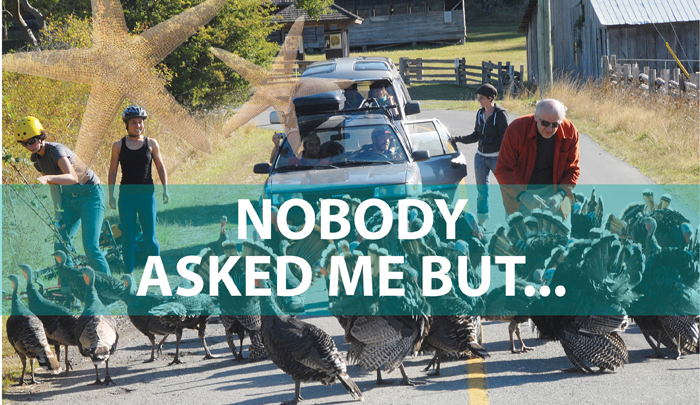
Nobody Asked Me But: Third funniest person sports sore-loser pout

0

Way back in the early winter of 1988, my friend Sam and I decided to pass a little slower than usual time by creating some tongue-in-cheek awards for citizens and organizations here on Salt Spring. We tried to give these awards a feeling of authenticity, something akin to the Academy Awards in Hollywood and the Tonys from Broadway in New York City. It didn’t take too much imagination to come up with the name “Salties.”

That first year, we created 25 mythical Salties. A couple of examples were the “Just Kidding, Folks” award, which went to the B.C. Ferries Corporation for creating a controversy over the Isabella Point ferry terminal and then sheepishly claiming that it had all been a big misunderstanding (not that much has changed, apparently). The Peacemaker of the Year Salty went to Luigi’s Pizza for calling off the then hotly contested cold pizza war (back when a good slice of pizza was hard to come by on the rock).

You’ve probably caught on to the idea, but here are a couple more of the awards to help cement the concept. The Democracy in Action award went to the Salt Spring general public for electing all their political representatives by acclamation (then again, some things do change), and the Non-Event of the Year Salty went to the Harmonic Convergence (remember the Harmonic Convergence?) with a close second to the defeated leisure pool.

Of course, there never really were any votes cast, nor any awards presented, but Sam and I made it look official by announcing the winners in a letter to the editor in that week’s issue of the Driftwood.

Many Driftwood readers found the awards amusing, and some were even taken in by the “fake hoopla,” believing that they had somehow missed out on the gala event of the year. The next winter, I decided to forego Sam’s complicity and award the Salties all by my lonesome. This meant that the third annual 1989 Salties were up for grabs (don’t ask how the third annual could take place in the second year of presentation; this is a popularity contest, not an intelligence test).

To make matters even more confusing, the public was informed that the “Saltie” was a shortened name for “Salt in Wound” award to give the general public some idea of the spirit the awards were meant to convey. This particular year, The Montague-Capulet Merger Award was given to Greenwoods and Lady Minto Hospital while the “Walk on Water” trophy went to the Ganges Seawalk.

The Salt Spring Hysterical Society defended their previous victories from past years by collecting the “Last Show, Definitely” Salty for once again claiming they would retire the old material but instead kept trotting out the old comedy scripts for one more kick at the can. The late Driftwood columnist Bill Webster was given the Lifetime Achievement Award for proving that his column could be written just as well using a food processor instead of a word processor. (For years afterwards, whenever I ran into Bill anywhere in town, he would tilt his head downwards, shake it from side to side, and mutter the words “food processor.”)

Anyway, with time, the idea for the Salty Awards became a bit stale and the Salties were mercifully put out to pasture. Just a few years ago, however, a business awards promotion was picked up again by the Chamber of Commerce. I was honoured by being asked to host the presentation of the awards at the Harbour House Hotel where a decent crowd turned up to witness the presentation of the awards under the lights in what could be described as Salt Spring’s version of a “red carpet affair.”

Old and new businesses were nominated and judged by a three-judge panel, and there was a “people’s choice” award as well. Unfortunately, I was not asked to return the next year as MC (which is okay by me except for some minor bruising of the ego).

In the meantime, with or without me, the Salty Awards continue bigger and better than ever. Last year I received a phone call from someone representing the Chamber informing me that I had been nominated in the category “Funniest Person on the Island.” I was told that judging by the votes counted thus far, I could finish no worse than third (which is where I finished). My old friend, Arvid, who had died over a year earlier, was still funny enough to be funnier than me. There’s irony there somewhere and I’m sure he’s enjoying it wherever he may be now.

All this is just a long-winded way of announcing that the 2018 Salty Awards are upon us and the winners will be announced at a gala dinner on Thursday, Nov. 8. A total of 30 awards will be handed out in two categories: Business and Community. Included this year is a Fun & Games category for the more quirky and esoteric among us. Both the nomination and voting processes are now officially closed and the winners will once again be announced at the “big blowout” presentation at the Harbour House Hotel.

Nobody asked me, but it is with bated breath that we must wait these last few days for the words “may I have the envelope, please.” There will undoubtedly be acceptance speeches galore thanking mothers, fathers, spouses and that special grade 3-4 split class teacher at Fulford Elementary. You may even see me there. I’ll be the one with the sore loser pout.

Toad People wins Wildscreen Award

A local filmmaker has won an “Academy Award of wildlife films” for her conservation film Toad People.

Isabelle Groc, a Salt Spring-based filmmaker, was nominated for the Wildscreen Panda Impact award for small budget films in August, and was delighted to hear the announcement at the ceremony on Oct. 19 in Bristol, U.K. The film was one of 37 nominees for various awards.

“We were really nervous,” she said about the awards ceremony. “It was a big event with lots of people. We were literally on the edge of our seats with tension. When we heard the name ‘Toad People’ called it was unforgettable.”

The film looks at the yearly migration of the western toad and how it is affected by habitat encroachment. The toads are born in wetlands and migrate to the forests for their adult lives. However, their migration paths have been bisected by roads and large numbers of the young toads are killed by traffic. The story of the toads got the attention of activists in communities across B.C., who rallied to help the amphibians migrate.

“This award means a lot because it encourages me to continue my work in conservation and storytelling around the work that local communities do. When I spoke on stage I dedicated the award to all of the local people who have worked so hard to conserve endangered species right in their backyards,” Groc said. “For me, the impact award provides hope that other people can do the same thing: be involved locally and help make a difference for the environment and for species at risk. That’s the main thing.”

Groc was also a speaker on a panel called Conservation Stories Closer to Home at the Wildscreen Festival. She and two other wildlife photographers talked about how conservationists can look at cases closer to home. The other photographers were Doug Gimesy, an Australian photographer, and Luke Massey from the U.K.

“It’s really about the fact that you don’t have to travel to distant places to find conservation issues to be involved in,” Groc explained. “The toad story is a great example of how you can be involved in local conservation to make a difference and create a greater impact.”

Already, the story of the western toad has reached an international audience. Groc explained how she was approached by a Swiss conservation biologist who said that her toads film prompted her to do work in her home country.

“Our British Columbian toads are helping save Swiss frogs,” Groc said. “I thought that was a pretty cool impact.”

The Wildscreen Festival is held every year in October. Bristol is home to the BBC’s Natural History Unit, which produces the BBC Earth films and other nature documentaries. The festival gives wildlife filmmakers a chance to learn from each other at screenings, speakers and other events.

Further showings of Toad People are planned for the fall in Vancouver. The filmmakers are working on international distribution for the movie and will announce screenings as they are known.

“Hopefully the film will reach larger audiences and will continue to inspire people around the world,” she said.

Viewpoint: Let’s create true democracy in B.C.

0

By BRIAN SMALLSHAW

I’m eagerly looking forward to receiving my ballot for the Referendum on Electoral Reform and hopefully by the time you are reading this we’ll have them in our hands. This is a historic opportunity for British Columbians to take a big step forward in advancing democracy in our province.

In our democracy every citizen who is 18 or older has right to express their political preferences by voting, but under our electoral system, often referred to as First Past The Post (FPTP), their views may not be well represented in the Legislature or Parliament. If the candidate they voted for gets more votes than anybody else, AND if that candidate’s party wins more seats than any other, a citizen will likely be fairly well represented in the Legislature. If their preferred candidate loses, or if their candidate’s party loses, they likely won’t be well represented at all.

This system is especially problematic in a multi-party democracy such as Canada’s, because it means that a candidate can win a seat and a party can form government with far less than 50 per cent of the vote. It’s common for parties with considerably less than 40 per cent of the popular vote to win a “majority.” Even worse, because many people don’t bother voting because they feel there’s little hope their preferred candidate will win, most of these ‘majorities’ are in fact nothing of the sort.

You might ask what’s wrong with that? The candidates with the most votes win. The winners can’t behave too egregiously or the voters will throw the bums out the next time around. The problem with this is, at any given time the government will likely only be representing the views—and enjoying the support of — a minority of the electorate (who showed up on election day). So parties govern in the interest of the people that voted them in and everybody else must wait until the next election to try to throw them out. If they succeed, the new party in power is likely to impose its views on everybody else, leading to the sharp policy swings you get when we lurch from one false majority to another.

It’s sometimes argued that the current system prevents extremist candidates and parties from gaining power. First of all, I would say that the governments of Donald Trump and Doug Ford show this to be manifestly false. Secondly, it’s easy enough with a PR system to set a minimum threshold a party must reach to gain representation, and this is exactly what is being proposed for British Columbia. And finally, if a party gains more than a minimum threshold and is still not represented, or is seriously underrepresented, can you even call the system a democracy, “a system of government by the whole population?”

We have the opportunity to change all that and create a system of government where elected representatives must compromise to find solutions that work for everybody and where all citizens are eager to exercise their franchise because they know their views are being represented in government. Your ballot contains two questions: whether you want adopt a Proportional Representation system or stick with FPTP; and which of three proposed PR systems you prefer. Please know that you can answer either question or both but I would urge you to at least vote in favour of PR. Also know that your ballot must be received by Nov. 30, so don’t wait until the last minute to mail it in.

There are lots of people as excited as I am to be voting to reform our electoral system, so we’re doing what Salt Springers always do, we’re having a party! We’re going to meet at 11 a.m. on Saturday in front of the library to celebrate, fill out our ballots and walk to the post office to mail them in. Come and join us!

Roadside parking curtailed

0

The Ministry of Transportation and Infrastructure is cracking down on Salt Spring businesses that make use of its road right-of-ways in their operations, with at least two locations receiving notice the practice will not be tolerated after Oct. 31.

Beddis Road Garage is one location that has been notified that cars will no longer be permitted to park on the roadside, after a visit from ministry staff last week. Owner Erik Lundstrom was warned that cars could be towed without notice starting Nov. 1, at the expense of the garage.

Other locations where cars may be towed include Rainbow Road and Lower Ganges Road north of the Rainbow Road intersection.

The ministry said it is acting due to road safety concerns.

“Public safety is always the ministry’s top priority,” a ministry spokesperson told the Driftwood. “Staff were made aware of two instances on Salt Spring Island where personal property was obstructing provincial right of ways and leading to safety issues. The ministry issued notices under the Transportation Act to remove the property from provincial land.”

Vehicles parked on the right-of-way have provoked tension among islanders in general over recent weeks, including two public cries for action on the Salt Spring Community Discussion Forum.

Daron Wall posted a complaint about the “used car lot” that has sprung up on Upper Ganges Road above Ganges Marina, despite no-parking signs posted there.

“More than once I have seen near collisions because of other vehicles stopped there that can’t pull completely off of the road, forcing vehicles that pass the stopped car to cross the centre line into the oncoming lane,” Wall wrote.

Other commenters noted the situation can make it dangerous for pedestrians to navigate through that area.

Another complaint arose about a truck parked on the side of Fulford-Ganges Road that was blocking visibility at an intersection.

Others have spoken in favour of protecting the freedoms that islanders are used to enjoying, or for the enforcement of much bigger problem areas first. Eric Booth wrote to the ministry staff and various elected officials, with the letter copied to the Driftwood, to demand the ferry traffic that often blocks entire lanes of the road at Fulford and Vesuvius villages be addressed before a serious incident occurs.

“Given MoTI is enforcing against private individuals, I would appreciate it if you could all please explain why these individuals are being discriminated against, since the largest encroacher onto the MoTI highways themselves, not the sides of highways, is the BC Ferries corporation with their now constant parking of their customer traffic in the traffic lanes at Fulford and Vesuvius,” Booth wrote.

Booth pointed out that any impediment to traffic flow on a highway that results in a one-lane situation requires two flaggers to safely direct traffic around the impediment, according to B.C. law.

“Given, however, the nature of BC Ferries customers parking on the highways, the situation is abysmally unsafe,” he said.

“I am putting the recipients of this letter on notice that should any traffic accidents, injuries, or deaths occur at either location, directly or indirectly, all parties will be held liable for damages due to their participation in their refusal, as public servants and/or elected officials, to enforce the traffic laws of British Columbia.”