
Home Blog Page 45

Big year ahead for water district

0

Salt Spring’s largest water provider is ramping up its spending plans heading into fall, hoping to adopt next year’s budget by late October — and with more than $18 million in capital projects slated for 2026, the North Salt Spring Waterworks District (NSSWD) has an arguably full dance card.

The lion’s share of that record spending will be taken up by construction of a new water treatment plant at Maxwell Lake, now a $15-million project ultimately mandated by Island Health in 2023. The district remains hopeful some large portion of that plant’s funding will come from a Canada Housing Infrastructure Fund grant, although there has been no word on when — or whether — that grant might be approved. 

The district also expects to advance the Duck Creek weir project in 2026 — a significant climate resiliency effort that for its part is already funded by provincial dollars. And an upgrade to the Crofton Road pump transfer station should, in the future, enable combining the similarly treated two “halves” of the district’s water system, adding or subtracting whenever the St. Mary or Maxwell Lake sides need to shift supply. 

Perhaps the most immediately visible project, at least for some users, surrounds work on the aging water meters at customers’ property lines. Over the next four years, NSSWD expects to replace between 350 and 400 water meters each year, according to a proposed capital projects document, with a relatively modest $350,000 slated from the utility’s reserve funds to cover costs in 2026. 

The meters in place aren’t reliably registering how much water is actually being delivered, according to a staff report to the NSSWD board Thursday, Aug. 28, creating uncertainty in conservation planning and what is likely an effective loss of revenue. The older equipment also requires significant staff time devoted to manual reading, which keeps them away from other tasks.

The new meters under consideration, according to operations director Ryan Moray, transmit data over cellular frequencies — prompting a question from district trustees on whether adequate network coverage existed throughout NSSWD’s service area.

Moray said the meters require little bandwidth to send out what are very simple messages back to the office or, in a pinch, to a nearby district employee.

“It’s not like streaming a movie, right?” said Moray. “It’s just a very small number being transmitted.”

NSSWD CAO Mark Boysen said manufacturers of the new meters also indicated there was a specific band on the cellular spectrum they used that tended to be “more available” than that used for most phone calls or text messages — he said he would have more information about that soon — and that even when there’s no signal, a “drive-by” with equipment to receive readings would be exponentially more efficient than reading meters manually.

District financial officer Tammy Lannan said the board could also consider reducing the water toll fee surcharge once the meter replacement program was completed and collecting user data became simpler.

“The fact is we’re not seeing the revenue we should, because it’s not capturing all the water [going through],” said Lannan. “With new meters, you can expect your [usage] bills to be higher.”

From a procedural perspective, islanders may soon see new clarity with respect to how water connections are approved — an issue the district has only recently been dealing with again after a 10-year connection moratorium was partially lifted earlier this year.

District trustees approved a bylaw revision specifying the use associated with those connections must be permitted “pursuant to Salt Spring Island’s Land Use Bylaw” — in other words, allowed by the Islands Trust.

“If they give approval to the zoning and the land use, then we should provide the water to that connection,” said Boysen. “It makes it really simple for us, and clearer for everyone.”

Boysen said new water service connections had “consumed” roughly 10 per cent of the available 300 multi-family-dwelling-unit-equivalent taps so far.

MASSY, Patricia

1

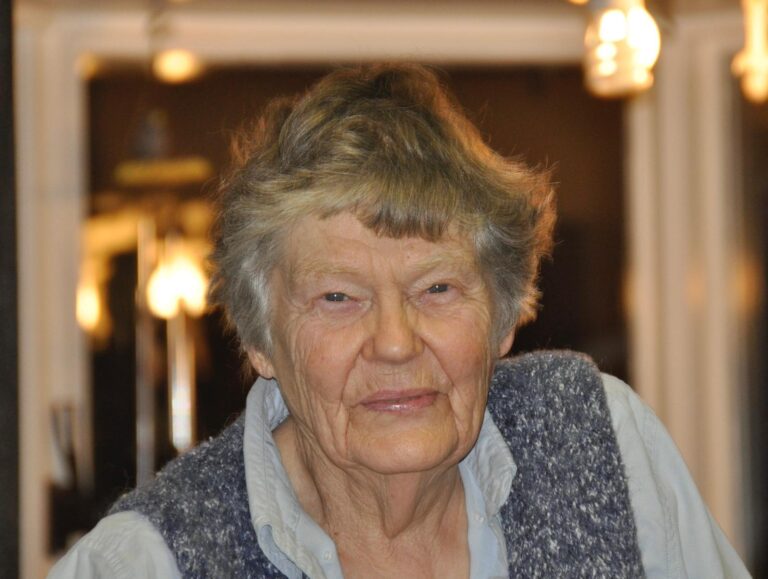
Patricia Massy (nee Nettelfield) passed away at the age of 102, at the Lady Minto Extended Care Unit, surrounded by her children, on July 20, 2025.

Born on March 18, 1923, Patricia was predeceased by her husband, David, and her son, Peter. She is lovingly remembered by her children, Jane (Lyle), Valerie (Gerald), Tony (Gail), William (Janet), and Richard (Jane), 16 grandchildren and their spouses, 27 great grandchildren and many other extended family and friends.

Patricia lived an amazing life. A British war veteran in the Intelligence Corps, she married David in 1944, and travelled on the Queen Mary with her three-month-old daughter, Jane, to join him in Canada in 1946. David’s teaching took them to various communities in BC and Quebec before settling with their six children in Victoria.

After raising her family, Patricia served as CRD Director for View Royal for several terms before moving to Salt Spring with David in 1985. Among other community activities, she coordinated volunteers for the Salt Spring Library and sat on the library board. She was a founding member of the Island Watch and was part of the APC of the Island Trust. Together with David she volunteered with Hospice for many years and she was always proud of the ribbons she won at the Fall Fair for her auriculas.

We have fond memories of her labradors, cats, compost piles and fertile gardens. As the matriarch of our family, her love of the earth, support for organizations like Green Peace, The CCPA, Eco Justice Canada and the Fire Fighters’ Burn Fund, have given us all a strong legacy of environmental and community responsibility, and social justice.

Her ashes have been scattered in the beautiful Salt Spring Natural Cemetery according to her wishes.

Pender benefit concert raises $46,000

Pender Island is still vibrating in the aftermath of a “pop-up” concert with local youth band The Dip and indie rock “jizz-jazz” star Mac DeMarco that raised $46,000 for Doctors Without Borders (DWB) on Aug. 24.

When Jo Beattie from The Crisp festival group and others wanted to hold a DWB benefit concert, she decided to ask DeMarco, who now lives on the island, if he would perform. Not only did he say yes but he asked some talented young musicians to open for him, having heard them play at a celebration marking the end of a major South Pender road reconstruction project noted for its “Dip” warning signs.

“Darcie and Alan Whittingham immediately offered their Camp Cowbell as the perfect outdoor venue, and Lisa Fleming of Ptarmigan Arts jumped in managing donations and providing some of the sound equipment,” said Beattie.

Her husband Greg organized the production, and she and Ripley Stafford got the word out through social media. Many others stepped up to fill key roles.

Beattie and her crew were blown away by the response, with an estimated 1,000 mostly younger-aged music fans showing up.

Concert tickets and donations brought in $23,000, with DeMarco matching that amount to reach the $46,000 total.

Vancouver DWB representative Georgia Keefe also spoke to the crowd about her organization.

Ben McConchie, a School District 64 music teacher who has taught The Dip members, was the event’s emcee.

“I was stoked seeing my students up there, you know, after years of bouncing around in a boat [travelling to teach kids on the different islands], finally seeing that all pay off, I was just like ‘sweet!’ It felt good.”

Salt Spring drummer Alessandro Perez also performed with The Dip, who not only opened the show but got to play with DeMarco and his band for one song.

It turns out that The Dip keyboard player Waylon Lapp is a huge DeMarco fan. As his dad and renowned musician Daniel Lapp posted on his Instagram account: “Mac probably doesn’t realize that Waylon, who has been recognized as Mac’s #1 fan on Spotify, probably knows his music better than anyone in the world! Mac’s generous spirit and gracious support of ‘The Dip’ changed lives in this moment . . . what a rock star! I’m now his second biggest fan.”

“It was really, really special,” said McConchie. “And it’s a huge boost to the Gulf Island music scene having a high-profile person like DeMarco chilling and living here.”

DeMarco, who has now begun a major fall concert tour of U.S. and Canadian cities, said he was pleased with how it turned out.

“I’m so happy the show formulated in the way it did,” he said by email. “So much help from tons of awesome people, all for a good cause. It really felt like the perfect way to cap off a summer on Pender. Hopefully we can make a tradition of it. Long live The Dip.”

_________________________________________________

On behalf of The Crisp, Jo and Greg Beattie wish to thank everyone involved, with a special shout-out to Mac DeMarco, his band, Darcie and Alan Whittingham, Todd and Deb Bulled, Lisa Fleming and Kate Biddell of Ptarmigan Arts, and the other volunteers who made it all possible, especially emcee Ben McConchie, Ian Pirie and his security crew, Janet Fletcher, Art Van Vliet and their parking crew, Chris McKenzie and Sarah Rae for helping with our videographer Joel, The Dip and all their friends! Thanks to the RCMP, Fire and Ambulance Services for their support! Special thanks also to Barb Grimmer, Karl Hampson and photographers Rose Da Silva and Kenta Kikuchi!

ICS makes volunteering part of membership criteria

0

Nine months after the last Island Community Services (ICS) annual general meeting, the society’s board has made public its new criteria for membership — and it’s unlikely to translate into anyone becoming a new eligible voting member of the 50-year-old organization before the next AGM set for Sept. 25. 

“ICS has adopted criteria and a process for membership selection that is considered best practice for the sector, and includes drawing members from those that are actively participating in the organization’s activities,” stated ICS board chair Jennifer Lannan in an emailed response to a series of Driftwood questions about the issue. “The current policy that defines that participation is completion of 20 hours of volunteer service annually.”

According to emailed notices shared with the Driftwood, that policy change was communicated in an Aug. 4 email to some of the dozens of individuals who applied for society membership in 2024. A May 28 ICS email to applicants had asked if they were still interested in becoming an ICS member, if they still lived on Salt Spring or in the Southern Gulf Islands, what capacity they had to support the organization and whether or not they had conflicts of interest to disclose. A response deadline of June 30 was set. They were advised that if they did not reply by the deadline then their application would need to be resubmitted.

Earlier in the year, on March 6, the board sent membership applicants a letter advising that “The board has been engaged with a number of external consultations including board development and legal. A membership committee has been struck and is actively working on a response to the applications that is fair, objective and consistent . . . We will be communicating at some point in the spring of 2025 with regard to an information session for applicants on the subject of the society and we look forward to your attendance.” 

But that session did not occur. 

Gayle Baker, who last year took an active role in trying to get more members for ICS, said the board’s actions in “stringing along” last year’s applicants with interim communications and then ultimately drafting the 20-hour volunteer work criteria that eliminated most of them were “disappointing.” 

“It’s unfortunate it worked out this way,” said Baker. 

Facing many membership applications in the months leading up to its Nov. 14, 2024 AGM — in response to concerns expressed publicly by former local MLA Adam Olsen, past board members and others about the organization — the board decided at that time to approve no new members. Doing so, board members said, ensured no “hostile takeover” of the society would occur at the AGM or through additional general meetings that a certain number or percentage of registered society members are allowed to call. 

“As part of its ongoing commitment to continuous improvement,” Lannan wrote in her Driftwood response, the board of ICS has undertaken an extensive review of the membership selection process over the last year that has included significant research and consultation, including legal and other expertise in the non-profit sector.”

She also referred to a 2023 Pacific Legal Education Outreach (PLEO) Law for Non Profits legal reference sheet about membership, which is posted on the ICS website in the section on membership and includes a paragraph describing how some non-profits “will require prospective members to volunteer before they can apply to become members. Having that in a policy is a good way to establish the ground rules for members. This practice may help protect the non-profit from conflicts that result from individuals joining the organization who do not share its mission or values.” 

Current ICS volunteers meeting the 20-hour requirement were reportedly invited to apply for membership in the society. Lannan did not respond to a specific question of how many of those individuals had made an application. 

Although ICS executive director Rob Grant was not asked for input to this story, he emailed a copy of the PLEO Law for Non Profits document on the ICS website to the Driftwood, highlighting sentences such as “Membership in a non-profit is not a right; it is a privilege,” and “Many non-profits have bylaws requiring the board to have the final say on whether an individual can become a member. However, others have gotten out of the habit of taking this important step.” 

“Law For Non Profits is a significantly more credible source of facts about non profit governance than Facebook,” Grant wrote, adding, “This is what my research into journalism ethics turned up” and providing six paragraphs of ChatGPT-generated information about “journalism ethics.”

Changes made to ICS bylaws in July of 2024 included board approval being required for society membership, but with no criteria spelled out. Further bylaw changes made this past July added that membership was open to people who are “free of Conflicts of Interest relevant to the Society” and who meet “the requirements for participation in the Society as a volunteer as established by the Board of Directors.”

Lannan said the Sept. 25 AGM will take place at 3 p.m. on the third floor of The Core on McPhillips Avenue, “at which time we will be marking our 50th year as a registered B.C. society.” 

Salt Spring Arts Fall Grants & Awards applications Now Open

SUBMITTED BY SALT SPRING ARTS

Artists and community groups on Salt Spring Island have the opportunity to bring their creative visions to life with support from Salt Spring Arts’ (SSA) Grants and Awards program.

The organization’s fall 2025 intake is now open, offering two funding opportunities designed to support artistic development, community engagement and cultural projects.

The application period runs until Oct. 31 and includes two micro-grants: Community Project Grants and the Susan Benson Fund for Visual Artists.

Community Project Grants engage public-facing arts initiatives that contribute to Salt Spring’s vibrant cultural landscape. Individuals and organizations working in any artistic discipline may apply for up to $1,000 in funding to support creative, community-focused projects. These may include — but are not limited to — public exhibitions, performances, creative youth programming or interactive workshops.

The program prioritizes projects that are innovative and of cultural benefit to the community, aiming to spark creativity and expand public access to the arts.

The second opportunity, the Susan Benson Fund for Visual Artists, supports women visual artists who are looking to deepen or develop their creative practice. Established by the acclaimed Canadian artist and designer Susan Benson, the Benson Fund acknowledges the unique barriers faced by women artists, while welcoming all artists living on Salt Spring Island to apply.

Grants of up to $1,000 can be used for materials, exhibition costs, mentorship or other professional development activities. This fund is especially geared toward visual artists who are committed to advancing their careers and making meaningful contributions to the artistic community.

Salt Spring Arts encourages all interested applicants to visit saltspringarts.com/grants-awards for full details, eligibility requirements and application instructions. SSA is committed to supporting diverse voices and encourages applications from artists of all backgrounds, disciplines and experience levels.

Viewpoint: AI Overviews harm media industry

1

By PAUL DEEGAN

A little over a year ago, Elizabeth Reid, vice president and head of search at Google, announced, “AI Overviews will begin rolling out to everyone in the U.S., with more countries coming soon. That means that this week, hundreds of millions of users will have access to AI Overviews, and we expect to bring them to over a billion people by the end of the year.”

In making the announcement, Ms. Reid wrote, “With AI Overviews, people are visiting a greater diversity of websites for help with more complex questions. We also see that the links included in AI Overviews receive more clicks than if the page had appeared as a traditional web listing for that query. As we expand this experience, we’ll continue to focus on sending valuable traffic to publishers and creators.”

So, how is it going? Brightedge, a firm specializing in search engine optimization and content performance, released new research on the first anniversary of Google AI Overviews, which found a nearly 30 per cent reduction in click-throughs since May 2024. So much for more clicks . . . .

Large language models are harming publishers in two ways. First, AI companies are flagrantly scraping and summarizing content directly from published news articles via retrieval-augmented generation. Second, because AI overviews are significantly more comprehensive than the snippets associated with traditional links, users may feel they have no reason to click through to the source article on a publisher’s website. With the user staying within Big Tech’s increasingly tall-walled garden, rather than being directed electronically to news websites via links, publishers are deprived of audience, and their ability to sell advertising and subscriptions is significantly diminished. Yet, AI companies are selling ads against copyrighted (and often paywalled) content as well as subscriptions for their premium products.

Readers are being harmed, too. First, there are numerous examples of AI overviews serving up inaccurate, irrelevant, outdated and even harmful information. Second, if publishers cannot monetize their content, they cannot reinvest in the accurate and authoritative journalism that readers rely on to make informed decisions.

In a recent op-ed in the New York Post, Danielle Coffey, president and chief executive officer of News/media Alliance, which represents American publishers, wrote, “Big Tech’s dirty secret is that the success of its AI tools has been almost entirely built on theft.” Last November, OpenAI was sued by a group of Canadian publishers, including The Canadian Press, Torstar, The Globe and Mail, Postmedia and CBC/Radio-Canada. In February, publishers, including The Toronto Star, Condé Nast, McClatchy, Forbes, and The Guardian, sued Canadian AI company Cohere, alleging the company produced word-for-word copies of thousands of news articles without permission or compensation.

How can policymakers help scale innovation leaders while ensuring the ethical, positive and responsible use of AI? Through reasonable guardrails: First, intellectual property should be protected. Second, platforms should provide fair compensation to publishers. Third, platforms should provide clear attribution to source content. Fourth, publishers should be allowed to opt out of AI overviews without their websites being removed from search. Fifth, platforms should not discriminate in search results ranking.

In summary, to ensure our free and plural press remains commercially viable, there should be no AI crawling without consent, credit and compensation.

The writer is president and CEO of News Media Canada.

Editorial: Money (not) to burn

0

When the Salt Spring Island Fire Protection District opens its doors for a budget town hall on Sept. 8, trustees and staff will be presenting the smallest increase in budget — and appurtenant taxes — in years. 

The district is looking at a 6.9 per cent overall hike, and while that still means a budget topping $6 million, draft budget documents are showing efforts Salt Spring’s budget hawks will likely find encouraging: holding administration costs to a two per cent bump, less than the speed of inflation; setting wage increases at 2.7 per cent for next year, although preparing for the potential of 5 per cent in future years; and holding operations at a 3.9 per cent rise, again modest even as the cost of vehicle and hydrant maintenance rises.

Slipped inside the budget package is a colourful page of fire apparatus, and a list of dates when they’ll need to be replaced. The march of time is inevitable, and the importance of safe and effective equipment is difficult to overstate, as is the likelihood that the trucks aren’t going to get any cheaper in the future.

One big knock down in the budget is, counterintuitively, related to the new fire hall: there’s no need to keep feeding reserves every year to plan for a future build, because it’s happening as we speak. Of course, in one sense that annual expenditure is being replaced with the cost to service a mortgage.

The district is also embarking on a multi-year plan to increase capital building reserves again, this time to fund the eventual relocation of Fire Hall No. 3 to somewhere presumably slightly more northerly than its current spot at Central —  a five-year plan that envisions the new satellite hall operational by 2030. Trustees seem well focused this year on choosing and acquiring the right piece of land.

Planning the next fire hall before the paint is dry — or frankly even applied — to the current one is prudent; keeping a tighter rein on ratepayers’ costs is a bonus. Fire district budget town halls are the perfect opportunity to listen in — and sound off — on the future of Salt Spring’s fire protection plans, and we recommend attending. 

Community Labyrinth project completed

0

Thanks to the vision of a small group of women and support from the wider community, Salt Spring Island now has its own Community Labyrinth, with an opening event set for Saturday, Sept. 13 at 10:30 a.m.

According to project initiator Sarah Belknap, the amenity located on the Anglican Parish of Salt Spring Island cemetery property at 710 Upper Ganges Rd. is a simplified Chartres Cathedral design, with seven rather than 11 circuits.

“The turns and the pattern are similar to the labyrinth that was laid in the Chartres Cathedral in Paris in the 12th century,” said Belknap.

Pathways are 25 inches wide, with accessibility being an important consideration, she said.

“We always stressed that the labyrinth was designed to be as safe and accessible as possible. Everyone — kids, who invariably want to run around the pathway, and elders who rely on a cane or walker, and everyone in between — can enjoy the labyrinth.”

The project germinated in the fall of 2022 after Belknap attended a labyrinth workshop led by Anglican minister Gyllian Davies. Belknap has walked several labyrinths in her life, she said, and was inspired to envision one for Salt Spring after seeing a community labyrinth on Pender Island. After gathering a group of women to initiate a labyrinth project here, a proposal for the site was approved by the Anglican Parish of Salt Spring Island in the spring of 2023. Labyrinth team members were Jacqueline Byron, Susan Grace, Gloria McEachern, Gail Robinson, Rosamund Woolley, Davies and Belknap.

Nolan Magnus of Living Accent Contracting was hired to lay the foundation and provided invaluable input. Foxglove Farm and Garden Supply, Windsor Plywood and Salt Spring Slinger were also involved and provided discounts and/or above-and-beyond support. Members of The Circle Education’s Pass It On Boys group helped place the 1,667 rocket paver bricks.

Total project cost was $26,000, with about one third raised through Salt Spring Island Foundation and Lions Club grants and the rest through individual donations.

“At our fundraising events we had a cookie jar and a lot of people came by and when they realized what we were doing just dropped cash in the cookie jar, and wanted to know where the labyrinth was going to be and they wanted to walk it. So a lot of donations were made in that way, and then some people made larger donations.”

“The most expensive part of the project was the first part — the foundation of the labyrinth. It took time to raise those funds, because it was built to last,” she said. “The foundation was constructed so that the labyrinth might serve islanders now and in future generations.”

Two native plant species — yarrow and field chickweed — were planted on the paths, but only some of the yarrow has survived so far, Belknap said.

A kiosk on the site acknowledges project contributors and provides more information.

Belknap said studies have found that walking a labyrinth can positively impact one’s emotional well-being, and that’s been her experience as well. It’s an ideal spot for considering problems or possibilities, for example, which are physically taken into the labyrinth.

“You’ve got something you’ve been working on in your own mind . . . and you literally get different perspectives as you walk the circle. People find that new ideas come up, or they are just able to really relax and kind of look at things differently.”

One of the benefits is that people are forced to just be present as they walk.

“Some people think that a labyrinth is a maze, but they’re very different. A maze is meant to trick you . . . with a labyrinth, you just put your foot on the path and the path will carry you to the centre and out again. So in that space where you really don’t have to think about anything, you can just put one foot in front of the other, and you’re going to get to the centre and out again.”

The Sept. 13 opening celebration will include a short ceremony and expressions of thanks, with live music provided by islander Simon Millerd and friends.

As funds will be needed to maintain the labyrinth in future, donations of any size are welcomed. A Canada Helps page on the Anglican Parish website — with a QR code linking to the page on the labyrinth kiosk — being an easy way to contribute.

Root to Bloom Centre launched

SUBMITTED BY THE SALT SPRING ISLAND FARMLAND TRUST

What began as a scrappy grassroots effort to protect and preserve farmland on Salt Spring Island has blossomed into a thriving hub for education on regenerative practices. With the launch of the Root to Bloom Centre, the Salt Spring Island Farmland Trust is entering a bold new chapter, evolving its popular learning into a full-fledged education centre that aims to spread the innovations and expertise of island growers far and wide.

Drawing on the incredible talent of local and regional experts, the Root to Bloom Centre is inviting locals and visitors to delve into hands-on workshops, webinars and training in regenerative agriculture, food sovereignty and farm-to-table culinary arts.

“The Root to Bloom Centre aims to become a Hollyhock for farming on Salt Spring Island,” said program manager Shannon Farmer, referring to the world-famous Hollyhock retreat centre on Cortes Island. 

“We’re building on our popular Learning Series,” Farmer explained, laying out the centre’s lineup that offers fall courses ranging from seed saving to soil health to compost brewing to Indigenous wild food stewardship. “It’s all grounded in a shared commitment to ecological sustainability and community well-being.”

The Root to Bloom Centre springs to life just as Royal Roads University (RRU) is carrying out a community engagement process to inform their planned programs and services at the Bloom Castle by the Sea. The Beddis Beach campus was donated to RRU by the late Susan Bloom, an environmental philanthropist and pioneer in land conservation.

RRU is working collaboratively to develop academic programs, resources and community events to be offered at the new Bloom Castle campus for residents and visitors to Salt Spring Island. Francesca Jackman, senior advancement specialist at RRU, said, “Our collective vision is for this one-of-a-kind space to be a shared resource focused on regenerative sustainability that benefits residents, local Nations and Indigenous community groups, students, faculty, staff, alumni, partners and the broader academic community, and reflects a blend of educational pursuits and community tradition.”

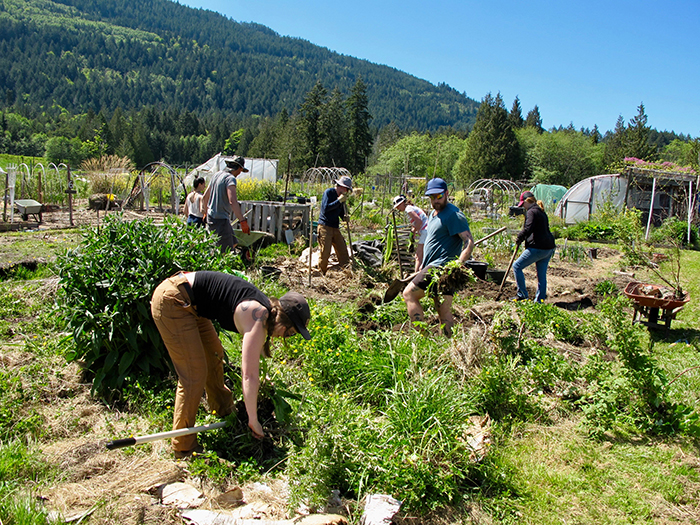
Salt Springers will be able to provide input via a public survey in early September, and can check out other engagement opportunities on the university’s website. Meanwhile, the Farmland Trust is rolling out innovative programming this fall at sites including The Root food hub on Beddis Road, the Burgoyne Valley Community Farm, and various farms around the island.

“We’re thrilled to be collaborating with RRU as they bring higher education directly onto the land,” said Jenn LeBlanc, chair of the Farmland Trust. “Together, we’re fostering a model where academic learning, community knowledge and on-the-ground experience all feed each other.”

Unlike a traditional classroom, the Root to Bloom Centre unfolds across Salt Spring’s fields, forests and farms. This fall’s Root to Bloom hands-on offerings provide an inspiring mix of technical skills and place-based wisdom:

• Walking the Wild Food Web with Indigenous food educator Jared Qwustenuxun Williams

• Cover Cropping 101 with Daria Zovi of Quarry Farm

• Seed Saving with Dan Jason of the Living Seed Sanctuary

• Soil Microbiology & Compost Brewing with Soil Food Web technician Paz Rainville

• Gardening With Native Plants with ecological biologist Emony Nicholls

• Cooking With the Bounty of Salt Spring with Jenn LeBlanc

• Year-Round Gardening with Linda Gilkeson

“We’re building something special on Salt Spring — a resilient local food system, grounded in regenerative practices,” said LeBlanc. “The Root to Bloom Centre is a natural evolution of our work — a way to pass on skills, share knowledge and spread ideas that are being incubated on Salt Spring Island far and wide.”

Workshops take place at sites across Salt Spring and online, with many courses being filmed for future on-demand access, ensuring the knowledge spreads far beyond the island. To register for upcoming workshops or become a Friend of the Farmland Trust, visit ssifarmlandtrust.org.

Farmers’ Institute changes ready for Sept. 6-7 Fall Fair

0

When the crowds descend on the Farmers’ Institute grounds for the Salt Spring Fall Fair next weekend, it will be hard for them not to notice some changes.

Improving and adding to the amenities at the Rainbow Road acreage has been a focus for the past year or more — and it shows.

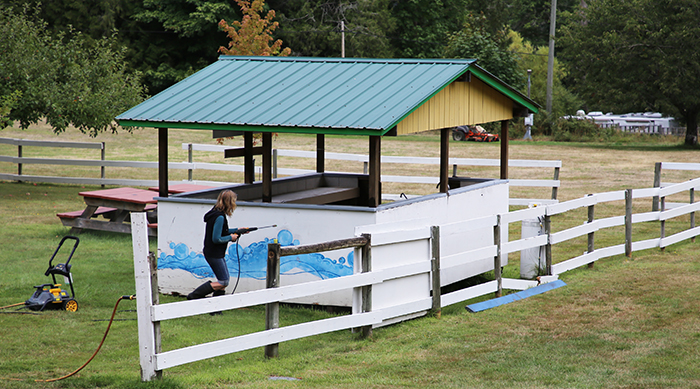
“It’s been a really good, productive year,” said Friends of the Farmers’ Institute (FOFI) member Carol Walde as she and her colleague Pam Fetherston scrubbed and powerwashed the vendor booths on the institute grounds during a regular Tuesday morning work session Aug. 19.

“It’s bit by bit, but we’re really getting a lot done,” said Walde. “We’ve completely finished painting the whole inside of the main building, so that was a huge one,” especially since that includes the bathrooms and bathroom floors. A local painting contractor will take care of the ceilings. New lighting was also installed in the exhibition hall, Walde said.

The picnic tables and music area benches have been repainted, she said, as has much of the fencing, some of which is new. Last Tuesday the institute sawmill was in operation as Farmers’ Institute directors Merv Walde, Graham Lorimer and Dolores Bender-Graves cut and stacked more future fence pieces.

Brad Bompas was working on what is likely the most noticeable change on site: a future shed for the institute’s collection of tractors and other vintage farm equipment located in the vacant spot between the blacksmiths’ forge and former spinning mill.

“It’s the first new building in years,” said Fall Fair committee chair and FOFI member Gail Temmel, noting it was made possible by a Salt Spring Island Foundation grant, as was the new pollinator garden underway, an area adjacent to the hall covered in black plastic at present. The demonstration garden will be an educational resource for farmers, gardeners and students and marks the beginning of a program to “green” the property in other ways.

Some preliminary removal of blackberries and ditch rehab has begun, said Temmel, with the aim of better managing the water that goes through the property due to its location in the Mount Erskine watershed.

Fall Fair Zucchini 500 racers and spectators will also notice a change as the tracks will be housed in a 32-foot-long culvert.

Also new this year is a 12-foot by 12-foot misting station set up by the 4-H barn, prompted by last year’s searing heat, especially on the Saturday of Fall Fair weekend.

As for the general site clean-up, Temmel said a number of people have volunteered their time to make it happen.

“I walk around and I make lists of what needs to be done, and I have a whiteboard up in the office with a list on it,” she explained. “People come in and they see what’s there, and they go, ‘Okay, how much time have I got? What do I feel like doing?’ And it works. And hopefully by the Fall Fair, it’ll look neat and tidy and clean, and people will appreciate it.”

Even the fruit trees in the picnic table area have received some much-needed TLC.

As introduced last year, the fair’s main entrance gate will be further up Rainbow Road, with the paved road reserved for staff, accessible parking and the horse trailers.

Saturday, Aug. 30 is the deadline for submitting general entry forms for the Sept. 6-7 fair. That can be done online at ssifi.org/fall-fair-entries or by dropping printed entry forms and cash fees off at Foxglove Farm and Garden, Island Savings or the Ganges Visitor Centre. Entry fees per category are $1 for juniors and $2 for adults.

See the Fall Fair Catalogue link at ssifi.org or get a hard copy at the three entry spots and the Driftwood office. This year’s fun theme is Not Baaad in Plaid.

More volunteers are needed to make the fair run smoothly.

“As of last Tuesday, we still needed over 65 bodies between the gates and indoor monitors and extra hands the week before for whatever needs doing.”

People can sign up at ssifi.org or by emailing contact@ssifi.org or gmtemmel@shaw.ca.