
Home Blog Page 459

In Response: Real estate regulation changes easy to misinterpret

By SUSAN DE STEIN

There is great potential to misinterpret some of the upcoming changes to real estate regulations that are coming into effect on June 15, about which the government has done a very poor job of communicating. 

While I absolutely support Marianne Hobbs’ call for consumers to voice their opposition to the new regulations in her May 30 opinion piece in the Driftwood, I would like to clarify a few points.

Mrs. Hobbs stated that consumers can no longer choose their own realtor. This lack of choice, however, occurs only in some situations, one of which is when the consumer is interested in viewing and wants to make an offer on one of their chosen realtor’s listings.

For the most part, buyers can deal with the realtor of their choice. They cannot, under the new rules, however, ask a listing realtor to act as their agent in the transaction on that listing. But far from having to “import” another agent (as she put it “say from Nanaimo”) — that buyer can choose from any number of other realtors on Salt Spring, who are very well acquainted with Salt Spring.

After June 15, realtors may no longer act in what has been called “limited dual agency.”  That is, on June 15, a realtor can only act as an agent for either the buyer or seller in a transaction. Where the realtor has had both seller and buyer as a client in the past, there are two choices (and both buyer and seller must agree on those choices). One client (more likely the buyer) may opt to be un-represented in the transaction, in which case the listing realtor is allowed to fill in paperwork and perform some of the functions of a realtor, but cannot act as that participants’ agent. Or, as Marianne Hobbs pointed out, the second choice is that one participant in the transaction (again, most likely the buyer) may opt to use another realtor as their agent. Here on Salt Spring it’s not likely they will need to go so far afield as Nanaimo, since there are qualified realtors on Salt Spring who can perform that function. 

To another one of Ms. Hobbs’ points, in my view, it isn’t the lawyer, in fact, who judges whether the deal is in his client’s best interests. The lawyer can and often does advise about the legalities of a transaction, including the interpretation of covenants, rights-of-way, and other notations and items on title. It is the lawyer who facilitates the conveyancing of the property. But I’ve never known a lawyer to judge whether a deal is in his client’s “best interests.”

It’s my experience as a listing realtor that many buyers in the past have chosen to deal with the listing realtor as a limited dual agent, as they believe that this individual knows more about the listing. 

Of course buyers I have dealt with over a long period of time also want me to show them all suitable listings, including mine. My listing clients hope and expect that I will introduce the property to buyers I am working with. Under the new regime, while I can show my listings to clients I am working with, I do so under the understanding that I am not and cannot be their agent when showing them my listings and in the event they decide to offer on any of them. My interactions and communications will be limited and will not include advice. Clients will be informed of this limited role from the start. It is at that point that the client can decide to be unrepresented, or choose another realtor to lead them through the transaction. 

There is no question that the new Office of the Superintendent of Real Estate, under direction from the B.C. government, is in many instances taking away consumers’ ability to decide who they want to represent them. The rationale for these changes, I believe, lies in the actions of a few bad apples, primarily in the Vancouver market. The new rules are, at their core, politically motivated and not based on an understanding of how the real estate industry works, nor do they factor in the reality of our unique and small marketplace. They certainly do not take into consideration the professionalism and integrity of realtors on Salt Spring and all over this province.

There are now some documents available that explain these changes, but we are also hoping that the government embarks on a program to educate all consumers as to what they can expect from their realtors. 

Yes, we are neighbours and friends who support local charities, do business in our shops and coach your kids. And yes, we would love public support to oppose these changes, although the time for changes may be past (or up to a subsequent government to undo).

But whether we are able to lobby to change these new regulations, or we simply have to adapt to them, we will continue to be professional, represent you to the best of our abilities, act with integrity and, of course, adhere to regulations governing our industry. 

The writer is a Pemberton Holmes realtor on Salt Spring Island.

Editorial: Stick to the plan

0

When property tax bills arrive this week, one chunk will be the $396,250 we pay for the “transportation” service through the Capital Regional District.

In the fall of 2014, Salt Spring voters approved by referendum a $250,000 increase in the requisition to be paid between 2015 and 2018 for transportation (not transit) services. The referendum wording was broad enough that the $1 million collected over four years could be spent on any number of pedestrian safety improvements in the Ganges area, but the referendum campaign emphasized a portion of Rainbow Road and Lower Ganges Road as the priority areas.

Almost four years later, the results of that exercise are clear. While a bit of work has occurred, the bulk of the money has not been spent. Federal gas-tax funds have also been added to the pot.

The latest roadblock to significant progress is the Capital Regional District’s realization — just before getting ready to go to tender — that part of the project goes through a well-documented Coast Salish village site. As a result, a provincial government permit must be obtained before proceeding. That should have been flagged well before this point, notes the CRD’s new engineer for Salt Spring, Chris Davidson.

At its most recent meeting, Salt Spring Island Transportation Commission members expressed concern that if the public sees the CRD still has a couple of million dollars in the bank for the Rainbow/Lower Ganges road projects that it will not approve further taxpayer support for future projects. That concern is valid, as the public should not be expected to pony up $250,000 each year for projects that may never occur, or those that are not completed efficiently.

With the Rainbow/Lower Ganges Road project delayed, the SSITC has directed staff to redirect some attention to Ganges Hill and spend some of the referendum funds on a design concept, at least. While we understand the SSITC’s frustration at seeing its signature project stalled, the solution is not to spend money on different projects that may also never be completed. Before more funds are requisitioned from taxpayers, the CRD needs to prove it can complete a project with money it already has in the bank.

Islanders initiate orca rescue

0

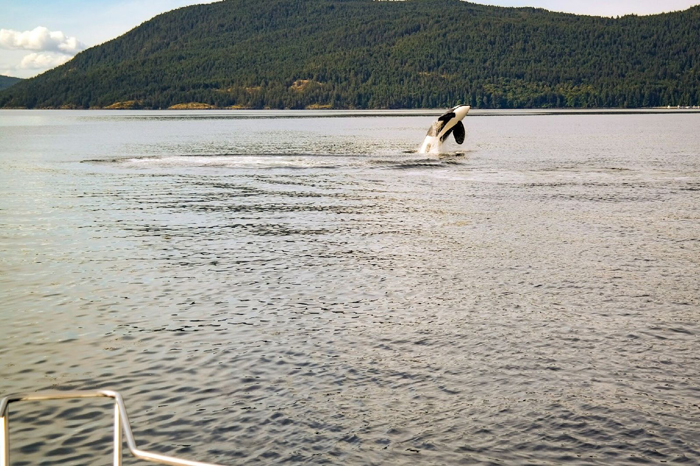
Salt Spring Islanders past and present teamed up for a timely emergency response that led to a transient killer whale’s rescue on Thursday.

Local residents Suzanne Ambers and Keith Simpson were at the heart of the action after witnessing a large male orca in considerable distress about a mile out from Vesuvius. Their call to the Canadian Coast Guard put them in touch with the B.C. Marine Mammal Response Network and its lead disentanglement officer Paul Cottrell, who grew up on Salt Spring before going to work for Fisheries and Oceans Canada (DFO).

Ambers told the Driftwood that she and her partner are often on the water. They had gone out at about 7:30 a.m. for a fishing trip and were just a few minutes away from the dock when they spotted the orca.

“I thought there had to be something wrong by the way he was moving, because they don’t usually stay in one spot,” Ambers said.

Simpson, who is a wildlife biologist, confirmed there was something “desperately wrong.” They realized the whale must be tangled in the lines from a commercial crab float.

Their immediate response was to want to step in and help, but the couple knew they needed expert assistance. Ambers and Simpson connected to Cottrell and coworker Taylor Lehnhart at their Vancouver office through the B.C. Marine Mammal Response Network hotline. Cottrell said calling for help was exactly the right thing to do. Well-meaning members of the public have frequently tried to help in such situations by cutting a line themselves, and in doing so ensuring the whale’s doom by removing the disentanglement team’s only guideline. Cottrell is in fact the only person who is trained and authorized for whale disentanglement in the Canadian Pacific region.

The two DFO agents immediately jumped into a boat with their tools to cross the Strait of Georgia. Though they made good time and arrived in around two hours, it was a long wait for Ambers and Simpson, who stayed on hand to observe the orca and offer their updates. Cottrell and Lehnhart made contact every 10 minutes or so to keep apprised and offer advice.

Because they were so close to the ferry crossing, Ambers was concerned the distressed whale would pull the gear into the ferry’s path. Other boaters were another potential concern.

Cottrell said this particular whale — a large bull transient identified as T0778 — has been known to play with ropes and then get stuck before. It’s a dangerous habit because though huge, orcas are not strong enough to deal with too much weight and they don’t have the stamina of larger whale species.

“It’s just strange behaviour that’s been documented over the past four years. In the past, he’s been able to free himself from a commercial crab float,” Cottrell said, noting the whale seems to like playing with things on the water’s surface. “We’re hoping this teaches him a lesson.”

Cottrell and his teammate took an easy approach to the whale when they arrived to observe the situation safely and get in close without spooking him. They found his tail had been wrapped by one of the lines. They were able to free him by applying pressure to the attached buoy.

“Once we just put a little tension on the buoy he was able to roll out,” Cottrell said. “When we did that he shot off and it was just incredible the aerials he did, plus some tail flaps.”

Anyone who sees a whale or other marine mammal that is entangled, injured, distressed or dead should call the 24-hour BCMMRN hotline at 1-800-465-4336.

For more on this story, see the June 6, 2018 issue of the Gulf Islands Driftwood newspaper, or subscribe online.

Change of perspective needed

By RON COOKE

There is a growing awareness and concern regarding homelessness here on our little bit of paradise.

For many of us, who own our own homes or have a stable rental situation, it doesn’t really show itself to be the growing problem that it is, but I would ask you to leave your comfort zone for a moment to consider what is actually becoming a crisis situation, percolating out of sight but beginning to have a profound effect on the sanctity of our island home.

Homelessness is an uncomfortable topic for many, as it conjures up stereotypes that cloud the issue: those who are drifting and living rough. While this element deserves our compassion, it is not the real issue.

In point of fact, “homeless on Salt Spring” now has come to mean the many, many amongst us who have lived here for years, even grown up here, and call this home, and yet now find themselves in the unenviable position of having to move, and not being able to find a place to move into. Stagnant wages and the ever-increasing cost of real estate are partly to blame, so for some, it is just that they can no longer afford the ever-increasing rents being asked here.

But worse than that, it is the fact that our housing stock has not grown to meet the needs of our community. There are simply no houses left to rent, nor houses that a young family can afford to buy. Take a look at the real estate mag in the Driftwood — almost everything advertised is $800,000 and up into the millions. That is perhaps great for those who wish to retire here, but for those beginning their life journey, it is simply unattainable — and I would suggest to you that without our young and middle-aged work force, we are all totally screwed — young, middle aged and old.

If you were to talk to any of the major employers here — the food stores, Windsor, Moby’s, the hospital, the school district, etc. — they would all be quick to tell you that finding and keeping employees has become a major concern. I don’t mean to sound alarmist, but it has become a true crisis.

We have over the years put in place safeguards to slow the influx of newcomers to our island paradise, and understandably so. The Islands Trust, our official community plan and land-use bylaws are all designed to preserve and protect the sanctity of the island, but we are now at a point where they have all become impediments to meeting the needs of our community. They all need to find a way to bend to meet and resolve our housing crisis — particularly where affordability is concerned. More than that, though, we the residents need to accept the fact that without meeting this challenge head on, we are facing a major degradation in the quality of all our lives.

The answers to this problem are complex and long overdue, but there are things we can do. None of us wants to see big housing developments coming in, but we can and should review how we regulate growth here. Farming is changing from single-family enterprises to co-op and communal endeavours, but our regulations fail to recognize this. Tiny homes are an answer for some, yet this movement meets with intransigence. Our definition of a “density” can be modified to better suit the times. There are many good minds at work trying to grapple with these issues, but the lack of awareness on the part of the average islander has proven to be a problem in itself.

So what can you do? First, be aware — we all need to see the problem. Second, be supportive of those who are working to solve this. Third, when you hear the word “homeless,” remember it does not necessarily mean someone with a backpack and a dog — it means your friends and neighbours, and those who provide the necessities of a healthy community. For those of us trying to solve this problem, NIMBY-ism and fear of change are in many ways the biggest obstacles that we meet.

There is, however, more to life than our property values and comfort zones. Most of us moved here to be part of a community: it is time to put our community’s needs front and centre.

The writer is a Salt Spring Community Services board member working on the island’s housing crisis. 

Viewpoint: Fairer voting system is possible

By GARY HOLMAN

Attorney General David Eby, after extensive public consultation, has just released details on the upcoming referendum on electoral reform. There will be two questions. The first is whether voters support changing our current first past the post (FPTP) system to one based on proportional representation (PR). The second question will provide direction to government on which one of three specific PR options to implement.    

Critics have complained that the 50 per cent approval threshold for the referendum is too low — ironic given that the current system gives single parties 100 per cent of the power with much less than 50 per cent of voter support. Eby’s announcement, coming six months before the mail-in ballot deadline of Nov. 30, provides plenty of time for voters to understand and consider the merits of the proposed PR options. Elections BC, an independent office of the legislature, will provide voters with objective information on these options. 

Regardless of the specific PR system chosen, voter preferences will be better reflected in the legislature. Many votes are essentially wasted now, such as in 2017 when the Greens and Conservatives together won over 20 per cent of the vote but elected only three per cent of MLAs. In fact, most elections in B.C. under the current system mean that 55 to 60 per cent of voters are represented by parties with zero power in the legislature. I can attest as a former opposition MLA that this is not a pretty sight. This “winner take all” nature of our current FPTP system, and the fact that hundreds of thousands of votes do not result in the election of an MLA, have contributed to sharp declines in voter turnouts. 

The PR options proposed for B.C.’s referendum ensure that every vote for a particular party will count towards election of MLAs if the party receives at least five per cent of the provincial vote. The five per cent threshold has been adopted in a number of countries with PR systems to mitigate the influence of extreme or fringe parties. Under PR, collaboration among parties is usually necessary to form government. As Christy Clark’s 2017 post-election “clone speech” demonstrated, this creates a powerful incentive to see the value of other political perspectives, and would force greater cooperation in the legislature. All of these features of PR will help reduce voter disaffection and increase participation. Independents could still be elected directly, as under our current system. 

It is often incorrectly claimed that PR systems eliminate the direct election of local MLAs. All of the three PR systems recommended by Attorney General Eby include direct elections and ensure that no region in B.C. would have fewer MLAs than currently.  Although not part of the upcoming referendum, Eby has also proposed that part of the electoral reform agenda will include ensuring First Nations representation in the legislature, as seen in New Zealand.     

Over the next six months, please take the time to consider the merits of PR voting systems that better ensure every vote counts, and where parties must collaborate to form government and make laws. To help with your deliberations, the Salt Spring Island NDP Club, in cooperation with local Greens and Fair Voting BC, will hold a public forum on electoral reform on Saturday, June 16 at Meaden Hall at the Legion, with more details to come. All are welcome, regardless of their views on politics and voting systems.

The writer is the former NDP Opposition Critic for Democratic Reform and was Saanich North and the Islands MLA from 2013 to 2017.       

Art show helps break down barriers

Work by local art collective Artists from the Fringe is being showcased at the library’s program room throughout the month of June.

The group is made up of homeless people who have been meeting every week at a drop-in program called Art Jam. They meet Sunday afternoons to create art, collaborate and inspire each other’s work.

This is the sixth show that the group has put on since starting almost three years ago. The group comes together to get a chance to create, and to put aside the challenges that they face every day.

Lynne Johnson is the coordinator of Art Jam. She started the group after volunteering two winters in the seasonal shelter.

“The second winter, I noticed that everyone was stealing the paper from our clipboards and drawing on them. I went out and bought a whole set of coloured pencils and got a stack of computer paper for them to use. Before long there were all these drawings that we put up all over the inside of the shelter,” she said.

In the last few years, she has gotten funding for food, and has added a foot care specialist to help the group members. The program gives the participants a sense of community and belonging.

“They’ve become a tight knit group. People come and go… There’s always one or two who stay. I now have an email list of over 50 people who have come through the program who are still attached one way or another,” Johnson said.

The biggest hurdle for Art Jam participants is respect. By participating in Art Jam, the artists become more than just people who live on the streets.

“If you treat them with dignity and respect you’re a lot less likely to get that overabundance of anger,” she said. “It’s what they want more than anything else, to be treated with respect, treated no differently than anyone else that you come into contact with.”

Nicholas Jewell, one of the artists at the show, said that the art does not necessarily reflect the outward appearance of the artist, but rather offers a look within. Jewell’s own work is abstract. He uses various colours and techniques to create visuals that invite the viewer to bring their own interpretation. While he doesn’t always go to Art Jam to create, he often gets inspired by the work of the other artists there, he said.

All of the artwork at the show is for sale, with proceeds going to the artists. Pieces range from paintings to sculptures, and are all made by members of the group. While there is no cohesive theme to the works, they do provide a deeper look into the lives of the artists. To Jewell, the diversity in the art is part of the attraction.

“You might not like everything,” he said, “but there will be something you love.”

For more on this story, see the June 6, 2018 issue of the Gulf Islands Driftwood newspaper, or subscribe online.

Student-painted mural unveiled at Fulford school

0

A new welcoming mural at Fulford school was officially unveiled at a ceremony on Monday morning.

Called West Coast Wildlife, it replaces the old sunshine mural that was on the school wall. The goal was to create a piece of art for the school that looked at wildlife, celebrated First Nations culture, fostered creativity in the students and involved the community.

West Coast Wildlife was designed as an expression of the west coast as seen through the eyes of the students. It was painted by students at the elementary school, with help from Quentin Harris, Johanna Hoskins and Karen Reiss. Hoskins and Reiss have collaborated on artwork projects at the school for 15 years.

“The old one had to come down and we both had worked on that, so it seemed fitting that the two of us should work together. We did want to have the First Nations component, so Quentin was an obvious third party to the mural,” Hoskins said.

“It’s heartwarming to me how well it turned out and how good it makes me feel,” Reiss added.

Planning for the murals started in January and the final product was installed at the end of March. Students were a big part of the process. They were asked to brainstorm ideas, to draw a small version of their part, enlarge it to get a sense of the scale and then to paint onto the plywood.

“This is an elementary school and these kids are very creative. They’ve expressed themselves as such right here,” Reiss said.

The mural gives visitors to the school a sense of welcoming and helps them appreciate the environment. Hoskins also hopes that people get a chance to enjoy the children’s art.

“We sort of try and start out with perspective and sizing, but after a few times you throw that aside . . . There are small whales and big birds. It’s kid art and it’s just great,” she said.

KING, Ross

Ross King
1942 ~ 2018

Ross King, loving husband & father, faithful friend, civil engineer & property developer, tireless campaigner for causes winnable & unwinnable, tilter at windmills and unrepentant iconoclast, died on Salt Spring Island on Sunday May 20th 2018 aged 75.

Ross leaves his wife Barbara, her family, his daughter Clara of Calgary, his son Jeremy his wife and 3 grandchildren of Boston.

Ross was born in England in the war years & grew up in the countryside of Lincolnshire and the Cotswolds. Trained as a civil engineer he emigrated to Calgary with his wife Madeleine in 1981. He later became a property developer in Calgary but his heart lay on the West Coast. In retirement he first moved to Wise Island, then in 2007 with his wife Barbara to the Beddis area of Salt Spring.

Retired but always busy, Ross took up many causes, local, national & global and fought hard for them, unflinchingly challenging what he saw as hypocrisy, selfishness or nimbyism. He was a relentless correspondent with the Driftwood and The National Post, urging readers to revisit their preconceptions with wit and vigour – & always in flawless English. Among his many battles, he cared deeply for and became involved with a small charity helping Cambodian children afford education, for which among other things he organized community bottle drives. That charity’s valuable work continues through the Homestay Volunteer Teachers Association of Cambodia. HVTA.org. Recently he was a passionate and vigorous advocate for affordable housing on Salt Spring enraged by impediments to its progress.

Always the rock to those close to him, Ross became depressed due to the effects of accident and illness, about which, characteristically, he was disarmingly frank & transparent. Tragically, he ended his life, to the heartbreak of those who loved him and the great sadness of many. Salt Spring is a poorer place without his vim & vigour, his larger than life presence, personality & brilliant wit, his compassion and his kindness.

In lieu of flowers, the family ask that donations kindly be made to the Crisis Intervention and Suicide Prevention Centre of B.C.

PERKS, Raymond

RAYMOND PERKS
April 28, 1922 to May 20, 2018

Raymond, at a great age of 96 years old, passed away peacefully of old age at Greenwoods on Saltspring Island. Cremation followed by a private ceremony will be held in the near future.

Raymond was born in Caterham Sussex, England. He was predeceased by his brother Michael and his sister June, and is survived by his sons John (Julie) and David (Laura), his grandchildren Jamie, James, Ben and Will, and his nieces Helen Hutton, Marilyn Perks, Clarissa Bass-Davies, and his nephew Jonathon Jepson.

Raymond lived an interesting life – he served on a red cross boat in the English channel during WW2 and survived multiple gun shots and the boat sinking, followed by then cutting-edge surgery, rehabilitation, and a year-long recovery. He then started a small business cultivating and breeding new varieties of daffodils in England. In the late mid -1950s he moved to Vancouver Island and held various jobs including a school custodian and a fisheries inspector before starting up the Orange Box, and later, with his wife Elsy Mary Perks (nee Price), Perks Florist and Nursery in Victoria while raising his family. His family have many fond memories of month long family adventures, first on Joda (25’ sailboat) and then Mangarava (30’ sailboat) exploring the entire length of the east coast of Vancouver Island.

Heartfelt thanks to Greenwoods Elder Care Society’s magnificent staff for their wonderful care of Raymond, first at Braehaven, and then at Greenwoods (a special thanks to Lisa) – their care and kindness made Raymond’s last days peaceful.

Donations to The Greenwoods Eldercare Society in memory of Raymond would be appreciated by the family.

BLANCHETTE, Randall Paul

Randall Paul Blanchette
July 13, 1951 – April 24, 2018

Randall (Rand) Blanchette passed peacefully, surrounded by friends and family at age 66 in the ICU at Cowichan District Hospital after suffering a devastating stroke.

Rand is survived by his son Jesse Paul Blanchette; sister Paulette Henttonen; brother Gary Blanchette and many cousins, nieces and nephews.

Randall was born in Thunder Bay Ontario to parents Paul and Dorothy (Gavin) Blanchette. In 1970 he relocated to BC and eventually landed on Salt Spring Island where he and then wife Lynda Grindle had son Jesse in 1975. His passion for music, skill in carpentry, humour and great heart earned him many friends on Salt Spring, but in 1993 he relocated to be near now predeceased parents and beloved sister Elaine (Blanchette) Grattan.

Rand found a new passion in hospice work and served with the Cowichan Valley Hospice Society for many years until he retired at age 65. Rand gave so much to people and poured his heart into his work and was proud of what he did and the people he worked with at hospice.

The family would like to thank the staff at the Cowichan District Hospital ICU for all their hard work and keeping Rand comfortable until the end.

On June 10th 2018, a celebration of life will be held at the Duncan Community Lodge at 224 Moose Rd. between 2:30 and 5:30pm. Beverages and snacks will be available.