Home Blog Page 5

Retreat centre proposed for Musgrave property

0

The newest owners of a 230-acre waterfront property at the remote southwest end of Salt Spring Island hope to develop a private retreat centre there — and local Islands Trust officials say they’re breathing easier as the land becomes less likely to be carved up and fully developed.

The four parcels that comprise the Musgrave Farm and Retreat plan include acres of old-growth Douglas-fir forest environment, multiple existing residences and farm buildings and almost two kilometres of shoreline facing Sansum Narrows, according to an application for rezoning brought to the island’s Local Trust Committee Thursday, April 9. The historic agricultural property at 230 Smith Rd. was listed for sale at $14 million in 2022, and according to a rezoning application was sold by the Kellogg family to new owners David Menschel and his wife Nina Amstutz. 

“I think we all were nervous when this property was for sale years ago, as to what it could have become due to this 1971 ‘vintage’ zoning that exists,” said local trustee Laura Patrick. “The potential that could have happened really could have changed that side of the island. So I’m so glad to see an owner that has taken the time and effort to really think about use of this land and bring forth an innovative proposal.”

According to application documents, in addition to a private residence and substantial conservation covenant on much of the property, the couple plan to found a retreat centre, itself independently owned and operated by a non-profit charitable organization. To that end, the project introduces a new definition into Salt Spring’s Land Use Bylaw: “retreat centre,” specifically requiring operations be guided by a non-profit society.

“This is a large piece of property that’s quite beautiful, quite special ecologically,” said Village Builders’ Elizabeth FitzZaland, representing the owners to the LTC Thursday. “It’s special to First Nations, special in the settler history of the island and Salt Spring’s farms. The owner is really looking to protect all those aspects of the property.”

The retreat centre concept was “born from the owners’ professional careers and philanthropic work in justice and the arts,” according to the application, “. . . envisioned as a place to support the healing, restoration and professional development of artists, social and environmental activists, understood broadly to include people from all sorts of occupations — writers, academics, filmmakers, journalists, ecologists, musicians, public interest lawyers, public health advocates, community organizers and Indigenous community leaders — people united by a common commitment to make life on earth more just, tolerant, inclusive, peaceful and sustainable.”

“It’s really a healing and arts retreat that would be done by scholarships,” said FitzZaland. “Small-scale cohorts in the high season.”

The centre will invite guests who will be provided accommodations and meals free of charge, funded through the nonprofit, according to the application, eventually accommodating as many as 20 guests — or “fellows” — from May through to September or October each year. 

“Fellows” will be identified through a combination of invitation and application, according to the retreat’s vision description, based on their current projects and “contributions to the world of art and activism.”

“Some will come for a week, as a group, to meet, discuss common challenges and learn from one another,” according to the application. “Others will come for as long as a month and bring long-term projects with them; they might work on a book chapter, write an academic article, edit a documentary film, or complete a work of art.”

Guests and “fellows” will largely arrive via a small private boat operated by the Retreat Centre from Vancouver Island and Victoria Airport, according to a transportation plan; if included in the bylaw amendment, “retreat centre” programs and guest residencies will be constrained to more than two and fewer than 30 days in duration. 

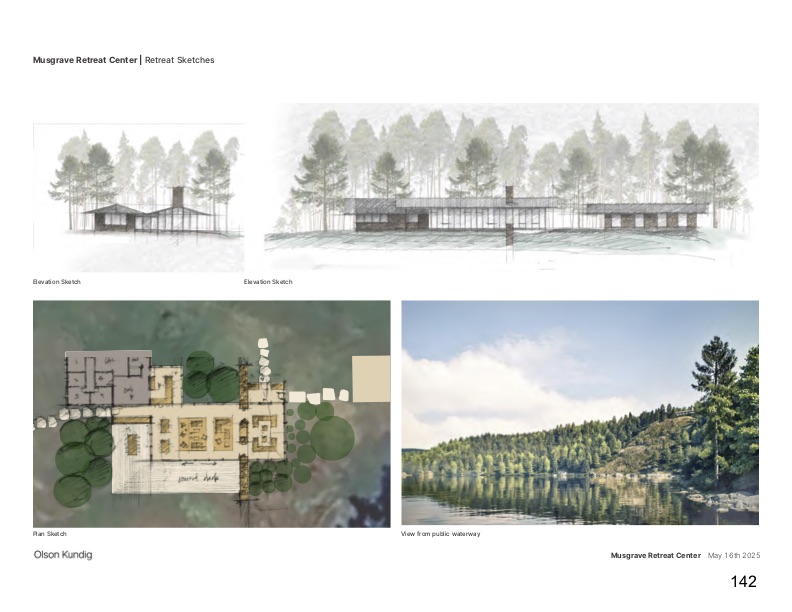
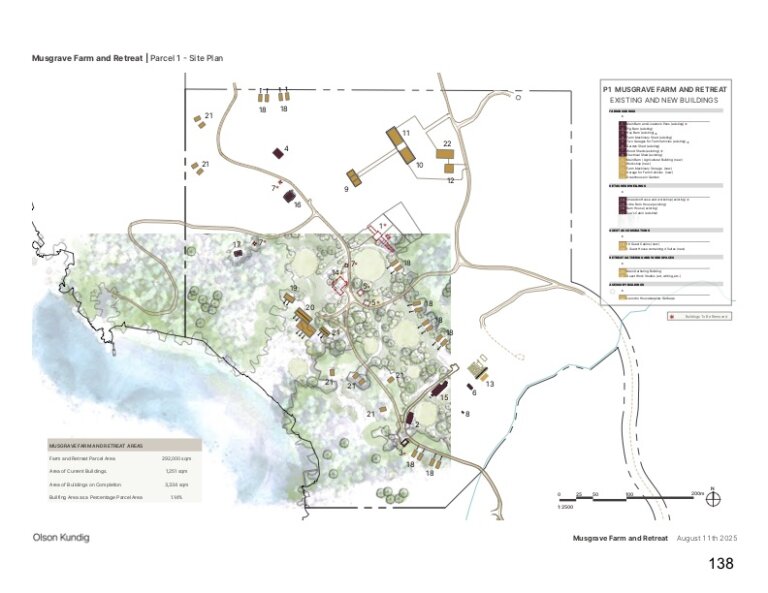
The proposal includes renovating some existing structures and building as many as 20 guest accommodation units without kitchens, according to a staff report, along with a main program building with communal dining and accessory uses.

Trustees directed staff to proceed with preparing a draft bylaw amendment to facilitate the change in use, refer the project to local advisory committees, First Nations and other applicable agencies for comment and schedule a community information meeting to be held at least two weeks prior to the LTC meeting where the draft bylaw is expected to receive first reading.

Musgrave Retreat drawings.

Trustee opinion: Partnerships are the path forward in challenging times

By LAURA PATRICK

SSI LOCAL TRUSTEE +

ISLANDS TRUST COUNCIL CHAIR

Across local and regional governments, difficult choices have become the norm.

Councils and boards are routinely faced with deciding whether to fund one priority at the expense of another. Too often, worthwhile initiatives — those that could meaningfully improve community well-being or protect the environment — are delayed or set aside. For elected officials, this can bring a quiet but persistent sense of frustration.

Yet there is a growing recognition that no single government can meet today’s complex challenges alone. Partnerships are no longer optional — they are essential.

The Islands Trust is uniquely positioned in this regard, as a member of two United Nations Biosphere Regions: Mount Arrowsmith and Atl’ka7tsem/Howe Sound. These designations are more than symbolic; they create opportunities to collaborate across jurisdictions and sectors in ways that traditional governance structures often cannot.

At a recent roundtable for the Mount Arrowsmith Biosphere Region, participants — including local and regional governments, First Nations, academics, and industry and community representatives — came together to explore both the challenges and opportunities presented by the United Nations Sustainable Development Goals (SDGs). The SDGs offer a shared global framework for advancing human well-being while safeguarding the planet and are fundamental to a UNESCO-designated biosphere reserve.

What makes the SDGs particularly powerful is their recognition that these issues are interconnected. Addressing poverty cannot be separated from improving health and education. Economic growth must go hand in hand with reducing inequality. Environmental protection is inseparable from tackling climate change. Progress in one area depends on progress in others.

At the heart of this framework is Goal 17: Partnerships for the Goals. It is a reminder that meaningful progress happens when diverse groups come together, share knowledge and align their efforts.

Roundtables like the Mount Arrowsmith Biosphere Region create space for exactly this kind of collaboration. Participants step outside the constraints of legislation, bylaws and institutional silos. They can think more broadly, exchange ideas and explore innovative solutions that might not emerge within the limits of any single organization.

For the Islands Trust, this collaborative approach is not just beneficial — it is fundamental. Its legislated mandate explicitly calls for cooperation with others. By engaging in partnerships such as biosphere region roundtables, the Trust strengthens its ability to preserve and protect the vast Trust Area and its unique amenities and environment for the benefit of current and future generations.

At a recent Mount Arrowsmith Biosphere Region roundtable, facilitators introduced the concept of “futuring” — the practice of intentionally shaping the future we want to see. In this context, adopting the SDGs is like planting seeds. Each partner contributes ideas and energy at the shared table, then carries those ideas back into their own organizations and communities. In the right conditions, those seeds can take root and grow into tangible action.

In an era defined by complexity and constraint, partnerships offer a way forward. They allow us to move beyond the limits of individual mandates and toward a shared vision of sustainability, resilience, and collective well-being.

The challenges we face are too interconnected — and too urgent — for any one body to solve alone. But together, through strong and purposeful partnerships, a better future is within reach.

Island groups push solutions to housing gap

0

When BC Housing finally craned modular units into place at its long-awaited project on Salt Spring’s Drake Road, the province — at almost the last minute — included a small nod to the island’s affordable housing shortage.

Along with 32 housing units for people at risk of homelessness, BC Housing set aside a bachelor suite and three one-bedroom units, according to Lookout Society’s Lee Fox — without those supportive services, but offered with rental costs tailored to working islanders.

Critics who called that a “drop in the bucket” may have understated things.

“We had over 100 applications for those four units,” said Fox. “They were rented out really, really quickly.”

Lookout was among several earnest community groups who gave updates on their housing efforts to Salt Spring’s Local Community Commission Thursday, April 9. And while that body is working to craft its own strategic housing plans, all agreed that lasting solutions to the crisis on Salt Spring will be necessarily costly, collaborative and complex — involving a mix of building more housing and optimizing how existing homes are used. 

If the most conspicuous result of Salt Spring’s lack of affordable housing has been staff shortages, the most visible recent effort to reverse that trend has likely been the Lady Minto Hospital Foundation’s (LMHF) Bittancourt Road project, now called Heartwood House. With 18 units on Salt Spring’s busiest road, options range from studios to two-bedroom apartments, all set aside for provincially employed healthcare workers. 

The building is also almost completely full.

“Our foundation’s mission had nothing to do with housing, but here we are,” said LMHF chair Julian Clark. “It became very clear that we could spend as much money as we liked on equipment for the hospital, but if there was no one to run that equipment it wasn’t going to do much good.”

The majority of Heartwood’s residents are from Island Health and Greenwoods, according to Heartwood House Housing Society executive director Brett Webb, from registered nurses and health care aides to peer support workers, med students, cooks and support staff — anyone required to run facilities.

“Of the current tenants, six were vulnerably housed [employees] on the island that we’ve now housed at Heartwood, and eight are new staff that have come to the island from Canada, the U.S. and in some cases even further than that,” said Webb. “And if staff already on the island lose their housing, they can come live at Heartwood for a few years — and we won’t lose them.”

Subsidies through the foundation hold residents’ portions of the all-inclusive rents at 30 per cent of their income, when necessary; there are three units set aside for travelling staff — nurses, midwives and doctors brought in to fill temporary shortages on the island. 

And all units have a hard three-year residency cap, a policy meant to align with how long it generally takes new islanders to meaningfully access Salt Spring’s “grapevine” word-of-mouth rental market. Even more importantly, according to Clark, that cap multiplies the effect of building Heartwood in the first place — an $11-million project mostly funded by local donations that arguably might’ve just been “dropped in the bank,” he said, with interest used to generate housing subsidies.

“But our purpose in all of this was to decrease the vacancy rate of healthcare workers on the island,” said Clark. “If we’d brought, say, 18 healthcare workers here who never left Heartwood House, then we’d barely have brought that down by a blip. But if we can ‘matchmake’ these fabulous tenants with unrented suites on the island, we can have real success over the long run.”

Clark said the foundation’s push now would be “whatever help we can give or get” to encourage getting those underutilized properties into the rental market. Unfortunately, two efforts along those lines have so far failed to find eager participants on Salt Spring. 

The Housing Now home-share program has had some successes on smaller islands, according to Salt Spring’s coordinator Adam Evanik — but not so much on the largest.

“Salt Spring has been the problem child,” said Evanik. “We have plenty of people looking [for housing], but not too many looking to share.”

Housing Now’s collaboration with app Happipad is designed to produce strong lease agreements, facilitate conflict resolution and structure equity-building for tenants. But despite having its own referral program — businesses can “sign off” on reliable employees, Evanik said — it’s been a hard sell.

“We’ve had a lot of issues with homeowners on Salt Spring overcoming the fear of having tenants — what if I can’t get a tenant out? What if they’re a problem?” said Evanik. 

Evanik also said Salt Spring property owners seem to be seeking more of what he called a “traditional renter-landlord situation.”

“So [they] have the space, and it needs to make this much money,” said Evanik. “It’s just that traditional structure, and the need for people to rent their suites out for a market rate that helps them, based on their costs.”

Meanwhile, the CRD’s three-year pilot Rural Housing Program’s (RHP) accessory dwelling unit (ADU) stream — which set aside $500,000 for rebates of up to $40,000 for eligible homeowners who create or upgrade discount-rent housing at their properties — is also struggling to find takers.

“We haven’t received any applications yet,” said RHP coordinator Joan Wandolo. “So the focus is now turning toward increasing awareness of access to this rebate.”

Notably, and from a second half-million-dollar RHP pot, the program’s “pre-development” funding stream is awarding $100,000 to the Gulf Islands Seniors Residence Association (GISRA). Much like LMHF, GISRA — which employs 20 staff operating the Meadowbrook independent living retirement facility — found itself stepping into the unexpected role of affordable housing creator. 

GISRA’s property on Kings Lane had long been slated for a “Meadowbrook 2” sort of development — but as it turned out, the original had satisfied the market.

“The need for that type of housing for seniors was well-met on Salt Spring,” said GISRA executive director Harry Barnes. “The best use for the property is affordable housing, with ‘workforce’ housing being in the highest need.”

Convincing the Islands Trust to rezone the parcel for affordable housing was an easier task than closing what Barnes said is an $8- to $10-million funding gap to build and operate the project, even supported through future rents. GISRA has already invested some $3 million in the project, but a BC Housing grant application last year was turned down for not being “shovel-ready” enough, Barnes said — and a submission seeking funding via the provincial Community Housing Fund has been sidelined, as the government put that $3.3-billion program on pause for “reallocating.”

“We are in a discussion with BC Housing about some of their other programs,” said Barnes. “We don’t know whether there’s any money there; we’re all waiting with bated breath for some big announcement. But we’re not going to stop; we are going to do this, as far as GISRA possibly can.”

Editorial: Choosing wisely

0

It’s not a simple thing to tease voter sentiment out of the results of a low-turnout local election.

More cynical observers of island politics might point to single-digit turnout for the Salt Spring Island Fire Protection District’s election as a signal of apathy, or suggest that the scaling back of mail-in ballots might’ve brought those numbers down. Island history buffs would note that, particularly for improvement district leadership, ballot numbers have most often trended parallel to controversy — fewer votes means less drama.

But as much as Salt Spring voters can be counted upon to not fix that which ain’t broke, they also — at least as whatever microcosm of the island the fire district might be — paid enough attention to pick and choose from five candidates, including three with recent track records, and two of those three adding a third newcomer to their “teamwork” slate.

Incumbents thrive in elections where voters support the direction things are going, and a drama-free status quo is usually kind here to those running for re-election. That just two of three found themselves returned to duty suggests voters saw at least some daylight between them — whether on issues, competence or comportment. 

But most importantly, and despite small numbers, these results suggest those voters were truly engaged. In a relatively short time, candidates successfully differentiated themselves, and the ratepayers weighed in — mostly choosing, this time, to stay the course.

Meanwhile, the island’s other major improvement district — the North Salt Spring Waterworks District — has already sent out mail-in ballots and set May 6 from 2 to 6 p.m. at Community Gospel Chapel as in-person voting day, bringing another opportunity for voters to sort out what they want from local board leadership. Driftwood readers will hear directly from the three candidates vying for two seats in a Q&A format in next week’s paper and on our website.

And while October may seem a lifetime away, local candidates have already begun positioning themselves to run for Salt Spring’s broader elected positions.

If there’s a lesson to be taken from the first contest of 2026, it might be that on this island, there are no laurels stable enough that candidates can simply rest upon them; the electorate must be convinced — and re-convinced — you’re the right person for the job. 

Creative island team presents MINOTAURUS!

SUBMITTED ARTICLE

There’s something deeply satisfying about watching a myth unravel — especially when it refuses to stay in one shape for long.

In MINOTAURUS!, an ensemble of performers takes the familiar language of ancient Greek tragedy and stretches it to its limits. The piece opens with heightened, almost ceremonial imagery — echoes of chorus, ritual and inevitability — before sharply shifting gears.

Suddenly, the tone fractures. Rap music cuts through the atmosphere. The physical language loosens. What felt controlled becomes unpredictable, even unruly.

This is not a straightforward retelling. It’s a constant transformation.

Written and directed by Brette Little with choreography by Charlotte Priest, both graduates of Simon Fraser University’s Contemporary Arts BFA program, the production brings together dancers and actors in a physically driven exploration of the Minotaur myth — one that refuses to settle into a single mood or meaning. Instead, it moves restlessly between intensity and absurdity, structure and collapse.

The monster at its centre is no exception. Here, the Minotaur doesn’t stay fixed —i t’s part wrestler, part Greek mythological creature, shifting between something fearsome, exaggerated, and at times unmistakably ridiculous.

Clown elements — drawn in part from Little’s training with Philippe Gaulier — thread through the work as a disruptive force. Just when the world feels grounded in myth, it slips. Gestures are pushed too far. Images tip into absurdity. The performers embrace a kind of controlled chaos, where precision and failure sit side by side.

The ensemble — Anthony Charrette, Simone Cazabon, Michael Bean, Zach Lundrie, Charlotte Priest, Roy Val Clery, Kristen Frampton and Rigobert Kefferputz — moves as both a unified force and a collection of distinct voices, constantly building and undoing the world of the piece in real time. There’s a sense of risk throughout, as though the performance could veer in a new direction at any moment.

Rather than guiding the audience cleanly through a story, MINOTAURUS! invites you to stay with the shifts — to experience the tension between the serious and the absurd, the mythic and the contemporary.

Because in this version of the myth, the labyrinth isn’t a structure. It’s a state of mind — and there’s no clear way out.

MINOTAURUS! runs at Bullock Lake Farm on April 17, 18, 19, 24, 25 and 26 at 7 p.m.

Tickets are available through Eventbrite.

Jesus Christ Superstar singalong a treat

By Wendy Webb
Special to the Driftwood

If you were to walk by Beaver Point Hall on Good Friday afternoon you would have heard 75 voices raised in song interlaced with laughter and applause.

Michelle Footz, music instructor at Gulf Islands Secondary School, (a.k.a. Shelder the Electric Clamfish) stepped out on a limb a few years ago and organized the first unusual annual music event at Beaver Point Hall Good Friday and it has grown in popularity since.

Footz came up with the idea of a Jesus Christ Superstar participatory sing-a-long using a screen with words as in karaoke in a unique way of expression. It is a bringing together of community “in many different ways,” whether in the spirit of the day or a tribute to the incredible 1971 rock opera by Andrew Lloyd Webber and music by Tim Rice. The venue being casual and relaxed is perfect. Footz definitely has the presence, voice and musicianship to pull it off. She encourages being in character and a few people were. About mid-show a surprise appearance of well- known Vancouver accordionist Pavel Rhyzlovsky was a special treat and surprise to everyone, including Footz! He slipped in and joined in easily.

My final thoughts? Many attending still own the sound track album or passed it along when CDs made the scene. I’m looking forward to next year. Think I’ll dress as the temple money lender.

You can meet Michelle and company at Beaver Point Hall on July 4 when three bands rock it: Local band Zelk, Bu Von Blume from Cumberland and Balkan Shmalkan from Vancouver. Tickets are on sale now.

The writer is a South Ender and lover of Beaver Point Hall.

World-class artists at ArtSpring Friday

By MEGAN WARREN

FOR ARTSPRING

The curtain goes up this Friday, April 17 at 7:30 p.m. for the Salt Spring Community Showcase! Emceed by Grace Jordan, the Showcase is a night dedicated to the world-class artists that call Salt Spring Island home. Last week, we introduced lullaby creator Lisa Maxx, alt-folk musician Matthew McKinney and puppeteer Tangle McClaron. Now, we turn the spotlight toward the final three acts of this remarkable lineup: fiddler Wesley Hardisty, the duo of Edgar Hann and Em Walker, and the student-creators of GISPA.

Showcase tickets are available now at the ArtSpring box office or online at purchase.artspring.ca

Wesley Hardisty

For fiddler Wesley Hardisty, stepping onto the ArtSpring stage for the Showcase is a  full-circle moment. Having spent his teenage years in the building as a GISPA student, Hardisty views this performance as a chance to return as a full-fledged professional and share his evolution with the community that nurtured his start.

Hardisty first picked up the fiddle at age 12 in his hometown of Fort Simpson, NWT. He began composing original music almost immediately, developing a signature sound that pays homage to West Coast and Métis styles alongside the “odd time-signatured, crooked fiddle tunes” of the Gwich’in style. This creative drive has culminated in a landmark year: Hardisty was recently awarded both a Canada Council for the Arts grant and an OHSOTO’KINO Recording Bursary. He is currently preparing to record two separate 10-track albums of original material, slated for release early next year.

At the Showcase, Hardisty will ignite the room with jigs and reels from his “Exodus Set.” While his technical mastery is undeniable, he views music primarily as a vessel for connection. He speaks joyfully of sharing the stage with Charlie Gannon and Sam Howard at the recent Stowel Lake Hootenanny Square Dance and looks forward. At the Showcase, he’s thrilled to be supported by guitarist Justin Kelley of Fawkes and Hownd. “It’s one thing to be a solo player,” he says. “But to be a musician who gets to work with others. At that point, it feels like community.”

Edgar Hann & Em Walker

Edgar Hann and Em Walker.

When Edgar Hann draws the bellows of his button accordion and Em Walker strikes a rhythm on the ugly stick, the 5,000 kilometres between Newfoundland and Salt Spring Island seem to vanish. As the only duo on the island performing with these traditional instruments, they bring a singular East Coast energy to the local scene. If you caught their performances at the 2026 Newfie New Year’s celebration, you know their sound coaxes even the most resolute non-dancers to tap their feet.

Edgar, a Newfoundlander who spent his youth living off the land, is a self-taught master who plays entirely by ear. “I didn’t know what was happening at first,” he recalls of his start at age 12. “All of a sudden, I was picking up short notes, then melodies, and suddenly it was a fast jig. It was a gift.”

Em, a former professor who researched the ancestral links between Irish and Newfoundland melodies, provides the historical heartbeat. She explains that the music carries echoes of the Irish famine, blending resilient joy with a longing for what is left behind. While songs like “Fields of Athenry” are plaintive, Em notes that people from anywhere can relate to the themes of home and displacement.

Joined by Wilf Davies on keyboard and William Steiner on bass, the pair will perform two songs with Newfoundland and Irish ties and a stirring cover of Leonard Cohen’s “Hallelujah.” They will close with a high-energy jig, punctuated by Em on the ugly stick—handcrafted by Edgar and complete with beer bottle caps and a cowbell. In the spirit of a true kitchen party, they invite the audience to do more than listen: they invite you to tap your feet, dance the jig, and find a joyful sense of home in the music.

GISPA

Gulf Islands School of Performing Arts students.

At the Gulf Islands School of Performing Arts (GISPA), the stage is a laboratory. For the Showcase, 16 student-creators in Grades 10–12 will premiere an excerpt from their year-end production of The Little Prince, based on the novel by Antoine de Saint-Exupéry. This is no traditional adaptation; it is the result of extensive collective creation where every note, step and line is student-led.

Music teacher Michelle Footz notes that the original score “comes from their brains,” with students composing pieces that range from psychedelic textures to Baroque-style waltzes. Meanwhile, dancers (led by Sonia Langer) choreograph the movements while theatre students (led by Jason Donaldson) refine a script. The three disciplines then work together to weave a cohesive piece. Beyond the spotlight, these students are the designers and builders behind the sets, costumes and lighting. It is a true ensemble-based program where even the lead characters help move sets backstage. 

Their Showcase set spotlights three scenes: the Introduction, the Rose Garden and The King. These vignettes explore childhood wonder while offering, as GISPA says in the performance’s description, “an indictment of adult priorities that hasten the loss of that wonder.” 

Through this work, one theatre student wants to “bring people back to childhood ideals, where they can be less concerned with matters of consequence and more concerned with joy and creation.” Says another, “With age, you do lose pieces of your past, but we’d like to show people how to bring back and unearth the joy that they once had.” 

As the students prepare to take the ArtSpring stage, they invite the community to unearth their own sense of whimsy and witness the clarity that emerges when a young creative ensemble finds its collective voice.

Cook, Hetherington, Martin win fire board election

0

Final results for Salt Spring’s fire district election have been released, with incumbents Rollie Cook and Mary Lynn Hetherington, along with Darryl Martin, to be seated at the annual general meeting (AGM) set for Monday, April 13.

Returning officer Anthony Kennedy released preliminary results on the morning of Sunday, April 12, later confirming no change to them after a second counting of ballots.

Cook, first elected to the board in 2017 and serving as its chair since the end of 2021, received 275 votes in the preliminary count. Hetherington, with nearly a decade on the board, tallied 262. New to the board will be Martin, with the most votes of any candidate: 292, according to preliminary figures.

David Courtney, who sat on the board a single term, received 76 votes in the preliminary count; Jenny McClean, who has served on a SSIFPD committee, received 75.

The AGM will be held at the Ganges fire hall training room (for one last time before the move to the new hall next month) beginning at 6:30 p.m. or online via a link on the fire district’s website.

Note: an earlier version of this story indicated results were preliminary. Returning officer Anthony Kennedy confirmed later on Sunday afternoon that those results were final.

Tourism season off to busy start

1

As the first Saturday Market kicked off an unofficial start to Salt Spring’s summer tourist season, residents and businesses might have noticed 2026’s vacationers didn’t wait for the first blossoms before heading to the island.

In fact, according to new statistics compiled by volunteers at the Visitor Information Centre in Ganges, walk-in numbers for the first three months of the year have already jumped 18 per cent over 2025. Brigitte Diebold, who coordinates consolidation of stats for Destination BC, said the noticeably busy centre tallied 887 visitors in the first quarter, compared to 753 in 2025. Diebold said one reason for the boost is likely the longer hours of counting, with the centre open seven days a week — recording 268 hours compared to 199 in 2025, or 35 per cent more.

“On the long Easter weekend we provided services from 11 a.m. to 4 p.m. to cover the demand,” said Diebold. “Over 101 visitors came to the centre from April 1 to 5.”

That strong start — much of which was technically still taking place during the winter season — is exactly the sort of tourism increase residents are hoping for, according to a survey conducted this past fall by the Southern Gulf Islands Tourism Partnership (SGITP). While 63 per cent of residents — surveyed across multiple islands — reported a “sense of over-tourism” during the summer months generally, 44 per cent said they believed the region was under capacity during the winter.

Notably, according to SGITP’s survey, resident perceptions about both spring and fall “shoulder seasons” showed something of an equilibrium; the perceptions of “too few” versus “too many” visitors differed by only four per cent, which SGIPT said suggested current visitor levels during those periods aligned closely with community expectations. 

Most of the first quarter’s Salt Spring Island visitors — about 80 per cent, according to VIC statistics — came from within the province, with another 14 per cent from elsewhere in Canada. Just a handful (2.1 per cent) arrived from the U.S. and another 2.8 per cent reported visiting from Europe, Asia, Australia and elsewhere.

Community Showcase performers gear up for April 17

By MEGAN WARREN

For ArtSpring

It’s time to show some love for local performers! On Friday, April 17 at 7:30 p.m., the Salt Spring Community Showcase brings six incredible local acts to the ArtSpring stage. 

There is so much to say about the Showcase artists that if we covered them all in one article, we’d need our own issue. For this week, let us introduce to you three: The Singing Amma, Matthew McKinney, and Tangle McClaron.

Lisa Maxx: The Singing Amma

Lisa Maxx believes the whole world needs a lullaby. With over 50 years of experience singing children to sleep, Maxx is currently channeling this lifelong practice into a dedicated lullaby album under the stage name The Singing Amma. Her set at the Showcase features soul-healing tracks designed to regulate the spirit as much as the ears.

Known to many as Lisa Sigurgeirson or Lisa Sig, Maxx daylights as a parenting coach and understands the profound science behind her art. “I often talk about that precious time at bedtime,” she explains. “It’s not just a nice thing to do; there is so much brain science coming out now about what lullabies do for our nervous system regulation. It is really beneficial, both for a child’s sleep and in general, to get us through our days.”

Many of her original lullabies were inspired by specific children. In “Nature’s Lullaby,” for example, she weaves the wind, birdsong, and lake ripples that were the soundtrack of her outings with a child who finished each walk with a nap on her lap in her wheelchair.

For Maxx, this performance is a personal triumph. Despite being a regular Salt Spring performer in the decades since she debuted in a school production of Oliver Twist at Mahon Hall, the pandemic, a house fire, and chronic illness, have put her stage career on hold since 2020. “I feel like I’m rising from the ashes,” she says. “I’m really excited that my debut back on the stage is at ArtSpring. It’s a relaunch of Lisa Maxx.”

Matthew McKinney

Singer-songwriter Matthew McKinney

When you hear the word “bard,” chances are you don’t picture a performer from this century. Matthew McKinney is out to change that, describing his style as a “homegrown, old-time Bardic weave for these times.” His folky riffs and “soapbox-sermon” lyrics draw on myth, history, and modern existential challenges to create a sound that gestures at the antiwar anthems of the ‘60s and ‘70s . It’s no wonder his music is most at home in the barns, backyards, and community spaces that defined his recent US tour.

McKinney has been a Salt Springer since 2017, when he moved from the US to work with the W.O.L.F. kids program at the Wisdom of the Earth school. He sees his roles as a counselor and a musician as different forms of the same skill, both relying on deep listening and a precise sense of timing. “With counseling, you can say the right thing at the wrong time or environment, and it won’t mean as much,” he says. “But, if you say it with the right timing, it can change a person. That’s such a musical skill.”

At the Showcase, McKinney will play songs from his new album, Singing at the End, with storytelling woven between each track. “We’re on the precipice of massive transitions in the world, culturally, politically, socially, environmentally and also digitally,” he says. “Singing at the End is about finding our own way to contribute the innate giftedness that we each have to share in hard times.”

 His set aims to help audiences make peace with the “darkness playing out on the world stage” and find gratitude for life amidst it all. 

Tangle McClaron: Entangled Puppetry

Tangle McClaron of Entangled Puppetry

Decades after first roaming ArtSpring’s dressing rooms as a high-school theatre kid, Tangle McClaron is returning for a full-circle performance at the Showcase. Her award-winning 10-minute puppet show, “How the Whale Brought the Rain,” is a literal transformation of the island’s landscape. McClaron carves her puppets from local driftwood, a medium she first embraced in 2010 when she and a friend started Entangled Puppetry with endless creative energy and zero budget. While walking a beach, she discovered a piece of wood that “held the suggestion” of a whale, sparking an original creation myth about how the West Coast became wet. 

After “How the Whale Brought the Rain” won Canmore’s 10-Minute Play Festival, McClaron decided not to lug the fifty pounds of driftwood puppets back to the coast. Now performing alongside her husband Tyler, McClaron has recreated the show’s puppets using driftwood she found beachcombing with her children on the shores she grew up exploring.

For Tangle, puppetry is a powerful medium for both education and wonder. “A lot of the amazing and fantastical things that we see are digital. They’re separated from us by a screen,” she explains. “But with puppetry, we’re able to experience these three-dimensional moments of magic, and we’re able to make them tangible and bring them to life.”

“We’re living in interesting times, which also can be troubling times,” she says. “As an artist, sharing a sense of whimsy is a way to connect people with hope.”

Tickets are available now at the ArtSpring box office or online at purchase.artspring.ca. $30 adults, $10 youth. Book yours now and get ready to be blown away by the talent in your own backyard.