

Home Blog Page 52

Viewpoint: Trust takes a step too ‘FAR’ 

By Frants Attorp

Applying an urban planning formula to a protected area makes no sense. Yet that is exactly what Trust Council has in mind for the Gulf Islands.

The formula, called FAR (Floor Area Ratio), is being introduced through the new Trust Policy Statement, slated for first reading at Trust Council’s July 29 meeting. When finalized, the umbrella document will guide official community plans (OCPs) on all 13 major islands.

The draft includes this: “Density may be defined by the number of units per given area of land. Density may also be measured by dividing the built area including all floor area, by the total area of the lot, e.g. floor area ratio (FAR).”

This means that limiting the number of dwellings per lot and, by extension, overall population growth, could soon be dropped as a conservation measure. The new approach would see elected officials “set floor area and lot coverage” — just like in any city.

The definition is particularly significant for Salt Spring where density means number of dwellings and the general rule is one dwelling per lot. This policy is based on the premise that more people equals more environmental degradation.

If passed, the new definition would lay the groundwork for multiple dwellings per lot, not to mention multi-storied buildings. Depending on how the concept is applied, Salt Spring’s maximum house size of 5,382 square feet could, for example, translate to a primary dwelling of 2,000 square feet plus three smaller dwellings of 1,000 square feet each, or perhaps even 10 tiny homes.

The problem with this growth model is that it ignores the long-term, cumulative impact of an increasing population on ecosystems, water supply, infrastructure, services and rural character. Even modest homes require tree felling, and it’s not as if the people who live in them don’t shower, flush toilets, drive cars, travel on ferries, generate garbage and use health care services.

Ecologist David Rapport, whose research helped shape Salt Spring’s existing OCP, states: “The real measure of our impact lies in the combined influence of our numbers (population), our consumption and our use of destructive technologies that have the capacity to degrade ecosystems even in places where population densities are very low.”

Andres Duany, professor of urban planning, writes: “Abdicating to floor area (market forces) is the opposite of aiming a community toward something more than the sum of its parts. FAR does not consider the factors affecting the environment like the new buildings, greenhouse gas emissions, energy consumption and repercussions on local ecosystems.”

FAR can send property values soaring by turning undeveloped square footage into investment opportunities. Speculators will be pleased to note the draft Policy Statement now refers to “attainable” rather than “affordable” housing.

There’s also the sticky issue of short-term rentals, which deliver fast profits to property owners while robbing full-time residents of accommodation. Given past experience, the requirement to “where necessary, regulate and limit” does not inspire confidence.

There is only one way to resist this development agenda: participate in the upcoming public engagement process and call for non-market housing and defined, science-based growth limits. We must remind trustees of the destructive power of the free market and their duty to protect these islands for future generations.

Hayley Wallis & the Bright Futures on stage

SUBMITTED BY SALT SPRING ARTS 

The Summer Outdoor Concert Series continues next week with its third performance of the season on Thursday, July 31, bringing the powerhouse vocals of Hayley Wallis & the Bright Futures to Centennial Park. Presented by Salt Spring Arts, this free event runs from 6 to 8 p.m., featuring an opening set by local favourite Mary Kastle. 

Wallis is an artist from the Kitasoo/Xai’xais First Nation in Klemtu, a small and remote island community located in the heart of the Great Bear Rainforest in British Columbia, whose voice is as commanding as it is soulful. Drawing from her Indigenous roots and contemporary influences, Wallis weaves powerful stories into her music, which spans pop, folk and soul. Since the release of her single Coffee Cup, she has been recognized across the country for her raw emotional delivery and inspiring stage presence. 

Backed by the Bright Futures, Wallis brings an electrifying live show that balances soulful grooves with deep emotional impact. Together, they create a sound that is both modern and timeless, infused with hope and honesty. 

Opening the evening is Salt Spring-based Mary Kastle, known for her rich vocals and warm, jazzy folk stylings. Anchored by funky piano lines, rhythmic guitar, soulful vocals and an inviting openness, her music carries a sense of warmth, resilience and connection. With roots on both the island and in Vancouver’s music scene, Kastle brings a grounded, soulful energy to the stage that perfectly sets the tone for the night. 

The Summer Outdoor Concert Series has become a seasonal highlight in our community, drawing locals and visitors alike for six consecutive Thursday evenings of free live music in the heart of Ganges. This year’s lineup is a dynamic mix of global sounds and West Coast favourites, curated to reflect both the diversity and talent of the wider music community. 

With three concerts still to come, including performances by Alpha Yaya Diallo, Ashleigh Ball and Empanadas Ilegales, the series is in full swing. But on July 31, all eyes — and ears — will be on Hayley Wallis and her Bright Futures. 

And as detailed last week, the July 24 concert features Inn Echo and opening act Yael Wand. 

Visit saltspringarts.com/socs to learn more. 

From branch to basket: harvest season begins

BY ELLA ROWLAND

Food Share Program Coordinator

This week, as plums and cherries ripen on the trees, the Salt Spring Island Farmland Trust is kicking off its long-awaited 2025 harvest season, and calling out for volunteers. 

The Harvest Program is part of the broader Food Share Program, which aims to increase food security on Salt Spring, acting as a connection point between delicious, island-grown food and the people who need it. 

After a wildly successful first year in 2024, program co-leads Nick Adamson-Jones and Indra Singh couldn’t be more proud of the impact the Food Share has had so far. With the help of amazing volunteers, they were able to save over 15,000 pounds of apples from going to waste, redistributing them to the community — and that’s just apples! 

As Singh leads me through The Root at 189 Beddis Rd. to the empty storage facility that will soon be filled top-to-bottom with salvaged Salt Spring produce, she reflects on the inaugural year of the program. 

“It was so wonderful last year to see the sheer variety of produce shared with us, and to work with such a lovely group of volunteers,” she said.

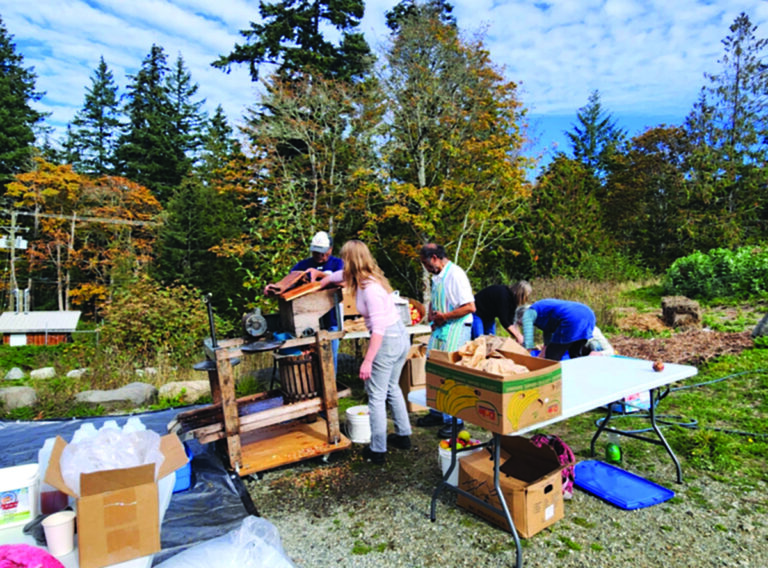
Harvested foods were distributed island-wide to organizations like the Food Bank, Gabriel’s Kitchen, IWAV and the Women’s Institute “Pie Ladies.” During one joyful community event, apples were even pressed into juice using an antique apple press. This trusty piece of history has since been retired to make way for a brand-new commercial apple press, allowing the team to greatly scale up production. 

This year’s Food Share coordinator, Ella Rowland, is organizing and guiding backyard harvests across the island. In addition to coordinating harvests, she is also launching a cost-recovery initiative featuring our signature “Eternal Apple Juice” — a custom blend pressed from apples harvested throughout the island. The Food Share team is excited to announce a weekly booth, where community members can sip our delicious cosmic apple juice elixirs, pick up fresh two-litre jugs of apple juice, learn more about our gleaning efforts and connect with local food initiatives. All proceeds will go towards supporting the Food Share program. If you have an event that could benefit from a cider booth, the Food Share team is eager to collaborate, and let the juice speak for itself.

“We had a few information booths last year that were a huge draw to the program,” laughs Singh, “mainly because the juice samples were really, really good.” 

For those unfamiliar with how the Food Share works, the program structure is simple: local treeholders with excess or hard-to-access fruit can register their tree with the Farmland Trust, and a group of dedicated volunteers will come by to harvest it. The bounty is then shared equally between the land owner, volunteers and community organizations. This act of collecting leftover or excess crops, called “gleaning,” reduces food waste, encourages food sharing, and strengthens involvement in local food systems. The Salt Spring Island Food Share is only one of over 200 gleaning programs across North America that are actively working toward these goals. 

Volunteers are essential to the program’s success, and 2024 was proof of just how much can be accomplished with community involvement. The team is now putting out a call for volunteers to join in the 2025 harvests. There’s no minimum commitment, and volunteers like Richard — a fixture of the 2024 program — say the experience is both fun and rewarding. 

“Being a part of the Food Share is a win-win-win for me,” he said. “I get to make a tangible difference in the lives of others while enjoying the camaraderie of like minded-individuals, fresh, local fruit and the beautiful gardens and orchards we have here on Salt Spring.” 

If that sounds appealing to you, sign up to volunteer on the Farmland Trust website by navigating to the Food Share page and clicking “Volunteer Registration Form.” 

The Root will also continue to host its monthly Food Exchange — a beloved tradition where islanders gather to share homegrown produce and homemade dishes. These exchanges take place on the third Sunday of every month, from 3 to 5 p.m., and always begin with a short moment of gratitude for everyone’s contributions. All are welcome. 

As the 2025 season kicks off, the Food Share team invites everyone to take part. Let’s let local food take root! 

Athletes bring B.C. home medals and top times

BY ROB WILTZEN

For SSI Special Olympics

The Special Olympics BC – Salt Spring Island swim team returned from the 2025 Summer Provincial Games held in Prince George from July 10 to 12 with an impressive array of placements and medals, along with a series of personal best times.

The four swimmers competed in a total of 15 events over the course of the weekend and brought home two gold medals, one silver and two bronze.

Dawn Hadler was awarded a gold medal in the 50m freestyle, and a bronze in the 50m backstroke. Jason Newport received a gold medal in the 50m freestyle and Carlos Manzano returned with a silver in the 50m freestyle and a bronze in the 50m backstroke. Deb McNaughton placed sixth in the 25m freestyle and seventh in both the 50m freestyle and the 50m backstroke.

The team has been practising at the Rainbow Recreation Centre since September of 2024 with the team having qualified to compete in the provincial games last season. 

Special Olympics on Salt Spring Island consists of several programs held at island locations that are open to youth and adults with intellectual and developmental disabilities, including swimming, club fit, bocce ball, golf and potentially others. including swimming, club fit, bocce ball, golf and potentially others.

Special Olympics on Salt Spring Island has been challenged in recent years to maintain operations with a lack of funds and volunteer power. Several positions are available for those looking for a fulfilling volunteer opportunity and donations are most welcome as it is incumbent upon the local chapter to fund the activities and travel expenses for local athletes participating in the games and other invitational meets in the region.

Anyone interested in more information can contact Special Olympics local coordination lead Amy Gibb at agibb@specialolympics.bc.ca.

Paving, Beddis intersection work on schedule

0

Asphalt paving on Fulford-Ganges Road between Beddis and Cranberry roads is on-schedule for this week, according to the project contractor, who said the intersection work at Beddis will kick off in earnest as well — and will likely take about two weeks. 

Over Thursday and Friday, July 24-25, according to a notice from Northridge Excavating Ltd. project manager Bob Mitchell, fresh asphalt will be put down as planned, one direction at a time on the southernmost stretch of the project — meaning drivers can expect single-lane alternating traffic on both days. Over the weekend and into the following week, he added, the intersection between Fulford-Ganges and Beddis/Charlesworth roads will remain gravelled while work there takes place. 

“This will increase traffic pressures for Beddis Road users,” said Mitchell. “Please be aware of gravelled surfaces and changed traffic patterns here.” 

Over the month of August, according to the notice, all intersections along the 1.6-kilometre project will receive their first layer of asphalt, and steel castings — think manhole covers and water valve boxes — currently beneath the surface will be cut out and raised to the eventual final roadway level.  

After that, a second layer of asphalt will be installed along the whole length of the project; the drainage system on the west side of the road will be paved; all intersections get their second and final layer of asphalt; all intersecting driveways will be regraded, and paved to the property line; and finally signage and painted pavement markings will be installed. 

The Fulford-Ganges Road Project is a $22.9-million effort, chiefly focused on the Ganges Hill section, where Ministry of Transportation and Transit officials have said work would include stormwater improvements, resurfacing, widening and paved shoulders for pedestrians and cyclists. 

Burn ban expands to campfires

0

As the days grow warmer and drier, officials announced campfires will be prohibited across Salt Spring Island — and across the Coastal Fire Centre region — as of noon Thursday, July 17. 

Salt Spring Island Fire Rescue Chief Jamie Holmes confirmed Wednesday the district was following the broader regional ban on campfires, which had been allowed so far this summer even while other sorts of backyard burning had been prohibited. This year’s prohibition on recreational fires comes at roughly the same time as a similar ban last year, when campfires joined the list of already prohibited burning activities on July 12, 2024. 

The broader notice on Thursday’s ban came Tuesday through the BC Wildfire Service. Apart from an exclusion in the Haida Gwaii Forest District and the portion of the Central Coast Regional District that falls within the North Island Central Coast Forest District, the region is prohibiting fires of all sizes on both public and private land –– an effort to prevent human-caused wildfires and protect public safety, officials said. 

In addition to campfires and open burning, fireworks, sky lanterns, burn barrels or burn cages, binary exploding targets, air curtain burners, Tiki (and similar) torches and chimineas are also prohibited. This prohibition does not include the use of stoves used outdoors for “cooking, heat or ambiance,” according to wildfire regulations, which burn charcoal briquettes, liquid or gaseous fuel, and have a flame height less than 15 cm tall.   

Anyone who lights, fuels or uses an open fire when a fire prohibition is in place or fails to comply with an open fire prohibition may be issued a ticket for $1,150 or, if convicted in court, be fined up to $100,000 and/or sentenced to one year in jail. If the contravention causes or contributes to a wildfire, the person responsible may be subject to a penalty of up to $100,000 and ordered to pay all firefighting and associated costs, according to the Coastal Fire Centre.     

For the latest information on current wildfire activity, burning restrictions, road closures and air quality advisories, visit bcwildfire.ca. The saltspringfire.com website has more local information, including a “cheat sheet” describing restrictions related to high-risk activities such as chainsawing and mechanical land clearing. 

Pass it On program expands to Victoria

SUBMITTED BY THE CIRCLE EDUCATION

With the help of a three-year grant from the federal government’s Department of Women and Gender Equality Canada, The Circle Education is expanding its Pass it On Boys program to Victoria in the fall.

Students of the Pacific School of Innovation and Inquiry (PSII) can enrol this September in the evidence-based program that empowers boys and young men to explore masculinity, build healthy relationships and contribute to a more equal society.

Janine Fernandes-Hayden, executive director of The Circle Education, is excited by the expansion to and partnership with the school.

“PSII is known for its innovative approach to learning, encouraging students to think creatively and explore new ideas. We’re excited to learn from them, as well as to expand our reach to help young men develop into confident, compassionate individuals who can make a positive impact in their communities.”

Founded by former School District 64 superintendent Jeff Hopkins, PSII is an inquiry-based high school that supports learning that comes from learners’ interests. “It is not a school where people attend classes and learn things just because teachers are teaching that lesson in that block on that day. It is a place where students come up with questions and, with the help of teachers, they figure out ways to research and explore those questions,” explained co-principal Jessica Asp. “It starts with the student at the centre of their learning, as opposed to a teacher deciding on a student’s behalf what they should be learning.”  

Asp sees the Pass it On program as a natural complement to PSII’s approach to education. At PSII, learning starts with what matters most: the unique qualities and values that make each student who they are. “Questions that come up for teenagers include: What is my place in the world? How can I be of service to other people? How do I fit into the community? How do I decide what is valuable to me? We see Pass it On as a way of looking at those valued human aspects very directly. It links back to the foundation of what we do here with learners.”

The Pass it On Boys program will be one of the micro-learning environments at PSII, which has a community of around 100 students.

“We are excited about creating a dedicated group that gets to collaborate closely throughout the year,” Asp added. “While we already have groups working together, I believe Pass it On will be different. It will allow learners to form a mini-community, one that is very supportive and will provide a place for participants to talk about or share things that they might not be as comfortable doing in the bigger community of our school. There is something unique to having a safe, caring community for boys. We are all individuals coming from slightly different places, but it is good to know for young people that there is a shared understanding or shared experience. We all need that.”

Pass it On Boys ran in 2024-2025 on Salt Spring Island for the fourth year. It is an after-school program for high school students that supports self-awareness and healthy relationships by creating a safe and trusted space for sharing, learning and practising important life skills.

Viewpoint: Ferries should find EV transport solution

By JIM STANDEN

Salt Spring is special. Like many smaller island communities, we don’t have automotive wrecking yards and we don’t have big car dealerships with fancy repair tools. And boy, are we generally pretty happy about that. We do, however, have some fine talented automotive mechanics. More happy.

BC Ferries (BCF), under the watchful eye of Transportation Canada, has recently announced the enforcement of a ban for inoperable hybrid and fully battery electric vehicles due to safety concerns with lithium batteries. Even if lithium battery fires are very rare, it’s a legitimate concern as the fires are very hot and difficult to put out. A fire could seriously damage the ferry itself. Similar bans or restrictions are now in effect in many other countries.

There are two categories of inoperable hybrid or battery-powered cars. The first is cars that are seriously damaged or totalled in an accident. As we don’t have a wrecking yard, what is to happen with the carcass?

The other category is cars that simply don’t start for some mysterious reason. Island mechanics are able to resolve some of these issues. A common example is a fully drained 12 volt battery (which is also the cause of many dead internal combustion cars). Some of these mystery problems can be handled locally, but some will require a visit to the dealer. Some have to be at the dealer to avoid a warrantee issue.

BCF has a responsibility to safely transport their passengers, staff and cargo. In the history of BCF, like other carriers they have adapted their safety standards to accommodate flammable liquid and gaseous fuels. This includes implementing and enforcing reasonable safety measures to reduce risks, such as shutting off propane valves and limiting the transport of flammable cargo.

However, restricting the transportation of damaged or inoperable hybrids or fully electric vehicles is at odds with federal and provincial goals of reducing our emissions to slow the pace of climate change. In addition, there is the factor that none of the hundreds of current owners on Salt Spring was advised that this was an issue that would present itself. I wonder about a tourist in an EV — might they choose to avoid ferry destinations?

With lithium batteries abundant in cell phones, power tools, e-bikes and EVs, a reasonable set of standards is required to maintain an appropriate level of safety.  The growth of EVs is well known on Salt Spring and we still may have the highest per capita EV ownership of any region in B.C. As early adopters, we have some of the oldest EVs, which may be more subject to failure. We can certainly expect more EVs on the island in future. Cars (personal, taxi, delivery), school buses, trucks (private, tourism support and the CRD) and, on the distant horizon, the ferries themselves. Which prompts a question: many ferries in other countries are hybrid or fully electric — what safety rules or precautions do they follow?

I believe it makes sense for BCF to spend the time and effort to find a solution to get the vehicles on and off island. Maybe a special container, maybe a special ferry run with the vehicle surrounded by special fire-put-out stuff. I think this is a new category of challenge that is present today that needs technology and collaboration to resolve. A solution would be a significant win, and other countries may wish to adopt our innovative solution.

Respectful comments are welcomed at jstanden@ucalgary.ca.

Baker Beach DP appeal denied

0

Unmoved by an appeal, Salt Spring’s land use officials voted to uphold a staff decision that leaves a controversial shoreline erosion mitigation project at Baker Beach without development permits. 

That decision came Thursday, July 10, after a consultant team engaged by the proponent property owners came to support the project, speaking before the island’s Local Trust Committee (LTC).  

In May, through authority delegated to them by the LTC, staff had decided not to grant a permit to the project, sidelining the proposed “nature-based” climate adaptation plan that centred on erosion mitigation using non-uniform rock clusters, revegetation and application of engineered sand and gravel “beach nourishment” material at the toe of an eroding slope above Baker Beach. 

Alongside an application for a licence of occupation from the Ministry of Water, Land and Resource Stewardship (WLRS) to do work within the Crown land at the shore, the Islands Trust required a permit for the project, since the land lay within a development permit area (DPA) laid out by Salt Spring’s Official Community Plan (OCP). 

In the appeal, through extensive documents and their own in-person reporting, the team addressed an itemized list of concerns staff had cited in choosing not to issue a permit for the project and warned the beach itself was in danger from the same erosion processes that threatened the proponents’ homes. 

But ultimately the LTC deferred to its own staff, noting trustees’ lack of specific scientific expertise, and to public sentiment. 

“Founded or not, public concerns are important,” said LTC chair Tim Peterson. “They are something that, as decision makers, we need to take into account.” 

Continuing a pattern of public opposition to the project, several islanders spoke on Thursday to voice their concerns over potential habitat damage from the proposed deposit of hundreds of cubic metres of aggregate materials — across more than 500 metres of shoreline — and whether a nearby Penelakut shellfish tenure would be affected. Some said they did not believe the beach was degrading at all; housing advocate Eric March said he “failed to see the public good of shutting down a public beach” to do work to protect “four wealthy property owners” from the “natural process of erosion.” 

For its part, the consultant team argued the project would protect the habitats there rather than harm them, and showed data they said indicated the erosion taking place at Baker Beach was anything but “natural.” Registered professional geoscientist and agrologist Thomas Elliot said teams had conducted extensive soil sampling and observation in and around the site — including “novel” work involving a diver offshore — and lay blame for the advanced erosion taking place at the feet of human-caused processes upstream. 

“The [natural] system is failing,” said Elliot. “There are more than 20 trees along that coastal bluff that are in a precarious scenario and [when they fall] will deposit the exact same volume [of material] the proponents are seeking to import, but with a deleterious component to it.” 

“It certainly does attract a lot of attention because of the size,” said trustee Laura Patrick, although when pressed admitted she didn’t know what a reasonable amount of material for such a project might be. “Our job is to try to interpret and understand the OCP, the objectives and the reasons these guidelines were placed in here; my interpretation is that the OCP was [envisioning] more small projects — that it was designed for one property doing something.” 

“Ultimately, our decision is about interpretation of the information that’s available to us, from your professional reporting, from our understanding and interpretation of the bylaw, and our own staff and their work,” said Peterson. “I don’t think this is easy for anyone in any part in this situation.” 

The ministry had previously indicated that if the LTC decided to uphold staff’s rejection of the permit, the province may consider disallowing the existing Crown land use application — although it noted that would not prevent proponents from submitting new application documents “for a phased approach” to the erosion mitigation, according to a letter.  

Sweetwater 500 taking registrations

Lawns need fear no trimming at Salt Spring Island’s premier motorsports competition as registration opened last week for the third annual Sweetwater 500 Lawn Mower Racing event taking place Sunday, July 27. 

Salt Spring Island Lawn Mower Racing Association (SSILMRA) founder Bradley Damsgaard said the growing popularity of race day was drawing an all-star lineup of local drivers and visiting competitors — and, he said, the event had reached a tipping point where SSILMRA will be selling tickets and limiting attendance this year. 

“Last year and the year before, people came and had a lot of fun — and then told 20 of their friends,” said Damsgaard. “There’s only so much parking; tickets are the best way to keep a handle on the numbers.” 

This year’s Sweetwater 500 will feature multiple mower classes, including stock machines — basically “rolled out of the store,” said Damsgaard, with the mower’s cutting deck removed — and a new-for-2025 class that allows driver-mechanics to squeeze a little extra out of their hardware. 

“With the new modified class you can do a live axle,” said Damsgaard, “and that means you can run a chain drive and have positraction; you can run torque converters, centrifugal clutches, things like that — to get more ‘pep,’ more torque off the hop, so to speak.” 

The SSILMRA began as a small group of like-minded enthusiasts, Damsgaard said, and with the help of willing neighbours put together a hay-bale track and had some fun.

This year’s sponsors so far include stalwarts Mid Isle Marine and Sweetwater Farm, as well as new support from Country Grocer. Damsgaard said others interested in sponsorship opportunities — or in joining the association — should reach out to him at contact@ssilmra.ca. 

Damsgaard said he’d just finished a mower build for the modified class himself, with a six-and-a-half-horsepower engine taken from a gravel packer — creating what he said enthusiasts like to refer to as a “Chariot of the Proletariat.” 

“It’s a whole new mower! Well, I mean, it’s an old mower,” he chuckled, “but a new setup. I think we can all expect some excitement and faster action this year.” 

Racing begins at 10 a.m. July 27. Tickets are available through ssilmra.ca.