Home Blog Page 6

Transition group celebrates full year of impact

0

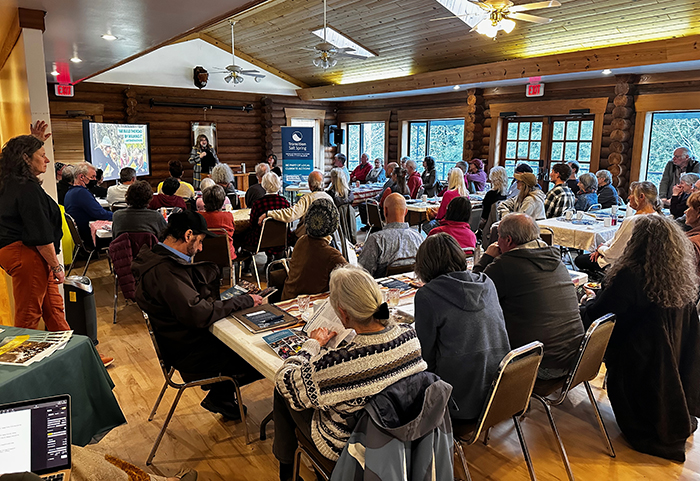
Transition Salt Spring (TSS) Society members, board and staff gathered at Lions Hall on Thursday, April 2 for an annual general meeting that served up hope, inspiration, celebration and a yummy potluck supper.

The event heard reports from all programs, circles and working groups, illuminating a year of accomplishments and change. TSS also received words of appreciation from MP Elizabeth May, who dropped in at the beginning of the evening.

“Looking through the annual report is pretty stunning,” May said to the full house. “It’s significant work. You’re doing the work, and you do it really well, and you also know how to have fun.”

TSS executive director Darlene Gage stressed the need to build relationships, referencing climate activist and author Bill McKibben, who has been quoted as saying that the best thing individuals can do to make a difference in the world is “to stop being an individual.”

“It means engaging people at every level, from the individual choices we make in our homes to the policies that shape our land and water for generations,” said Gage. “It means aligning with partners, because no single organization and no single person can do this alone. And it means staying responsive, adapting as we learn, because the challenges we face won’t stand still, and neither can we.”

Repair Cafés and toy and clothing swaps have become one of the main faces of TSS in recent years, bringing together sharing community members and reducing the island’s waste stream. In 2025, more than 400 items were fixed at four Repair Café events; 3,120 pounds of clothing were redistributed at the October clothing swap and 3,000 pounds of toys changed hands at the pre-Christmas toy swap. The TSS Coach Circle published 36 educational articles, attracted 377 new Lighter Living email newsletter subscribers and distributed $42,200 in rainwater catchment system rebates. More than 900 people attended an online TSS gardening workshop with Linda Gilkeson and more than 225,000 watched a Repair Cafe video that prompted 700-plus social media comments.

In terms of official AGM business, Rebecca Bloch was elected to join current board members Tisha Boulter (chair), Kelda Logan, Anne McKague and past chair Bryan Young.

In his closing remarks, Young emphasized the need for stable funding, ideally from monthly donors, as government sources contract in the current climate of economic uncertainty. The organization reported revenue of $510,998 for 2025, coming primarily from grants and donations; expenses were $478,637.

“I think we have something special going on here with all of you,” he said to the members. “You’re willing to engage, to listen, to wrestle with tough topics, and we’re in an organization that’s trying, sometimes imperfectly, but earnestly, to hold space, to resist polarization, to build common understanding and to move us together towards decisions that honour both people and the land. We want to thank you from our hearts for being a part of that, and thank you for helping carry this work forward.”

Young also shared some big news for one of its programs: the Climate Adaptation Research Lab (CARL), which has operated for five years under leadership from scientist Ruth Waldick, has “taken flight” and is now its own incorporated non-profit entity. Waldick reported on a busy year of continuing activities, partnerships and research to create healthy forests and watersheds and reduce wildfire risk in those areas.

Transition Salt Spring was born in 2010 in response to a locally created Climate Action Plan that included some 250 recommended actions to combat climate change and needed a group to take them on. It was then one of 323 Transition communities worldwide and one of 17 in Canada, with the first one set up in Totnes, Devon, U.K. in 2006. Today, 959 communities are part of the Transition International Network.


Opinion: Community needs and environmental protection must be balanced

By ERIC MARCH

I’m worried about the future of the Islands Trust.

I like the Islands Trust, or rather the idea of it. The idea of a local government duty bound to balance community needs with environmental protection is brilliant and I’d be proud to live in a community like that. Unfortunately I don’t.

I live on Salt Spring Island, where folks desperate for housing are shamed for wanting urban amenities and growth. Where, if someone has the money, property can be purchased, trees can be cut down, and unaffordable luxury housing can be built with all the water-wasting amenities money can buy, but workforce housing requires a herculean effort to come to fruition.

I like the Islands Trust, but it isn’t working for me. It seems it isn’t working for a lot of people I talk to. It definitely isn’t working for the one-third of Salt Spring Island residents living in some sort of housing need. It’s time to change that.

I have spent most of my life playing, working and living in protected areas. Before I moved to Salt Spring Island, the majority of my working life was spent in outdoor education, wilderness skills training and wilderness hospitality management. I have taught thousands of children and adults to love, value and protect the natural environment and to treat wild animals and wild places with respect. If you had told me I would end up as some sort of working-class or housing advocate I would have thought you were crazy.

But in February of 2020 I moved to Salt Spring Island to work in agriculture. I did my research, I knew there was a housing crisis, but no big deal, right? I was only coming for a 15-month contract, and I secured staff housing from my employer. Unfortunately, life doesn’t always follow the plan. I made friends, met my partner, became part of the community and learned in all too much detail just how bad the housing crisis was.

I am astounded that some folks are so out of touch with the reality of their own community they can downplay or even deny the severity of the housing crisis on our island. Not only is it plain to see, not only have plenty of groups released statistics saying how bad it is, but in the 2022 Local General Election, trustee candidates who included housing as a priority in their platform received the first, second and third highest vote count, with candidates who chose to emphasize the environment first receiving the fourth and fifth highest vote count.

Yet some out of touch folks want to threaten the Islands Trust with lawsuits if the Trust dares attempt to make housing slightly less onerous to build. They want to halt any reform to our governing documents such as the Trust Policy Statement or Official Community Plan. They claim to be all about environmental protection while in favour of a status quo that has led to over-development of shorelines, clear-cutting of properties for luxury houses and a housing crisis that has left almost 4,000 Salt Springers living in some form of housing need.

That is what makes me worried about the future of the Islands Trust. There are groups and individuals so absolutely opposed to seeing the truth about the material conditions a huge portion of our population are dealing with. They refuse to see that the status quo has created a community where some folks look towards a life without the Trust as better than one with it. And who can blame those folks?

Can we really expect one third of our population to choose to live in housing need so that some of our community can live in comfort and call it “protecting the environment?” Salt Spring Island may be united in our desire to live in a community that preserves and protects the natural environment, but it is fractured down class lines.

Attempting to preserve and protect by setting a build-out cap that promotes rural sprawl, allows vacation and luxury homes, and leaves workforce housing an exception to planning is foolish at best and is already trending towards disastrous at worst.

Fortunately, the updates to the Trust Policy Statement and Official Community Plan, and Local General Election in October offer us opportunities to change our existing narrative. We can manage growth by setting limits not only on how much build-out can happen, but setting limits on where and how it can happen too.

Let’s protect contiguous forests and preserve farmland. Let’s ensure build-out is well planned, focused close to village sites and planned around the needs of our working class. Let’s limit the ability to build luxury vacation homes and find ways to tax the ones that are already here.

If we want the Islands Trust to continue to steward our communities sustainably into the future, indeed, if we want the Islands Trust to survive, we need the Islands Trust to do better. We need to protect not just the natural environment but also the material conditions of the island’s workers and the agricultural community.

I want to live in a place that balances community needs with environmental protection, and the Islands Trust can make our community that place — if we choose to move beyond the status quo and adapt to meet the challenges facing us in 2026 and beyond.

The writer is a working-class advocate living and working on Salt Spring Island.

Award-winning Josephine comes to ArtSpring stage

ArtSpring audiences are in for an extraordinary musical theatre treat this week as Tymisha Harris’ multi-award-winning show Josephine comes to the stage on Monday and Tuesday, April 13-14.

Harris brings Josephine Baker’s revolutionary life as a singer, movie star, WWII spy, civil rights activist and cultural icon to life through cabaret, theatre and dance genres in the show that has won more than 20 awards since it debuted 10 years ago.

Some of the more recent honours came from festivals ranging from the Gothenburg Fringe (2024 Mind Blown Award) to the Montreal Fringe (2022 Patrons Pick and Outstanding English Production) to the Adelaide Fringe (2020 Critic’s Circle Award) and Victoria Fringe (2019 Best Performance, Favourite Solo Show and Overall Pick).

“From ballgown to banana belt, Tymisha Harris is a tour de force!” stated the Broadway Baby theatre review publication.

“(Tymisha Harris) should be starring in a movie version directed by Baz Luhrmann,” wrote actor, producer, TV personality RuPaul Charles about the show.

According to Josephinetheplay.com, “Baker was born in St. Louis in 1906 and achieved only moderate success in the United States, but became an international superstar after moving to Europe in 1924. She starred alongside white romantic leading men in films in the ‘30s, had multiple interracial marriages and homosexual relationships, and performed in men’s clothing before the term ‘drag’ was commonly used/known. She was a spy for the French Resistance in WWII, a civil rights activist and mother to 12 adopted children. Her success often gave her the opportunity to live free from the racial oppression of her home nation, though she never stopped yearning for acceptance in America.”

Harris, who lives in Orlando, Fla., has worked in performing arts for four decades. Her most recent show, A Cabaret of Legends, expands on Josephine by celebrating other female Black singers, from Billie Holliday to Ella Fitzgerald to Beyonce.

The ArtSpring shows begin at 7:30 p.m. both nights.

Tickets are available through ArtSpring, online or at the box office.

Holman announces Trust candidacy for fall election

BY GARY HOLMAN

As I stated during the 2022 election, this will be my last term as Capital Regional District (CRD) director.

My main motivation has been to demonstrate that our rural form of governance can work. While much needs to be done, the last two terms have seen an unprecedented level of investment in essential infrastructure, services and amenities on Salt Spring Island. CRD played a direct or indirect role in many of these investments, in partnership with other agencies and our capable community groups, foundations, and improvement districts.

Over 140 units of affordable housing were built and permanent funding established for a year-round shelter. The former middle school and Phoenix school site were secured by CRD for community use. A new Lady Minto emergency room and fire hall were constructed, and the Ganges fire hall transferred to CRD for community use.

Continued upgrades to the Ganges sewer system will serve new, affordable housing projects in our main village. The Maliview sewage treatment plant is being rebuilt. The CRD Board just renewed a five-year contract with Island Community Services (ICS) to continue operating our recycling depot at no cost to local taxpayers. Salt Spring’s first commercial scale composting facility is now operating.

Several kilometres of pathways were constructed around Ganges, the Ganges Active Transportation Plan completed, and Ganges Hill repaved with upgraded pedestrian, cycling and stormwater infrastructure. The CRD Regional Trail feasibility study was completed, and funding allocated in CRD capital plans for design and construction. Transit service was improved despite Covid, a new bus maintenance centre was funded and new bus shelters completed.

Critical maintenance at the Rainbow Road pool was completed and new shared daycare and recreation spaces created there. Centennial Park facilities and plaza were upgraded, and a new dinghy dock at Rotary Park built. Funding is in place to build a new ball field, and master plans for Portlock and Rainbow Road parks were completed. Land for the Mount Maxwell Community Park and new waterfront access in Fulford Harbour was secured.

We also improved local governance. The Local Community Commission (LCC), which I promised to establish in the 2022 election, has broadened elected representation, enhanced transparency and accountability and consolidated delivery of most local services.

I remain personally concerned about challenges to the Trust mandate to preserve and protect our unique natural environment and rural landscape. In part, this challenge is driven by a housing crisis, the root causes of which (senior government inaction, rapidly escalating land and construction costs, and the commodification of housing) have little to do with our official community plan or Trust policies. In fact, many existing policies, now under review, are essential to create truly affordable housing for local residents while protecting our forests, drinking water sources and agricultural land, while making best use of our very limited infrastructure capacity.

We’ve seen the unnecessary divisiveness of Bylaw 530, a misguided request for inclusion in the province’s Bill 44 that would quadruple market housing on Salt Spring, and abandonment of the Ganges Local Area Plan and our longstanding inter-agency Watershed Protection Alliance.

The province, First Nations, over 30 previous Islands Trust trustees, conservation advocates and the former legal counsel for the Trust have all expressed concerns about the Trust mandate and some recent actions. For the first time, a local trustee is openly calling for Salt Spring to leave the Trust. Taken together, the Trust appears to be facing an existential threat that could be heightened under a different provincial government.

I will work as CRD director until the end of this term to help further community goals. But I cannot stand by during a time when the Trust and its unique mandate are so threatened. I will be putting my name forward as an Islands Trust candidate in the 2026 election to help continue demonstrating that Salt Spring’s social and economic goals can be achieved in partnership with other agencies and using the policy tools already existing in our OCP.

STEVENSON, Judi (Judith Claire)

November 23, 1946—March 19, 2026

“When it is over, I want to say: all my life

I was a bride married to amazement.

I was the bridegroom, taking the world into my arms.”

“When Death Comes” – Mary Oliver

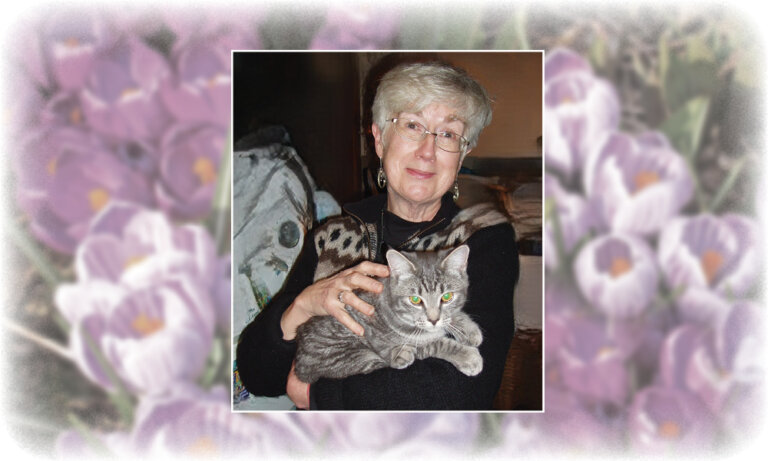
Our dear friend Judi possessed a fierce, wide-ranging creative intelligence. She was a community- minded social activist, feminist and environmentalist, writer and researcher, an avid photographer, traveler, art aficionado, a loving and loyal sister and friend, and lifelong cat-lover.

Judi spent her early years in Nanaimo BC, where her mother Gerry (née Geraldine Gertrude Browne), a teacher, encouraged learning, and the rich and fascinating time spent with her scientist father Cam (James Cameron Stevenson) at the Pacific Biological Station established her passionate love of nature and enduring interest in environmental justice.

After early high school in Vancouver, Judi’s family (now including her beloved younger sister Barbara), moved to Ottawa where Judi finished high school. She embraced student activism during her years at Carleton University, and developed life-long friendships with Marg Yeo, David Rayside, and others who recognized her keen intelligence and warmth. Graduating with an MA in Sociology, Judi was in London for several years, where she mixed further academic work with extensive European travels.

Back in Toronto, Judi built an exciting career in research and writing for documentary films. She was particularly proud of her work for TVOntario in the 1970s and 1980s including the documentary series “North of Sixty” that took her across the Canadian north. During that period Judi wrote and co-produced the award-winning, independent documentary on Canadian painter Alex Colville, “Alex Colville: of The Splendour Order” (1984). She was also a researcher and writer for the Report of the Royal Commission on Aboriginal Peoples, from 1991-1996.

Judi fell in love with Salt Spring on her first visit in 1989. By the next year she was building her house on her beloved Mt Belcher, moving back and forth between the island and her Toronto-based life.

After relocating to the island full time in 1995, Judi began working with SWOVA (Salt Spring Women Opposed to Violence and Abuse). For over a decade as senior researcher and evaluator, Judi’s work laid the foundation and development for the Respectful Relationships (R+R) program – pioneering work that gained it national recognition as an evidence-based, best practice program. Always meticulous in her design and thought-processes, Judi was a warrior for women’s and children’s rights to be safe and live their lives to the fullest.

“Mapping the Islands of the Salish Sea“ was a millennial community project led by Judi Stevenson and Sheila Harrington, with Briony Penn. From 1999 to 2005 the Mapping Project brought together over 3,000 people and thirty regional artists, culminating in the creation of more than 17 gorgeously rendered art-maps of the region, and in the publication of the award-winning book, “Islands in the Salish Sea: A Community Atlas”, (LTABC & Touchwood Editions 2005).

Over the years Judi conducted numerous research, writing and media projects on the effects of fluoride, the missionary William Duncan in Metlakatla, and homeopathy (for CBC Ideas). In 2010, she researched and wrote a fascinating and quirky monthly column for the Salt Spring newspaper, The Driftwood, entitled “My Year of Living Climatically,” discussing climate change at the local and personal level. Active politically for many years, she wrote articles, organized events, and supported political candidates and environmental campaigns and projects.

In her last years Judi gradually disappeared from community engagement as she fought the progression of Alzheimer’s disease. Supported for years by a close circle of friends, she was tenderly cared for by her unstintingly supportive partner, John Borst, private carers (Wendy & Marianne) and the Embrace team led by Brandy Borley. Last year she relocated to Greenwoods Longterm Care Residence, where her care was augmented by their caring professional staff.

Judith Claire Stevenson slipped away peacefully at Greenwoods early Thursday, March 19, 2026. She was interred in a private ceremony at the Green Burial site on Salt Spring. If desired, a donation to the Salt Spring Island Conservancy or Greenwoods Eldercare Society would be a tribute to a remarkable woman and dear friend to many, both here and in the east, who will be deeply missed.

Salt Spring becoming local government training hub

0

While Salt Spring’s tourist season centres on fair weather, another type of visitor is gradually becoming a year-round phenomenon — coming to the island to learn, from professionals eager to teach here.

In the last few years, Salt Spring has quietly become B.C.’s main centre for professional development of senior managers employed by local governments across the province — think municipalities and regional districts. Islander Linda Adams said the training is offered through the Municipal Administration Training Institute (MATI), a joint initiative of Capilano University and B.C.’s Local Government Management Association — and that the program’s popularity since moving to Salt Spring has only grown.

“When we first decided to try holding one of these courses here, we weren’t sure if it would be too difficult for people to access,” said Adams. “But they really like the location; it’s a great venue.” 

A faculty member of Capilano’s School of Public Administration, Adams coordinates, co-teaches and contributes to the Salt Spring courses after a decades-long career in local government herself — including 12 years as the chief administrative officer (CAO) of the Islands Trust. The MATI program actually started in 1982, she said, with classes mostly on Bowen Island. After a Covid-prompted hiatus, the facility on that island was no longer available and organizers had to look elsewhere. Many professional organizations do training in Vancouver and Richmond because of its proximity to the airport, Adams said, and fortunately it turned out the extra travel time to Salt Spring wasn’t a deterrent. 

“A lot of them take the float plane over to Ganges — and they think that’s just great,” said Adams. “With these courses we’re always looking for a venue that’s a bit removed, you know, so people can come and not feel drawn back to the office.”

The courses are all intensive five-day programs, Adams said, offered in a residential format — stay and learn — that often fill quickly. Since 2022, the move to Salt Spring and the Harbour House Hotel has brought still more accolades, as participants have the opportunity to spread out and visit restaurants, pubs and shops in Ganges. Adams said the most recent class in February — focused specifically on new and aspiring CAOs and city managers — was a “bit of a revelation” for people who attended from communities with less mild winter climates.

“We had some good weather, and of course the ones from the north were, ‘oh, I want to move here!’” laughed Adams. “People come away with a really good impression of Salt Spring.”

Adams said four of MATI’s six courses are offered on Salt Spring now, with titles like “Community Planning for Local Government Professionals” and “Managing People in Local Government Organizations.” Next week, Harbour House plays host to MATI’s Advanced Communications Skills for Local Government Professionals course, being taught for the third time on the island. Somewhere between 100 and 150 students now train here annually, Adams said, taught in groups of 35 by what is usually about a dozen guest lecturers — either current CAOs working around the province, or retired from public service.

“I won’t ‘out’ too many of them,” laughed Adams, “but we’ve got retired CAOs from around B.C. living here now, and they’ve helped us out as guest faculty. They all really like doing it and find it rewarding — it’s their opportunity to give back a little bit.”

From a community perspective, Adams said, it’s become a meaningful and growing counter-season boost to businesses — think around 40 hotel rooms and meals for the week — and a bit of a showcase for Salt Spring and its capacity to host province-wide events. Participants regularly return with their families as tourists, she said — and she agreed there’s nothing wrong with sending local government professionals back out into the province with good feelings about our island.

“There have been hundreds of people already that have gone through and hundreds more to come,” said Adams. “Most of them have never been here before, and they’re all leaving with a good impression. It’s good for Salt Spring to have all these people visiting and having a positive experience here.”

Editorial: TSS demonstrates people power

0

When Transition Salt Spring (TSS) was formed 16 years ago as a climate-change response group, it identified an unhealthy trend it hoped to address as part of its work.

An initial TSS public statement and potluck invitation in August of 2010 cited “a significant reduction in real communal activity” as “an unintended consequence of the prosperity created by our current capitalist system . . . Activities such as TV watching, surfing the net, shopping and other forms of consumption invariably take us away from connecting with those in our own community and even within our own families. TSS intends to engage all citizens in building a strong and resilient community.”

As its April 2 annual general meeting (AGM) and 2025 annual report illustrated, TSS is doing admirably well at working towards that goal.

Just as community members would gather to build a farmer’s barn in the “old days,” now we gather to deal with wildfire threats by sharing biochar kilns or helping clear lands of fire fuel and chipping it, facilitated by TSS. Through TSS Repair Cafés we get together to fix broken appliances and revive well-loved but battered garments, and perhaps learn how to do the repairs ourselves the next time. Those and other TSS activities engage people of all ages; members of the organization’s “Coach Circle” that leads Repair Cafés and other waste-reducing activities range in age from 17 to 77.

Diversity is an essential component when we’re talking about “resilience,” which is one reason TSS’ support of affordable housing initiatives makes practical sense. We need skilled and physically able people of younger ages to deal with the impacts of climate change. Those individuals and their families need secure housing in order to help themselves and all of us.

Both the 2025 TSS annual report (available on its transitionsaltspring.com website) and leadership presentations made at the AGM illustrate that while the numbers do matter — from how much waste is diverted from landfills to how many hectares of wetland have been restored — what’s more important is the relationships being built in order to prepare for and prevent the worst of an uncertain future, and to make the positive parts even better.

MLA column: NDP must lead on forests

By ROB BOTTERELL

MLA, Saanich North and the Islands

“Talk and log” old growth, mill closures, drought, wildfires, lack of value-added products from second-growth forests and climate change have shaken the very foundations of the forest sector in our province.

Key NDP forestry initiatives such as the Old Growth Strategic Review have stalled. Nor is the province any closer to protecting 30 per cent of the B.C. land base by 2030, implementing the biodiversity and ecosystem health framework, local watershed governance and a paradigm shift to a sustainable industry that protects workers and communities.

Following the money tells the same story: the Ministry of Forests’ 2026 budget is $910 million, essentially unchanged from last year. No new money means no new effort to deliver on previous NDP forestry promises.

What we know is that the current system of forest and ecosystem management is incapable of delivering the transformation in the forest sector we so desperately need. Out of the 2025 Green/NDP Accord, an independent body, the Provincial Forest Advisory Council (PFAC), developed a road map to transform forestry management to a system that delivers stability to the sector that everyone can support. See the report at pfac.ca/.

The NDP government needs to draw on the $5-billion contingency in the 2026 budget to quickly make the systemic changes recommended by PFAC: the development of accurate, trusted information on forests and ecosystems, regionalized land management with First Nations as full partners, independent non-political oversight and a relentless focus on eliminating dysfunctional elements of programs like BC Timber Sales.This needs to be followed by transformative change to our stumpage and tenure systems.

While this work is underway, we need to use the tools and funding we already have to build consensus amongst all parties on ways to immediately protect the Walbran and Fairy Creek. At my suggestion, Forests Minister Ravi Parmar started this work by establishing a roundtable and holding an initial meeting which included representatives of the Huu-ay-aht First Nations, Nanwakolas First Nation, Tseshaht First Nation, Ditidaht First Nation, Pacheedaht First Nation, Sierra Club, Endangered Ecosytems Alliance, Ancient Forest Alliance, Organizing for Change, Truck Loggers Association, Western Forest Products, BC First Nations Forestry Council, Nuu-chah-nulth and the Green Caucus.

I have urged the minister to continue this roundtable so that dangerous militarized police enforcement of injunctions and protests are soon a thing of the past.

For my part as the Green Caucus forests critic, I will continue to press for immediate implementation of the PFAC report, as well as previous commitments, including full implementation of the Old Growth Strategic Review, 30X30, the biodiversity and ecosystem health framework, and local watershed governance.

First Nations, rural communities, forest workers, environmental groups, forest companies — all British Columbians —have an interest in the future of our forests. The answers are in front of us. The question is whether the NDP government has the courage and political will to lead this transformation.

CRD FOI workload doubles in one year

0

Statistically, the Capital Regional District (CRD) is fielding fewer Freedom of Information and Protection of Privacy Act (FOIPPA) requests than it has in years, officials say — but the amount of work those requests create for staff has reached a new high point. 

The CRD’s Privacy and Information Services Division reported it responded to 255 Freedom of Information (FOI) requests in the 2025 fiscal year, reflecting a downward trend in the number of annual requests since reaching a peak of 284 in 2023. 

But the volume of staff work those requests generated — measured in the number of pages processed — has doubled compared to the previous year, as the regional district tallied an all-time high of more than 22,000 pages of records, mostly related to more than one theme and requiring a response from two or more divisions within the CRD.

“There were multiple requests with page volumes in the thousands,” said Melissa Sexsmith, FOI and privacy manager, who brought the report to the CRD’s Governance and First Nations Relations Committee Wednesday, April 1. “The largest request that we processed in 2025 had over 4,000 pages.”

Requests with large page counts are more complex and resource-intensive, said Sexsmith, requiring substantially more staff time to review, consult and then ultimately release records in compliance with the law. She added that the large-request applicant paid a “substantial fee” that recovered some of the processing costs.

“And many of these requests now say, ‘all records related to’,” said Sexsmith. “And what that means is emails, Teams messages, formal documents and drafts — rather than just a request that might be for the final report.”

The governing FOIPPA requires public entities to respond to requests within 30 business days — a tall order for document-heavy requests that Sexsmith said was nonetheless mostly met.

“In spite of the growth in request size, the CRD responded to 96 per cent of requests within the legislated timelines,” she said, “and on average, in 2025 the CRD took 27 days.”

The most commonly requested records related either to building inspections (64 per cent) or bylaw matters (25 per cent), and were mostly submitted by individual members of the public; 17 per cent of FOI requests were made by realtors, according to CRD figures, with businesses and special interest groups making up nine and four per cent of all requests, respectively. 

A bylaw amendment that came into effect in March is expected to change how some categories of building inspection-related records are accessed — moving responsibility for most of those record requests to the building department itself and hopefully reducing the number of pages handled under FOIPPA.

“I will admit to some extent it’s a bit of a shifting of duties from FOI and Privacy to Building Inspection,” said corporate services general manager Kristen Morley. “But part of that move is to hopefully reduce the workload on FOI and Privacy — so we don’t have to continue to increase our staffing needs.”

The CRD’s Privacy and Information Services Division is also responsible for reporting on data breaches; without going into specifics on privacy breach incidents, the report noted it investigated and remediated 12 “actual or suspected” privacy breaches last year.

Digital canvas creates immersive exhibition

BY ELIZABETH NOLAN

For Salt Spring Arts Council

The Salt Spring Arts Council invites artists and viewers alike to expand their perception of how digital and natural realities relate with the 2026 Spring Art Show.

Digital Ecologies: Bridging Nature and Technology is a dynamic group exhibition running April 10 to 26 at Mahon Hall. Featuring a diverse roster of artists working across traditional, digital and interdisciplinary practices, the exhibition challenges the perceived divide between the natural world and technological systems while signalling an exciting new direction for the Gulf Islands art community. The show is anchored by IM4 Media Lab’s extended reality mural Thunderbird Dreams, an intergenerational project uniting Indigenous youth, elders, artists and technologists in a shared exploration of care, sustainability, unity and kinship.

Digital Ecologies: Bridging Nature and Technology runs daily from 10 a.m. to 5 p.m. The opening reception is on Friday, April 10 from 6 to 9 p.m.

Curated by Rafael Katigbak, Digital Ecologies allows audiences to reconsider the relationship between nature and technology — not as opposing forces, but as interconnected systems that shape contemporary life. Through immersive installations, generative works and hybrid media approaches, the exhibition highlights how local and regional artists are navigating and redefining this complex terrain.

“Nature and technology are too often treated as opposites — as if choosing one means turning your back on the other,” Katigbak states in his curator’s statement. “What if these two worlds have more in common than we assume? What if, looked at closely enough, the patterns of one begin to mirror the other — and what if art is one of the best tools we have for exploring the space between them?”

With extensive experience curating international digital art exhibitions through his work with Refraction — where he has connected over 1,500 global artists with emerging technologies — Katigbak brings significant expertise to the project. He also draws on deep connections within the Salt Spring Island arts community to create a unique exhibition.

“We are thrilled to bring this cutting-edge realm of the digital canvas to our community,” said Bronwen Duncan, executive director of the Salt Spring Arts Council. “Unlike a traditional visual art show, visitors will not only see something new, but with the added multi-sensory experience of sound or touch, become deeply immersed within the thought-provoking message of each art piece.”

Participating artists include featured guests IM4 Media Lab from Vancouver, and Gulf Islands-based creators Anna Gustafson, Annika Hagen, Ben Frey, Brandon Stephenson, Leo Chan and Matt Robertson, Meredith Bates and Mena El Shazly, Pravin Pillay, Sara Gold and Veronica Classen. Their works span a wide range of media and approaches — from animatronic sculpture and textile-based practices to video, generative systems and collaborative ecological technologies.

Some artists, such as 2025 Salt Spring National Art Prize winner Gustafson, engage digital tools for the first time, finding that new tools open unexpected ways of seeing. Others use technical expertise to deliver a complex perspective. 

“There is no single answer in this exhibition, and that is the point,” Katigbak notes. “The diversity of voices, mediums and approaches is itself the argument — that this is not a problem to be solved, but a tension to be lived with.”

In addition to the exhibition, visitors can engage with a series of public programs, including curator tours, an artist panel discussion and a celebratory multimedia show on the evening of April 25. The 2026 Spring Art Show also features a youth exhibit, Interface, coordinated through the Arts Council’s Artist in the Class program, that highlights emerging perspectives on digital and creative practice.

Katigbak reflects, “My hope is that visitors leave not with answers, but with better questions — about what they notice in the natural world around them, about their own relationship with technology, and about what becomes possible when we stop treating these two worlds as enemies and start letting them speak to each other.”