Home Blog Page 63

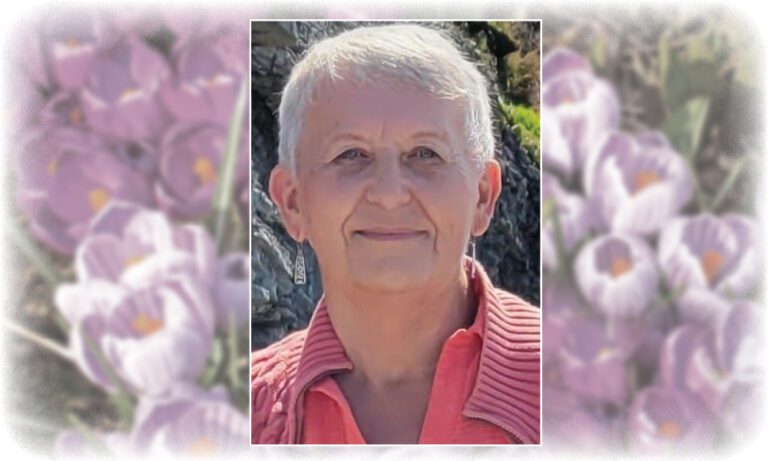
MORTENSEN, Diane Lynette

With sadness we announce the passing of Diane Lynette Mortensen (Herbert) of Salt Spring Island on May 4, 2025. Beloved wife of Klaus, they were married happily for 59 years. Predeceased by sister, Donna and parents Donald and Barbara Herbert. Best friend to Evelyn Jensen (Langley BC).

A kindhearted, thoughtful, talented and industrious woman who valued self-sufficiency, Diane was determined, headstrong and comfortably spoke her mind.

Diane met Klaus while they were students at Lindsay Thurber High School in Red Deer Alberta. She obtained her BFA (studio) at UBC and was a graduate of the Banff School of Fine Arts.

For over 50 years, Diane was a professional weaver. Known as an expert in colour, she taught weaving, both domestically and internationally. Diane began her business during Expo 86, continued in her home studio upon moving to Salt Spring Island and completed her weaving career running a successful online operation that began during Covid. She was grateful for support from Darlene, Donna and Ally in her business endeavors. Diane was also an accomplished painter, jewellery maker, and clothing designer. An avid gardener, she frequently shared her bounty. Likewise, her baked goods were gratefully received by others. Diane’s private pleasure was to happily bookend each day sitting in her oceanfront hot tub.

Diane was devoted over the years to her many Golden Retrievers. She was a member of the Southern Arizona Golden Retriever Rescue Society during the decade of winters she happily spent with Klaus in Tucson. (She is fondly remembered there by friends Bill and Bonnie Mullin.)

We wish to express gratitude to the staff of Lady Minto and Royal Jubilee hospitals for their excellent care and attention, and to Kim Carlson and other neighbours/friends/family for their ongoing support.

At Diane’s request, there will be no service, but she will be honoured privately by family and friends. She will also be deeply missed.

Housing summit sets table for OCP review

0

As a familiar face in on-island food security circles, Jon Cooksey’s involvement in Transition Salt Spring’s housing summit is only surprising before you learn the gathering’s foundational forums were largely built around meals. 

Tackling the island’s affordable housing issues one dinner at a time is on brand for Cooksey, as is helping to wrangle consensus from conflict. He and partner Pam Tarr organized dozens of islanders for Salt Spring’s productive food summit in the fall of 2023. So, among what grew to more than 70 participants at the Common Ground Summit April 29, Cooksey landed upon quite a group — everyone from trustees to tradespeople, farmers, planners, under-housed islanders and philanthropic leaders — all working together to find some consensus on the big questions intersecting Salt Spring’s housing, environment and community values. 

But well before the summit, Cooksey said, there was a fair amount of uncertainty; there were no guarantees even those first kitchen-table meetings would bear fruit. 

“There were people invited that were fairly skeptical, who have been at this for a very long time — and some that saw the system as broken and unfixable,” said Cooksey. “But at every dinner, people walked in the door, took a glass of wine and started talking — and didn’t stop for four hours.”  

Cooksey chuckled. “By the end, nobody ran for the door.” 

Anchoring the effort, TSS was perhaps a less obvious fit, society board chair Bryan Young agreed; but land use on Salt Spring is inextricably tied to climate action, and the TSS team has had great success with its own culture of consensus-building. 

Young said the idea for the Common Ground Summit was to find some points of agreement among islanders, going into the Islands Trust’s official community plan (OCP) and land use bylaw review before it ramped up in earnest — to support the Trust’s limited-resource process, he said, by feeding it a few of the island’s preferred ideas “pre-masticated” for consideration.  

“We’re not going to come up with an OCP,” said Young. “That’s the job of planners. What we can do is have ‘dialogue across differences’ in this community, sort of work that ground in advance.” 

Young said TSS felt the process would be stronger if more people from different corners of the island were involved — and at the summit, he said, they saw it happen, as groups discussed and supported one another’s ideas for addressing affordable housing on Salt Spring, from diverse and often surprising directions.  

“It was beautiful, seeing how people from different sides of these discussions interacted,” said Young. “It feels like it’s taken this whole discussion to a new level — one of peace and curiosity, rather than animosity.” 

It was a challenging but inspiring event, Cooksey agreed; he said building the day’s sense of collegiality — among islanders who had a history of frank disagreement with one another — was made a lot easier for having those dinners beforehand. 

“These were all people I liked,” laughed Cooksey. “By the time we got to the summit, most of these 70 people were literally my friends — so I was able to say to each one of them, ‘if you’re mean to somebody today, remember: they’re probably my friend.’” 

The tabletop groups were presented with more than 60 ideas gleaned from those dinners, and around the room’s walls, using coloured dot stickers, participants tagged their favourites — a “dotmocracy,” in the parlance of facilitators. Notably, Young said, almost all of those ideas had some level of support — as if indeed islanders might have a few ideas in common after all. 

“They all love the environment, they all care about the community,” said Cooksey. “They all want housing in the right places. It’s evidence of people agreeing on the shape of a problem, something they all have experienced.” 

And remarkably, a few ideas emerged as clear favourites, according to Cooksey and Young. A rezoning and redesign for Ganges was popular, finding ways to expand commercial and industrial spaces; attendees liked clustered housing, light on the land and potentially highly affordable; and there were a lot of green dots around creation of a nonprofit housing association — a central one-window hub for development, support and management of affordable, environmentally sensitive housing. 

And perhaps, even for financing. 

“Imagine something like community bonds partially funding these projects, where you create local ownership of this issue,” said Young. “Getting buy-in on affordable housing — quite literally — within the community.” 

“That’s one of the next dinners,” joked Cooksey. “Hopefully, these things will arrive; we’ll see better zoning in Ganges, we’ll have a housing association and alternative financing to feed that housing association, and we’ll have better interface with all these government officials we’ve gotten to know. 

“We do need to build trust between ourselves first, so that all these parts can work together,” he continued. “And it’s started; it’s happening.” 

For more information or to join the ongoing Common Ground process, visit transitionsaltspring.com. Salt Spring’s OCP/LUB review can be followed at islandstrust.bc.ca/island-planning/salt-spring/projects/salt-spring-official-community-plan-review/. 

Guild and library host Fleece and Fibre author

By MARGARET MACMILLEN

For the SSI Weavers and Spinners Guild

This year the Salt Spring Island Weavers and Spinners Guild has adopted an Islands Fibre Challenge to use local fibres in their work. The intention is to raise awareness not only about the versatility and beauty of local fibres but also the benefits to community and environment that are derived from their use.

In support of this endeavour, the guild and the Salt Spring Island Public Library have partnered to invite Francine McCabe, author of Fleece and Fibre: Textile Producers of Vancouver Island and the Gulf Islands, to give a talk at 2 p.m. on Saturday, June 7 in the library program room. McCabe’s book explores the world of small-scale farms along the Salish Sea and their pivotal role in sustainable, artisanal textile production and the slow fashion movement. A display of local fleece and yarn will also be on hand during the day of her talk. People can find out more about the impact of commercially produced textiles on the environment and discover sources of local fibre for their own projects.

In conjunction with McCabe’s presentation, the guild will have a month-long exhibit in the library’s program room showcasing an inspiring array of woven, knit, felted and hand spun items created using locally sourced fibres.

To inquire about displaying fleece or other natural fibres during McCabe’s presentation, or for more information, contact Susan Astill at 250-653-4207 or saltspringsusan@gmail.com.

Confluence exhibition extended to June 1

BY KIRSTEN BOLTON

FOR ARTSPRING

With Birgit and Robert Bateman in attendance, close to 200 people, including some who travelled from off-island, came together for the opening reception of ArtSpring’s exhibition Confluence: The Bateman Collection on Saturday, May 17.

A week later, as Robert celebrated his 95th birthday, almost 1,000 people had been through the gallery to experience this intimate look into the lives, work and personal collections of two of Canada’s most influential artistic and conservation voices. 

In preparation for Robert’s birthday on Saturday, gallery curator Zoe Zafiris-Casey home-baked dozens of complimentary cupcakes for visitors to mark the occasion. Little did she know that Robert and Birgit would return to the gallery and bring 28 extended family members with them.

“I couldn’t believe it,” said Zafiris-Casey. “After months and months of working on this exhibition, to have them show up on his birthday and bring multiple generations of children, grandchildren, nieces and nephews to celebrate almost brought me to tears.”

With cupcakes in hand, Robert and family lingered for more than an hour as he delighted surprised visitors with impromptu stories about several pieces on display with his trademark storytelling charm.

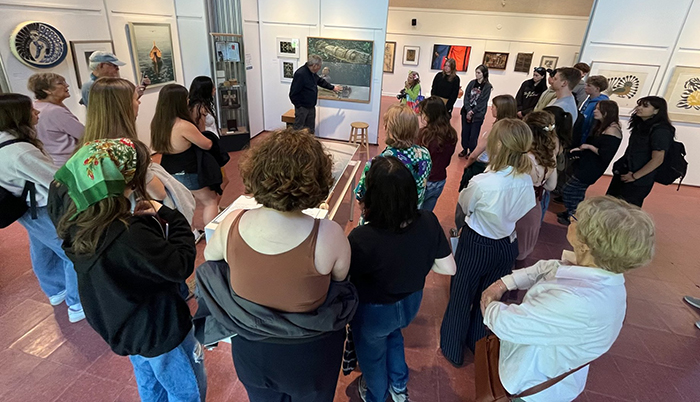
Earlier in the week, he slipped back into his life as a teacher and educator to lead tours and talks to multiple Gulf Islands Secondary School student groups about the backstories to his pieces, the intersection of art and the environment, and living a life of purpose.

On Tuesday, May 27, Zafiris-Casey and local photographic artist Seth Berkowitz conducted a curators talk, spotlighting the art, adventure and advocacy of photographer Birgit Freybe Bateman. While lesser known around the world than Robert, wife and artistic partner Birgit is a venerable and much-exhibited photographer — an artist whose global travels and poetic eye bring forward the quiet, layered beauty of overlooked places and people.

“I have had many visitors comment they appreciate Birgit’s work and voice being represented in this exhibition,” said Zafiris-Casey. “She wrote the introductions to each of the continents and regions we have here on display, she has been an absolute force in their journey together and is an artist in her own right.”

It was Berkowitz, a colleague who has co-presented work alongside Birgit for years, who sparked the original idea for the behind-the-scenes Confluence exhibition. His display wall of Bateman family photos has become one of the most popular stops in the gallery.

Displaying a life of love and commitment, the photos capture moments with Jane Goodall, a camel nibbling Birgit’s face, action shots in the jungle, snapshots from a logging protest and quiet moments in their home studio.

From Salt Springers to tourists from Whitehorse, California and Edmonton, visitors of all ages have taken the opportunity to sign the guest book with messages wishing Robert a happy birthday, but also to express some heartfelt connections, memories and feelings the exhibition has evoked.

As the emotional visitor from Edmonton wrote, “This was more than I expected. Family stories, sculpture, fellow artist influencers. All so moving. Bateman was my late wife’s favourite artist, and I feel like she is here with me in this room today. Kudos.”

The exhibition has been extended to Sunday, June 1. Open daily from 10 a.m. to 4 p.m.

UPDATE: Primer, asphalt re-scheduled for Fulford-Ganges Road

2

Update: Northridge Excavating Ltd. Project manager Bob Mitchell has reached out to inform the public of a rain delay; asphalt paving has been rescheduled to Friday, May 30 and Monday, June 2; sections of Fulford-Ganges between Drake and Alders will have primer application on them over the weekend (May 31-June 1).

The original story appears below.

Contractors said they are reviewing events leading up to recent “extreme” delays during construction on Salt Spring’s busiest stretch of road — and have had discussions with various parties that inadvertently contributed to a day-long delay in hopes of avoiding such snarls going forward. 

Northridge Excavating Ltd. Project manager Bob Mitchell said his team had examined the delays on May 13 — and an earlier notable back-up May 6 — and have adjusted their procedures and “determined a way forward” with other impactful road users. Further, he said there would be more detailed and frequent public updates, which should give island drivers better information about when road issues would be present. 

“We recognize that we should be updating the public much more often, especially over the last few weeks,” said Mitchell. “Going forward we will be making much greater efforts to keep everyone informed.” 

In that spirit, a construction notice issued early Thursday, May 22 warned of emulsified primer being applied to gravel sections of Fulford-Ganges Road Tuesday and Wednesday, May 27-28 — the sticky effects of which drivers may want to avoid by reducing speed and/or trips if possible. 

The notice also advised of asphalt paving work scheduled for Thursday and Friday, May 29-30 between Drake Road and Alders Avenue, as well as removal of the asphalt surface between Alders and Beddis roads scheduled for June 2. 

“To be very clear, we recognize the extreme nature of the delays that occurred,” said Mitchell. “We take traffic management very seriously on this site, and have multiple controls in place to manage all sorts of aspects related to traffic — delays being one of them.” 

Mitchell said there would be stretches of roadways that would be gravel-surfaced for as long as 10 days at a time, meaning uneven and/or slippery conditions; he advised obeying signs and driving cautiously. 

“Our team is reviewing May 6, 13 and the remaining days of the project very carefully to ensure we maintain everyone’s expectations,” said Mitchell. 

Work began last September on the 1.6-kilometre stretch of Fulford-Ganges Road from Seaview Avenue to Cranberry Road known locally as Ganges Hill, a $22.9-million project with planned improvements including pedestrian crossings and refuge areas and paved shoulders for pedestrians and cyclists — a 1.2-metre-wide shoulder heading north (or downhill into Ganges) and 1.8 metres in the southbound direction. 

Province turns down Trust review request – again

0

The government of B.C. has responded to the Islands Trust Council’s latest request for a governance review — and in a word, the answer is no. 

In many more words, the two-page letter from Minister of Housing and Municipal Affairs Ravi Kahlon laid out the province’s position that in the current uncertain climate, a focus on “services and choices that make an immediate and material difference, while managing within our means” was the order of the day. 

Further — and despite Trust Council’s insistence that it needed updates or clarification on a range of matters surrounding the mandate, governance and structure of the Islands Trust — Kahlon said a review of such “sweeping issues” was not under consideration, notably taking pains to highlight the Trust’s environmental mission.  

“Land use planning to preserve and protect the Trust area and its unique amenities and environment is the core responsibility of the Islands Trust,” wrote Kahlon. “This reflects the ecological mandate of the Trust, the toolkit deliberately supplied by government, and that island communities have a role to play in local environmental stewardship. It is my expectation that the Trust Council recognizes that this requires careful deliberation and consideration of perspectives to manage expectations of growth, development and local economies without exceeding the carrying capacity of local ecosystems and preserving unspoiled natural amenities.” 

Trust Council in October had requested the review, citing among its concerns a lack of clarity on the Trust’s “preserve and protect” mandate, a “democracy deficit” regarding island representation and obstacles to meaningful reconciliation with First Nations it said were inherent in the structure of the Islands Trust Act. The request was similar to one made in the summer of 2022, which was also declined. 

While acknowledging trustees’ current plans to update several islands’ official community plans and the broader Trust Policy Statement, absent from Kahlon’s letter was specific mention of housing, choosing to task Trust Council with taking “particular care” to ensure engagement with the public and First Nations on those amendments were done in a manner demonstrating “mutual respect and build[ing] towards consensus.” 

“The established Trust Policy Statement is the current touchstone which aids in the interpretation of the organization’s mandate,” wrote Kahlon. “The development of the next iteration requires care to result in a Policy Statement in which all involved can all have confidence. Along similar lines, before returning with another request for provincial review I will expect the Trust Council to ensure that it has engaged in a meaningful way with the agencies and governments that would be expected to participate in or be impacted by such a review.” 

Kahlon indicated those should include First Nations, local governments and the Islands Trust Conservancy board. 

Receiving the letter at the Islands Trust’s Executive Committee meeting Wednesday, May 14, committee and Trust Council chair Laura Patrick noted that “due to some errors at the ministry,” the letter, while dated April 28, did not arrive in trustees’ hands until May 7. The committee voted to advance the letter to Trust Council for its consideration at that body’s June meeting and decided to respond back with a letter of its own, requesting to meet. 

“Notwithstanding the fairly unequivocal turning-down of the request,” Lasqueti Island trustee Tim Peterson told committee members, “I still think it’s incumbent upon us to pursue meetings with the minister, if possible. We know the staff connections exist, but it’s always good for the elected officials to have a conversation, even if it’s brief.” 

More on the Trust’s request for provincial review and its continuing communications on the mandate are available via the scrolling banner at islandstrust.bc.ca

Youth choirs build connections

BY KIRSTEN BOLTON

For ArtSpring

It’s 4 p.m. on a Friday in ArtSpring’s Jankura Lounge. Choir director Caroni Young and piano accompanist Cicela Månsson manage the bustling transition from grade 2 to 5 students flowing out and grade 6 to 9 students coming in to take their places for what will be the final practice before taking the stage on Saturday, May 24 for Makana Youth Choirs’ Spring Concert.

As an official ArtSpring Presents performance, Makana’s  Never One Thing concert takes its name from a powerful song by May Erlewine that celebrates the complexity of being human — that we are not defined by just one label, one emotion or one role.

It’s a theme that feels particularly resonant for Makana’s young singers growing up in a world full of expectations. The concert features a dynamic program ranging from humorous to deeply moving selections, with songs in multiple styles, languages and cultural traditions. The choirs are joined by guest musicians Bo Curtis on flute and Margaret Fisher on French horn, adding even more texture to an already rich program.

For Young and Månsson, the anticipation of this concert proves to be a full circle moment.

Founded in 2018, Makana Youth Choir began as a dream to bring a high-calibre, inclusive choral youth program to Salt Spring — one that mirrors the success of acclaimed youth choirs in larger cities. It all started with a conversation between conductor Young and then-ArtSpring executive director Månsson, a lifelong singer and champion of arts education.

With heart, hustle and some well-placed funding, including sponsors Viva Chorale choir, Seth Berkowitz and The Lost Chords, the Makana program took root. From a humble group of nine singers, it has blossomed into two thriving choirs spanning a wide range of ages and abilities.

Even during the challenges of the pandemic, the choir found ways to stay connected — Zoom rehearsals, local collaborations and community performances have helped Makana become a cherished musical touchstone on Salt Spring. The young group has sung for Remembrance Day ceremonies, joined forces with ensembles like The Lost Chords and Viva Chorale and most recently performed alongside a John Denver tribute band.

Squarely at the heart of Makana is Young, a Salt Spring-raised conductor whose own musical journey began as a child in the Fulford Elementary School choir and carried on to a master’s degree in choral conducting from UBC. Now based in Vancouver, Caroni commutes to bring professional experience, warmth and boundless energy to the island each week.

Accompanist Månsson has returned to her musical roots after her eight-year executive director tenure at ArtSpring. A passionate performer and educator, she brings sensitivity and skill to every rehearsal and concert, helping young singers bring their voices — and their stories — to life.

Howard Jang, ArtSpring’s executive and artistic director, sees the long-term effects.

“Programs like the Makana Youth Choir have a lasting impact — not only do they nurture musical talent, but they also build confidence, teamwork and a sense of belonging in young people. These are the kinds of experiences that shape future artists, leaders and engaged community members.”

ArtSpring encourages the whole community to come support young artists and experience the joy and power of collective music-making. Never One Thing is a celebration of growth, resilience and the beauty of being.

The May 24 concert begins at 7:30 p.m. Tickets cost $10 for adults and $2 for youth.

Viewpoint: The grace of letting go

By RIVEN MERROW

In conversations about Salt Spring’s future, the term resilience is often invoked with optimism: communities preparing for climate uncertainty, protecting freshwater, fostering continuity and building infrastructure that supports a vibrant, sustainable island life.

But what if true resilience doesn’t always mean doing more? What if resilience could also mean letting go?

A recent conversation with a long-time islander offered a striking counterpoint — what they called relinquish planning for resilience. Their position was not anti-environment, anti-community or anti-youth. It was something quieter, more haunting and perhaps more honest.

“Why build?” they asked. “Why promote growth, or push to sustain a young, growing community at all costs? What if, instead, we allowed the island to slow down, to retract from the ambitions of expansion and to let this settler moment fade in dignity?”

It’s not the kind of message you’ll hear at a development open house or sustainability workshop. And yet, in the shadow of a climate crisis, vulnerable aquifers and aging infrastructure, it feels oddly relevant.

This relinquish view imagines resilience not as an act of building, but as an act of strategic withdrawal. It suggests that sustainability may come not from development, but from de-development. From decline. From relinquishing density, tourism and the pressures of modernity. In its most radical form, it asks us to imagine an island that doesn’t just prepare for change but reverts toward ecological sovereignty.

This vision aligns with a freshwater reality. We know that many watersheds on Salt Spring are over-licensed, overdrawn and over-fragmented. We know that aquifer recharge is seasonal, variable and intensively affected by land use. We also know that each new parcel, pump or pipe adds to the burden. Under the relinquish view, resilience is not achieved by engineering more but by reducing demand, decommissioning systems and protecting watersheds through non-occupation.

Likewise, for Indigenous resurgence, this perspective may offer a long-overdue decentering of settler narratives. Rather than asking how settler communities can remain indefinitely “resilient,” the relinquish view creates space for re-emergent Indigenous governance, values and land relationships to breathe — without endless settler “improvements.”

In this way, relinquish planning may also serve environmental equity — not just in who has access to resources, but in relinquishing the authority to define care, stewardship and belonging to those whose relationships with this land extend from time immemorial.

And in terms of biodiversity, the logic is undeniable. What preserves an ecosystem more effectively than absence? A declining footprint. A trail left to grow over. A stream left undiverted.

This is not to romanticize collapse or ignore the realities of community care. But maybe it’s time we brought this contrarian view into the dialogue. Maybe resilience isn’t just about building for tomorrow, but about knowing when to slow. When to yield. When to let the forest take back the road.

Island resilience might mean not how much we can grow — but how gracefully we can let go. Relinquish to replenish.

The writer is a Salt Spring resident.

Editorial: Neighbourhood house a good plan

0

Taking risks doesn’t come naturally to most government agencies. If an unconventional initiative goes sideways or implodes, the political fallout can be brutal.

But the Salt Spring Local Community Commission (LCC) has proven itself willing to take a chance on the Chuan Society and its proposal to create a “neighbourhood house,” leasing the former Phoenix school property on Drake Road to the society for one year. The society plans to host a range of activities — from arts and culture events, to health and wellness offerings, workshops, gardening and lots of food sharing.

Only two proposals for leasing the site, which is still owned by the Gulf Islands School District but is leased to the LCC through the Capital Regional District (CRD), were received. The other was for the Creek Song Learning Centre, a Waldorf-inspired educational program that has operated this year on the Salt Spring Centre of Yoga property. While the school district’s lease with the CRD states that preference should be shown for lessees with a youth focus, LCC members felt the Chuan proposal filled a more critical gap in services.

With Chuan having leased a former portable building on the same property from last December through March of this year — running the Hearth warming space and its popular Gabriel’s Kitchen weekly meal there — the LCC is already familiar with their new tenant, and the experience was a positive one. In fact, the LCC took a “risk” with that venture and, as was so obvious at the final Hearth gathering attended by the Driftwood on March 29, where participants shared their experiences, it was well worth it from a whole community perspective.

As with any undertaking requiring interactions between humans, problems will certainly occur. But the people involved with Chuan have already proven they know how to deal with issues that arise and how to make the most of solid alliances.

Situated next to the new BC Housing-funded supportive housing complex, and close to Ganges, the location is ideal for a community centre where giving, sharing and inclusion will be the norm.

Assuming nothing pops up to derail the process, we look forward to seeing what the opening of doors and turning of soil will bring next to the former Phoenix school site — and what’s on the menu, of course!

LCC chooses Chuan Society for Phoenix lease

0

Salt Spring’s Local Community Commission (LCC) has voted to enter into a 12-month lease with the Chuan Society for a portion of the former Phoenix Elementary School property, a move commissioners say is an important step toward community-building on Drake Road. 

The unanimous vote Thursday, May 15 will allow Chuan to build upon its wintertime pilot project known as the Hearth, the daytime gathering space for vulnerable community members it had run from the Phoenix property’s portable building. Chuan plans to operate a comprehensive “neighbourhood house” from the upstairs floor of the former school’s main building, creating a community gathering place with learning spaces, a kitchen, garden and pantry.  

The agreement will be in place for the next year, while the downstairs is occupied by Capital Regional District (CRD) Parks and Rec staff awaiting construction of their new Kanaka Road facility. 

Just two proposals to rent the property were received in time for the LCC’s full consideration Thursday; the other, submitted by the Creek Song Learning Centre, had hoped to use the space for an estimated 10 to 14 children it anticipates for its Waldorf-inspired educational program.  

But that proposal fell out of the running quickly, according to LCC chair Earl Rook, given the broader benefit commissioners saw in Chuan’s plans. 

“I think our community’s got a whole series of serious, multi-level problems that we’re trying to deal with,” said Rook. “Providing lower-cost rental for a group of parents for a school doesn’t seem to rise to the level of our housing crisis . . . I think the fact that children are involved isn’t enough to put enough weight on the scales to tip it that direction.”  

Rook was referring to language in the lease agreement with the Gulf Islands School District — which still owns the Phoenix property — stipulating the CRD’s uses “shall prioritize youth activities and bookings,” with subsequent priority given, in order, to CRD activities, adult not-for-profit activities, then public activities. Staff had noted that while the choice of tenant was the LCC’s to make, it was arguable that shifting those priorities may run counter to the terms of the lease. 

“They’ve asked that we prioritize youth activities within the building,” said CRD senior manager Dan Ovington. “It’s completely at the LCC’s direction if [you] see another priority, or a need higher than that. But then the school district’s well within its right to terminate our lease, or not provide us a renewal.” 

Commissioners were undeterred. 

“Both [proposals] are good, solid ideas,” said LCC member Brian Webster. “One is of benefit to kind of a constrained range of families — who are community members, and so good on them for applying — and the other, in my view, has broad benefits to the community.” 

Expressing his support for the Chuan proposal, LCC member/CRD director Gary Holman noted while the Hearth had been “managed quite well,” there had been issues around parking and dogs. 

“And there are going to be issues,” said Holman. “I’m a little concerned about conflict with Parks and Rec staff — so if additional fencing or other measures are needed to separate out the uses, I can say here publicly I’m absolutely committed to supporting that with more Community Works funding. But all things considered, it’s worth taking a chance.” 

Commissioner Ben Corno agreed, saying the use may dovetail with community needs.

“This also takes care of a bit of our work for the future,” said Corno. “I don’t think the LCC has another answer for the warming space for the wintertime right now.” 

Webster quickly pointed out Chuan’s proposal was not for a warming space, saying he has come to envision a future with a “true grassroots community centre” in the vicinity of BC Housing’s supportive and affordable housing project, being built down the street from the former Phoenix property — and saw this agreement with the Chuan Society as a step in that direction. 

“I stood in a circle of folks on the last Saturday event of the Hearth,” said Webster. “It’s impossible for anybody who has an open mind and an open heart to participate in something like that, and not feel a compelling need to make sure that our definition of ‘community’ really includes the whole community.”