
Home Blog Page 66

PAYNTER, Daulton

We are very sad to announce the passing of Daulton (Doc) Paynter @ LMH on May 2, 2025, surrounded by his loving wife and family.

Doc was a kind, gentle man who savoured & appreciated every moment of his full life. He loved his family and the people in this world from every race, country & situation and was passionate about caring for the planet. Born in Powell River, he had one brother & two sisters. He had a life-long love for B.C.’s wilderness, forests and coastline which resulted in his participation in many protests over the years to protect it.

When he was 13, his obsession to fly an airplane spurred him to find a job to pay for lessons. With these hard-earned monies he would bike to the Vancouver airport to take flying lessons and eventually qualified for a solo flight. Later, while building houses, he lost one eye in an accident which ended his dream of flying, so he took up sailing.

After a year at UBC he decided to become a house builder. He spent a year in Africa but didn’t agree with their politics so returned to Vancouver to build houses there. At the time they were so desperate for shop teachers that he was offered one year at BCIT, then a full time job. With this training he became a shop teacher in Merritt. During this time his two children, Chris and Shannon, were born. Eventually they moved to Hope where he met Susan, the love of his life, and they married. They bought a 23 ft. sailboat in which the family spent many summers cruising up and down the gulf islands. Dreams of crossing the ocean & sailing around the world beckoned.

While working in Mission B.C. after the third house they built he went on a yearly bike trip with his friends and had a serious accident in Golden while blazing down the hills. He had brain & bone injuries which forced him to quit teaching. A month before that accident they had purchased a 36’ steel hull to prepare to eventually cruise. It took 4 more years and lots of help to finally get the ship ready to go. The kids had graduated so they sold their house, Susan quit her job, and off they went. After 6 days they decided not to cross the Pacific but to travel down the coast. This adventure ended up being 4 years of exploring Mexico, Central America, Panama, N. South America & finally all up the east coast, in the inter coastal waterway & eventually back to Canada and the Trent Severn canals. He loved getting to know and learn about all the different cultures and his calm, easy going nature made the Paynters welcome in many villages.

On the home front, Chris and Shannon were starting families so it was time to return to Canada and be grandparents. They had bought land on Salt Spring years ago so the boat, “Manotic”, their home, was shipped to the west coast and they built a house near Ruckle park, designed and built by Doc. Grandkids, Tristan & Kaitlin, loved to come and visit. He continued to be part of Salt Spring Sailing club and cruised up the Canada – USA inside passage all the way to Alaska, stopping in numerous places of interest.

The Paynters stayed on King Rd. for 20 years before moving to Ganges. One of Doc’s other interests was gliders. It took 43 years but he quietly and calmly built a Fauvel glider which he & Chris saw fly after getting their glider pilot’s licences. He eventually gave it to the pilot who drags the gliders up.

Doc will be remembered as a kind, humble, witty, loving, caring & extremely capable builder. The last few years have been very difficult health wise, and he & his family were all relieved to be able to bring an end to his pain & suffering. I also want to say I think the whole staff at LMH were absolutely wonderful to us. They really made us feel better and helped us cope with much sadness. I love them.

Doc will be greatly missed. Doc is survived by his loving wife of 50 years, son, Chris (Lori Waters) and daughter, Shannon Minvielle, grandchildren Tristan and Kaitlin.
Maxwell water treatment plant referendum passes by wide margin

0

The $11.7-million borrowing referendum for the Maxwell Lake water treatment plant has passed by 74.3 per cent.

Results were announced at the North Salt Spring Waterworks District (NSSWD) annual general meeting held at Community Gospel Chapel on the evening of Thursday, May 8. 

With 32.5 per cent of eligible voters casting ballots either by mail or in person on Thursday, participation was at the highest level for any previous vote undertaken by the NSSWD, said chief administrative officer Mark Boysen, with 1,023 ballots cast by 3,143 eligible voters in the district. Twenty-seven ballots were deemed not acceptable, for a total of 996 eligible ballots: 740 voted in favour and 256 voted against the proposal. 

“That’s great news,” said NSSWD board chair Brian Pyper at the AGM. “Thank you to all the ratepayers that supported us in this process.”

Referendum approval means NSSWD ratepayers will see a $100 per year parcel tax increase next year, unless a $6-million applied-for federal government grant is received, in which case no increase will be needed.

It is also one of the components in the district’s “Building Resiliency” strategy to improve water supply and quality in the coming years, along with raising the St. Mary Lake weir, with $10 million in funds provided by the provincial government, improving the Maxwell Lake watershed and joining the St. Mary and Maxwell sides of the system. 

The AGM also reviewed major accomplishments for the previous year, which included a partial lifting of the 10-year hook-up moratorium on the Maxwell Lake side of the system.

“This was a difficult decision and controversial to many in the community,” said Pyper in his chair’s report, “but to be clear, the lift, which began on March 31, is on the Maxwell system only, and is expected to increase water consumption by roughly eight per cent in the district as a whole. To ensure that this new available supply was closely monitored, the quarterly connections reporting process was implemented by the board to regularly assess the status of the system capacity.”

The St. Mary Lake weir project, which Boysen stressed was in its early stages, was among topics raised by the approximately dozen ratepayers attending. Boysen invited any impacted landowners to bring their questions to him directly at the office.

A $25 per month increase in trustees’ honoraria was proposed and approved by a vote of ratepayers, bringing the amount to $400 per month and $425 for the board chair. 

Fred Lizotte of McLean, Lizotte, Wheadon and Company was appointed NSSWD auditor for a three-year term.

All AGM documents, including financial statements, are available on the northsaltspringwaterworks.ca website.

Treasure Fair makes donation call

BY KIRSTEN BOLTON

For ArtSpring

Held every July, ArtSpring’s best known annual fundraiser Treasure Fair has announced it is now actively accepting donated items from the community, but for the first time in several years, it finds itself without a locked-in high-value headliner item prior to opening the call.

Last year’s record-breaking 25th anniversary year auction was significantly enhanced by the inclusion of a donated custom-built 1957 Porsche 365 Speedster replica, which was won by a final bid of $56,000 from a father in Sidney. ArtSpring’s annual goal for Treasure Fair is to raise $55,000. 

“With that one generously donated item, it created buzz and allowed Treasure Fair to hit its target within minutes of the website going live,” said former committee chair Catherine Griffiths. “But the real story about last year was that the rest of the auction, comprised of some very special and some very everyday items, attracted another $70,000 of interest.”

Treasure Fair 2024’s $127,000 total may be difficult to duplicate, but volunteer organizers are optimistic there will be a great turnout, intriguing items for all budgets and a positive community spirit vibe. 

From furnishings and decor, collectables, holiday destinations, concert tickets, artworks, wines, musical instruments, jewellery, kayaks and sporting equipment, cappuccino makers, experiences and professional services, over 500 items were included in the last auction, starting as low as $20. 

“What is unique about this event is that is curated, not a garage sale,” said Griffiths. “Our team evaluates each submission for quality to determine if it would be special or useful or treasured by someone, regardless of price point.” 

Treasure Fair has attracted donated items for practical reasons such as decluttering, downsizing or estate clearances, but many clever businesses and professionals donate gift certificates, experiences, or services such as landscaping, gardening advice, accounting, spa treatments or adventure tours as a way to introduce or grow their businesses.

The volunteer Treasure Fair Committee, now led by Janna Zahorodhiuk as long-time chair Griffiths scales back to a support position, has been starting to field inquires and submissions through the Treasure Fair website. The team can then assess, evaluate, photograph and help with transport or storage of items. 

When asked about what dream headliner item Treasure Fair hopes to attract, Griffiths is circumspect. “We’ve had a Porsche, a Mercedes, a grand piano so far. Who knows? A sailboat? An Airstream? An unprecedented experience? Sky’s the limit!”

One hundred per cent of funds raised go to supporting ArtSpring, which receives only 10 to 15 per cent of its funding through government grants. Tax receipts can be issued for most donations. Deadline for donations is June 18. Treasure Fair runs July 16 to 19.

For more information about donating or volunteering visit treasurefair.artspring.ca.

South-end home destroyed by fire

0

Fire officials said despite the total loss of a Beaver Point Road home, no one was injured and the fire was contained to a single structure near Weston Lake. 

Salt Spring Island Fire Rescue (SSIFR) Deputy Chief Dale Lundy said firefighters raced to the scene Friday, April 25, after a caller reported dark grey smoke coming through a rooftop. But even as trucks were rolling, Lundy said, updates from dispatchers indicated the situation was worsening. 

“Another caller had reported heavy flames coming out of the roof,” said Lundy. “So it was pretty well involved by the time we got there.” 

Using about 8,000 gallons of water, Lundy said, SSIFR crews were able to contain the fire enough to save a nearby cottage — and to prevent fire from spreading into the surrounding forest. 

With no hydrants in the area, crews set up to quickly refill trucks with water from Weston Lake — notably just the kind of tender shuttle scenario SSIFR was recently reaccredited for, through the department’s successful Fire Underwriters Survey evaluation in February. That 10-year accreditation is recognized by most home insurers as functionally equivalent to having a fire hydrant nearby. 

“And that all worked the way it should,” said Lundy. “Any fire where there’s loss, it’s obviously not good, but I can say the crews did a great job mitigating any further damage.” 

No one was home at the time of the fire, Lundy said, and a preliminary investigation indicated the fire was likely accidental.  

As Salt Spring Island’s wet season comes to an end, Lundy said, SSIFR is reminding islanders that residential property assessments through the fire department are available free of charge, for anyone seeking professional tips on ways to make their property less susceptible to wildfire. 

“Our FireSmart team is in full force right now, doing home assessments,” said Lundy. “If anybody’s interested, they should definitely reach out.” 

The free assessments typically take about 45 minutes, Lundy said, and can be booked either online at saltspringfire.com or by contacting the fire hall, 250-537-2531 or firesmart@saltspringfire.com. 

Almost no opposition to new service so far

0

No one at the Capital Regional District (CRD) board table can remember a regional Alternative Approval Process (AAP) counter-petition succeeding — and right now, at least for the district’s planned creation of a Regional Transportation Service, it seems that run isn’t likely to end. 

The CRD board voted in March to begin an AAP for that new service, intended to address transportation needs within the regional district, including the development of “transportation policies, plans, projects and studies related to public transit, active transportation, mobility hubs, demand management and road and trail safety,” according to staff reports.   

Salt Spring elected officials have repeatedly opposed being included in the new scheme, pointing out the island already has its own transportation service, and questioning whether the additional taxation would actually improve local service. 

In contrast to an affirmative referendum vote, the AAP allows the board to adopt the service-establishing bylaw if less than 10 per cent, or fewer than 33,127 electors within the CRD, join a counter petition. With 9,500 registered voters on Salt Spring, local officials noted, even if every islander signed in opposition the counter petition would fail anyway. 

But whether due to discouraging mathematics or in a reflection of support for the new service, with just days left before the deadline, no significant voter objection has emerged. 

Responding to a question during the CRD’s Committee of the Whole meeting Wednesday, April 30, housing, planning and protective services general manager Kevin Lorette reported there had been just 151 elector response forms submitted in opposition to the establishment of the new service — less than one  per cent of the number needed to send the issue to a referendum, according to Lorette. 

With the new service, according to CRD staff estimates, an average residential tax bill on Salt Spring could increase by nearly $50 annually, if the requisition grows to the full $20 million authorized.

The deadline for submitting signed elector response forms — whether in-person, through the mail or by scanning a legible, signed copy and emailing to legserv@crd.bc.ca — is Friday, May 16. Forms are available online at crd.ca.  

This story has been updated from an earlier version to better reflect the potential tax increase.

Editorial: Enough vitriol

Who says elections and politics are boring? 

The federal government campaign that concluded on April 28 proved how quickly fortunes can turn in a tumultuous world, and that all polls do not represent the gospel voters’ truth. Locally, Elizabeth May was rightly rewarded for her record as an MP and parliamentarian. 

We’d like to hope the results are a sign that Canadians have resisted the worldwide slide to right-wing authoritarianism. For as much as veteran Conservative politician Pierre Poilievre tried to appear prime ministerial during moments of the campaign, quotes and images from his long political career made it clear he prefers using insults and division to get his results, much like the current U.S. president, and that he shares some of that individual’s anti-progressive views, as do many of Poilievre’s party. 

On political discourse in general, it’s distressing that a large number of people think viciously insulting and threatening political opponents is acceptable, and that the bot farms responsible for much of the barbaric online vitriol seemingly cannot be stopped. 

Citizens have been weaponized through “rage-farming” and groomed to be manipulated by fear and hate based on unfiltered information that taps into our basest selves. It is not that people don’t have a right to feel any anger about past, present or future circumstances; it is that they don’t have the right to express it with physically or verbally violent and threatening words and tactics. Something terrible has been unleashed in the world of political/social discourse in the last 10 years and it needs to be confronted, quashed, shifted or controlled in some way. 

Political criticism and holding those with power to account are important parts of democracy. The use of sarcasm in critiquing an opponent’s position or actions is a fair tactic and can be considered a fine art. It’s not that we always have to be “nice.” But constantly gushing waterfalls of negativity and sheer crap do not contribute to a healthy democracy. Many good people have been discouraged from participating in politics in recent years due to the horrific treatment of themselves and their families. 

One wish we have for the next session of Parliament is that it will be less acrimonious than its predecessors. Hopefully when Poilievre returns to the House of Commons he will have been humbled by the rejection from his own Ottawa constituents and encouraged to leave his “attack dog” persona behind.

Viewpoint: Sidelining the environment

By FRANTS ATTORP

When trustees reinterpreted the preserve and protect mandate during an in-camera meeting in 2023, environmental protection suddenly became just another “element” to consider. Now there is evidence it is being sidelined altogether, at least on Salt Spring.

The latest shocking example is the contract the Trust signed with the consultant who undertook the recent Complete Communities Assessment. The project’s request for proposals states: “. . . the analysis must focus on growth through the lenses of housing, daily needs, transportation and infrastructure . . . .” Guess what’s missing from the “lens!” (The environment was added later according to planners, but only “through the stakeholder workshops.” It seems someone had to complain.)

Asked why the natural environment was excluded from the growth lens, a Trust spokesperson wrote: “That methodology did not require consideration of the unique mandate of the Islands Trust.” While that may be technically true, it is false in every other sense. Even the provincial Complete Communities Guide — which was never designed for protected areas — includes “preservation of the natural environment.” Furthermore, it is the responsibility of staff and trustees to apply the Islands Trust Act to all land-use planning.

Interestingly, the document required this task: “Based on input received, create a single scenario that reflects a working community vision to inform policy development . . . .” Yet when the consultant did exactly that — by highlighting “a community deeply committed to preserving its unique character and natural environment” — trustees sent his final report back for a “substantive edit.” That resulted in a revised report that planners described as “more neutral” and not reflective of “a community vision.”

Another phase of public engagement for the official community plan “update” will start soon, but already there is evidence the environment is being sidelined. Even though proposed changes are sweeping, irrevocable and a violation of existing growth limits, the scope of the project will be limited primarily to housing, and “community visioning” will be “targetted.” That is a reversal of priorities. Housing, while important, has never been the raison d’etre of the Islands Trust.

This leaves us with a burning question: Who is directing the choir as the Islands Trust sings its swan song?

That the debate about the future of Salt Spring (and the other islands) has to happen in a community newspaper is evidence of a broken process. The fundamentals of proposed policy changes should have been aired before the whole idea of “integrated solutions” was foisted on the community, before the Housing Action Program Task Force made its recommendations, before trustees tried to upzone most of the island for extra dwellings and of course before trustees resolved to nullify the mandate.

Massive changes are in the offing, both locally and at Trust Council, without the public ever having had full opportunity to weigh in on key issues of growth, sustainability and the Islands Trust Act.

Given the circumstances, we should all be grateful to the Driftwood for allowing the debate that trustees seem determined to stifle.

The writer is a Salt Spring resident.

Raven Spirit presents powerful dance show

BY KIRSTEN BOLTON 

for ArtSpring

Visiting ArtSpring for the first time on Tuesday, May 13, yet with individual performers who have been here before, comes Vancouver-based Raven Spirit Dance to present Braiding the Land, a trio of contemporary Indigenous performances that follows three powerful female narratives exploring the physical, the spiritual, the rhythms of nature, resilience and legacy. 

“The collection traces the connections between vast ancestral landscapes and the human body through movement,” said co-artistic director Michelle Olson from Yukon’s Tr’ondëk Hwëch’in First Nation. 

The solo piece Frost Exploding Trees Moon is the journey of a woman following her trap line in the woods and from her temporary camp site, looking at the stars in silence, she contemplates the physical and spiritual. How does one house one’s spirit?

Spine of the Mother began as an innovative collaboration with Indigenous artists in Canada and Peru. The metaphor of the Spine of Mother Earth is a name given by Indigenous Elders in South America to the Andean mountain range that spans from the base in Argentina, through the Americas, and ends at the tip of Alaska. The piece seeks to trace the inner terrain of connection, spirit and breath through this shared corridor.

Finally, Confluence is a dance work that weaves perspectives, histories, landscapes and bodies together to create a tapestry that speaks to the resilience of Indigenous women through the journey of a rushing river. Music includes a track from Dyet and the Love Soldiers who performed at ArtSpring last season.

The company also looks forward to featuring Steppin’, an energetic contemporary Métis jig solo by Jeanette Kotowich, a Treaty 4 territory Saskatchewan dancer who creates work that reflects Nêhiyaw/Métis cosmology. Those who attended ArtSpring’s April 2024 Matriarch’s Uprising series of performances and workshops will remember her lively presence celebrating movement, healing and Métis culture.

Diverse ancestral heritages represented in this ensemble also include Omushkegowuk Cree (Moose Cree First Nation – Treaty 9), Ojibway, Ktunaxa, Coast Salish, mixed with French, German, Welsh, Scottish and European Jewish. 

For 20 years, Raven Spirit has created and produced contemporary dance rooted in Indigenous worldviews, perspectives and practices. While the medium is contemporary dance, the troupe is known to incorporate other expressions such as traditional dance, theatre, puppetry and multi-media to tell stories that resonate.

By sharing this work on local, national and international stages, Raven Spirit reaffirms the vital importance of dance to the expression of the human experience and to cultural reclamation, while inspiring engagement and dialogue.

From the earth to the stars to the innovative collaboration with Indigenous artists in Peru, the evening, which begins at 7:30 p.m., promises to be an experience to remember.

A Q&A with the artists will be held after the performance, led by Rosemary Georgeson, a Coast Salish and Sahtu Dene filmmaker and multi-media artist from Galiano.

Thank you to the late Joan Farlinger and Salt Spring Coffee for supporting this performance.

Tickets cost $35 for adults and $5 for youth, with $15 Angel tickets available on request in person at the box office or by phone while they last.

The Diverse Village grows island inclusivity

As a mom to four neurodivergent children, Salt Spring’s Anna Vineyard can speak from experience on the challenges families on-island face in finding resources and inclusive activities for their kids. 

And while islanders are deservedly proud of their predilection toward self-sufficiency — where something isn’t available, we step in to fill gaps — for families with neurodivergent children, the workload can be formidable; the fundamentally human act of trying to build community with others in similar situations can become overwhelming, Vineyard said. 

“It can be quite isolating, and stigmatizing — and sometimes very lonely,” said Vineyard. “In the past, when I’ve looked for more inclusive programming, I was just told, ‘well, you need to run it yourself.’ But there’s only so much one person can do, right?” 

So for several years, Vineyard has been running a parent support group on Salt Spring Island for families with neurodivergent children, sharing resources, activities and ideas in a supportive space. In January, acting on growing demand, she founded a new non-profit called The Diverse Village to expand that mission. 

“We wanted to build a community where we could connect and support each other, and it’s turned into this beautiful collective of people,” said Vineyard.  

The Diverse Village is facilitating community change, in part by providing a central location for resources, education and information, but also by highlighting gifting grant opportunities, facilitating community inclusion initiatives and — perhaps most importantly, Vineyard said — building a more inclusive Salt Spring. 

“When we first started that group, we had it outside — because everyone was social distancing, two metres apart!” laughed Vineyard. “We sat in my yard, in this big circle with a little fire pit in the middle, and cups of tea, and just kind of cried together and connected.” 

Now, through a partnership with the Gulf Islands Family Together Society (GIFTS), The Diverse Village meets in GIFTS’ building — for events, playdates and a growing number of family workshops. Vineyard said there’s help available for families trying to navigate filling out forms and applications for assessments — what she called “just walking through life” with neurodivergent children — among a community of families on a similar path. The group tries to hold one parent support group and one workshop a month, then sprinkle in play dates and family events — some of which spring up, like the group itself, out of an identified need. 

“For example, one of our families came and said they could not access any of the Family Day events on the island,” said Vineyard. “They knew it would be too much for their child, and asked if there was any way we could have our own? I was like, ‘OK, let’s do it.’” 

Just two weeks later, The Diverse Village hosted its first Summer Family Fun playdate event — with stations set up like a sensory table and a “quiet tent” — that saw more than 30 participants. 

“We had older kids playing board games in a room, we had kids doing play-doh and kids with movement activities,” said Vineyard. “We brought some sensory supports from my house and a little mini trampoline, everybody just kind of wandered around and met their needs where they wanted to; it was really, really nice.” 

In addition to outreach through parent support meetings, equipment lending programs, library literacy kits, workshops and family events, Vineyard said The Diverse Village is seeking funding to help run specialized supportive programming. One opportunity is a “community challenge” that will run in June through ParticipACTION BC, a Canadian government initiative. Anyone with a “V8K” postal code can enter, Vineyard said, log their activities and “compete” on behalf of The Diverse Village to help it receive substantial funding. 

“There are some practical supports we would like to be able to fulfill for our families,” said Vineyard, “to help them pay for services they still need off-island that are really quality-of-life-changing.” 

And while existing inclusive opportunities for neurodivergent individuals on the island are great, Vineyard said, they’re still limited. 

“The adaptive program through Salt Spring Gymnastics is amazing,” said Vineyard. “And the sensory swim time at the pool — it’s wonderful to have that dedicated time and space. But we have so many sports activities available on the island, it’s crazy there aren’t more inclusive and adapted opportunities.” 

The Diverse Village has offered consulting for camps and different organizations that have expressed an interest in inclusive programming; Vineyard said she hoped that by raising awareness of good things that are already happening — and of how important it is to be inclusive — other groups on Salt Spring will think about ways they can offer adaptive programming. 

“You know, maybe a soccer team is all-ages, with ten balls on the field,” said Vineyard. “There are so many little tweaks that can be done to make it possible for these kids to participate; most people really want to be inclusive, they just don’t know how, or what that would look like. That’s one of the missions of The Diverse Village, to really promote the idea that simple, small things can make a huge difference to families.” 

For more information visit thediversevillage.ca; to join the ParticipACTION challenge at participaction.com/individual-pledge, enter your postal code and choose The Diverse Village to have your activity count towards its overall participation numbers.

Ultimate frisbee and rugby join GISS roster

By Nolan Boivin

This spring, Gulf Islands Secondary School (GISS) has decided to expand its athletic world by introducing two new and exciting programs: ultimate frisbee and rugby.  

For someone like Mike deRoos, the head coach of the ultimate frisbee team, initiating this program is more than personal. 

“I started playing ultimate when I was in high school and totally fell in love with the sport. It was a very positive part of my youth,” he said.

Last year, after the school approved a student-led club for the sport, deRoos took the initiative to evolve the group into a competitive team. His goal is to create a fun, inclusive and welcoming environment for the players, while being guided by ultimate frisbee’s focus on “spirit of the game” — a code of conduct that values respect, fairness and sportsmanship, and the ability to play without referees and the intensity of cutthroat competition. 

The students have so far embraced this spirit. Senior player Clement Dahle, who resides on Mayne Island, was immediately caught by ultimate’s accessibility, the challenging aspects of the sport and its cohesiveness.

“I liked the fact that there was going to be a competitive team, unlike the rugby program,” he said. 

Dahle, an experienced athlete who has played soccer and baseball and practised numerous martial arts, strongly appreciates the sport’s relaxed and welcoming vibe, calling ultimate “a fun, less aggressive and easy-to-learn version of football.” 

Ryleh Campsall, another senior player at the school, couldn’t agree more with her teammate.

“It doesn’t feel as competitive because everyone is new to it,” she said, emphasizing the team’s mix of ages and genders creates a supportive and low-pressure environment. Ultimate frisbee offers a new, yet relaxed, entry point to athletics at the school, which is beneficial for students who may not have found their place in traditional high school sports.  

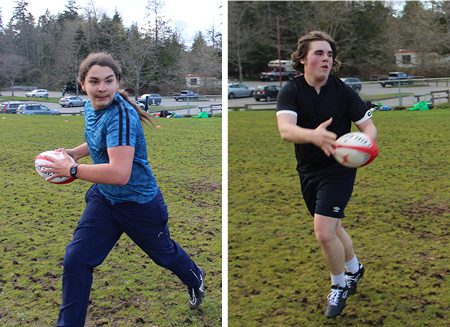
While ultimate promotes a more lighthearted approach to competition, the rugby scene at the high school provides a more traditional and rugged experience, seldom encountered by students at GISS. Head coach and teacher Douglas Clayton, who has a lot of experience in rugby, once worked at a prestigous rugby school in New Zealand. Clayton believes that the sport can become a cornerstone for GISS.

Raazi, left, and Kyrus, practice rugby skills at GISS. (Ryan Massey photos)

“It’s been a sport that has been denied to the kids of the Gulf Islands for too long. I used to work at one of the fanciest rugby schools in the world, Auckland Grammar in New Zealand, and when it was time for a home game, there were swarms of people waiting outside, always there to support the boys. It’s such a fun sport to watch live, with the kind of atmosphere you’d find in a movie, so I think there is a lot of potential for community involvement.” 

Despite the encouraging environment in New Zealand, starting the rugby program hasn’t come easily for coach Clayton, as equipment shortages and a complete lack of experience among players who  signed up meant the team had to start almost from scratch. But for Clayton, those challenges have only added fuel to the fire and helped strengthen his long-term vision for the sport at the school. 

“It’s been fun watching people learn completely new things,” he said. 

Beyond the addition of the physical game, Clayton sees rugby as a potential answer to a broader issue found in the school’s athletic offerings, especially the barrier for boys during the spring season.

“Boys have holes in athletics in the springtime, considering how soccer, volleyball and basketball are played in the winter. Unless you want to golf or sail, rugby is the perfect opportunity for a team sport. I don’t see how it couldn’t grow,” Clayton explained. 

He believes that rugby could become “a potentially community-unifying spring sport,  especially — but not limited to — for boys,” finally patching that hole in the schedule.  

Grade 9 player Cohen McArthur, another multi-sport athlete, has found the challenge of rugby rewarding as the team builds itself up. 

“My favourite part is that you can kick the ball a lot,” he said.

It’s clear that both programs emphasize inclusivity and their coaches share the same hope that these sports will become long-term fixtures at GISS. While ultimate offers a welcoming, laid-back environment, rugby hopes to bring back the intensity and grit missing at the school and across the island after being congested by the more “chill sports” like soccer and volleyball. It’s exciting to finally add some new flavours to the athletic diets of the students.

Whether you want something fun or fierce, there’s now something new and fresh waiting on the field. With both programs growing, this could be just the beginning of many more sporting opportunities at Gulf Islands Secondary School.