Home Blog Page 69

Garden club plant sale on this weekend

SUBMITTED BY SSI GARDEN CLUB

The Salt Spring Island Garden Club’s annual Spring Plant Sale is on Saturday, April 26 at the Farmers’ Institute, offering hundreds of plants propagated by the club’s members for sale at bargain prices.

This year, you will find a large array of both ornamental and edible plants. Ornamentals include irises, poppies, daylily, hardy geraniums, phlox, leopard’s bane, roses, violets, ajuga, Shasta daisy, wooly lambs ears, sedums and much more. Some of the edibles include fruits such as jostaberry, raspberry and strawberries, as well as some veggie starts. New this year is a table devoted to native plants, which will include sea thrift, kinnickinnick, goldenrod, salal, huckleberry, blue-eyed grass and more.

Chorus Frog Nursery operators will also be there, offering quality starts of vegetables, herbs and flowers. Additional vendors include Idle Wilde Nursery selling permaculture plants and more. Fawn Lily Nursery will sell native plants such as shooting star. Nigel Kay will have permaculture plants and Charley Miller will also be set up with starts.

The sale runs from 1 to 3 p.m. People should bring boxes to put their plants in, and a few extra boxes, if they can, for someone else to use. Payment is by cash or credit card.

MLA’s comments on Islands Trust not appreciated

By Mairead Boland, Saturna Island Local Trustee,

Lee Middleton, Saturna Island Local Trustee,

Paul Brent,  Southern Gulf Islands Electoral Area Director (CRD) and former Saturna Island Local Trustee

This is a response to MLA Rob Botterell’s April 2 column regarding the Islands Trust.

From the Islands Trust Act:

“The object of the trust is to preserve and protect the trust area and its unique amenities and environment for the benefit of the residents of the trust area.”

Botterell’s article suggests that trustees have chosen to re-interpret the mandate (this is correct), and that their interpretation doesn’t accord with his assessment of the law.

We are confident that the original mandate to preserve and protect the Trust is still functioning. Islands Trust staff or trustees would have been able to inform Botterell that more than five legal opinions sought by the Trust on this topic over the past decades disagree with his. Those legal opinions, repeatedly, and clearly, give trustees the responsibility of interpreting the wording of the mandate.

While the definition of “unique amenities” has been debated it has never been defined as “the environment.” Were it simply the environment that was the purpose of the mandate, the original crafters would have written it so. The Islands Trust Act explicitly refers to “unique amenities AND the environment.”

We can assure readers that unique amenities have always included many different characteristics of the Trust area including community centres, recycle depots, food banks, service clubs, community gardens, volunteer fire and ambulance services and, most importantly, a collective spirit of caring for one’s neighbours in any time of crisis.

As is proper in the context of reviewing the Trust Policy Statement, Trust Council (TC) once again reflected on the mandate and all of the legal opinions. The view of TC is once again that unique amenities are broad-ranging and may include aspects such as, but not limited to, housing, livelihoods, infrastructure and tourism.

A summary of the discussion and conclusions can be found in the Islands Trust Council Statement on the Scope and Meaning of Section 3 of the Islands Trust Act (Object Clause) posted on the islandstrust.bc.ca website on Jan. 18, 2024.

As to the inference that discussions about unique amenities in camera were somehow nefarious, it is simply the recognition that there were legal opinions that are privileged, and there to inform the trustees of the day, just as in previous terms.

MLA Botterell stated “Development and population growth in the Islands Trust area is not inevitable; it is a choice.” Indeed, and the communities of the islands made such informed choices when they agreed to the social contracts contained in each island’s official community plan and bylaws. For each island there is an implicit growth limit defined by the land use designation maps taken together with the subdivision and development regulations. This limit cannot change without full community consultation — and the processes that govern this consultation are clear. Extensive and transparent consultation occurs each and every time a bylaw amendment or subdivision is proposed.

Has there been election fraud? MLA Botterell suggests that trustees do not have an electoral mandate to review the Islands Trust Policy Statement. Several trustees in this term were elected in November 2022 as a direct, negative response to an initial draft of the Trust Policy Statement (July 2021) and to replace some of those trustees who were involved in its creation. Surely this is democracy at work?

Since that time, the amendments and engagement sessions with residents, First Nations and local governments have been extensive. To suggest that they’ve been inadequate demonstrates either lack of familiarity with the process or a disagreement with the content.

MLA Botterell notes that “last year Islands Trust Council asked the B.C. government to conduct an open-ended review of the Islands Trust Act.” Minister Nathan Cullen said at the time that a request for such a review would have to be made by TC, and TC obliged in that same term — as well as in this term, so twice now. The review was to address far more than the Islands Trust Act. Topics included the involvement of Indigenous peoples, funding for the Trust, and its structure and authority. (See Oct. 17, 2024 Islands Trust Requests Provincial Review of Islands Trust Act website post.)

Since two Trust Councils covering eight years have asked for a review by the province, one would think it is high time for some action, particularly in light of the external and highly critical report on the Islands Trust conducted by Great Northern consultants in February of 2022.

Instead, our MLA is publicly suggesting a delay of the review to yet another (third) term, noting in his opinion there are more pressing issues for the Premier and Cabinet to attend to. Clearly the Premier and Cabinet wouldn’t be doing the review, a contracted third party would be investigating the workings of the Trust, providing options for revisions to the act, different governance structures and even clarifying the mandate.

Having a look at options to improve the workings of the Trust was what the majority of two terms of trustees were lobbying hard to get, but it appears not what our newly minted MLA wants.

We appreciate differing opinions, but not from an elected representative who publicly advocates a position contrary to the democratically informed wishes of trustees elected in the same area he represents and who publicly questions the basis in law of their decisions without an examination of the particulars.

The writers have a collective 22 years of “trustee experience” spanning the last 13 years.

Federal candidates gather at Fulford 

0

For a floor hockey venue, Salt Spring’s Fulford Hall felt a lot like home ice for MP Elizabeth May, who entered to a burst of applause even before the island’s all-candidates’ event began Tuesday, April 15. 

Joining the Green Party incumbent onstage were challengers David Beckham, a former farmer and environmental tech innovator who hopes to add the Saanich-Gulf Islands seat to the Liberals’ national tally; and Colin Plant, a schoolteacher, Saanich councilor and former Capital Regional District board chair looking to grow local enthusiasm for his run as a New Democrat.   

Absent was Conservative Party candidate Cathie Ounsted, to the voiced dismay of several members of the public who said they’d hoped to hear from all four running for a seat in the riding; a mid-morning email from Ounsted’s staff on the day of the event informed organizers she had decided against participating, citing nonspecific concerns over “smartphone debate footage [which] was selectively edited and shared on social media.” 

Those who did attend were rewarded with a robust, respectful exchange that covered candidates’ policies and plans, ranging from healthcare and proportional representation to the climate emergency and international relations. Those last were clearly weighing as heavily on the minds of community members, as they lined up to ask questions often related to mounting tensions with the U.S.  

One islander asked about candidates’ plans regarding the pilotage waivers Canada grants to allow American oil tanker vessels to transit the Inside Passage to Alaska. Setting aside clear environmental concerns for our waterways, May said, the answer for those waivers was easy: revoke them. 

“We do it as a favour to the United States,” May said. “We receive no benefit, not even an economic one, and just take on the risk as a favour to ‘our good neighbours to the south.’” 

Beckham agreed, saying while he wasn’t sure the best path toward less oil tanker traffic on the West Coast, the current situation wasn’t in Canada’s best interest — particularly given growing conflict with the U.S.  

“Right at this moment, we don’t really owe them anything,” agreed Beckham. “We should be getting any tankers that are carrying dangerous materials out of ecologically sensitive waters.” 

Much of the conversation predictably led to national Liberal Party leader Prime Minister Mark Carney, particularly whether voters on Salt Spring — where May and the Greens have long enjoyed reliable support — should be “strategically” voting for the local Liberal if they wanted to help Carney’s chances to remain PM.  

Beckham emphasized the closeness of the race and the high consequence of the election itself, and said one of his main goals in running was to bring the riding into what he hoped would be the majority government. 

“I believe in democracy,” said Beckham. “This is a tight election — the numbers are tight, it’s getting closer. Is there a possibility that this riding might end up being a swing riding? Anything is possible.” 

May disagreed that the national seat count was that close, and sought to contrast Beckham’s relative influence on the Liberal Party with what she called her own “outsized” voice in Parliament, pointing to her legislative record and relationships built across party lines —and recounting a phone conversation she had with Carney “the day the writ dropped,” where she recommended extending the all-party-inclusive “Team Canada” approach for dealing with U.S. trade pressures.  

“I work well with others,” said May. “I like finding solutions and working constructively with people. And if you give me a chance as your Member of Parliament, I’ll have more access to Mark Carney than any Liberal backbencher ever would.” 

With perhaps some irony, given Ounsted’s decision not to attend, the discussion landed briefly on candidates’ concerns over social media misinformation, even while many in the arguably older-leaning crowd stressed the importance of reaching young voters.  

Responding to a community member’s question, Plant — acknowledging his comments might make him sound older than he was (“Kids used to play outside,” he jokingly rasped) — said that in his school, he had seen first-hand how social media had led to greater anxiety and fear, particularly among youth. 

“Social media is both wonderful and horrible,” said Plant. “Wonderful because I see my friend from my high school grad class I haven’t seen in 25 years, but these companies do not have the right to promote hatred.” 

Beckham said he felt social media had become an “open sewer” of extremist language and misinformation; noting unspecified “underhanded tactics” associated with the Conservative Party, Beckham said a serious national conversation was overdue. 

“There is a handful of tech companies run by billionaires who are controlling the conversation,” Beckham told attendees.  “Right now, they’re filling the zone with nonsense and disinformation, with propaganda and hate and rage and bitterness — and turning people against one another.” 

And May pointed directly to U.S.-owned Facebook, calling it a “publisher, not a platform” that refused to pay its fair share when profiting from Canadian-produced content. 

“We have let the predatory foreign social media corporations rip us off,” said May. “They get away with murder, they don’t pay taxes in our community. And on top of that they run algorithms to create rage farming to further divide our societies.” 

A video of the event is here.

Election day is Monday, April 28, with advance polls running April 18-21.

Salt Spring Island federal election candidates meeting video

0

Three of four candidates in the Saanich-Gulf Islands election race met with a full house at Fulford Community Hall on Salt Spring Island on Tuesday, April 15, providing opening and closing statements and answering questions from audience members.

Incumbent Green MP Elizabeth May, David Beckham of the Liberals and Colin Plant of the NDP attended. Conservative candidate Cathie Ounsted sent notice to the Driftwood on Tuesday morning that she would not be attending.

“This choice comes after careful consideration. In recent elections, some Conservative candidates who stepped forward to serve their communities experienced situations where smartphone debate footage was selectively edited and shared on social media, creating impressions that didn’t accurately represent their positions or character.”

The previous day at an all-candidates event at Berwick Royal Oak, May and Ounsted had an exchange that was reported by CHEK News yesterday.

The Salt Spring event was co-sponsored by the Salt Spring Forum and the Gulf Islands Driftwood newspaper, and the video created by Living Water Media Services.

Biochar expert at April 23 club meeting

Submitted by the SSI GARDEN CLUB

The next Salt Spring Island Garden Club speaker is Georg Janssen with a presentation called The Wonders of Biochar.

The meeting will be held at Meaden Hall on Wednesday, April 23 from 6:45 to 9 p.m.

Biochar, a long-lasting soil amendment, elevates the quality of soil by enhancing aeration and water-holding capacity. We are pleased to have Janssen share the benefits of biochar at our April meeting. In this presentation, you can learn how to use biochar to take your soil health to new heights.

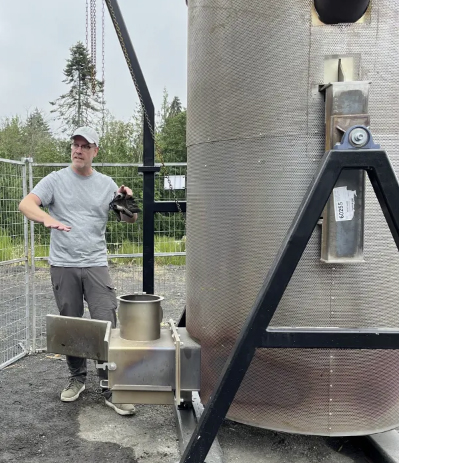
The potential importance of biochar was recognized when anthropologists discovered dark, highly-fertile soils scattered throughout the Amazon rain forest. It is speculated that over 2500 years ago, Indigenous peoples living in the Amazon produced the fertile soils referred to as the Amazonian Dark Earths by adding charcoal, a form of biochar, along with other organic residues to the soil. Today, biochar is being created in backyard pits and in biochar kilns, where organic material is heated in an environment that is devoid of oxygen.

Janssen started to think about biochar when he learned how much carbon was released into the atmosphere from slash pile burning in BC’s logging industry. With a background in Physics, Janssen knew that pyrolysis created a carbon-rich material from wood residues.

Janssen launched Preterra BioCarbon Solutions after moving to Salt Spring in 2021. Using a biochar kiln, Janssen is transforming Salt Spring wood residues into a valuable resource.

You can visit his website at preterra.ca.

Newcomers are welcome to attend the April 23 event. An annual membership is $25. Non-members pay $5 at the door.

Federal candidates Q&A

0


The Driftwood posed three questions to the four candidates in the Saanich-Gulf Islands riding federal election race. Their written answers are below; see next week’s Driftwood for a report from the April 15 all-candidates debate at Fulford Hall, and later this week on this website for a link to the video of that event, co-sponsored by the Driftwood and the Salt Spring Forum.

DAVID BECKHAM

Liberal Party of Canada 

davidbeckhamliberal.ca

Q. How does your party propose to help Canadians weather the threat to Canada’s economy and sovereignty posed by the current U.S. administration? 

A. A Mark Carney-led Liberal government will stand strong against Donald Trump and help Canadians by cutting taxes for the middle class, making EI supports easier to access and using all Canadian tariff proceeds to support Canadian workers.  

We will do more than simply weather this storm. This is an opportunity to build the fastest-growing economy in the G7 by combining our now 13 separate economies into one single Canadian economic powerhouse. Among other actions, we will remove all federal internal trade barriers by Canada Day and invest $5 billion in a new Trade Diversification Corridor. Creating one Canadian economy will create higher paying jobs, improve affordability and strengthen our national security. This will more than offset the hit from Donald Trump’s unjustified tariffs. Expanding our economy by up to $200 billion a year is equivalent to a gain of $3,000 to $5,000 for every Canadian.  

Q. Please describe another policy or focus of your party that you feel is particularly important. 

A. I’m running to be part of the next Liberal government because I share Mark Carney’s belief that protecting the environment and growing the economy are not conflicting goals but are intertwined — a belief that underscores every plank in our platform. 

I have first-hand experience in this. My two environmental innovations — one in recycling toxic wastewater in the concrete industry, the other in designing building envelopes that use solar energy to generate electricity for their buildings — prove that environmental innovation can be the key to future economic growth. 

Q. Please describe two of your personal characteristics and/or experiences that you think will make you an exceptional MP for this riding. 

A. While I’ve lived in B.C. since 1995 and have been a resident of Sidney since 2012, I grew up working the family farm in Manitoba. As a farmer, I’ve had the privilege of sowing and harvesting crops for more than 40 years. This has done more to inform my character and worldview than any other single aspect of my life. I have loved farming with an almost spiritual passion, and I hold the farming community deep in my heart with profound respect and reverence.

I am a passionately patriotic Canadian and I am determined to fight for our sovereignty, our culture and our traditions, and I believe that every citizen — regardless of wealth or status — deserves a fair chance to succeed. As a member of Mark Carney’s government — sitting in the Liberal caucus — it would be the honour of my life to represent the people of this magical place we call home.

–––––––––––––––––––––––––––––––

CATHIE OUNSTED 

Conservative Party of Canada

votecathie.ca 

Q. How does your party propose to help Canadians weather the threat to Canada’s economy and sovereignty posed by the current U.S. administration? 

A. Our plan starts with an immediate response of reciprocal tariffs while supporting local businesses affected by these measures through our Keep Canadians Working Fund. These tariffs are unjustified, and I want to be clear — Canada will never be the 51st state.

After the election, we’ll propose accelerated CUSMA renegotiations with paused tariffs during talks. Throughout negotiations, we’ll fiercely protect our borders, resources, farmers, water and the local businesses impacted by tariffs. We’ll rebuild our military not because President Donald Trump demands it, but because it’s the right thing to do.

Long-term, we’ll strengthen our economy by cutting taxes, eliminating capital gains on Canadian investments and developing our resources. Building this economic fortress is how we truly protect Canadian sovereignty while ensuring prosperity for our communities here in Saanich-Gulf Islands and across Canada.

Q. Please describe another policy or focus of your party that you feel is particularly important.

A. If elected as your Conservative MP for Saanich-Gulf Islands, I’ll tackle our housing crisis head-on. I’ll fight to eliminate the GST on new homes up to $1.3 million, potentially saving homebuyers up to $65,000 per home.

I’ll work to reimburse municipalities for cutting development fees by 50 per cent, resulting in up to $50,000 in savings for new homebuyers. Combined with the GST removal, this could save homebuyers up to $115,000.

I’ll push to free up land and expedite permits to increase housing construction by 15 per cent annually. I’ll also advocate to release underused federal land and buildings for housing development right here in our community.

I understand the frustration of endless bureaucratic delays. I’ll work tirelessly to streamline approval processes so we can build more homes, faster. Saanich-Gulf Islands deserves affordable housing solutions, and I’ll deliver them.

Q. Please describe two of your personal characteristics and/or experiences that you think will make you an exceptional MP for this riding. 

A. First, my deep community roots and proven leadership. As a 35-year resident who has chaired the Victoria Airport Authority and served on the Central Saanich Police Board and Peninsula Co-op Board, I’ve dedicated decades to understanding and addressing our unique local challenges. This extensive community service demonstrates my commitment to putting local interests first.

Second, my financial expertise as a controller at a local accounting firm equips me with the practical skills to scrutinize government spending and ensure fiscal responsibility. I understand budgets, can identify waste and know how to make strategic investments that benefit our community rather than Ottawa bureaucrats. I work and live here alongside you, sharing your concerns about affordability, healthcare and environmental protection. I’ll bring both my leadership experience and financial acumen to Ottawa as your dedicated voice.

–––––––––––––––––––––––––––––––

ELIZABETH MAY 

Green Party of Canada

votemay.ca

Q. How does your party propose to help Canadians weather the threat to Canada’s economy and sovereignty posed by the current U.S. administration?

A. The Greens recognize that Canada’s economic and political independence must not be at the mercy of unpredictable or unstable foreign governments, even longstanding allies. Under the current U.S. administration, we’ve seen an alarming shift toward protectionism, disinformation and climate denial, all of which pose real risks to Canada’s sovereignty and economy.

To protect Canadians, we will strengthen domestic manufacturing — particularly in renewable energy technologies and essential supply chains — so we’re less reliant on U.S. imports. We also advocate for a just transition toward a green economy that includes investing in sustainable agriculture, clean tech and interprovincial trade. The Greens believe in economic resilience through ecological responsibility. We will also champion a foreign policy that is values-based, asserting Canada’s independence while nurturing global cooperation rooted in climate leadership and human rights.

Q. Please describe another policy or focus of your party that you feel is particularly important.

A. One of the Green Party’s most important priorities is electoral reform. Our democracy is suffering under a first-past-the-post system that often fails to reflect the will of voters. We believe in implementing proportional representation to ensure that every vote counts, no matter where you live. This ensures creating a government that works collaboratively and can effectively tackle long-term issues like the climate crisis, housing and healthcare. Without a truly representative system, bold action is continuously hampered by partisan gridlock. Real democracy is the foundation of real progress.

Q. Please describe two of your personal characteristics and/or experiences that you think will make you an exceptional MP for this riding.

A. First and foremost, I bring experience and unwavering commitment. As a co-leader of the Green Party and the first Green MP elected in Canada, I have a proven record of standing up for this riding and amplifying the voices of our communities on the national stage. I work tirelessly, across party lines, to get results — whether that’s protecting the Southern Gulf Islands from tanker and freighter traffic or advancing environmental legislation.

Secondly, I bring deep-rooted integrity. I don’t make decisions based on political gain; I make them based on what’s right. I have lived on Vancouver Island for over a decade and consider the well-being of this region personal. I listen, I show up and I act with the values of our communities at heart. My only loyalty is to the people I serve and the future we want to build together.

–––––––––––––––––––––––––––––––

COLIN PLANT 

New Democratic Party

colinplant.ndp.ca

Q. How does your party propose to help Canadians weather the threat to Canada’s economy and sovereignty posed by the current U.S. administration? 

A. This is the issue that I have heard the most on the doorsteps. Trump’s tariffs will mean job losses for  Canadians, higher prices for Americans and Canadians, and a weaker Canadian dollar. I am in it for working people and everyday families. 

New Democrats have laid out a plan for: Dollar-for-dollar retaliatory tariffs, cutting off the supply of critical minerals that the U.S. relies on. We would create a Jobs War Room that includes provinces, unions and business leaders so we can coordinate a sustained, well-organized, well-resourced outreach campaign to U.S. counterparts. We would implement a Build Canadian Buy Canadian strategy to build more of what we need here in Canada and prioritize products made by Canadian workers in public procurement. Instead of hoping trade with the United States will normalize, it’s time to build an economy that doesn’t rely on America. This includes investing in public infrastructure, building homes, hospitals, highways and bridges with Canadian materials, using Canadian workers. New Democrats would reform EI to ensure that all workers impacted by the trade war are taken care of. 

Q. Please describe another policy or focus of your party that you feel is particularly important. 

A. In a similar vein as the first question, the second issue I am hearing the most about in my conversations with neighbours is the rising cost of living. It is easy to blame Donald Trump’s trade war for rising costs, but this was a problem before he picked this fight. Corporate greed has been driving up the costs of everyday essentials for years. New Democrats will put a stop to that. We will take the GST off of essentials, including home heat, as well as placing a cap on grocery prices. We have committed to building 300,000 homes, we will work with provinces to implement rental caps and we will pay for this by eliminating the subsidies we pay to our already massively profitable oil and gas companies. 

Q. Please describe two of your personal characteristics and/or experiences that you think will make you an exceptional MP for this riding. 

A. It is hard for me to speak about myself. I think two things that have made me successful in local government are my optimism and my desire to listen. I don’t pretend to have all the solutions, or know all the issues. I am committed to hearing from the people who have put their faith in me, taking their issues to heart, and advocating for them. My experience as a Saanich councillor and with the Capital Regional District has also taught me a lot about how to get things done in a region governed by multiple bodies. 

Viewpoint: Help build resiliency in the NSSWD water system

By North Salt Spring Waterworks District Board of Trustees

On Salt Spring Island, water is our most precious natural resource. 

As the board overseeing the North Salt Spring Waterworks District (NSSWD), we have reached a significant moment in building the resiliency of our water system, which requires our ratepayers to support funding for a provincially mandated water treatment plant (WTP) at Maxwell Lake. After years of careful planning, designs have been developed, and a funding strategy has been prepared to keep costs under control. Now we are asking for your support for the most important component of our overall water-infrastructure plan: building the new WTP that will meet provincial standards for drinking water while enhancing our supply resiliency in the face of future climate change. 

Ballots were recently sent to property owners and we are seeking a positive vote for a loan approval of $11.7 million that ensures the plant is built on budget (as the St. Mary Lake plant was). The 20-year loan payments have been accounted for with parcel tax increases in 2023, 2024 and 2025 to gradually adjust impacts on ratepayers. The only projected additional cost to ratepayers will be a final $100 increase in the parcel tax in 2026. 

Our staff have developed a sound financial strategy to minimize the costs to ratepayers, including exploring all funding opportunities. A decision is pending on a grant application to the federal Canada Housing Infrastructure Funding (CHIF) program that would reduce the plant cost by $6 million, and we hope to hear about that application soon after the federal election concludes. If successful, that grant award will allow us to significantly reduce the parcel tax burden faced by ratepayers. 

It’s important to note that in addition to providing safe drinking water, the Maxwell Lake WTP will add considerable resiliency to the future water supply of the NSSWD system as a whole. When completed, we can combine the Maxwell Lake and St. Mary Lake distribution systems, allowing Maxwell to support the St. Mary side during the critical summer period, while St. Mary assists Maxwell refill during the winter period. In short, the new plant will add much-needed flexibility to our management of a reliable water supply in the decades to come. 

Please help us move this important project forward with a positive vote in the referendum. There are two opportunities to vote. The first is by advanced mail-in balloting between March 24 and May 6. The second is in-person voting on May 8, the day of the annual general meeting, between 2 and 6 p.m. at the Community Gospel Chapel.

Questions about the new plant can be answered in several ways, including by visiting our website (northsaltspringwaterworks.ca/projects), by emailing or by calling our district office (projects@nsswaterworks.ca or 250-537-9902). If you’d like to have a conversation in person, just drop by the office and one of our managers will be happy to discuss the proposed new plant with you.

LTC bars Harris from participating in meeting

0

As a Salt Spring trustee sought to take part in his sixth regular Local Trust Committee (LTC) meeting from off-island, that body voted to conduct its April business without him. 

A motion to waive the rules and allow trustee Jamie Harris to participate in LTC discussion and decisions on Thursday, April 10 failed — meaning Harris, who last attended in-person in July 2024, has now been officially “absent” from his first meeting as tallied under the Community Charter.  

Until this week, the other two trustees — LTC chair Tim Peterson and trustee Laura Patrick — have permitted Harris’ participation through a unanimous vote to waive attendance restrictions mandated by Salt Spring’s meeting procedures bylaw, which prohibits trustees from attending two consecutive regular LTC meetings remotely if the meetings are held in person.    

Since there was no meeting that August and an all-online meeting was called in October, the policy’s limits weren’t technically reached until the December meeting — the first time the other two trustees, attending in person, voted to waive the restriction.  And with no LTC meeting scheduled in January, the unanimous vote was repeated in February and March. 

But with no explanation forthcoming from Harris — concerning either his intentions or indeed his whereabouts — at least one trustee seems to have reached their limit. 

“While I am sympathetic to trustee Harris’ situation, we’ve already done this three times,” said Patrick. “And each time I’ve asked to hear trustee Harris’ plans.” 

In public Zoom meetings, Harris has said he lost his own living situation and was forced to move away, citing a potential threefold rent increase for “something comparable” on-island, but not elaborating further. Harris has not responded to repeated Driftwood requests for comment. 

“Our meeting procedure rules are here for a reason,” said Patrick, “and I think we as a Local Trust Committee, as well as the people of Salt Spring, need to know his plans going forward. With that, I’m hesitant to agree to waive the requirements today.” 

Peterson noted that procedurally, hearing from trustee Harris during the meeting absent a vote to allow his participation “seems irregular,” and Patrick agreed. Harris had attempted to join the meeting nearly an hour after it began, well after a public comment period that might have afforded him an opportunity. 

“I think he needs to formally communicate with us, and with the community, as to his plans going forward,” said Patrick.  

The unanimous vote failed; Peterson voted in favour, Patrick voted against, and the two trustees proceeded with the rest of the day’s agenda. While not participating, Harris remained online until the LTC went into an in-camera meeting for committee appointments. Staff confirmed Harris did not participate in that non-public session.  

Under Salt Spring’s meeting procedures bylaw, a trustee is deemed “present” at a regular meeting if they participate, either in-person or through electronic means.  

If a member is “absent” from four regularly scheduled meetings — or for 60 days, whichever is longer — they are disqualified under the Community Charter from holding office until the next general local election in 2026. 

After the meeting, Patrick told the Driftwood Harris had “indicated” to her he planned to be present at the next meeting in May. 

If Harris does not attend, and Salt Spring’s LTC holds its May 8, June 5 and July 10 meetings in-person — and if at least one trustee votes against a motion to waive the attendance restrictions during each — Harris’ disqualification could take effect upon failure of that July 10 vote.  

The Local Government Act states candidates must reside in B.C. at least six months before standing for election but is silent on residency requirements once elected. 

ICS memberships still not resolved

0

Some community members are concerned their applications for membership in one of Salt Spring’s most active charitable societies submitted last fall have still not been approved.  

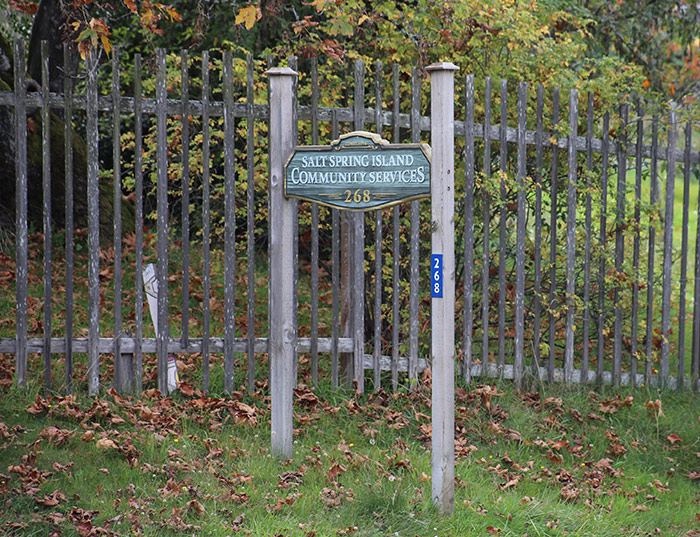
The Salt Spring and Southern Gulf Islands Community Services Society — more commonly known as Island Community Services (ICS) — received dozens of applications for membership in advance of its Nov. 14, 2024 annual general meeting held via Zoom, but its board decided to not accept any of them until they had taken time “to consider how they will handle the sudden wave of interest in the society,” said ICS operations and communications manager Rob Wiltzen at the time.

Prior to ICS bylaw revisions passed at a meeting in July and filed with the B.C. societies registry on Sept. 16, 2024, being a resident of the Southern Gulf Islands for at least six continuous months and at least 19 years of age were the only criteria for ICS membership. Revisions included a need for members to be accepted by the board of directors, which “may, in their sole discretion, accept or refuse an application for membership.” 

On Feb. 10, 2025, 17 people who had applied for membership signed a letter to the ICS board asking them to accept all membership applications, noting the length of time that had passed.

“We are concerned about your delay in processing our applications,” the letter states. “We request that you address this concern in compliance with your Bylaw 13 concerning board complaints: ‘Concerns or complaints received in any manner by the Board about any aspect of its functioning from employees, persons served or the general community must be duly reviewed, and acted upon in a timely manner in accordance with the Investigation and Discipline Policy.’

“We look forward to acceptance of all the member applications by Feb. 28, 2025 at the latest. Should an application be denied, please provide a detailed rationale.”

On March 6, the ICS board sent a letter addressed to all membership applicants.

“Please be advised that the board of directors of Island Community Services are continuing to process the many applications for membership that were received in late 2024. 

“The board has been engaged with a number of external consultations including board development and legal. A membership committee has been struck and is actively working on a response to the applications that is fair, objective and consistent. The matter deserves the utmost care in deliberation, to which we are committed. 

“We will be communicating at some point in the spring of 2025 with regard to an information session for applicants on the subject of the society and we look forward to your attendance. 

“We will update applicants as matters progress.” 

Elected Local Community Commission (LCC) member Gayle Baker said she applied for society membership and paid the requisite $1 fee on Sept. 18, 2024. 

“The only response concerning our applications to date from the board of Community Services has been to ask for our patience,” she said. “After seven months of waiting, my patience has worn very thin.”

Baker added: “Community Services has the opportunity to welcome an interested, hardworking group of islanders to learn more and help make this important organization ever better. Instead, they have chosen to continue to shut out its community, functioning instead in a closed, almost secret, system. I am saddened and disappointed by this unwelcoming and shortsighted choice. What will it take to put ‘community’ back into Community Services?”

“As a membership applicant, I also received an email indicating the ICS board is ‘working on it,’” said Capital Regional District director Gary Holman. “I don’t understand the problem. And it isn’t clear to me, now almost a year after the resignation of four board members, that ICS is taking community concerns seriously.”

When contacted by the Driftwood, ICS board chair Jennifer Lannan said the board had nothing to add beyond what was in the March 6 letter to applicants. 

“We have been, and will continue to be, in direct contact with membership applicants and they have been invited to communicate directly with us,” said Wiltzen. “We see no role for the media in our communication with them.”

‘High Ground’ hikers learn tsunami safety

0

In the event of a tsunami, according to officials, knowing where to go can make all the difference. 

And Salt Spring’s second annual High Ground Hike held Sunday, April 13 was a learning opportunity for islanders — to meet emergency personnel, learn about disaster preparedness and get an on-the-ground look at the tsunami hazard zone that covers most of low-lying Ganges.  

Local Capital Regional District emergency program coordinator John Wakefield said while the zone coveres much of downtown, the good news is that Salt Spring’s topography means islanders should be able to get to a safe area pretty quickly. 

“Because we’ve got a lot of vertical rise, you don’t have to go far here to get to higher ground,” said Wakefield. “But if we had a tsunami, you do not want to be standing in this area in town.” 

The day’s hike started at Fire Hall No. 1 in Ganges — inside the tsunami hazard zone — and ended at a tsunami-safe location: the island’s Emergency Operations Centre (EOC) at the Salt Spring Island Multi Space (SIMS) building, formerly the middle school. About a dozen islanders found they were able to cover the relatively short distance at a leisurely pace in just a few minutes. 

At the EOC, participants were able to see the “command and control” of Salt Spring’s emergency response — from amateur radio operations to satellite communications — coordinating collaboration with partner agencies during a crisis. While the public doesn’t tend to think about tsunamis as much as other potential emergencies like earthquakes, severe weather or wildfire, Wakefield said people should be ready to respond if one is imminent. 

“You could get alerts on your phone,” said Wakefield, who recommended islanders sign up for the public notification system through the Alertable app. “Or if you felt a sustained ground shake, it could very well be happening. At the waterfront, if you hear a jet engine sound coming from the water, or see the tide going out quite far quickly, that could be a tsunami.” 

Emergency management deputy Colin Medhurst invited the public to an upcoming emergency preparedness fair on Saturday, May 10 at the Ganges Fire Hall from 10 a.m. to 2 p.m.  

“We’re going to have a great group,” said Medhurst. “Ground search and rescue will be there, the radio club, our emergency support team, ambulance service, fire-rescue folks. It’ll be an opportunity to get good information to bolster your emergency plan.” 

The Capital Regional District’s Tsunami Information Portal and interactive hazard map are online at tsunami.prepareyourself.ca