Home Blog Page 76

Rufous hummers return on schedule

Salt Spring’s preeminent hummingbird fan and photographer Bruno Gonzalez recorded the first rufous hummingbird at his Langs Road home on Sunday, March 16 at 4 p.m.

That’s two days before what Gonzalez refers to as the “deadline” for the birds’ annual return — March 18 — which is also his birthday.

Unlike the year-round resident Anna’s hummingbird (Calypte anna), the rufous (Selasphorus rufus) migrates to Central America or Venezuela during the winter, leaving our region beginning in July.

According to a past submission to the Driftwood from Salt Spring Christmas Bird Count coordinator Tim Marchant, when the rufous return “they rely on early blooming shrubs like salmonberry, red-flowering currant and Salish plum at low elevation for fuel.”

Marchant also noted in that piece that the first Anna’s hummingbird was seen in the 1991 Christmas Bird Count on Salt Spring. For the 2024 event, 190 of the birds were counted.

Aleutian kayaking trip event to raise youth camp funds

A multimedia presentation and fundraiser at Lions Hall later this month will take people to the remote archipelago of the Aleutian Islands.  

The event called Kayaking Expedition in the Aleutian Peninsula will recount a two-month, 900-nautical-mile adventure undertaken by paddlers Jack Rosen and Brian Craig, who said they experienced “the wildest conditions one could ever imagine paddling in,” while witnessing “not only storm and gale-force winds and unrelenting rainstorms but the most spectacular scenery and wildlife. Rugged treeless landscapes, mountain glaciers that dipped into the ocean and rose thousands of metres eventually gave way to the lush green fjords of the Kenai Peninsula.”  

Wildlife seen on the trip included coastal brown bears (peninsula grizzlies), wolves, foxes, Steller sea lions, belugas, humpbacks, sea otters, murres, puffins and more. 

The presentation on Friday, March 28 from 7 to 9 p.m. is being offered as a fundraiser in honour of dear friend Alex Lyons, who lost his battle with cancer one year ago (and whose celebration of life was held on Sunday, March 9). An enthusiastic outdoors-person, Lyons signed up for kayak guide training after years of sending his son Arthur to Island Escapades/Coastal Current Adventures camps. 

“Alex was passionate in his role of outdoor educator and kayak guide and we valued him immensely,” said Rosen. 

All funds raised during the March 28 evening will be allocated to the Alex Lyons Memorial Camp Fund, which will provide financial help for youth to attend camps that emphasize wilderness skills, outdoor education, and the beauty and biodiversity of our natural world.  

Admission is $10, with larger donations gratefully accepted.  

Rosen adds that the special event is also a 35th anniversary celebration of providing wilderness programs and a renewal of Island Escapades/Coastal Current Adventures as it changes hands from Jack Rosen and Candace Snow to their son Jasper Snow Rosen and his partner Carissa Winter. 

Salish Sea course returns

A popular online environmental course presented by Transition Salt Spring is back for the sixth year, and open for registration now. 

Wonders of the Salish Sea is a four-week program designed to foster a deep connection to our uniquely biodiverse yet fragile ecosystem guided by scientists, naturalists and environmentalists. The course is for adults and youth and people of all learning levels. 

It runs for four Mondays from 7 to 9 p.m. March 31, April 7, 14 and 28.

The schedule is as follows:

March 31: Introducing the Salish Sea. From Estuaries to Ice Ages, Tide Flats to Tafoni: The Geological Intrigues of the Salish Sea Region — with Bob Turner, geoscientist, author and filmmaker. 

Plankton in the Salish Sea: The Tiny World Below — with Chandler Colahan, education coordinator, Padilla Bay National Estuarine Research Reserve.

April 7: Ecosystems: Deep to Shallow. Underwater Amazon of Puget Sound — with Parker McCready, professor of oceanography, University of Washington. 

Living on the Edge: How Life Thrives in the Intertidal — with Rebecca Hansen, researcher, Friday Harbor Labs and University of British Columbia.

April 14: Continually Swimming: Hope and Sharks. What’s So Funny About Fish, Love and Understanding? With Bob Friel, producer of Salish Sea Wild video series.

Salish Sea Successes and Tips for Staying Hopeful — with Ginny Broadhurst, director of the Salish Sea Institute.

Sharks and Ecosystem Interconnectivity — with Cara Poulsen, aquatic ecologist and Ocean Bridge ambassador.

April 28: Webs of Life. Herring — with Briony Penn, author and artist.

Juvenile Salmon — with Will Duguid, senior biologist, Pacific Salmon Foundation.

Life on the Rocks — with Kendra Luckow, eco-guardian, Race Rocks Ecological Reserve, and registered veterinary technologist. 

See the wondersofthesalishsea.com website for more information and to register. 

Cost is $30 for the series, with group discounts and subsidies available.

More than 1,000 people have taken the course, which is different each year, since its inception.

Salt Spring trustee elected to chair Islands Trust Council 

0

Salt Spring Island local trustee Laura Patrick has been elected by Islands Trust Council members to be that body’s new chair, replacing outgoing three-term chair Peter Luckham in a vote among elected trustees. 

The secret balloting was launched near the start of Trust Council’s three-day quarterly meeting that kicked off Tuesday, March 11. Patrick won a simple majority vote over Mayne Island trustee David Maude and Lasqueti Island’s Tim Peterson. Also nominated was Galiano Island trustee Ben Mabberley, but he declined to stand for election. The vote totals were not reported. 

Patrick was first elected to represent Salt Spring at the Islands Trust in 2018. On Tuesday, she thanked fellow trustees for the honour to be chosen as chair and “for their confidence.” 

“This is a team effort, and we have a wonderful team at this table –– and at this table,” said Patrick, gesturing in turn at trustees and at Islands Trust staff. “And together, let’s do some good stuff.” 

The Trust Council’s chair not only heads that body’s meetings but also those of the Islands Trust’s Executive Committee. In addition, the chair is typically the first-line spokesperson to the public and media.  

In remarks to fellow trustees before the vote, Patrick referenced recent challenges faced by the Islands Trust, including staff retention difficulties, a sense that the body was suffering under a negative public perception and the significance of its recent repeated effort for a wholesale governance and structure review by the B.C. government. 

“Trust has voted twice in recent years to ask the province to do a review; the province has, in turn, asked us to get our house in order,” said Patrick. “Someone must lead that effort. Let’s be clear, the longer we wait to take action, the more ineffective the Trust will become, the more wear and tear it will have on our staff, and the more eroded our public trust will become.” 

As the Trust Council’s official business began with its new chair, Patrick reminded trustees of promises they had made to fellow islanders in their oaths of office, and referenced recent trustee discussions surrounding civility and codes of conduct. 

“I know that some of the things that we’re going to be covering this week are going to be divisive,” said Patrick, noting an extensive agenda that included both the Trust’s strategic plan and its upcoming budget. “I need your help to make our discussions as focused and as productive as possible.” 

Luckham will continue to serve as a trustee for the Thetis Island Local Trust Area where he was first elected in 2005. He had chaired Trust Council since 2014. 

Islands Trust Council must acknowledge needs of working islanders


The following was adapted for print from a presentation given March 11 as part of the Trust Council quarterly meeting in Nanaimo. 

By ERIC MARCH 

When I first decided to get involved with local politics it was to run as a candidate in the May 2023 Local Community Commission election on Salt Spring Island. At that time I received the sage advice that “guys like us are the wrong age and wrong class to be getting involved in Salt Spring politics; the CRD and the Islands Trust only exist for wealthy retirees.”

While this person’s statement has stuck with me, it is not a unique sentiment. I have heard similar refrains from many, many working-class folks. Just in preparing for this presentation I heard from several people how talking to the Islands Trust is too difficult, a waste of time, and pointless. And who can blame people for feeling this way? 

First of all, almost all public engagement for the Islands Trust happens during the work day. It cost me $54 in lost wages to speak at a recent meeting of my Local Trust Committee and today my partner and I have had to give up $496 in combined wages in order to be here. Can you imagine charging someone a $50 fee to speak at a town hall or a $500 delegation fee? As if the cost wasn’t enough, since my partner and I both work, we are required to make difficult sacrifices to attend these meetings. We both have important tasks we should be doing today that we are not not able to do. Worse, not only are we workers but we are employees, so we need to justify our missed work to our employers. This time and wage cost doesn’t even include the time necessary for writing applications, outlines and the presentations themselves. 

The very nature of Islands Trust public engagement is exclusionary and therefore lacks a diversity of opinions. How can you expect to hear from the general public when some members of the public need to face egregious costs and make sacrifices to attend? 

Nowhere is this lack of diversity of opinions more clear than in the public engagement around the Trust Policy Statement. Since the statement of Sept. 26, 2023 where the Trust Council announced that they believed that unique amenities were “broad-ranging and may include issues such as, but not limited to, housing, livelihoods, infrastructure and tourism,” a handful of voices have been frequent attendees at Trust Council meetings to speak out against protection of housing and livelihoods. Meanwhile, the folks who need their housing and livelihoods protected are unable to attend due to the difficulties in attending these meetings. 

So let’s talk about the Trust Policy Statement. That statement from Sept. 26, 2023 was amazing. Finally, we heard a statement from the Islands Trust that recognized not only working-class livelihoods but the need to house them and build infrastructure to support them! A statement from the Islands Trust that recognized that the Trust Area, its unique amenities and its environment are three pieces of a whole! Unfortunately, such a statement cannot go unanswered, and so the same small number of voices have been showing up at Trust Council meetings to let us all know that no, the environment must come first, and adding any mention of protecting the workers of the Trust Area weakens environmental protections. 

When the Islands Trust was created in 1974, the largest threat to the Gulf Islands was, by far, overdevelopment. The Islands Trust stopped that, undoubtedly a good thing. However, in 2025, overdevelopment has to compete with climate change, drought and gentrification for the greatest threat to the Trust Area. Unfortunately, while I and many others see gentrification as the current greatest threat to the Trust Area, there are those that consistently weaponize the fear of overdevelopment against any attempt to build any sort of densification. Due to the unforgiving laws of supply and demand, the limited housing in the Gulf Islands has quickly spiralled out of the reach of even the hardest-working and hardest-saving workers. How can the Islands Trust claim to be protecting the Trust Area when working-class islanders, the folks who built these islands and provide the services needed to make them functioning communities, are struggling with unaffordable, unsustainable, unsuitable housing? 

The Islands Trust must make greater efforts to support all members of the Trust Area. The Trust Council and the Local Trust Committees must ensure delegations and town halls are accessible to all members of the public, and commit to reaching out to the public if they are not able to make sufficient strides in accessibility. More importantly, the Trust Council must recognize that the Trust Policy Statement must include protections for rural workers, rural livelihoods and housing. If the Islands Trust excludes protections for rural workers then the Islands Trust is simply facilitating the extirpation of the Gulf Islands worker in favour of gentrification. 

It is time for a balanced Trust Policy Statement that balances environmental protection with protections of housing and livelihoods for working-class residents of the Gulf Islands. 

Elizabeth May succeeds across party lines


By NANCY WIGEN 

In this time when our security and future are threatened, I heard someone say, “I’ve always voted Green, but now we need someone tough to protect us.”

Like who? Elizabeth May has been our MP for 14 years and she is the best, most hardworking, smart and effective representative we have ever had.

Elizabeth succeeds across party lines, working with respect and kindness together with other MPs who are doing good work for us. While in office she has got three private member’s bills (PMBs) passed into law on our behalf, while Pierre Poilievre, with more time in office, has not passed even one PMB.

The first PMB was to create a federal strategy to confront Lyme disease. The second prohibits keeping whales, dolphins and porpoises in captivity, and the third is a law to provide a strategy for environmental justice, which became law in June   2024.

In 2011, there was a lot of controversy about how MPs’ expenses were not made public. The big parties had all decided against revealing how they spent public dollars. It was assumed that as the only Green MP Elizabeth would not be able to make a difference, but she set up a website attached to her office and posted every expense for which she spent public dollars. Having been shamed by her good example, within a year every MP was required to submit every invoice and all their spending of tax dollars became public.

Another very important victory is the passing of Lindsey’s Law, which established a DNA data bank to register the DNA of missing persons and was initiated by previous MP Gary Lunn. Elizabeth and many others, including Indigenous leaders, got the law passed. By June 2024 the National Missing Persons Program had the DNA profiles of 2,500 missing persons, which has helped identify more than 90 people who were otherwise lost. Elizabeth has also brought millions of federal dollars for infrastructure into Saanich and the Gulf Islands. 

Also, she and past Green MLA Adam Olsen have worked hard to try to save our wild salmon from diseases from fish farms. That is still ongoing.

Any time I have raised an issue with our Green MP, or our Green MLA, I have gotten a personal reply, with information relevant to my concern, or thanking me for my advocacy, including for saving an important salmon-spawning site in the Fraser River from being turned into a gravel pit.

Elizabeth’s belief that “you can do anything you want if you don’t care who gets the credit” gets egos and partisan politics out of the way, so work gets done, but often those who don’t deserve it get the credit.  The news media tend to ignore all but the big parties so we don’t hear of what Green members do for us.

I’d like us to have proportional representation, with all MPs working together, but when Green policy is to work across party lines it comes to almost the same thing. I hope Elizabeth continues as our MP, and many more Green candidates are elected in the next election to give us a truly democratic government.

A positive, constructive, creative attitude bringing us all together in cooperation and unity makes Canada so much stronger than the division, fear and hatred sweeping the world right now. That’s why I support Elizabeth and the Green Party to lead the way.

Driftwood Editorial: Purse power 

0

Reading glasses have been more de rigueur than usual among island shoppers, as we peer into the fine-print origins of every purchase not wearing a prominent maple leaf.  

And as comfortable as the rest of the nation has been transitioning into a Buy Canadian mindset, it may have been even easier for islanders, long accustomed to the reality that “buying local” is the best way to mitigate the risk of a critical business not being there when it’s needed most.  

Local governments are shifting their buying habits as well, as their constituencies demand it; from Salt Spring’s fire district trustees to the Capital Regional District board, island representatives are looking at what procurement choices can be made to amplify the national effort. And as we were going to press on Monday, B.C. Premier David Eby was announcing the excommunication of all things U.S. from government-run liquor stores — concluding his statement with what has become a nationwide rallying cry of “Elbows up!” 

From fire trucks to beer, an overwhelming majority of these items will have a good “made in Canada” alternative (or, to paraphrase one staff member’s quip, “made anywhere but the U.S.”). Indeed, at the very local level, we are repeatedly delighted to discover the variety and quality of offerings available from our own islands.  

Again, as islanders know well, making buying decisions with values beyond the bottom line can be complex, time-consuming and more costly. While we should demand that discretion at a government level, it can be financially unreachable for individuals; we hope those with the privilege to do so exercise it as often as possible while withholding judgment on those who cannot.  

A protracted trade dispute across our southern border was as far beyond our imagination this time last year as paving on Ganges Hill actually happening was. But here we are, in both cases, and for now a bumpy ride is all but guaranteed.  

Things will, we hope, improve eventually. In the meantime, we say slowing down, watching for potholes (proverbial and otherwise) and exercising patience with one another will be the keys to navigating it all –– including with those trying to point a way through. 

Bach with Silverman ‘double-header’ on tap

SUBMITTED BY BACH ON THE ROCK MUSIC SOCIETY 

Salt Spring continues the Bach extravaganza with a much-anticipated “double-header” at ArtSpring theatre next Saturday and Sunday, March 22 and 23. 

A Night of Bach and Haydn: March 22 

Saturday evening’s performance features the Bach on the Rock choir and orchestra, under the direction of Jean-Sébastien Lévesque, with special guest, world-renowned Canadian pianist Robert Silverman. 

The concert will open at 7:30 p.m. with Joseph Haydn’s Symphony No. 80 in D minor, a striking piece composed in 1784. This symphony is one of the few later works by Haydn to begin in a minor key, giving it a bold and dramatic tone. With its highly structured movements, Symphony No. 80 demonstrates Haydn’s mastery in creating both emotional depth and musical complexity. 

Next, Silverman will be the piano soloist for Bach’s Concerto in D minor, BWV 1052, a powerful and virtuosic keyboard concerto. Originally composed for harpsichord and Baroque string orchestra, this concerto showcases Bach’s genius in balancing intricate counterpoint with elemental energy. The first and third movements are especially energetic, with themes that evoke the dramatic, lively spirit of Vivaldi. The middle Adagio movement, in contrast, offers a lyrical, deeply expressive moment. 

The evening will conclude with Bach’s Mass in A major, BWV 234. This beautiful work is part of a series of shorter “Lutheran masses” that Bach composed, designed for use in church services. The Mass in A major is filled with rich choral harmonies and expressive solo lines, offering a powerful experience for both performers and listeners. It has a clear, flowing structure, with each movement balancing choral and solo sections, and is noted for its elegance and reverence. To top it all off, there will be a concession at intermission including (Canadian) beverages. 

A Piano Recital: March 23 

On Sunday afternoon, Robert Silverman will take the stage once again, this time performing 18 of the preludes and fugues from Johann Sebastian Bach’s The Well-Tempered Clavier, Book I. This monumental collection of 24 prelude and fugue pairs is considered one of the greatest achievements in Western classical music. Composed in 1722, The Well-Tempered Clavier showcases Bach’s genius in creating music that is both complex and deeply satisfying. The preludes and fugues demonstrate his mastery of counterpoint, harmony and structure. Silverman brings a lifetime of experience to these works. This will be an unforgettable performance, which begins at 3 p.m. 

There will be a wine and cheese reception post-concert with a chance to meet and chat with Silverman.   

About Robert Silverman 

Robert Silverman is one of Canada’s most respected pianists, with a career spanning decades.  

Born in Montreal, he has performed around the world, earning acclaim for his recordings, including complete sets of Beethoven and Mozart’s piano sonatas. Now in his 80s, Silverman is still active and has made significant contributions to Canadian music. He is a member of the Order of Canada and is known for his devotion to the works of Bach, having recorded the entire Well-Tempered Clavier twice.  

His performance this March promises to be a highlight for music lovers. 

Whether you are a long-time fan of Bach’s works or a newcomer to classical music, these concerts are a perfect opportunity to experience some of the world’s most profound and beautiful music. The March 22 concert offers a mix of choir, orchestra and solo piano, while the March 23 performance focuses on the intricacy of Bach’s keyboard music. 

Do not miss these opportunities to hear one of Canada’s finest pianists perform Bach’s masterpieces in the intimate setting of ArtSpring. 

Tickets are available now through the ArtSpring website or at the box office.  Get tickets to both concerts and receive 10 per cent off the ticket price. 

Island residents earn King’s Coronation medals

0

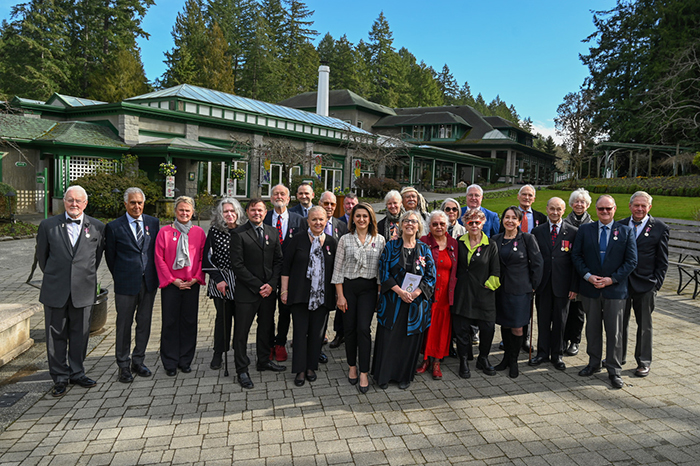
Four Salt Spring Island residents were among 25 in the Saanich-Gulf Islands constituency who received prestigious King Charles III Coronation Medals in a ceremony at Butchart Gardens on Feb. 27, with a fifth awarded through a different process.  

Robert Bateman, Jean Gelwicks, Valdy and Ronald Wright joined some 30,000 Canadians deemed to have “made a significant contribution to Canada or their community, or who have achieved excellence abroad that brings credit to the nation,” explained an announcement from the office of MP Elizabeth May.  

“This award is a symbol of gratitude for the exceptional service and contributions these individuals have made. It is well-deserved recognition of their outstanding efforts in strengthening our community,” said May. 

Medal recipients are nominated by the public, reviewed by a panel of local leaders and May, and approved by the Governor General of Canada. 

Filmmaker Christine Welsh, a longtime resident of Salt Spring Island, will receive a coronation medal from Les Femmes Michif Otipemisiwak (LFMO), the national Métis women’s organization.  

LFMO have awarded their allocated medals to “individuals who have demonstrated tireless and ongoing efforts to advance the well-being of Métis women, two-spirited individuals and gender-diverse kin.” 

Welsh said the ceremony will be held in Ottawa later this month but she is not able to travel at that time.  

Winners’ brief biographies  

Christine Welsh 

Welsh has been the writer and/or producer of a number of films, including Women in the Shadows (1991), Keepers of the Fire (1994), Kuper Island: Return to the Healing Circle (1997), The Story of the Coast Salish Knitters (2000), Finding Dawn (2006) and Lii Michif Niiyanaan: We Are Métis (2023).  

She has lectured and taught extensively, and published several articles on the historical and contemporary experiences of Métis women, and was associate professor in the department of Gender Studies at the University of Victoria until her recent retirement. 

Robert Bateman 

Bateman is a renowned Canadian artist and naturalist. After earning an honours geography degree from the University of Toronto, he taught high school for 20 years, including two in Nigeria. Bateman’s art has been exhibited in museums worldwide, the biggest of which was at the Smithsonian Museum in Washington, D.C. He has used his work to support conservation efforts. He has received numerous honours, including Officer of the Order of Canada and the Order of B.C., and authored many best-selling books.  

Jean Gelwicks 

Gelwicks has had a profound impact on Salt Spring Island. She founded and chaired a community coalition called Partners Creating Pathways, building a network of pedestrian and bike trails. She was the founder and heart and soul of the Stewards in Training program, where dozens of volunteer mentors lead kindergarten to Grade 8 school students in nature-focused learning experiences. An active contributor to the Salt Spring Island Conservancy and a founding member of Transition Salt Spring, Gelwicks is a volunteer with a passionate commitment to her community. 

Valdy 

Valdy (a.k.a. Paul Valdemar Horsdal) is a Canadian folksinger: a singer, songwriter, guitarist and relentless touring entertainer. Born in Ottawa, Ont., Valdy has earned two Juno Awards, four gold records, a SOCAN Song of the Year Award, and has been invested as a Member of the Order of Canada.  With a career span verging on six decades, he is known for captivating performances and impressive guitar playing. He remains an advocate for literacy and a supporter of Canadian Seniors’ Climate Action. 

Ronald Wright 

Wright is a Canadian author of history, fiction and essays published around the world in 18 languages. His Massey Lectures, A Short History of Progress, won the Libris Book of the Year Award, and like much of his work explored humanity’s past and future, civilization and sustainability. His other bestsellers include Stolen Continents, winner of the Gordon Montador Award, and Time Among the Maya. 

Five federal election candidates ready to roll

0

With Mark Carney becoming Canada’s prime minister-designate following his resounding Liberal Party leadership contest victory Sunday, a federal election is expected to be just around the corner. 

In the Saanich-Gulf Islands riding, a full raft of local candidates has emerged to try to unseat Green Party MP and party co-leader Elizabeth May, who was first elected to the riding in 2011. 

At press time Monday, May will face Liberal candidate David Beckham, Conservative candidate Cathie Ounsted, NDP candidate Colin Plant and People’s Party of Canada candidate Raymon Farmere. 

Ounsted was elected by riding association members on Feb. 22. According to a press release, Ounsted is a businesswoman, community volunteer and financial professional with Ounsted and Company. She is the first female candidate to stand for office with the Conservative party in Saanich-Gulf Islands since Marilyn Loveless ran for the Progressive Conservatives in the 1997 election. Ounsted was joined in the race by North Saanich councillor Jack McClintock and businessman Angus Ross. 

According to the Liberal Party of Canada website, Beckham was acclaimed as the local Liberal party candidate on March 5.  

Plant, a teacher, has been a Saanich Council member since 2014 and served as chair of the Capital Regional District Board. He was declared the NDP candidate in the spring of 2024.  

Candidate websites can be found at:  

• Conservative: Cathie Ounsted – saanichgulfislands.conservativeeda.ca/  

• Green: Elizabeth May – greenparty.ca/en/candidate/elizabeth-may 

• Liberal: David Beckham – liberal.ca/nomination-notices/acclamation-notice-saanich-gulf-island-2025/  

• NDP: Colin Plant – colinplant.ndp.ca/  

• PPC: Raymon Farmere – peoplespartyofcanada.ca/candidate/raymon-farmere