Driftwood staff are among those cheering a seeming end to the month-long postal strike that saw regular newspaper distribution operations disrupted.
It’s not that no sympathy is due to postal workers, whose wages and working conditions have been credibly described in media reports as wanting; or to the Crown corporation, for that matter, which continues to lose money.
It’s not that we didn’t like seeing many of our subscribers face-to-face in the Driftwood office. That part was most enjoyable, even if it made it a bit more challenging to get our regular work done.
But it also made us appreciate the sorting and delivery job done by our local post office workers. We’ve had enough of postal code juggling and gymnastics for awhile and are happy to hand the task back to the experts.
The Driftwood was just one of hundreds of local small businesses and organizations impacted by the strike at the worst-possible time of year. Many craftspeople, for example, had to seek alternate ways to ship goods to customers.
Nonprofit organizations that mount annual giving campaigns in November and December — encouraging donors to take advantage of the Dec. 31 deadline for donations to be tax receipt-eligible in the calendar year — were particularly impacted. Some members of the older generation, for whom annual donations are a natural part of civic and financial life, prefer to use cheques and the mail service to get their contributions where they need to go. They are understandably not comfortable with the various online options for giving, and short of visiting an organization’s offices during opening hours in-person, which is not convenient for everyone, no other option existed.
Hopefully with the mail-in option restored, people will remember to make their donations as soon as possible, as local charitable groups rely on that annual infusion to their budgets.
One more thing for people to remember is to pay their bills, even if paper reminders didn’t arrive in the mail in the past month.
Major Patricia Ann Lavender nee Traynor (Pat) passed away peacefully at Veterans Memorial Lodge in Victoria BC on December 3, 2024 at the age of 88.
Born April 20th 1936 to Bert and Ella Traynor in Kingsville Ontario. Graduated from Grace Hospital School of Nursing in Windsor 1957. Encouraged by her parents to “See the world” Pat joined the R.C.A.F in 1962 and was posted to Churchill Manitoba. Not the “World” she was expecting. Other postings included Marville France, NDMC Ottawa, CFB Gander Newfoundland, CFB Petawawa, Regional Headquarters Winnipeg where she was Matron in Chief for Western Canada and finally CFB Esquimalt in BC.
A highlight of her Military career was in 1970 being appointed the Canadian Nurse to accompany Queen Elizabeth, Prince Philip, Prince Charles and Princess Anne on their tour from Manitoba to the Northwest Territories.
In 1971 Pat married Major Keith D. Lavender the love of her life and became a Stepmother to four teenagers!
Pat took early retirement in 1985 so she and Keith could move to Salt Spring Island BC. Retirement included cruises to Antarctica and Alaska, year-round golfing between Salt Spring and trips to Arizona. With the occasional trip to a casino where Pat managed to stick to her twenty-dollar limit!
Patricia is survived by her sister Cathy (Pat) nieces Heather and Erin, great nieces Ella and Bryn. Step Sons Terry (Sharon) Lavender and David (Myra) Lavender and Grandsons Michael and Daniel, Brothers in Law Dennis (Helen) and Lyle Lavender. Predeceased by stepson Dennis Lavender, stepdaughter JoAnne Lavender and her loving husband Keith.
More than 130 years after its doors first opened, the St. Mary’s Church at Fulford is “pleasantly warm now,” thanks to a modern heat pump installed by Salt Spring’s Whirlwind Heating and Refrigeration.
According to churchwarden Simon Wheeler, the switch from an increasingly costly heating oil system to an efficient heat pump was recently completed.
The church, which hopes soon to once more house programs by the non-denominational Star of the Sea Centre for Spiritual Living and Practice, was consecrated in 1894 and the adjacent cemetery holds the graves of several members of well-known Salt Spring families.
The building faces additional challenges before opening, Wheeler said, such as a flood in the washroom that came in through a roof leak and an unreliable water supply. A fundraising campaign is being considered to address those issues, he said.
St. Mary’s Church in Fulford Harbour, part of the Anglican Parish of Salt Spring Island, which in recent years has also been known as the Star of the Sea Centre for Spiritual Living and Practice. (Simon Wheeler photo)
Salt Spring’s nonprofit community is keen to advise islanders that while the return of mail service might come too late for many Christmas parcels, there is still time to get in much-needed charitable donations before year’s end.
Mail carriers represented by the Canadian Union of Postal Workers (CUPW) who went on strike Friday, Nov. 15 returned to work on Dec. 17, notably heralding the return of languishing bills and print newspapers. But for nonprofits running annual end-of-year fundraising campaigns, it’s a race to reach donors who prefer traditional mailing to online transactions.
ArtSpring communications and donor engagement manager Kirsten Bolton said next to the Treasure Fair, ArtSpring’s Annual Appeal is the organization’s most important fundraising campaign –– and by the first week of December, donations were down 35 to 40 per cent compared to previous years. That led to a quick scramble for outreach alternatives, she added, including email lists and social media.
“Within a week, the push is seeing an influx of donations that is starting to make up the shortfall, which is encouraging,” said Bolton, noting ArtSpring’s final day before its holiday closure –– and the last day to physically drop off a cheque –– is Friday, Dec. 20, although several online avenues will remain open through the new year.
The Salt Spring Island Foundation has also encouraged people to drop off cheques at their office at 158A Fulford-Ganges Rd. by Dec. 20, recognizing that not everyone is comfortable with online donation methods.
Many nonprofits on Salt Spring have become creative in getting their messages out during the strike, including several efforts to transform traditional mail campaigns into in-person requests. Bolton said while ArtSpring had focused on pointing out ways people could skip the mail and give “remotely” –– including by phone, credit cards online, through CanadaHelps or via secure e-transfer –– those “ground game” campaigns were indicative of the needs island nonprofits have found unmet during the strike.
“I even had a surprise envelope from the wildlife rescue people tied to my fence today,” said Bolton, “with a green ribbon saying it was ‘hand-delivered.’”
A charitable donation tax credit can be claimed for donations made until Dec. 31 for the 2024 tax year, according to the Canada Revenue Agency, as can any unclaimed donations made in the last five years.
Having abandoned its moratorium on new hook-ups to its water supply system, the North Salt Spring Waterworks District (NSSWD) has announced big plans for changes to its system that could incorporate more than 1,000 new customers in the near future.
At an open house on Oct. 30, they presented a water master plan (WMP) that included estimates of what all the changes in hardware and infrastructure would cost their customers. The bills would not be paid via general tax increases because the enhancements would benefit only the customers of NSSWD, roughly half of the island population.
Enhancements and repairs are anticipated in several domains. First and foremost is the new Maxwell Lake water treatment plant plus the associated Clearwell reservoir and Shepherd Hills pumping station. The design has not yet been finalized, but it is certain to cost in excess of $10 million, not including land acquisition. Then there is the piping system to distribute all that water. Current pipes add up to 76.3 km, and large portions of the network are old and in need of repair or replacement. About 34 per cent of those pipes are antiquated asbestos cement.
Part of the WMP entails a flood of new connections of homes to the water system arising from 252 housing units (potentially 554 people) already promised water by NSSWD mainly on Channel Ridge, plus an anticipated potential increase in the population of Ganges by 660 units (about 1,320 people), and an unspecified growth of population beyond Ganges. Those customers would pay monthly fees for water consumed, but first there could be a need to pay for the added infrastructure to make the water flow. The WMP estimates that system capacity would need to increase by 22 per cent from the current 38.1 litres per second to 46.5 litres per second to support new connections for a population increase of 1,200 in the near future.
The original plans for the water system decades ago took no account of water that might be needed for fighting fires, assigning zero litres per second for fire flow. It is recommended that there be emergency water storage near the more heavily populated regions of the island for fighting fires equivalent to 25 per cent of the mean daily discharge for six hours and 60 litres per second for 1.4 hours for a single house (in Ganges only), which would require larger pipes in many neighbourhoods. There would also need to be a larger storage reservoir in Ganges plus pumps to boost line pressure. Low pressure that currently exists in 12 places in the system, including four places in Channel Ridge (pages 6-2 and 6-3 of the WMP) would need to be remedied. More rural portions of the system would continue to exist with no fire flow provisions.
The very preliminary budget for the Maxwell plant is currently $10.6 million. I estimate piping for 9.9 km of new water mains plus upgrading another 3.6 km would cost more than $2,000 per metre of pipe. Add up these improvements and additions to the system, and the total at the present time, would be about $46.3 million, without provisions for the seemingly inevitable cost overruns. This huge bill would need to be approved by a referendum and could need to be financed by borrowing at moderately high interest rates.
The WMP is an ambitious proposal that has not yet been presented to the people of Salt Spring Island for discussion and approval. It is the first system-wide plan for the entire NSSWD water supply. It is only an interim assessment of future needs because of impending changes to the official community plan and perhaps the mandate of the Islands Trust that could radically alter prospects for population growth here. It includes no provisions for building or servicing affordable housing. Neither does it address concerns of First Nations.
There’s been a lot of local consternation over BC Ferries (BCF) cancelling the ferry advisory committee (FAC) program in the 13 smaller communities across the system. While the recent news from BC Ferries management to axe and silence the FACs was not surprising, the truly disappointing part is that they didn’t have a plausible program to replace it. It was a knee-jerk reaction to those FACs that have been less than civil in the engagement process.
Over the last two decades, BCF has had “terms of reference” in dealing with the FACs. Tenure of the chairs has not been observed in some cases: “Members are expected to serve a term of four years, for a maximum of two consecutive terms. NOTE: a member can serve for greater than two terms under extenuating circumstances; however, they would be expected to only serve one year into the next term.” The idea was to adopt fresh ideas and approaches by electing a new chair from within every four years.
BCF felt they needed to approve members appointed to the committee. That instantly sends a red flag up the pole, when it comes to being biased. In other words, we would like to hear your constructive thoughts and opinions, but only from the people we approve of. The FAC chair and patrons on the Sunshine Coast increasingly became frustrated with BCF (they are not alone) and hostilities towards BCF unfortunately boiled over at a joint committee meeting.
Remember the outrage from patrons on Route 6 (Vesuvius Bay – Crofton) when everyone said, “Please be reasonable, don’t deploy the MV Quinitsa on Route 6?” This after concerned warnings from regular patrons and most importantly the commercial operators who provide our essential goods and services. What unfolded was an unmitigated disaster. BCF management refused to listen to their FAC and patrons, but more importantly the employees who were deployed on the service and live in our community.
Dec. 21, 2024 marks the third anniversary of “The Fix for Route Six” petition, 2,257 signatories strong, which is still active. It was encouraging to have the support and signatures of some FAC members over the last three years.
Where do we go from here? We feel the advocating and engagement process with BCF should come from the elected officials of the communities being served. In our case this means the Local Community Commission (LCC). If you don’t like the manner in which your commissioners address the issues with BCF, you have the opportunity to express your displeasure at the polls every four years.
Here’s the public request I am making on behalf of the 2,257 petitioners:
Dear chair Earl Rook, on behalf of the LCC, please consider advocating along with Mayor Rob Douglas and his North Cowichan Municipal Council in a joint communique to Premier David Eby and BCF CEO Nicolas Jimenez to restore the funding from service agreements 5 and 6 for the previous commitments to the infrastructure at Vesuvius Bay and Crofton terminals. Specifically, the 2019 approved design for Vesuvius Bay and Plan B, the preferred plan chosen by the residents of Crofton and the patrons of Route 6 for the Crofton terminal upgrade. Thank you!
Carols for Christmastide, the annual community carol sing held at All Saints by-the-Sea, and hosted by Music Makers of the Anglican Parish, this year falls on Wednesday, Dec. 18 at 2 p.m.
The popularity of this hour-long afternoon event may be due to both the start time, which allows for daylight driving, and the ambiance of candlelit intimacy, with the traditional sounds of the pipe organ in this acoustically excellent venue.
It also offers islanders the opportunity to take a break from the Christmas rush and enjoy time together over delicious Christmas fare, including traditional Christmas cake, mincemeat pies, mulled apple juice and more.
Accompanied by choir director David Storm at the piano and organ, All Saints’ choir will be leading the familiar carols, with soloists performing seasonal gems that bring Christmas straight to the heart. Soloists include the duos of Anke Smeele and Connie Holmes, Jennifer Ashley and Ellen Vesterdal, Deb Smith and Andrea Metzger, accompanied by John Metzger, flute, and soprano soloist Debbi Toole.
Admission is by cash donation with optional refreshments a suggested $5. All proceeds go to the Salt Spring Island food bank.
The Islands Trust’s Executive Committee (EC) is supporting one island’s small –– if arguably historic –– steps toward reconciliation within its own regulations, unanimously approving new language for Galiano Island’s Official Community Plan (OCP) that specifically addresses Indigenous-owned land.
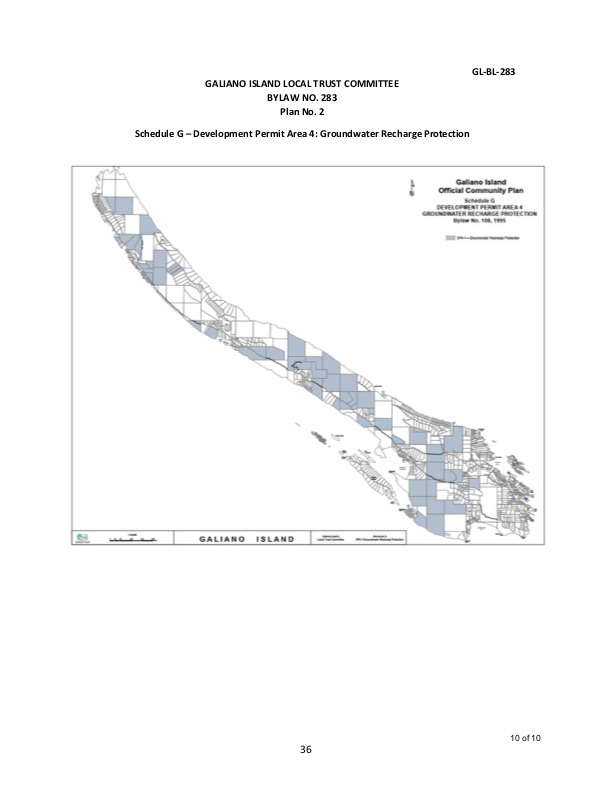
On its face, Galiano’s proposed Bylaw 283 is simply the latest amendment to the island’s OCP, updating groundwater policies and objectives –– including guidelines for developing land within “aquifer recharge” areas identified by the bylaw. Galiano’s LTC gave first reading of the bylaw back in March, ultimately approving it in November and sending it along to EC for its consideration Monday, Dec. 9.
The bylaw carves out a number of exceptions where the requirement for a development permit within some areas may not apply, including some “grandfathering” language for existing structures and their maintenance, farm operations, some limited tree removal and invasive species control. But uniquely, it also includes a qualified exemption for “land owned by a person with federal Indigenous status living in their traditional territory with proof of Indigenous family lineage.”
That last line has prompted significant comment from local islanders since it was introduced, ranging from concerns over the LTC overstepping its authority to notions of fairness and bald accusations of favouritism and self-interest. Some correspondence from residents worried a well-intentioned exception would encourage “selfish” development from individuals that might not serve Indigenous people in the collective –– the long tail of the Indian Act, one wrote, “hard at work to create division and oppress Indigenous people further.”
“I just want to recognize that there have been over 40 letters, every one of [which] has been against this, or suggested that the Executive Committee should not approve this bylaw,” said EC vice-chair Tobi Elliott. “I would just ask everyone for patience as we all adjust to new considerations –– that maybe should have been considerations 200 years ago.”
Galiano Island Local Trust Committee Bylaw 283 map showing DPA 4- Groundwater Recharge Protection areas in blue.
Another wrinkle noted by both letter-writers and staff: an exempt person could potentially sell their property after development.
“In terms of where we are, as part of a colonial governing system, I want to remind us that this may be seen as pushing the envelope,” said EC vice-chair Tim Peterson, adding that there could be some “synergy” between passing the bylaw and the Trust’s recent request to the province for governance review –– necessarily including aligning decision-making with the Declaration of the Rights of Indigenous Peoples Act.
“Is this the best way for Galiano LTC to advance reconciliation? Maybe, maybe not,” said Peterson. “But it is [a] piece of legislation that’s in front of the LTC that provides an opportunity to signal the intent.”
Both Galiano’s LTC and the broader Islands Trust have strong policy statements favouring reconciliation, which a legal opinion suggested might be part of a defence should a court challenge be sparked. According to the opinion requested by trustees, such action is a possibility, as granting exemptions based on the identity of a landowner might be outside the powers intended for local governments.
Noting that staff had nonetheless recommended supporting the bylaw as written, EC vice-chair David Maude said the relatively “nice, tidy and small” language might provide just the right opportunity for trustees to find their first footing for further Indigenous collaborations.
“I think that if we’re going to test the waters, this is the appropriate time,” said Maude, thanking staff and the LTC for the work put into developing the bylaw. “I cannot, in my mind, find a solid reason to vote against it.”
In joining fellow vice-chairs in support, Elliott said she had been moved after viewing the Islands Trust’s archived recording of a recent meeting where Penelakut Chief Pam Jack had addressed trustees, voicing support for the proposal.
“So thankful to technology for that,” she said. “It’s quite a bit different to hear the words from Penelakut Chief Pam Jack that were spoken, than it is to read –– and then weigh all these different considerations.”
Elliott said the word of a chief speaking on behalf of her community “carries a lot of weight,” and that her own support came after significant consideration of pros and cons, including concerns over precedent and whether it would raise expectations past the abilities of –– or authorities delegated to –– the Islands Trust.
“It was mentioned many times that Penelakut Tribe had not been consulted in the development of bylaws before, and this is the first time that they saw themselves in a document –– in an instrument that we are giving power to,” said Elliott. “So is this fair? I would say maybe no. But is the system fair? I would also say it isn’t.”
There were some operational concerns, such as how property owners would “prove” their Indigenous family lineage. When asked for clarification, staff told EC that while there could be legal consultation involved, such proof would generally be provided by the property owner, reviewed by staff and an exemption letter issued stating the information was sufficient to satisfy the exemption. That answer made it clear, trustees agreed, that they were likely leaving such interpretations to a future body of planners –– and possibly future trustees.
But, they also agreed, finding ways for Indigenous governing bodies to be in a position of inclusion in bylaws was important, if “tricky,” for local government everywhere.
“Even if it’s not [in] an appropriate place,” said Elliott, “that recognition alone, I believe, is going to support the Islands Trust as a whole in establishing and maintaining mutually respectful relationships between Indigenous and non-Indigenous peoples.”
“To me, it’s about doing the right thing,” said chair Peter Luckham. “I don’t want to stand in the way of that, and I am prepared to see how that unfolds.”
Peterson told attendees at Galiano’s LTC the following day the next step would be sending the bylaw to the province for ministry approval.
“And we’ll see how that all rolls out,” said Peterson.
If two points define a line, three may suggest a trend –– and on Salt Spring Island, one foundation’s latest analysis found the hourly wage needed to cover living expenses is yet again moving higher.
A spike in the region’s cost of living has pushed that number to $26.25 per hour, according to Salt Spring’s 2024 Living Wage report from the Salt Spring Island Foundation (SSIF) –– a 7.75 per cent increase from 2022 mostly driven by housing costs, according to the report.
The 2024 report is the latest from the foundation, which periodically crunches the numbers in cooperation with the Canadian Centre for Policy Alternatives and Living Wage BC. In 2022, the figure was $24.36 and in 2018 it was $20.95.
As in previous years, the wage figure is built from a set of assumptions around a hypothetical family on Salt Spring Island –– comprised of two adults working full-time, and two children aged four and seven.
The living wage is expected to cover basic expenses, including rental housing, food, transportation and –– with those two children –– childcare. That last expense is an increasingly difficult challenge among many, according to SSIF executive director Shannon Cowan, and despite financial relief provided by government measures like subsidies and income-tested benefits, it’s a race many island families are losing.
“There’s a substantial gap between the amount of available subsidized childcare spaces and the number of children needing care on Salt Spring,” said Cowan.
“Government childcare subsidies have greatly reduced the cost of care, but unfortunately for only a fraction of the families who have accessed those licensed care spots.”
The “shelter and communications” portion of costs has increased 36 per cent since the 2022 report, an equivalent of almost $900 more per month in rent for a suitable home for the hypothetical four-person family. That data has been gathered courtesy Salt Spring Solutions, the foundation said, which shared results from its recent Point in Time Housing Count surveys.
Some figures, like the cost of essential clothes for a family of four or a modest amount of parent education, were sourced from places like Statistics Canada and Camosun College. And for others, foundation researchers did what the hypothetical family of four might: they asked. For example, they gathered a variety of cell phone and internet quotes from providers that offer Salt Spring service –– and took the most affordable from each.
Even as B.C.’s current minimum wage has risen –– to $17.40 per hour –– the gap between it and the living wage has persisted, according to Anastasia French, provincial manager for Living Wage BC.
“Hundreds of thousands of B.C. workers earn less than the living wage,” said French, “and face impossible choices like buying groceries or heating the house, keeping up with bills or paying the rent on time.”
In a region where the cost of living keeps climbing, French said, racialized workers and women are disproportionately affected by low wages –– and for those not part of a family or group that can pool resources, it’s likely even more difficult.
“Some preliminary estimates we have produced suggest that the living wage may not be sufficient to support single parents and single people on Salt Spring Island,” said French. “In other communities this is not the case, and we want to explore this in more detail in the future.”
And the living wage, Cowan said, is just the basics –– a “decent but modest” standard of living without many of the extras we might take for granted.
“It does not cover credit card, loan or other debt payments,” said Cowan, “savings for retirement or for children’s future education –– or the costs of caring for a disabled, seriously ill or elderly family member.”