Home Blog Page 97

Drummond playground getting upgrade

0

A shoreline park on Salt Spring popular with island families is getting a modest facelift, as local officials approved a replacement play structure for the aging –– and unsafe –– playground equipment at Fulford’s Drummond Park. 

The parks and recreation department has been fielding community concerns about the state of the play structure at Drummond for some time, according to manager Dan Ovington, specifically regarding the cracked slide that has been closed for several years. 

Drummond Park sits on two one-acre lots fronting the water on Isabella Point Road, owned by the Fulford Community Hall Association (FCHA) and used extensively by the neighbourhood for children’s play and community events. Costs for operation and maintenance are borne by the Salt Spring Island Local Community Commission (LCC), whose members heard an update on the protracted permitting process as they approved the new structure. 

The park sits at a registered archeological site, and a process that began more than a year ago is now at a 30-day referral stage, after which responses from First Nations will need to be considered well before work begins. 

“There were some additional budget implications around having cultural monitors,” said Ovington, “bringing on archeologists to actually do the assessments and submit the permitting, which ate up a large portion of the initial construction budget.” 

Additional funding from the CRD has been budgeted, according to a staff report, and the regional district has already approved $50,000 in Community Works funds, which joins $10,000 in reserves and a $5,000 contribution from the FCHA to reach the proposal’s cost.   

A revision to the original plans included sourcing designs meant to minimize ground disturbance, Ovington said, and staff presented the LCC with a recommendation that fit with both the proposed footprint and the budget. 

Stein-inspired salon at ArtSpring

Can an audience expecting the unexpected still be surprised?  

If history and the calibre of talent involved are any judge, the upcoming Of Sound Minds production called Time for Gertrude Stein will answer with a resounding “yes.” Expressing their own art through the lens of Gertrude Stein’s poetry and presence, many of Salt Spring’s finest composers and performers have collaborated to deliver islanders a love letter to eclecticism –– and a celebration, 150 years after her birth, of a cultural revolutionary. 

“The collection is probably one of if not the weirdest projects I’ve been in,” said Salt Spring musician Brandon Bronson. “It’s not a type of music that there’s much opportunity to play; it’s brought a lot of excitement for me.” 

Bronson joins something of a who’s-who of Salt Spring performers, assembled for an evening organizers are calling “genre-defying.” Keen readers will recognize names from both the music and theatre scenes on the bill –– Kathryn Cernauskas, Don Conley, Leslie Corry, Gwenyth Dobie, Michelle Footz, Cicela Månsson, Christina Penhale, Mary Pickering, John Whitelaw and Tracie Whitelaw.  

Composers include Eve Beglarian, John Cage, Joi Freed-Garrod, Erik Satie, Virgil Thomson and Peter Hatch; Hatch credited Salt Spring’s “willingness to embrace the unexpected” as the driving force to help assemble such a fusion program.  

The evening will evoke the vibrant energy of Stein’s renowned salons, where she brought together cultural luminaries like Picasso, Braque, Hemingway and Sinclair Lewis. Cutting-edge works by 20th- and 21st-century composers combine elements like tabletop percussion, flute and electronics. Imagine Satie’s music for piano, mashed up with Stein’s poems. 

“It’s a very weird project, but this island’s full of weird projects,” said Hatch. “And you can do it here. Luckily the Salt Spring Island Foundation helped make it go, and everyone’s been super keen, enthusiastic and on board; people will have their expectations blown away.” 

Time for Gertrude Stein will run for a single night at ArtSpring –– 7:30 p.m. on Thursday, Dec. 5. For tickets visit artspring.ca or the box office.

Driftwood editorial: The Trust’s identity crisis

1

The Islands Trust’s re-request for the province to review its governance structure —as well as the mandate of the Trust –– has prompted endless second-guessing, from Trust committee meeting members to coffee shop patrons.

The vote to request that review was as close as these things can be (14 trustees in favour, 10 against) and that nearly even split perhaps said as much about the organization’s mission uncertainty as the letter itself. 

From questioning foundational Islands Trust Act language (what is “unique?” What is an “amenity?”) to reconciling how to engage meaningfully with First Nations even while lacking most of the tools necessary to do so, the current uncertainty feeds a particular brand of skepticism among islanders, exemplified perhaps by the increase in Freedom of Information requests.  

It leads to islanders questioning whether they are being heard, as seen in repeated letters and delegations that often seem to be hammering the same points again and again. 

And it doubtless contributes to the increasingly acrimonious meeting environment where splenetic outbursts threaten the thoughtful deliberations of the very islanders we sent to the Islands Trust to sort these things out. 

Meanwhile, Bowen Island –– part of the Islands Trust, and notably also a municipality –– is sending its mayor to December’s Trust Council meeting, a follow-up to a letter indicating that municipal council’s displeasure at not being consulted before the request for provincial review. Bowen’s council specifically called out the lack of a public strategic plan, and quoted the Trust itself: if “without systemic change, the Islands Trust cannot meet the challenges of [its] time,” Bowen does not support any direction of resources to engagement on the Trust’s policy statement “until these issues are resolved.” 

While none of the current issues are likely to be resolved at next week’s council meeting in Victoria, Trust leadership should make the most of having almost everyone in the same room, and welcome the perspective of Bowen Island Municipal Council as well, to try to find a more unified path forward.

HOBBS, John

7

 With heavy hearts, we announce the passing of John Hobbs, who left us peacefully in his sleep at Lady Minto Hospital after a courageous battle with cancer. Born in Vancouver, John was a beacon of kindness, humour, and generosity, leaving an indelible mark on everyone who knew him.

John devoted 30 years to the airline industry, beginning with CP Air and later transitioning to Air Canada, where he built a career filled with dedication and adventure. In retirement, his passion for travel and storytelling found new life as a guide sharing the beauty of Canada with visitors from around the world. A proud member of the Salt Spring Island community, John volunteered tirelessly, being an emergency POD leader for his neighbourhood and offering his time to the SSI Tourism Centre and Sendial, a Thrifty Foods shopping service for the elderly and shut-ins.

John was a beloved husband, a loving father and grandfather (aka Papa G), an avid member of the Paw Patrol and a cherished presence in the community. His warmth, humor, and quiet acts of kindness enriched the lives of everyone fortunate enough to cross his path.

He is survived by Roz, his loving wife of 54 years, his son Chris and his wife and children Catherine, Sila and Kai, his son David and his wife and children Farran, Declan and Parker, his daughter Michelle and his dog Sammy.

In honoring John’s memory, the family invites you to carry forward his selfless nature. Perform an act of kindness for a loved one or a neighbor—expecting nothing in return—just as John would have done for you.

Viewpoint: The ayes have it

0

By FIG MULDER

Over a year ago, during a visit to the local pool, I saw an image of the master plan for Portlock Park. Having a baseball diamond on-island sounded like a great idea! I said as much in the accompanying survey.

Now, fast forward to two weeks ago: I learned in casual conversation that approving the master plan for Portlock also meant building six pickleball courts between the swimming pool and the heronry. Since then, I’ve heard that I’m not the only one who missed this important part of the consultation process.

Salt Spring’s Local Community Commission (LCC) approved the master plan on Nov. 14, right after hearing from the Salt Spring Island Pickleball Association that they have serious concerns about the new location. Rainbow Road neighbours, too, voiced worries about noise.

An appendix to the meeting’s agenda presented the concerns gathered as part of the public consultation process, and many of them were about sound generated by pickleball. Yet the Capital Regional District (CRD)’s master plan responds to these concerns only with a vague promise of “sound buffering.” The LCC did not require a clear, research-based statement about how the sound will be buffered before approving the master plan unanimously.

I’d like to understand why the LCC is confident that whatever sound buffering is put in place here will work better than what has failed in many other communities. North Saanich recently closed its courts at Wain Road after nine years of noise complaints. It’s entirely possible that the CRD plans to implement different and much more effective sound buffering than was in place at Wain Road. I’d like to believe that, but so far, I’ve seen no sign that the CRD has a thoroughly researched, evidence-based plan on how to mitigate the sound.

I still support the baseball diamond, and I understand that placing it at Portlock Park means moving the pickleball courts elsewhere. I also acknowledge the argument of LCC member Brian Webster, as quoted in the Driftwood: “There’s a point at which we either make decisions knowing that not everyone will be 100 per cent satisfied –– and not every question can be fully answered today –– or we just have an endless consultation process going on for years and years.”

However, to my mind, the pickleball association and the neighbours (both the humans living adjacent and wildlife at the heronry) are more affected than anyone else by this shift in pickleball court location, and they’ve not had their concerns addressed by anything more than a vague promise.

Both the CRD and LCC represent our tax dollars at work. How can we as a community hold them accountable to provide evidence-based solutions for local concerns, before pushing through with plans rejected by some of the very people they’re meant to benefit?

Island Community Services responds to criticism 

0

By Rob Wiltzen, ICS operations and communications manager, AND

Jennifer Lannan, chairperson, ICS board of directors

Island Community Services (ICS) is compelled to address inaccuracies and misperceptions in the Nov. 20 Editor’s View piece headlined “With Community Services AGM in the books, it’s time to open up.”

The first states that for years, members have essentially only been the board of directors contributing to its image as a closed shop. It is untrue that only directors are members, and the closed shop comment may be the opinion of some but that does not make it “its image.” 

Some organizations have large memberships. Many social service organizations do not. In the end, a non-profit society exists for a specific purpose and is legally obligated to observe that first and foremost. With a call to shift ICS to a wide membership for the first time in 50 years, and with this call coming from individuals with personal interests and agendas, a thoughtful and careful review is required.

It is interesting to see that the Driftwood editor presumes to know what ICS board members and senior staff tell themselves about the reasons for being in the spotlight. This can, however, be traced largely to the Driftwood itself, as in the Oct. 16 headline “Island Community Services in the spotlight” with a two-page spread giving voice to accusations from toxic social media platforms as if they were credible and corroborated.

For the record, the “issues” originated with a director who resigned immediately following a bylaw revision proposal regarding conflict of interest, and who has since carried on a campaign to malign the agency and its leadership.

Moving on to the inaccuracies:

•  The executive director report was not just an abbreviated summary of the annual report but addressed board governance directly.

• There were no membership renewals accepted by past board members. 

• A director did not resign and then rejoin after being asked to return when others resigned. 

• Discussion at the AGM was not “prohibited.” It was restricted to members as described earlier in the piece and although the Driftwood seems to use the two terms interchangeably, they have quite different meanings. 

• With regard to the two individuals who claimed to have requested the link and not gotten it. One did not request it and the other was sent it along with all others who requested it.

• ICS has stated for clarity where its formal accountability relationships are but has never stated “not responsible to the rest of you.”  

The purpose of the editor resurfacing Adam Olsen comments characterized as “uttering some stinging words” has to be questioned, when the very same editor reported on Oct. 16: “Olsen recently told the Driftwood he is concerned that his words may have been expanded upon and some inferences made that he did not intend . . . .” 

ICS is a non-governmental, non-profit society (NGO) with a portion of revenue being public funds. This is different than a public organization such as the CRD and it is bizarre to make comparisons between the two. Elements such as governance, finances, decision making and accountability structures are fundamentally different. NGO societies secure public funds with specific conditions and budgets. Neither directors nor members decide where $8 million is spent in the way that the CRD determines expenditures.

The Driftwood editor criticizes the society by speculating that “the coping strategy at this point seems to be to climb into the bunker . . . .” This “bunker” reference seems to be with regard to muting non-member attendees to the AGM. ICS staff and board members have endured vitriolic assaults and personal attacks by individuals both grandstanding in public and on social media. Disrespectful treatment of staff and board members is not something to be tolerated. It is unfortunate consequences for the majority who were only seeking respectful dialogue about the services of the agency.

The dismissive nature and the minimization of concerns outlined by the editor in this article are noteworthy: “We all understand that ICS deals with vulnerable individuals that require special consideration and extreme discretion. We get that there’s a certain amount of interpersonal conflict and personnel matters that can’t be discussed publicly. We get that a ‘takeover’ of the society by angry people would not be a good thing; nor is the erosion of frontline staff or volunteer morale. But . . . .”

It seems the Driftwood doesn’t, in fact, get it. These are not details taking a back seat to the greater good. They are issues of the utmost importance to the agency and take priority above anything else, including the wish to feel included by some by being unmuted at the AGM or becoming a member of the society on demand.

The society is entering the 50th year of providing important social services to Salt Spring and the Southern Gulf Islands. If there are legitimate complaints about service delivery, then there are avenues to file complaints and have them investigated properly. The fact that the detractors are limiting themselves to social media, where anyone can say anything with no accountability or corroboration required, speaks volumes. The society invites anyone to engage in the processes available to them to file legitimate complaints in a proper and respectful manner.

We look forward to an open celebration of the 50th anniversary without the need to mute disrespectful grandstanding, and to focusing our attention on the important work at hand.


Nobody Asked Me But: Gluten-free logic and sanity in grocery prices

0

Way back in the ‘60s, there used to be a television game show called Supermarket Sweep. Contestants on the program were each given a shopping cart and assigned a short period of time to wheel through the studio set, which was designed to resemble a large supermarket, while they stuffed their buggies with as many groceries as they possibly could.

When the allotted time was up, a horn would sound and the items in the carts were tallied for a total value for each of the contestants. The winner was the one whose groceries had the greatest value and this lucky shopper was able to take the groceries home at no cost. Generally, the contestants who were the most successful on the show were the ones who spent most of their shopping time in the meat section of the store. The losers, inevitably, were the ones who filled up their carts with bags of puffed wheat.

In today’s harsh world of inflated prices, broken supply chains, and crop failures, it is quite possible that you could win the Supermarket Sweep contest with a few boxes of Rice Krispies. The snap, crackle and pop noises you hear might be the sounds your cashier’s card reader makes when it rejects your debit payment because of insufficient funds.

We are living in hard times. Nowhere is this more evident than when shopping for weekly groceries at the local supermarket. This may not be the Great Depression, but it sure is easy to find yourself greatly depressed. Here you are, trying to balance your budget, shop comparatively and intelligently, while at the same time looking to get the best bang for your buck, but you feel yourself being squeezed in every which direction by escalating prices for even your bare essential staples.

You can swear that even as you stand in the aisle staring at an item on the shelf, you can almost see its price rising. Not only that, but if you look carefully, you will notice that the size of the product is getting smaller. It’s called “shrinkflation” and the packaging is often designed so that you don’t realize that you are getting less. Sometimes the food container may be stretched taller while its width is narrowed or perhaps some optical illusion makes it appear as if your jar of honey has grown in size.

Nowhere is this more evident than in the purchase of coffee. It used to be sold in one-pound packages, which is equivalent to 454 grams. The packages have consistently shrunk to the point that you think you are getting a great deal until someone points out to you that the package contains only 300 grams. How long can it be before you will be buying coffee by the bean?

Similarly, the price of oil has been rising at an almost exponential rate. In particular, the effects of climate change are wreaking havoc on the cost and production of olive oil originating from the Mediterranean regions of the globe. It has gotten to the point where the leakage from a broken bottle of Terra Delyssa cold-pressed extra virgin organic olive oil dropped on the floor in aisle 7B will cause the same kind of mob fervour that the Exxon Valdez oil spill once did as shoppers rush over to soak up the precious viscous liquid with whatever absorbent materials they have handy.

As if that wasn’t bad enough, olive oil manufacturers have taken to selling their products in heirloom bottles, further driving up the price of the goopy liquid to over $70 a bottle. Purveyors of the finer oils market the product in hand-thrown stoneware jugs while Muraglia and Rosanna bottle their olive oil in containers so elegant that they will probably never be opened or taken down from the fireplace mantel.

Something similar can be said about commercial vinegars. You are probably familiar with the old faithful kinds such as rice, red wine, apple cider and balsamic, but there are literally hundreds of other very expensive varieties that are often infused with an assortment of exotic herbs and spices. AVW, for instance, markets a Hot Apple and Pear Cider vinegar which it describes with, “You taste the flavours in three sequential layers — smoke, savory and a little bit of lingering heat at the end.” Also at the extreme specialty end of the vinegar spectrum are Acid League Strawberry Rose, Tart Celery and Brightland Rapture Champagne. Not too shabby for fermented cider or wannabe hooch.

And then there’s gluten. Or, more correctly, gluten-free. Nowadays, almost every food product has a gluten-free option. You can probably buy a jar of pure gluten that has been rendered gluten- free. Don’t be surprised if what you end up with is a jarful of air.

You can also count on the certainty that any gluten-free item will be twice as expensive as the same thing containing gluten. Does that make any sense? Why are you paying more if they are leaving the gluten out? You are getting less so you should be paying less. An old-time Salt Springer and now expatriate, Bevan, used to joke that island potlucks had become so exclusively gluten-free that he was forced to carry a shaker of gluten around with him. You might say he was a gluten glutton.

Nobody asked me, but isn’t it about time that sanity made a return appearance in our grocery stores? It’s getting embarrassing asking for a price check at the cashier counter and then finding out that the prices are indeed really that high and you have to leave several items behind. Are you finding yourself slaloming your shopping cart, which is probably also shrinking, up and down the aisles a second time so you can return items you can no longer afford back onto the shelves from where they came?

I guess the only thing that will make it to the check-out is that big bag of puffed wheat. Gluten-free.

Maxwell Lake dam passes assessment

0

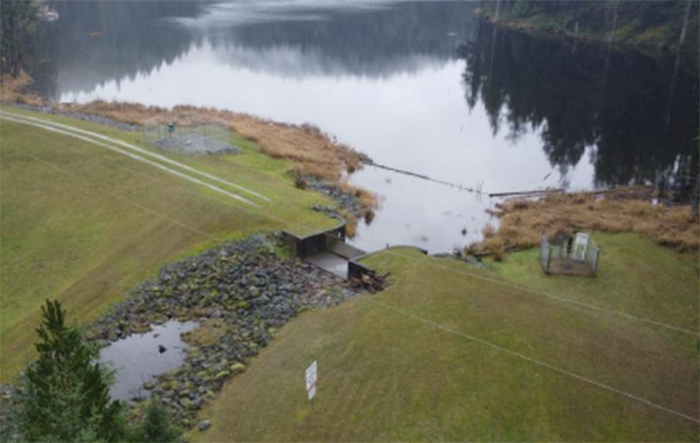
Despite sounding like faint praise, a report on the dam at the northeast finger of Maxwell Lake has indicated the dam is safe –– “reasonably,” according to consultants. 

“Given the downstream impacts [from failure], it triggered a dam safety review,” said North Salt Spring Waterworks District (NSSWD) operations manager Ryan Moray, who delivered the news to NSSWD trustees on Nov. 21. The dam had been recently reclassified as a “high-consequence dam” by B.C.’s dam safety program, which requires professional reviews every 10 years. 

“It’s quite detailed in nature,” Moray said of the 196-page report, “but it boils down to a handful of components we’re recommended to look at in the next three to five years.” 

Those include a closer examination of the structure of the dam, the installation of equipment to measure underground water pressure and the addition of some material along one section to avoid potential water “overtopping” during extreme weather events. 

“These are all minor in nature,” Moray said, “but they will come at a cost.” 

Within the report’s Dam Safety Review Assurance Statement, the consultant provided the district with formal assurance the dam was “Reasonably Safe,” a professional practice term meaning all normal dam safety management measures were being implemented –– as opposed to “Not Safe,” which would have indicated deficiencies requiring urgent action. 

“I’m happy to report the consultant said the dam is reasonably safe,” chuckled Moray. “Technically we need to do some things there, and I’m thinking a good time to address that is during our [water treatment] plant construction, when we have equipment on site. That could all come together nicely.” 

The Maxwell Lake water treatment plant project could be partly funded through grants under the new $6-billion Canada Housing Infrastructure Fund, Moray said he’d learned, noting its relationship with the expansion of drinking water availability. NSSWD trustees directed staff to apply for that funding support and continue investigating whether other projects within the district might be eligible. 

Fest flick brings forgotten musical star to life

BY STEVE MARTINDALE

For Salt Spring Film Festival Society

Once you hear Jackie Shane sing, you’ll never forget it. The Salt Spring Film Festival’s Best of the Fests series continues with an award-winning celebration of the remarkable life and mysterious disappearance of the enormously talented but largely forgotten African-American soul singer.

Co-presented by Gulf Islands Radio and the Salt Spring Jazz and Blues Society, Any Other Way: The Jackie Shane Story screens at ArtSpring on Wednesday, Dec. 4.

Shane shattered barriers with raw talent, courage and an unbreakable commitment to living as her authentic self in an era when voices like hers were typically silenced and marginalized. With an outsized stage presence that eclipsed even the greatest R&B artists, Shane blazed a dazzling trail from Nashville to Montreal to the top of the charts in 1960s Toronto, where she briefly ruled the nightclub scene before suddenly and inexplicably disappearing.

Through radiant state-of-the-art animation, never-before-heard recordings and an incredible soundtrack that seals her place as one of the greatest singers of the 20th century, the full scope of this transgender diva’s extraordinary life is revealed in an unforgettable portrait of a forgotten star miraculously brought back to life on the big screen.

Directed by Michael Mabbott and Lucah Rosenberg-Lee, Any Other Way: The Jackie Shane Story was named Best Documentary at the recent Edmonton International Film Festival, received a Special Jury Prize from the Directors Guild of Canada at Toronto’s Hot Docs and has won Audience Awards at film festivals in Nashville and Chicago.

The Best of the Fests series continues on Dec. 11 with the astonishing documentary Us, Our Pets and the War, featuring courageous Ukrainians risking their lives to evacuate abandoned animals from the war zone, co-presented by the Salt Spring Friends of Ukraine Committee and the BC SPCA.

All screenings in the Best of the Fests series are at ArtSpring on Wednesdays at 7:30 pm. Tickets are $14 each and are available online; in advance by phone (250-537-2102) or in person when the box office is open (Tuesday to Friday from 10 am to 2 pm); or at the door starting an hour before each film.

Photographic Perspectives Displayed at Library Art Show

0

Different Perspectives are indeed apparent in the photography exhibit of that name running in the Salt Spring Public Library program room through the month of December.

Photographers John de Bruyn and Stephen Morris produce thought-provoking and evocative images, and common themes and overlapping subject matter are apparent in some of their photographs. Nevertheless, the two have very different styles, presenting viewers with an erudite photographic conversation between two good friends.

The two artists’ biographies share many similarities. De Bruyn and Morris both grew up in Vancouver and have been friends since the mid-1970s. Both had successful careers as university physics professors, teaching and doing experimental physics research. Both did scientific research on pattern formation and fluid flow — among other things — and used photographic techniques to document and analyze their experimental results. Both retired a few years ago and moved back to their roots on the west coast – de Bruyn to Salt Spring Island and Morris to Vancouver. Both share a photographic fascination with pattern, texture and form. From that starting point, however, the perspectives diverge.

De Bruyn has been a photographer of some sort for most of his life and joined the Salt Spring Photography Club soon after moving to the island in 2021. His photographic interests are broad, ranging from capturing fine details with extreme close-ups to photographing the night sky. His work has been exhibited at several venues on Salt Spring and his photographs are in private collections in Canada and the United States.

“Living on Salt Spring, one can’t help but be drawn to the natural beauty that surrounds us,” he says.

His nature photographs, however, tend to the minimalistic – often highlighting shapes or small details, often black-and-white, often forcing the viewer to extrapolate the context of the image.

Over the last two years, De Bruyn has been photographing address signs all over Salt Spring Island. This project, entitled “Island Living,” poses questions about housing and attitudes on our island. Among the works included in this exhibit are several collages made up of many individual images of address signs. Each image is interesting in its own right, and the resulting collages are provocative and amusing.

Morris’ photographs come from both the natural world and table-top laboratory experiments. Drawing on his scientific research, he is intrigued by systems that evolve spontaneously into strikingly regular shapes and textures as a result of dynamic processes such as growing, folding, cracking or branching. Each of his images shows an object or process, sometimes quite small and often quite familiar, with a self-composed regular structure. His photographs are informed by the scientific aesthetic of nonlinear physics, and, he says, “Mathematics lurk behind every image.” No special knowledge is required to appreciate the beauty of the results, however. He has exhibited his “scientific folk art” photographs in galleries and outdoor art shows in Toronto and Vancouver.

Morris is also a co-founder of the ArtSci Salon, an art/science crossover group sponsored by the Fields Institute for Mathematical Science in Toronto. The salon has hosted many “mixer” events at which artists and scientists meet and share their perspectives. Morris has collaborated with composers to create large-scale multimedia musical pieces. He regards his artistic endeavours as a natural extension of his scientific work on pattern formation, as part of the same story.

Different Perspectives: Photographs by John de Bruyn and Stephen Morris will be on display in the library’s program room from Dec. 2 through Dec. 29 during normal library hours (10 a.m. to 5 p.m. Mondays through Fridays, and 10 a.m. to 3 p.m. on Saturdays). The public is invited to attend the opening reception on Tuesday, Dec. 3 from 6 to 8 p.m.

The photographers will also present a public talk about their work in the program room on Thursday, Dec. 5 at 3 p.m.