
Home Blog Page 98

GISS swimmers 9th in B.C.

By Brad Bunyan 

GISS Swim Team Coach 

Another year of swimming has come and gone for the Gulf Islands Secondary School (GISS) Scorpions, and once again, our little club in the islands found some excellent results at season’s end. 

Swim season begins early in September, often with first practices in the second week of school. While this is normal timing for most fall athletics, swimming has intensity: practices happen six times per week, twice before sunrise and all four days after school. We saw quite a nice resurgence in numbers this year, with 24 signing up to compete, including five international students and a large number of eighth graders. A huge shout-out to Zach Lundrie, Chelsea Harris and the staff at Rainbow Road pool for letting us have the space and time to train.  

Practices run seven weeks, and then it’s competition time. Oct. 20 saw the GISS team at the Vancouver Island Regional Meet in Nanaimo, for an extremely high-pressure event. There is a single race per event, and only the top five in the region qualify to move on –– often the entire competitive season takes less than 60 seconds. We had 16 qualify for provincials, many in relay squads and a goodly number swimming in individual events.  

Team captain Matthias Woodley led the way, qualifying in every event he swam in and earning a provincial berth in three individual events (breaststroke, butterfly and individual medley) and one relay. Not to be outdone, our longest wonder-twin team members Liam and Elyse Walsh also qualified in four events (Elyse in backstroke and three relays, Liam in four relays). Other qualifiers were Keegan Otsubo-Papp (backstroke and freestyle), Jack Jacquest (100m freestyle) and Pasley Hayden (backstroke and individual medley), and we had a representative team in every eligible relay race qualify for provincials. Not bad for a small school with a public rental pool! 

Nov. 15 was the first day of provincial races, with the top 32 swimmers in each event from all the regions gathered to race. The top eight swam for medals on Saturday, and the next eight swam for consolation team points. We had a slightly reduced team, losing four swimmers to various health and personal reasons, and our 12 competing swimmers hit the water with everything they had.  

Of our 15 events swum, nine qualifications for Saturday’s finals happened, and in the second-last race of the day for our team, our girls 4×50 freestyle relay put together their best combined swim and seized a surprise eighth place, to be given a chance to race for medals on Saturday. And despite a small “headware” malfunction, our girls mixed-medley relay held their positions and secured a top 10 finish.  

This was followed by a truly impressive feat, with Otsubo-Papp swimming in three races within an hour overall, and achieving some incredible results: 50m freestyle moving from 16th up to 13th, then 50m backstroke saw a 12th-place finish with a half-second improvement on Friday’s swim, and then the boys 4x100m relay saw the team move up from 12th to 10th for another top 10 finish, where Otsubo-Papp’s sub-minute 100m time saw him pass three other swimmers in the final 30 meters of the race. 

To compare, most swim club races and high-level events see swimmers in one race every several hours, sometimes one race per day, and the energy output from Otsubo-Papp was awe-inspiring to watch.  

Not to be outdone, the girls 4×100 relay finished atop their race for a ninth place provincially, and as a team they improved on Friday’s time by more than seven seconds (a long time in a sprint race), and on their qualifying time from regionals by just over 25 seconds (competition brought out the best in Elyse Walsh, Sashi Sanchez-Wickland, Kika Bayerova and Molly Magley in this one). Our most stacked and graduate-heavy relay (mixed medley) came up next, and swam to a hard-fought 10th-place finish, squeezing out three other teams within two seconds of them, in our race with both coaches (so much thanks to Zoe Sanchez-Wickland and Elyse Walsh for all the time and dedication they invested this year) and both of the highest-level boys (Otsubo-Papp and Woodley), as they swam to a hard-fought 10th-place finish removing two seconds from their Friday heat time. Had they just held the time, they would have finished 13th.  

The final two events of the day had Woodley in his individual medley race, having just qualified on Friday in 16th place, turn in an excellent swim and move up to 13th with a 1.5-second improvement, and in the only medal race of the day the girls’ freestyle relay held their eighth-place finish, taking two seconds off their time and closing to within seconds of the teams ahead.  

Our squad finished ninth overall in B.C., with the girls’ component — Bayerova, Elyse Walsh, Indigo Marshall, Magley, Zoe and Sashi Sanchez-Wickland — finishing eighth and the boys finishing 10th: Liam Walsh, Will Harder, Otsubo-Papp, Steffen Hendrik, Jacquest and Woodley.

With six graduates in the meet, we’ll be left with a very young team for the next few years, but the potential to climb even higher is certainly present here in the Gulf Islands.

Thank you to everyone who shared the pool with us, the parents who put up with the inhumane hours and especially to the kids who worked so hard. I truly hope they share the pride I have in their efforts and results, not just as athletes but as fantastic and humble people as well. See you next fall! 

BC Ferries to drop advisory committees

0

BC Ferries (BCF) announced Monday that it is abandoning the longstanding Ferry Advisory Committee (FAC) system of connecting with its communities in favour of more direct online engagement with the public.

The ferry corporation said in a press release that it is “launching a process to design a new engagement model that better addresses the evolving needs of growing coastal communities, reflecting the importance of more effectively incorporating digital engagement,” effective May 2025.

A lot has changed in the last 30-plus years since the FAC model was first created, and it’s time for us to have a look at our broader engagement process to make sure that it’s accessible, inclusive and representative of a broad range of input,” said Morningstar Pinto, executive director of external engagement, in the release.

Harold Swierenga, who has served on the Salt Spring Island Ferry Advisory Committee since 2006 and been its chair since 2007, said a meeting of FAC chairs had already been set for Monday morning, but no notice of the committee system being disbanded was provided.

“I was surprised with what they said today, but not totally shocked,” said Swierenga.

Some politicians had obviously been informed, however, as BC Ferries’ press release quotes Gibsons Mayor Silas White, Bowen Island Mayor Andrew Leonard and Klahoose Nation Chief Steven Brown.

“I am extremely encouraged that BC Ferries is listening to ferry-dependent communities that their public engagement processes need a restart,” states White in the press release. “Our residents have spoken through lack of attendance and confidence at recent public Ferry Advisory Committee meetings. Our community agrees it is time for a more inclusive and dynamic approach, and we look forward to working with BC Ferries to develop a process that targets a broad and democratic representation of voices, and most importantly, delivers results.”
BCF said surveys pointed to respondents wanting “more digital engagement options” to provide their opinions about ferry service.

Plans call for BC Ferries “ensuring accessible opportunities for many voices to be heard and actively shape the future of ferry engagement, including through community forums, terminal and on-board pop-ups, interest holder meetings, and attendance at local events,” beginning in the new year.

Swierenga points out that FAC members frequently had marine backgrounds or other relevant expertise, which was helpful in addressing challenges faced by communities and BCF. FAC meetings were public but not designed solely to solicit public opinion.

For more on this story, see the Dec. 4 issue of the Driftwood newspaper and updates on this website.

Restorative Justice group hosts info session

0

In recognition of Restorative Justice Week, happening the third week of November, Salt Spring’s Restorative Justice Program invites the community to an information session on how restorative practices are helping transform community safety, justice and conflict resolution.

The event takes place in the Salt Spring Public Library program room on Thursday, Nov. 28 from 4:30 to 6:30 p.m. People are asked to register to attend by emailing info@rjssi.org.

For over 25 years, Restorative Justice Salt Spring Island has offered an empowering, community-based program to address crime, conflict and harm in our community. Through restorative approaches, trained volunteers help those who have caused harm to take accountability and make meaningful amends, supporting both individuals and the community to heal. This work can repair relationships and help keep cases out of the criminal legal system, fostering a more respectful and connected community for all.

In addition to supporting individuals who seek to repair harm, the program also provides services to help neighbours, community members and organizations resolve conflicts in constructive and peaceful ways. 

Join us at Thursday’s event to learn more about restorative justice and its impact on Salt Spring. Hear real stories of change, meet our dedicated volunteers and discover ways you can get involved in building a more restorative community.

Feel free to email us at info@rjssi.org to get on our mailing list or visit the rjssi.org website for more information.

Galiano Trust launches suit over Wise Island tree cutting

0

The Islands Trust, on behalf of the Galiano Island Local Trust Committee, has filed a petition in the BC Supreme Court in order to preserve the unique environment of Wise Island, an island within the Galiano Island Local Trust Area.

According to a Nov. 22 Islands Trust press release, the claim seeks remediation of a property on Wise Island where trees were cut without a permit in an area protected by a Shoreline and Marine Development Permit Area.  
“The Galiano Island Local Trust Committee’s Shoreline and Marine Development Permit Area safeguards sensitive shorelines, and outlines regulations and guidelines for development. As required by the Galiano Island Official Community Plan, known as Bylaw 108, physical and ecological characteristics of shorelines in the Galiano Island Local Trust Area must be carefully managed to avoid potential negative impacts of development. The Galiano Island Local Trust Committee has been addressing this breach of Bylaw 108 with the property owner since 2022 and has provided several opportunities for compliance. Legal proceedings are the last course of action for Islands Trust, but are pursued where necessary.”
Galiano Island Local Trust Committee chair Tim Peterson said, “While legal action is never taken lightly, in this instance, court-ordered remediation is the most effective step to safeguard these delicate ecosystems.”

The Islands Trust, like local governments, follows a complaint-based bylaw enforcement and compliance process. While most bylaw investigations are prompted by community complaints, staff may also initiate investigations when there are concerns related to health and safety or potential harm to environmentally sensitive areas. Both the Islands Trust Council and local trust committees can establish general bylaw compliance and enforcement policies to prioritize investigations.

Portlock master plan concept approved

0

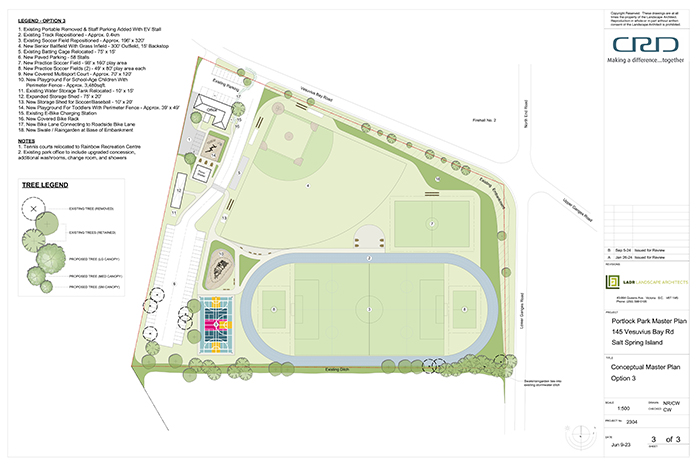
The track stays, pickleball is moving, and senior ball players are getting a field. 

After four rounds of public feedback, months of staff and stakeholder workshops, hundreds of survey responses and countless trips back to the drawing board, Salt Spring’s Local Community Commission (LCC) unanimously approved the draft Portlock Park Site Master Plan, concurrently revising the existing Rainbow Recreation Centre Site Master Plan and outlining the basic configuration for both properties going into the future. 

Development of a master plan for Portlock Park began as a priority with the island’s Parks and Recreation Strategic Plan back in 2019. The current plan relocates some park amenities from Portlock to the Rainbow Recreation Centre site to allow more playing fields –– most notably a senior-sized baseball field for youth at Portlock. 

Among those moves came a shift for pickleball from Portlock Park to the Rainbow Road site, with dedicated courts for the sport planned at the latter. Commissioners heard 11th-hour concerns from members of the public worried about light and noise, as pickleball has a storied history elsewhere in recent years of causing neighbourhood conflicts.

It was indeed pickleball enthusiasts themselves who broached the topic, worried that noise complaints could tarnish the growing sport’s standing. 

But the LCC agreed that those concerns could be mitigated; acting senior manager Dan Ovington said there was an engineered barrier material available, as well as other construction techniques to mitigate noise –– ones that didn’t necessarily require something as drastic as digging the courts below grade. Shifting the pickleball courts to Rainbow was the only way to “squeeze in” everything else between the two properties, he added, pointing particularly to the playing fields and oval track. 

“And it allows them to have six courts,” said Ovington. “They had four courts in the last revision, and the feedback I received was that [the pickleball players] were not supportive of four.” 

LCC member Brian Webster thanked staff for the work they had put in to find compromise, and noted the new master plan “significantly” upgraded outdoor sport activity on Salt Spring for a wide range of user groups. 

“There’s a point at which we either make decisions knowing that not everyone will be 100 per cent satisfied –– and not every question can be fully answered today –– or we just have an endless consultation process going on for years and years,” said Webster. “I think staff have done a pretty good job; they came back with a solution that made it work.” 

Commissioners agreed the noise and light concerns were legitimate, and that there was more work to be done –– but that would come at the next stage.  

“Concerns about how implementation is going to be sensitive to the needs of both the user groups and the neighbours, that is all going to be part of the ongoing process,” said Webster. 

Trust role limited in Baker Beach application

0

Bylaws passed by local officials to streamline their own agendas may have had unintended consequences, as Salt Spring’s Islands Trust representatives revealed they had first learned about a controversial project planned at Baker Beach through an online effort to halt it. 

“People assume that the Local Trust Committee (LTC) was aware and about to make decisions in regard to Baker Beach,” said trustee Laura Patrick, telling attendees at the LTC meeting Thursday, Nov. 14 that she, perhaps like many there, had become aware of the Crown land application first through opponents’ social media campaign –– and that trustees’ role is limited, since the province holds final authority over decisions there.  

“These provincial referrals can be quite of interest to the public,” said Patrick, “[but] when we aren’t part of the process, we’re not part of the process.”

The Ministry of Water, Land and Resource Stewardship is considering an application to modify a 560-metre strip of provincial Crown land fronting six Booth Bay waterfront parcels between Quarry Drive and Baker Road to protect against erosion –– a project opposed by an island group worried about public access at the popular beach and potential environmental impacts.

The period for public comment to the provincial ministry closed Nov. 13, although several islanders spoke against the project at the LTC meeting the following day, and a proponent representing the applicants spoke in favour.  

But while the Islands Trust intersects with the proposal through a ministry referral for its comments, the licence of occupation itself that would allow the project to advance is granted –– or denied –– through a decision by the province.

Trust regional planning manager Chris Hutton explained the referral from Crown Lands was received over the summer, and staff at that time –– as a matter of course, he said –– provided a response indicating that the proposal generally met regulations within the Islands Trust.  

“[Such referrals] can be numerous,” said Hutton, “and they are by and large mundane.” 

The Baker Beach proposal lies within the Trust’s marine shoreline development permit area (DPA), he added, which requires the Trust to issue a permit –– and applications for development permits for each of the four properties involved were received and have been under review “for some time.” 

But trustees themselves were not in the loop, largely because they voted two years ago not to be. 

The authority for marine shoreline DPA permit issuance fell to staff under a 2022 bylaw passed by the current LTC, delegating the issuance of several kinds of development permits to staff in efforts to “improve process efficiency, reduce the size of LTC agendas and provide greater certainty to the applicants,” according to a contemporary staff report.  

The delegation of permit approvals to staff was a recommendation in the Islands Trust’s governance review report; indeed, the Islands Trust Council had lobbied the Ministry of Municipal Affairs to amend the Trust’s regulation to give trustees the ability to shift such development permits’ issuance to an administrative level. 

Hutton said staff in their decisions are reliant upon reports from qualified professionals –– in good standing with their professional organization, with demonstrated relevant experience acting within their abilities and expertise –– to present application proposals to staff on behalf of the applicants. 

“At this time, for each of those four proposals, we have not issued a permit,” said Hutton.

“If staff determines they are in line with the development permit guidelines, then the application –– from the perspective of the Islands Trust –– would essentially be approved, and Crown Lands has to make a determination on the tenure.” 

If staff reject a development permit because it does not meet the guidelines, he added, the applicant has the option to request the LTC reconsider that decision.  

But trustees were noticeably uncomfortable with the notion that the provincial process –– and possibly their own legislation –– had seemingly left them with little role to play in an application with so much public interest. 

“What power do we have to actually do something here?” asked trustee Jamie Harris. “I’d like to know how far we can go with halting this.” 

Patrick suggested a review of the current letter of understanding on Crown lands between the Islands Trust and the ministry –– penned in 1994 and possibly out-of-date, she said –– and the LTC passed a resolution Thursday directing staff to forward all the public correspondence they’d received on the Baker Beach proposal as “additional information” to provincial regulators. 

Trustees also passed resolutions that may bring them back into the loop on such applications in the future, tasking staff to “directly” provide Crown land lease referrals to the LTC and add them to the applications report “with sufficient time for consideration of response,” although it’s unclear how that may ultimately mesh with their 2022 bylaw. 

“I think there’s a certain level of expectation from the public that the LTC should be at least well informed about these,” said LTC chair Tim Peterson. “And in some cases, providing input into a response beyond the technical staff end of things. That’s the intent of this motion.” 

Details for the proposal, now in review, can be viewed at comment.nrs.gov.bc.ca/applications?clidDtid=1415573; a petition outlining opponents’ concerns is still up at change.org/p/save-baker-rd-beach-its-rare-midshipman-fish-habitat-sign-this-petition and the applicants have developed a website in response at bakerbeach.ca

John and Sylvia Andrews

8

John and Sylvia Andrews, inseparable companions for 67 years, dying weeks apart in the Fall of 2024. John on Oct. 2nd at 98, and Sylvia on Nov. 6th at 92. 

In a letter to Sylvia prior to their marriage, John foretold how their lives would unfold:

“I feel my whole life to be built around or entwined with yours and would not want it any other way…. all my love Darling, forever.”

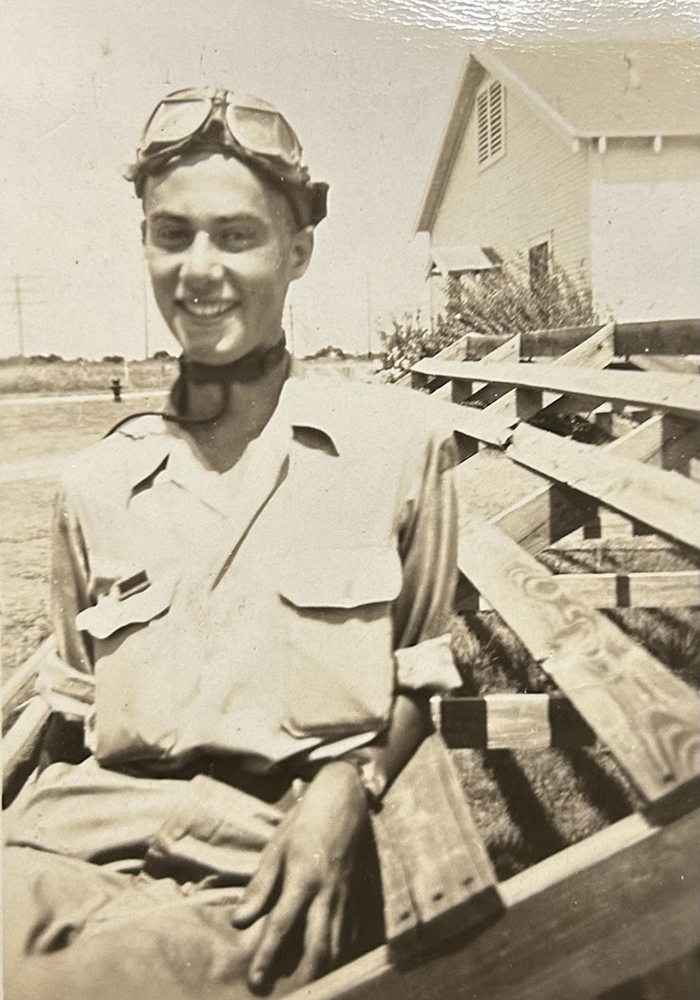
John William Henry Andrews was born on April 21, 1926 in Suez, Egypt to an English father, who was a senior manager for the Eastern Telegraph Company, and to a Spanish mother, the daughter of a well-loved and respected doctor. John spent his childhood in Malta but was schooled in Hastings, England, where his family eventually settled. With the fall of France this peaceful seaside town became the front line, which drew John into the Royal Observer Corps, counting enemy aircraft as they flew overhead. The danger and excitement inspired John to become an RAF pilot, which led to further schooling at St. Andrews University in Scotland, and then pilot training in America. 

For 19 year old John, this was a thrilling and joyous time, flying biplanes in sunny Texas. But it was also 1945 so it came to an abrupt end. 

Returning to the UK, John weighed his options and decided on medical school over becoming an RAF pilot, graduating from St. Thomas’s of London in 1954. He worked as a resident, as an ER physician, and as a ship’s doctor…

Sylvia Anne Andrews (née Jackson) was born on Feb. 22nd, 1932 in Wakefield, England as the middle child of five siblings. Sylvia’s childhood was defined by war. Her father’s school and family home were requisitioned by RAF Command, then the family moved from place to place to avoid the reach of the bombs. This instability coupled with the privations of war disrupted Sylvia’s education but years later she trained sufficiently to become a secretarial assistant in London. 

With Europe recovering, 24 year old Sylvia did find time to join her parents for a vacation to Lake Maggiore, Italy in 1956. 

It was the following year at a party in London that John and Sylvia met. She found him charming and funny. He fell for her smile. Decades later John would say that meeting Sylvia was the best thing to happen to him. 

They married August, 1957, then travelled to Switzerland for their honeymoon. Shortly thereafter, the young newlyweds made the radical decision to immigrate to Canada where opportunity seemed greater. 

John accepted a position with the RCAF as a medical officer and was posted to an airbase in Manitoba late 1958. To Sylvia this was a strange new world of supersized cars and food portions, open space and cold. She was also pregnant with William, which marked the start of a family building odyssey. 

After William’s birth, it was off to Labrador where Nick was born. Then to the Gatineau Hills of Quebec where Richard was born and where John completed his exams to become an OB/GYN specialist. 

Then to Germany where Susan was born, and finally to Ottawa where Fern was born and where John retired from the military. It was here the family settled and John ran a thriving obstetrics practice for 23 years. Asked why he chose this specialty, John replied “There’s nothing happier than a new mother”. 

In their penultimate move, John and Sylvia retired to Salt Spring Island, BC, where they lived happily for 30 years. They adored Salt Spring, the local ambience, their daily walks with a small dog, the view from their home. 

It was here that Sylvia found time to draw and paint, a passion that provided years of joy. But cruelly at the height of her abilities, her hobby was snatched away by the loss of her sight. 

Gracefully, Sylvia let painting go, devoting herself instead to providing for John who was now in a wheelchair. She continued to cook and keep house into her 90th year despite blindness, deafness and mobility challenges. But eventually it became too much, so Sylvia and John were moved from the home they adored to a care home in Sidney, BC. 

This was a sad and reflective time. In their final months, John and Sylvia spent their days outside in the sun, side by side in wheelchairs, quietly holding hands. They were lucid to the end.

John died peacefully Oct. 2nd with Sylvia at his side. Sylvia was then overcome by grief, so much so that her children rallied to her side, but her sorrow could not be undone. 

On Nov. 6th, the morning of Trump’s victory, Sylvia died in the arms of her son. It was the saddest day. So farewell Sylvia. Wishing peace to both you and John, now together forever. 

In addition to their children, John and Sylvia are survived by their grandchildren Jessica, Ciara, Aaron and Mira. 

John and Sylvia request no funeral, memorial service or flowers, but donations to Lady Minto Hospital would be appreciated. 

MASON, Philip Dudley

0

Phil passed away peacefully at Sunrise Senior Living in Victoria, B.C. He was the beloved husband of the late June Mason. Born in London, England, Phil immigrated to Canada, settling in the Niagara Region of Ontario. In 1961, he married June, having reconnected with her in Canada after her own immigration. Phil enjoyed a successful career as a photographer and was the author of two published books about the Niagara area.

In 1992, Phil and June retired to Salt Spring Island, B.C., where they embraced the beauty of nature. Phil was an avid bird watcher and a keen sailor who cherished his two sailboats, both named Toad Hull and Toad Hull II. He also had a passion for skiing and tennis, hobbies he pursued with great enthusiasm. During the winter seasons, Phil and June traveled extensively across the U.S. in their Airstream, creating many lively adventures and cherished memories along the way.

Phil was deeply loved and appreciated by his family and friends. His kindness, generosity, and fun-loving nature touched all who knew him. He enjoyed his weekly gin martini with three olives and his nightly brandy nightcap, pleasures he continued to indulge in even during his final days.

The family extends heartfelt thanks to the dedicated nurses and caregivers at Sunrise Senior Living in Victoria, who provided Phil with comfort and care in the later years of his long life. Special thanks are also given to Dr. Harley Syyong and Dr. Zul Nathoo for their excellent medical care, as well as to Rick Alexander for his compassionate support.

Phil is deeply missed by his sister-in-law Anne, his nieces and nephews, and many friends. Respecting Phil’s wishes, there will be no funeral service. Please remember Phil in your own special way and treasure the good memories.

Opinion: With AGM in the books, time for ICS to open up

0

By GAIL SJUBERG

Driftwood Editor

The much-anticipated annual general meeting of the Salt Spring and Southern Gulf Islands Community Services Society — aka Island Community Services (ICS) — took place on Nov. 14, and achieved its goal of being non-controversial — at least during the 35-minute meeting.

ICS held the meeting via Zoom and muted everyone except board members who were making and voting on basic motions or giving statements, and executive director Rob Grant when he gave his report, which was an abbreviated summary of the annual report contents. That report can be read on the saltspringcommunityservices.ca website, and it illuminates all of the important work done by ICS.

Approximately 40 little boxes appeared on the AGM Zoom meeting screen, many representing individuals who had applied to be society members in recent months but whose applications had not yet been accepted. A number of staff also attended.

ICS board chair Jennifer Lannan clarified near the beginning of the meeting that in addition to herself and four fellow directors — Jody Hawley, Gary McNutt and, to be confirmed at the AGM, Jenny McClean and Darryl Martin — the only other society members were Tisha Boulter and Cathy Patel. They are two past board members who resigned before their terms were up and whose memberships were valid until this year’s AGM. As such they were the only two non-board members allowed to ask questions.

Boulter asked why the board chose to hold the meeting by Zoom, to which Lannan replied, “We felt that it was a great way to be inclusive to all types of participation . . . we thought we could actually see more people in their homes and on their devices, and we felt that was best practice. We thought it was as inclusive as we could be.”

I doubt the irony of citing inclusivity at a meeting where discussion is prohibited was lost on anyone.

One other bizarre moment saw a former board member, Margaret McKenzie, asked by Hawley to comment on the Commission on Accreditation of Rehabilitation Facilities process, undertaken every three years, which ICS points to as proving it does a good job. At the time it felt like McKenzie was a public relations plant in the meeting, but it turns out she was apparently not expecting the question.

And then there was the visual of two people frantically waving their hands to be recognized, with Lannan having to reiterate that questions would only be taken from members. Maxine Leichter was one of those people. She later told me she wanted to ask when her membership would be approved. Here’s the answer provided to me by Lannan:

“The board has struck a committee and we will have the work done as soon as we can, allowing for best practice: proper research, consultation and legal review. Modifications and evolution of the society’s bylaws are only in the best interest of the organization. Changes that will be made are commonplace in our very own community already and in bigger societies in larger centres alike.”

Lannan did also say in her AGM remarks that the board would be “working on welcoming new members to the society in the coming weeks.”

Christian Tatonetti and Jennifer Campbell — two individuals who have publicly shared negative experiences with ICS in recent months, encouraged people to become ICS members and have applied themselves — said they were not provided with the Zoom link upon request, though received it from a third party and were allowed to join the meeting.

Most not-for-profit societies want members: for energy and ideas, to spread the good word about their group and its activities, and to give volunteers an extra stake in the organization. That ICS members have for years essentially been only the board of directors contributes to its image as a closed shop.

ICS has stated that it is responsible to the people it serves and to its funders, not the rest of us; and that workplace grievances can be handled by the employees’ union. But as an organization it touches so many aspects of Salt Spring life; other agencies rely on its cooperation and it has an enormous budget: $8.3 million in its 2023-24 fiscal year; almost identical to what Salt Spring ratepayers paid to the Capital Regional District in 2024. That’s up from $4.5 million in the 2019/20 fiscal year, and $1.7 million back in 2006. A small group of people are responsible for what is largely public money, even if most of it doesn’t come directly from Salt Spring pockets. The society owns eight properties worth approximately $20 million.

ICS board members and senior staff can tell themselves that the spotlight has hit them only because of a few disgruntled individuals or busybodies, or because former MLA Adam Olsen uttered some stinging words about ICS as he left his position. But that is not true, and on some level they must know it.

However, the coping strategy at this point seems to be to climb into the bunker with some extra provisions, wait for the storm to pass, and work on releasing some good news stories while finding legal ways to determine who can and cannot be a society member.

We all understand that ICS deals with vulnerable individuals, and that requires special consideration and extreme discretion. We get that there’s a certain amount of interpersonal conflict and personnel matters that can’t be discussed publicly. We get that a “takeover” of the society by angry people would not be a good thing; nor is erosion of frontline staff or volunteer morale.

But the controversy and desire for people to be society members or more involved with ICS needs to be accepted by the current board of directors, not as a public relations challenge but as a reality. The organization needs to step outside of itself to learn how it is perceived by others. Lannan did stress at the AGM that people can email agm@ssics.ca with questions or concerns and that the board does want to hear from people.

On Saturday, the Salt Spring Island Foundation marked its 40th anniversary at ArtSpring in what was a fantastic, fun, feel-good celebration. ICS marks its 50th anniversary next year. Will the organization truly be able to celebrate its successes and important role in the community, or will that milestone be celebrated with a few tepid words offered at another Zoom meeting with most of the participants muted?

School board drops international program

0

The Gulf Islands School District (SD64) is ending a long-running program that had welcomed international students to Salt Spring’s Gulf Islands Secondary School (GISS), citing both financial pressures and declining enrolment. 

At its meeting Wednesday, Nov. 13, a clearly conflicted school board voted nonetheless unanimously to end the Gulf Islands International Program (GIIP), effective June 30, 2025. The board considered its options as a report from SD64 secretary treasurer Jesse Guy outlined an enduring pattern of rising costs, fewer interested international students and a declining number of islanders making their homes available for those students to stay. 

The GIIP had been in operation for 25 years, and trustees noted enrolment in such programs had decreased throughout the province as attitudes toward international travel shifted globally.

The program, they said, did provide additional diversity to the district, and one or two additional teachers at the high school — as well as a modest amount of homestay revenue to the community who opened their homes. 

But since the onset of the pandemic, the program had yet to return to the 55 to 65 students per year that kept the program financially stable, according to Guy, adding that the current numbers sit at 35 to 40 each year. 

“This was not an easy report to write,” said Guy, agreeing the number was restricted not just by slowing demand but by fewer available homestays. Trustee Rob Pingle said he knew of at least one household that had not planned on offering a place for international students that year, but took on several “out of a benevolence” to allow them to come. 

“I benefitted from the international program, so I don’t dislike it,” said Pingle. “It’s just that the writing’s on the wall; it’s been operating at a loss for a number of years.” 

Further, Pingle noted, with the recent configuration change to fold Grade 8 into GISS, that facility itself is more or less at capacity. 

“Thirty-five fewer students in that building means our students will have more room to breathe and move,” he said. “We have to realize what size we are as a district, and work within our means.” 

Guy said just four applications had been received for the cancelled program, and no tuition had been accepted yet.  

In an announcement issued the next day, SD64 superintendent/CEO Jill Jensen extended the board’s “heartfelt appreciation” to all of the program’s staff for their contributions over the years — particularly program manager Sheri Wakefield — and to the families who had provided homestays. 

“For 25 years, the international program has been a cornerstone of pride in our district,” wrote Jensen, “fostering dynamic and diverse learning environments and enhancing cultural awareness. As this program concludes, we celebrate its enduring legacy of cultural exchange, lifelong friendships and global understanding, which will continue to inspire us to broaden our worldviews and perspectives.” 

Editor’s note: For more about the GIIP, see a story in the current Aqua – Gulf Islands Living magazine, which went to press before news about the program’s cancellation was shared.