
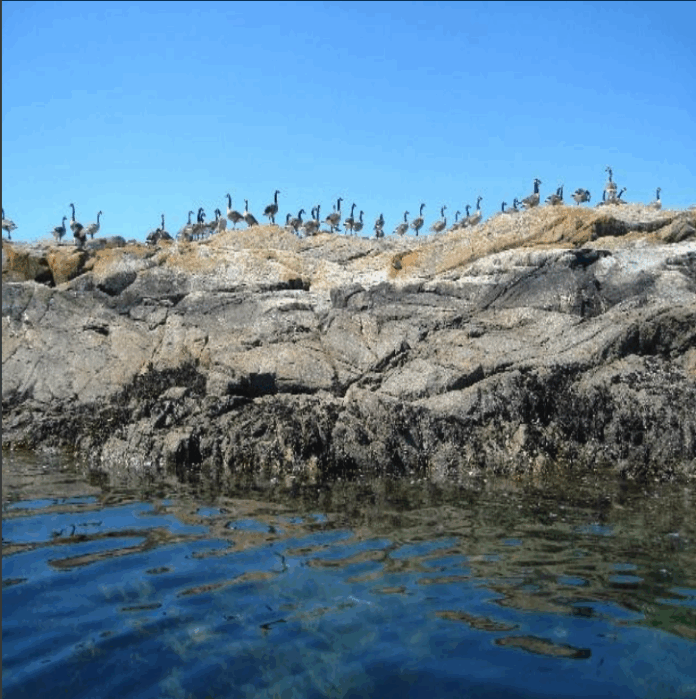
An iconic but regionally introduced bird has decisively worn out its welcome, and regional district officials now say action on Salt Spring Island is critical to slowing population growth of Canada geese — to protect both natural ecosystems and the island’s farms.
Historically, according to Capital Regional District (CRD) environmental stewardship and initiatives supervisor Jody Watson, the only Canada geese found anywhere near Salt Spring were occasional migratory visitors to Vancouver Island, usually over the autumn and winter months.
But numerous introduction programs were implemented by the Canadian Wildlife Service and BC Fish and Wildlife Branch in the 1960s and 1970s, meant to increase wildlife viewing and hunting opportunities. And the introduced birds –– from numerous subspecies –– were unable to learn migrating behaviour patterns from their parents, interbred and eventually created a hybrid population of non-migratory residents not native to the region.
“They came when they were juveniles, and they never ever left,” said Watson, who briefed Salt Spring’s Local Community Commission Thursday, Nov. 13 on the CRD’s Canada Goose Working Group activities this year. “Now we have a very large non-migratory population of resident Canada geese, and that population is growing.”
Significant impacts to endangered ecosystems in estuaries and tidal marshes “look like erosion” as the birds move through to eat, she said; and water contamination presents as heightened levels of E. coli and coliform bacteria in lakes — bolstered by phosphorus and nitrogen “inputs” from the birds.
But it’s local farms that are taking some of the biggest hits. In addition to poultry flocks increasingly at risk from Highly Pathogenic Avian Influenza — spreading with Canada geese as common vectors — many previously viable farm operations are losing significant crops to Canada geese.
“On Salt Spring Island there was one farmer who said he basically gave up on farming strawberries after he experienced a loss of nearly $100,000 from goose damage in a season,” said Watson. “It turns out that Salt Spring Island has more ALR land than any municipality in the CRD, so it’s very important that we’re talking with you and working with the community.”
So-called moult surveys — done when the geese lose their flying feathers, Watson explained, making them easier to count — found some 6,700 geese in the region in 2024; 2025’s count determined there were about 5,900 geese, or an 11 per cent reduction.
It’s good news, she said, but there’s a catch: roughly 30 per cent of the entire region’s population is in the Gulf Islands, and Salt Spring has the most — and they trend younger.
“Salt Spring Island also has the highest number of juveniles,” said Watson. “Across the region, juveniles represent about 20 per cent of the population, but in order for us to prevent population growth, we really need that number to be closer to 10.”
More juveniles means more nests, and Watson explained egg addling is the best way to reduce the number of new geese; it involves a skillful shaking of the egg that separates the embryo from the membrane, rendering it unviable. Goose management coordinator Samantha Hammond explained if you just remove an egg, the goose will lay another one, making addling more efficient and less disruptive.
“In the wild, geese will have their nests fail for numerous reasons,” said Hammond. “There are predators, or they’ll be gone too long and the eggs cool down and won’t hatch; it’s something they experience already in the wild, so it’s considered to be a relatively humane practice.”
Watson said the working group had surmised there must be a lot of nests on Salt Spring, meaning they’re not getting to them through the addling program — and since the working group has found roughly 72 per cent of nests occur generally on agricultural lands, they’re looking to island farmers to help them expand the program.
Landowners can’t addle their own Canada goose eggs, Watson said — as they’re still technically a migratory bird, it requires a “damage and danger” permit from the Canadian Wildlife Service — but if there are nests on their property, they should reach out.
“Through the program, we now have a region-wide permit, so anybody doing work through us — or if we’re going onto someone’s property to do egg addling — can come under our permit. That’s really helping reduce the administrative burden on municipalities and landowners.”
Watson said farmers could also come in under the service’s crop protection permit, and they’re also continuing work on a program that pairs hunters with farmers. Throughout the CRD, she said, that has included partnerships that have generated several new and ongoing First Nations-led harvests.
“And we have an app that we’ve developed, Goose Watch,” said Watson, referring loosely to the CRD’s webform. “Everybody can put in population data wherever they are at any point in time, whenever they see geese in the region. That’ll help us determine their seasonal movements, and where we need to be.”
The service’s egg addling program begins planning in January, and does its work at nests between March and May. Hammond said one of the most difficult hurdles was getting in touch with individual landowners, getting permission to go on their land to do nest surveys and find out where the geese are nesting.
“We’re definitely interested in getting more connected with stewardship groups and the farming community,” said Watson, “and seeing how we can increase the collaboration and work that we’re doing on those islands.”
Watson said interested landowners can reach them at goose@crd.ba.ca.