
A new petition before B.C.’s Supreme Court contends Salt Spring’s Local Trust Committee (LTC) has overstepped its authority in crafting development regulations meant in part to protect marine environments — a power lawyers for some property owners say lies exclusively with the government of Canada.
Arguing the LTC’s creation of Development Permit Area (DPA) 3 “Shoreline” within Salt Spring’s Official Community Plan (OCP) should be rendered invalid by the paramountcy of federal law, Baker Beach area homeowners Ethan Wilding, David Demner and Heidi Kuhrt have initiated a petition for judicial review of the LTC’s decision not to issue a permit for a shoreline stabilization project at their waterfront properties.
Alongside an application for a licence of occupation from the Ministry of Water, Land and Resource Stewardship (WLRS) to do work within the Crown land at the shore, the Islands Trust required a permit for the project to proceed, since it lay within DPA-3.
In the July appeal, consultants for the homeowners addressed an itemized list of staff concerns, warning the beach itself was in danger from the same erosion processes that threatened the proponents’ homes. Ultimately the LTC deferred to its own staff, noting trustees’ lack of specific scientific expertise, and reflecting vocal public sentiment against the proposal.
In the petition filed Aug. 27, lawyers for the property owners characterized both denials as products of “unconstitutional overreach by the Trust Committee, exercising powers over the protection of fish which neither it, nor the Province of British Columbia, possess,” according to petition text. It suggests that federal permission for the project to proceed had already been received from Fisheries and Oceans Canada (DFO) under the Fish and Fish Habitat Protection Program — indicating, lawyers said, federal endorsement for the erosion mitigation effort, in line with both environmental standards and those respecting the rights of First Nations.
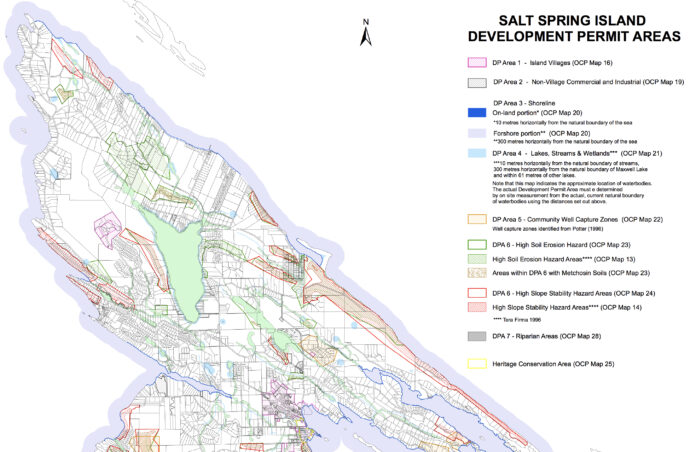
When the LTC’s planning services staff rejected the application initially, their concerns were based — at least in large part, according to the petition — on DPA-3 guidelines in Salt Spring’s OCP intended to protect tidal waters and aquatic habitats; DPA-3 extends into the intertidal zone seaward of the “natural boundary” of the ocean.
Lawyers for the property owners argue those guidelines exercise a power that exceeds the statutory authority of the LTC, established under the provincial Islands Trust Act, which, they said, could not empower it to directly regulate marine environments.
“During the July 10th LTC meeting, it became clear that the concern for fish and fish habitat arose primarily within the context of the LTC’s concern over Aboriginal rights to fish or harvest shellfish along Baker Beach,” read the petition. “The Islands Trust Act does not authorize the Trust Committee to enact rules for the protection of fish or fish habitat in tidal waters . . . [and] the impugned portions of the OCP exceed the Trust Committee’s statutory authority. They are invalid and ought to be set aside.”
The petitioners contend that the LTC’s DPA-3 guidelines encroach upon federal jurisdiction, which they say is exclusive over fisheries and fish habitat under Section 91(12) of the Constitution Act, 1867, and the Fisheries Act, emphasizing that federal agencies, particularly DFO, have extensive and detailed regulations, approvals and environmental assessments supporting the project’s compliance, rendering the LTC’s restrictions unconstitutional.
“As the Trust Committee is a creature of provincial statute, it may not under any circumstance exercise statutory authority not possessed by British Columbia,” read the petition. “By creating the impugned DPA-3 Guidelines for Development in the OCP, the Trust Committee has impermissibly stepped into an area of exclusive federal jurisdiction.”
The property owners’ petition also took exception with the LTC’s July debate on the appeal, saying trustees seem to have made up their minds before the public meeting — a procedural flaw compounded, according to the petition, by the LTC’s reasoning for rejecting the appeal, which lawyers said failed to address statutory exemptions explicitly granted in the OCP that would allow projects approved by federal agencies like DFO to proceed without requiring separate local permits.
“Because the project cannot proceed, the petitioners are exposed to real and ongoing risk of irreversible erosion to their respective properties,” read the petition.
“Ethan, and David and Heidi, continue to face the prospect of their homes slipping into the sea.”
The project proponents had petitioned the court back in May for an order requiring the LTC reach a decision on their application. Reached this week, Salt Spring LTC chair Tim Peterson said trustees would have no comment while the matter remained before the courts.