
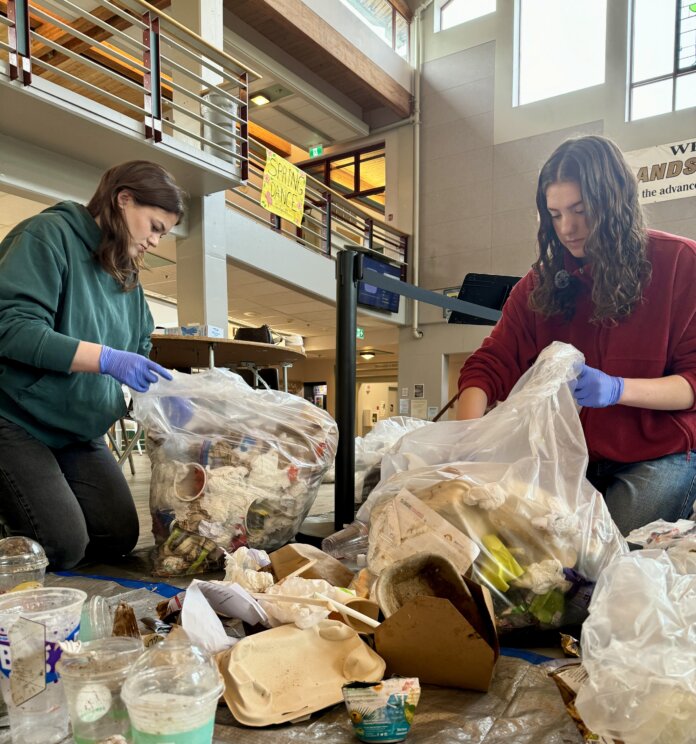
Sustainability advocates are warning high schoolers’ trash is being trucked to the U.S. rife with recyclables, as students conducting “waste audits” at Gulf Islands Secondary School (GISS) say they just want recycling — and composting — available at school.
On Wednesday, April 22, Earth Day started early for GISS Earth Club student lead Melody Silva. Before the morning bell had rung, the Grade 12 student was sorting through trash bags, collected by custodial staff for the club’s current project the night before.
That “waste audit,” the first of two planned in coming weeks, will precede a two-week pilot plastic recycling program run by club students — and produce a snapshot of how much of the school’s trash could have been diverted from landfills.
Judging by the first few bags tackled by club members, it’s a lot.
“One of the biggest things that inspired me to start on this project was looking in the garbage bin and seeing how much plastic was in there,” said Silva, gesturing around the pile. “We also want to show the other students just how much garbage we produce.”
Silva said both the audits and pilot recycling program would help inform a broader strategy the club intends to bring before the school board in June, including an estimate on volume and costs. The student initiative is partly supported by local advocacy group Transition Salt Spring (TSS) and its Youth In Action program, led by coordinator Fig Mulder.
TSS provided advocacy training, Mulder said, surrounding topics like how to contact local government, formulate direct and respectful messages and “awareness-raising techniques.”
“The students came up with the idea of the waste audits,” said Mulder. “Separating out what could be recycled, as well as food waste, and then figuring out how much landfill waste could be diverted if there was a school-wide recycling and composting program.”
Mulder said the students had reached out for help funding both the audits and the recycling pilot, with groups from the Salt Spring Island Foundation to Mouat’s stepping in to help. In an April 22 social media post, TSS also thanked the Raffi Foundation and the Salt Spring Institute for Sustainability and Action.
But Mulder said while the high school’s administrators had been fully supportive of the club’s advocacy program, there were concerns that the school was “getting around” a longstanding recyclables and food waste ban at Harland Landfill by using a garbage service that sends trash elsewhere.
In a social media post, TSS wrote that the GISS Earth Club’s efforts demonstrated “that the vast majority of what gets shipped to Washington State (at 14 cents a kilo) is actually recyclable paper and cardboard, plastic containers, aluminum cans [and] compostable food waste, which has been banned from BC landfills since 2015!”
According to Gulf Islands School District (SD64) secretary treasurer Jesse Guy, the district pays 41 cents per kilogram, not 14 — and, she added, while the district couldn’t confirm where their trash went after being picked up, she acknowledged the school’s lack of recycling options for students.
“And I’m fully supportive of partnering and connecting with any infrastructure that will help us reduce putting things in the garbage; we are not standing in the way of any of these things,” said Guy. “But we can’t manufacture something that doesn’t exist.”
While the recycling depot on Salt Spring Island accepts a wide variety of materials at no fee, it’s only for use by residential households. According to its contract with the Capital Regional District (CRD), the depot is not required to accept material from schools, who must join restaurants, businesses and industrial operations — including CRD’s Salt Spring Parks and Recreation facilities — in paying private companies to take it away.
Commercial services on Salt Spring have routinely hauled trash they collect to Hartland Landfill. Nancy Hedger of Laurie’s Garbage and Recycling confirmed last week they still do and rely on their customers to sort recyclables and compost from refuse (and accept those items separately). Bin customers are advised they will be responsible for fines if prohibited items wind up in what they bring to Hartland.
Salt Spring Garbage and Recycling (SSGR) representatives did not return messages by press time, but their bin rental agreements have similar language with extra fees and rates above the standard 41 cents per kilogram for dumpsters found with “banned from Hartland” items like cardboard and metal mixed in. The school district contracts with SSGR to take both trash and its sorted paper and cardboard, according to Guy.
So while the refundable bottles from the school’s vending machine are collected and the lunch program’s compost is picked up by a small-scale resource recovery company in Victoria, Guy said there is no funding stream for the district to expand refuse services at GISS.
“If there was a grant for the additional cost to sort, sift and truck these different things off island, we would [apply],” said Guy. “But there is no specific funding for that, so any additional spending would come directly out of classrooms.”
Smaller island schools within SD64 have come up with their own solutions. Saturna Elementary School, Guy said, found local grant funding for a modest indoor composter which creates material they use in their school garden. She suggested that works because they have fewer than a dozen students, and with those volumes it’s not unlikely that smaller island communities “turn a blind eye” to how much school recycling winds up in their local centres.
Guy said even if there were dollars for a GISS-sized composter, the district would then face managing community expectations around capacity, and even odour and pest control.
“I hate putting the word ‘business’ in front of education,” she said, “but we’re in the business of education; that’s our main mandate. We’re not in the business of public utilities.”
That leaves it up to students and parents for now, she said.
“Reduce,” said Guy. “Take it home, put it into your personal recycling.”
That “pack it in, pack it out” philosophy has been part of most students’ vocabulary since at least Salt Spring Elementary School; but Mulder and Silva worry that this district-wide tradition is unsustainable.
“‘Pack it in, pack it out,’ ideally, would be great,” said Mulder. “Ideally, we would all be zero-waste and shopping at the Refillery and living that way, but the fact is we don’t. ‘Pack it in, pack it out’ takes the pressure off the schools, but that’s passing the responsibility on to the students.”
Silva agreed, noting there were no good solutions for “gross” recycling that needs cleaning before it enters the stream — or has to be put into a student’s backpack for several hours.
“In practice, it’s terrible,” she said. “At any point, there are probably 700 people in this building; we can’t expect them all to bring everything home.”
In 2023, a provincial announcement heralding six-figure funding to help create the composting facility at the Burgoyne Valley Community Farm specifically stated it would process organic materials generated by Salt Spring’s schools. Today, operating without a licence it has no clear path to acquire, it still can only accept material from the Salt Spring Abattoir — although earlier this month the CRD’s Environmental Services Committee recommended the regional district exempt the facility from CRD bylaws that restrict its inputs.
“The emails are all signed ‘we respect this land,’ and yet this is happening,” said Mulder. “On one hand, I can see that their main interest is keeping that price low; on the other, we’re hopefully teaching this next generation how to care for the earth, and the actions aren’t matching the words.”
The CRD Board could consider expanding contracts for electoral area recycling depots, but will most likely begin the process to exempt the Burgoyne Valley composter from its regulations sooner. Guy said SD64 was looking forward to news about that composter with “bated breath.”
“We would love at some point to partner with the project, and get our food waste into that composting system,” said Guy. “We would be happy to partner with anybody who will help provide those public utilities that allow a school district to integrate into a system and recycle and compost.”
Meanwhile, Silva said she would be spending time this week in classrooms, telling fellow students about the bins for the pilot program. The Earth Club will be ramping up its education effort throughout the school, she added, with posters and signs indicating what goes into the temporary bins.
“You know, it’s not just about the recycling, it’s about taking some small steps,” said Silva. “I feel like in a world where so many things are out of our control, especially as younger people, this is a tangible thing we can do.”
She smiled. “It actually feels great to be doing something physically, here with my hands.”