
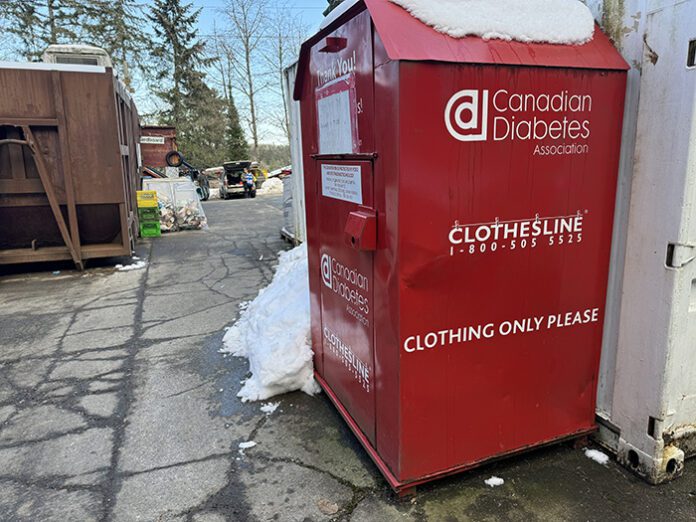
Salt Spring’s two social enterprise thrift stores are reaching out for community support after learning that Diabetes Canada will no longer be coming to the island to pick up the stores’ clothing discards.
Transitions Thrift Store and the Lady Minto Hospital Auxiliary (LMHA) Thrift Shop were informed at the beginning of January — as was the Salt Spring Recycle Depot, which has hosted a Diabetes Canada bin for clothing recycling since 2016 — that Feb. 24 would be the final monthly visit by the organization’s five-ton truck.
According to LMHA volunteer Lou Stevens, up to 2,000 pounds of clothing, purses, shoes and fabrics were taken from their store each month by Diabetes Canada. Funds raised at the shop benefit the island’s hospital and other healthcare programs.
“We’re stuck,” she said, “and as of now, we don’t have a solution for our rejects. If we have to truck it off the island, it’s going to be an expense that we have just not budgeted for.”
The same is true for Transitions, which supports Islanders Working Against Violence programs like the Transition House serving women and children. Store manager Alli Gaines is also concerned about how their discards will be handled, as well as the financial impact.
“If we have to pay to throw it out, it’s taking away from the work that we’re able to do in the community,” she said.
In light of the problem, both Transitions and LMHA Thrift Shop personnel are asking people to be more selective in what they donate, and to not be rude or abusive when items are rejected. (See sidebar for specific LMHA donation requirements.)
“Basically it’s just bring stuff clean, usable, and we would be very, very grateful,” said Stevens.
People will also have to be prepared to wait while donations are checked to ensure they can be sold.
Gaines added that for Transitions, sometimes the issue is not lack of donation quality, but sheer volume, especially if they already have a large number of a specific kind of item and no room to store or display them.
Gaines said the diabetes group paid a certain amount of money per pound of clothing collected. She said Transitions would be fine with that part of the deal being dropped as long as the pick-up continued.
While Diabetes Canada picked up directly from the LMHA Thrift Shop, Gaines said Transitions relied on taking their discards to the Recycle Depot for storage in between pick-up dates.
Depot manager Peter Grant said he hopes to find an alternative to the Diabetes Canada bin service, so the change should be viewed as a “suspension” of service, which occurred during the pandemic as well, but it may not be possible.
Diabetes Canada personnel told Salt Spring groups that it was just not financially viable to continue the service. Grant said the same would be true if the depot took on transporting the material off-island to agencies that will accept it.
LMHA Thrift Shop Donation Guidelines
To help reduce the amount of items that Lady Minto Hospital Auxiliary will need to pay to dispose of after Feb. 24, the store volunteers ask that:
• all donations be in good, sellable condition, so without rips, stains, missing buttons, broken zippers, etc.;
• all donations, including footwear, be clean, as LMHA has no washing facilities;
• donations ideally be brought in boxes, and separated into children’s and adult clothing items.
Donations may be brought in clear plastic bags, but filled only half full to make it easier for volunteers to carry them. Black garbage bags should not be used, as they are not recyclable.
People are also asked to phone the store at 250-537-0634, if possible, before bringing in donations, to ensure there is room for them to be stored that day.
The shop is generally able to accept donations Tuesdays through Saturdays, 10 a.m. to 3:30 p.m.
AND . . . please don’t be rude to the volunteers!