
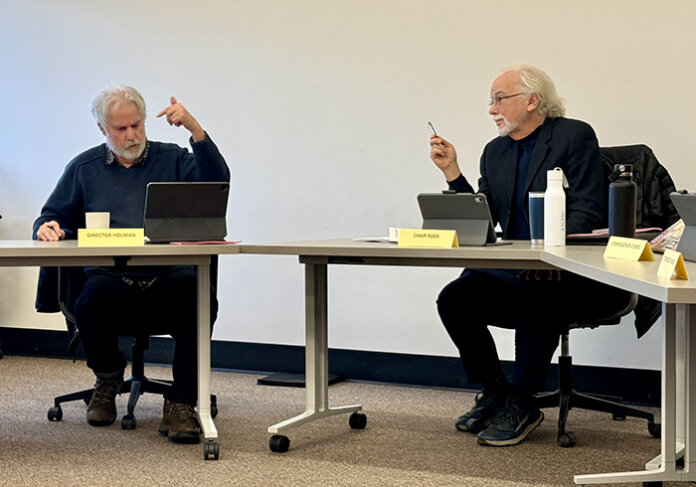
Salt Spring officials have revealed a closed-door effort to expand local authority was shut down before it even began, as the Capital Regional District (CRD) Board sent an unsubtle message to the island’s Local Community Commission (LCC): not now, Salt Spring.
Currently overseeing a slate of a dozen locally delivered services that range from pool-and-parks recreation to transit, commissioners have long made little secret of their hopes to eventually grow local responsibility — and accountability — since the LCC’s establishment in 2023.
But this week, after an hours-long closed meeting held Thursday, Feb. 19, the LCC disclosed that a behind-the-scenes effort to merely gather information on how it might take on more service authority had been met with firm resistance from regional directors meeting in Victoria.
Specifically, commissioners had been investigating a list of possible services to “bring local” that included the five CRD-administered water services — Fulford, Beddis, Cedar Lane, Cedars of Tuam and Highland-Fernwood — and both Ganges’ and Maliview’s sewer systems. The LCC was also mulling local authority over stormwater quality management, building numbering, Community Works funding and the island’s local administrative budget, all of which are today administered by the regional district.
So in December, during a closed meeting at the Salt Spring Island Multi Space (SIMS), the LCC passed a motion requesting staff report back on the “costs, consultation and administrative changes” required to reallocate those services to come under the LCC’s jurisdiction. They also sought information on a funding model to support a referendum on the changes, something they imagined could possibly take place as early as this October.
“This [motion] was passed in a closed session with the LCC in an effort to gain information on these proposals from staff,” said LCC chair Earl Rook Thursday. “However, the CRD Board and senior staff in Victoria determined on their side that this proposal needed to be run past the full CRD Board.”
That discussion took place during a different closed meeting, this time of CRD Board members in Victoria on Jan. 14. Rook said as the LCC chair he was able to make a brief presentation during that meeting, but was not present for directors’ discussions.
The upshot, according to Rook, was that the CRD Board passed a motion stating that it “will not consider the expansion of services under the [LCC’s] jurisdiction during this term.”
The CRD Board rose to report this outcome at its most recent meeting, which Rook said had prompted the LCC to report the outcome of its December closed meeting for context.
“I think this was premature on the part of the board, since we were only asking for information,” said Rook. “Since we have not received it, it makes it difficult for us to even formulate any proposals.”
On Thursday, commissioner Ben Corno suggested the LCC should perhaps consider passing the motion a second time, as it seemed the request for information itself was not explicitly denied.
“We were never asking for them to decide whether or not [to expand service authorities],” said Corno. “This has the potential to be an election issue — an election issue with no numbers to discuss, which is really silly.”
The LCC currently holds delegated authority for 12 services — a number that had been 15 prior to a budget consolidation which did not reduce the services themselves. Under CRD direction, staff within the Salt Spring Island administration department are already responsible for many of the services the LCC had eyed, according to a resources report, including operation of two sewer system plants and management of the five water utilities.
“This did not occur in the manner we anticipated,” said Rook. “And this subject will return to the agenda of the LCC.”