
Salt Spring’s bucolic reputation may be working to the detriment of local active commuters, as regional officials from Vancouver Island municipalities struggled to recognize whether a proposed bicycle path there should be included in a transportation service, rather than parks.
And despite repeated pleas from community members to advance timing for the Salt Spring Island Regional Trail (SSIRT) — cycling advocate Robin Jenkinson even managed to present her delegation via telephone from Nicaragua — directors serving on the Capital Regional District’s (CRD) Transportation Committee ended the day uncertain whether it should take responsibility for SSIRT, much less move design planning up 12 months.
That hesitance came even with the CRD Board’s budget allocation of $300,000 in design funding already made, albeit slated to start in 2027 — and after an exhaustive multi-agency feasibility study concluded the trail represented a “significant opportunity” to enhance active transportation across Salt Spring, laying out groundwork on routes and trail designs.
It also came after the CRD’s Parks Committee unanimously recommended the CRD Board refer “planning, implementation and operation” of Gulf Island regional trails to the Transportation Committee. The board did so, but on Wednesday, Jan. 28, the Transportation Committee referred the issue back to the board.
Several directors serve on both the parks and transportation committees.
“The Galloping Goose, Lochside and E&N, those are essential high-volume trails that are used by commuters,” said Langford director Lillian Szpak, herself on both committees. “I may be wrong here, but I thought that the Transportation Authority was looking at key commuter trails [and] I’m seeing the Salt Spring Island trail as a regional park trail. Like, there’s a difference between the two.”
The CRD plans $53.5 million this year for widening and lighting on the Galloping Goose and Lochside trails, which it has said see some 3.8 million visits per year; the 55-kilometre Galloping Goose trail alone sees more than 5,000 cycling and pedestrian users on its busiest days.
While comparable active transportation data are not available, the proposed route of the SSIRT — running between ferry terminals at Fulford Harbour and Vesuvius Bay — sees a peak motor vehicle count of just over 4,300 daily, according to the Ministry of Transportation and Transit.
Notably, Salt Spring’s only CRD regional park is the remote Mill Farm Regional Park near Mount Bruce — three non-contiguous parcels of forest with no park facilities, accessed by dirt roads well distant from the SSIRT route.
CAO Ted Robbins pointed out Wednesday that the CRD Board itself had not made an explicit decision that the SSIRT should be designated a “transportation” trail, which would neatly put decision-making before the Transportation Committee. And while there was an ability to move the design work up to 2026, it would still be subject to staff capacity — currently “fully allocated in 2026” to work on the regional transportation plan, according to general manager Kevin Lorette.
“One of the key deliverables, we feel, would be an analysis of what guidelines and parameters dictate a trail being a regional trail,” Lorette told the committee. “We do recognize that trail construction standards and design standards would be different if it was serving an active transportation corridor purpose versus if it was a recreational trail. And staff feel strongly that we need to undertake that work during the update to the regional transportation plan before it can consider whether or not [SSIRT or other Gulf Islands trails] should be included under the transportation service.”
Salt Spring property owners are expected to contribute some $339,000 this year to support the CRD’s new Regional Transportation Service, roughly $51 per average residential property. If managed by the Regional Transportation Service, SSIRT would be the first local manifestation of a tangible benefit for Salt Spring, according to the island’s CRD director Gary Holman. Holman, along with the island’s Local Community Commission (LCC), had opposed being part of the new service at all, given Salt Spring’s extant self-funded transit service.
Holman said the Transportation Committee indicated it wanted a fuller understanding of the implications of taking on trails in the Gulf Islands; the committee requested a staff report to that effect.
“The good news is that the dollars are still there with the Parks service,” Holman told fellow LCC members Thursday, Jan. 29. “The design work is coming out of a capital reserve, so there would be no impact on requisition in moving it up.”
Holman said he expected the issue to advance during the CRD board’s final budget meeting March 11.
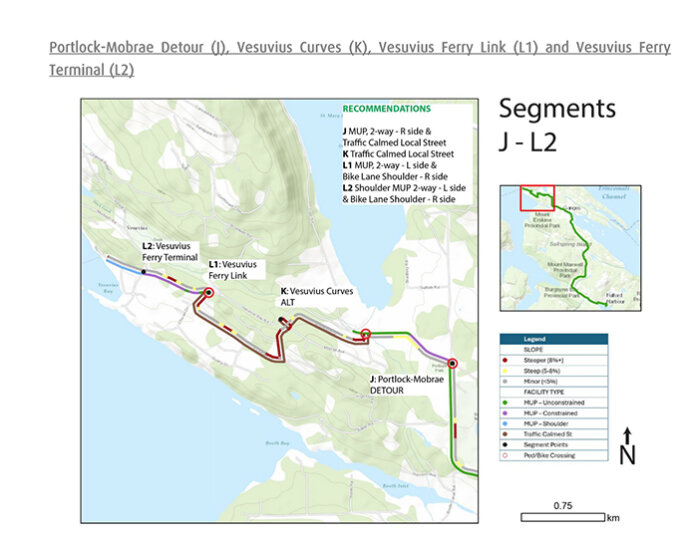
Initial work on the long-imagined 21-kilometre SSIRT is anticipated to focus on an identified “first priority” section of the trail between Portlock Park and Mobrae Avenue, a stretch advocates say is the lowest-cost and simplest of dozens of sections necessary to connect Fulford, Ganges and Vesuvius.