
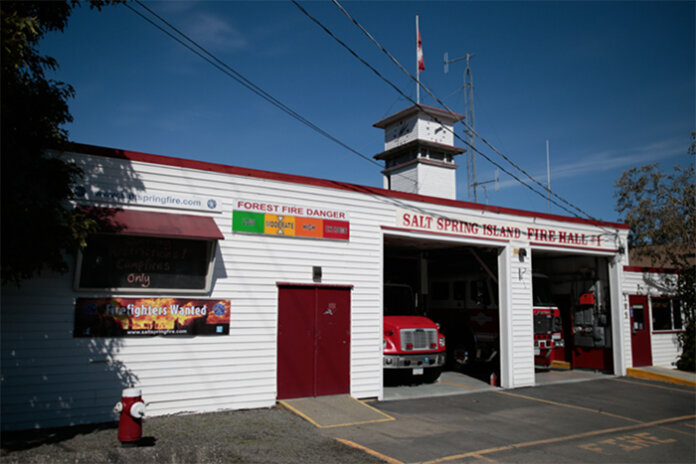
Salt Spring officials won’t have to raise taxes to maintain the old Fire Hall No. 1 in Ganges next year, having found efficiencies within the budget to both maintain the 73-year-old building and slightly drop a projected tax increase.
Salt Spring’s Local Community Commission (LCC) managed to shave a little more than $62,000 off the taxpayer’s portion of their provisional spending plan Thursday, Jan. 29, even after a modest increase in the budget to maintain the soon-to-be-vacant fire hall.
Ownership of that hall is being transferred to Capital Regional District (CRD) ownership for the princely sum of $1, following terms of a 2021 memorandum of understanding between that body and the Salt Spring Island Fire Protection District (SSIFPD). That agreement has SSIFPD retaining control of the hall until four months after the new fire hall on Lower Ganges Road is occupied — and created an easement allowing the fire district to construct and maintain a 30,000-gallon water tank on the west side of the property for firefighting.
Regional staff told LCC members they expect to assume full responsibility for the old fire hall as early as this summer, and until a future use — and possible revenue stream — is sorted out, the CRD needs to keep up with basic maintenance and security.
“Once it’s transferred over to us, we’re responsible for all the utility costs and security of that building,” said senior manager Dan Ovington, outlining typical expenses such as a phone line for alarm monitoring, repairs and maintenance during the transition period.
“And quite often, when we take over a building, there’s some wiring or similar thing that needs to happen so we’ll use our regular contractors that support our other facilities.”
Ovington said staff would be bringing forward the recent assessment of the building’s compliance with the BC Building Code to the LCC’s meeting Feb. 12 — at which point commissioners could consider what future use options were possible. That’s the LCC’s monthly evening meeting, he said, and staff had set aside most of that time for commissioners to bring those possibilities to the public for their input.
“The current occupancy permit is specific to a fire department,” said Ovington. “So in order to put in anything outside of that — there are limitations.”
The net impact of Thursday’s budget discussions will be a one per cent reduction in the tax increase projected for 2026, from an anticipated 9.5 per cent bump to 8.5 per cent — a somewhat hard-fought shift that went back and forth across the meeting. While commissioners found themselves acting with less unanimity than when they began three years ago, CRD director Gary Holman took a philosophical approach to those disagreements, opining the level of discourse was something to be envied, not avoided.
“I think, after our third budget, we disagree on some outcomes because our discussions are more productive,” said Holman. “Everybody, myself included, has a better understanding of the various budgets. The discussion we have here, this is the kind of discussion that we should be having at the [CRD] board level.”
The LCC’s Feb. 12 meeting will be held at SIMS starting at 5 p.m.