
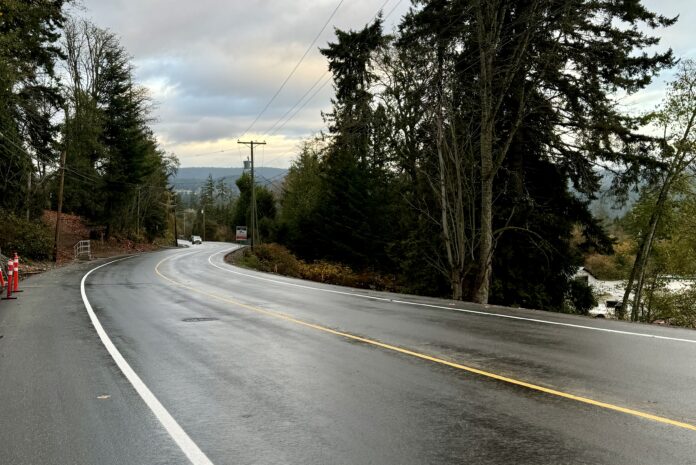
Difficult as it might be to imagine, there will be a day — soon enough, according to the contractor — when Salt Spring drivers, cyclists and pedestrians will find themselves on Fulford-Ganges Road without the accustomed company of heavy equipment and friendly flaggers.
It will be a welcome change, agreed Northridge Excavating Ltd. project manager Bob Mitchell, and a somewhat gradual one — there will still be weeks of small-scale work at intersecting driveways, for example — but a big change nonetheless.
“I feel like maybe I’m in the same boat as Salt Spring Islanders,” said Mitchell. “Suddenly we’re going to be done, and the road’s going to be there. Now I’m kind of wondering: what am I gonna do?”
He laughed. “This project has been my life for the last year.”
Indeed, the first flashing barricades and road plates showed up in September 2024, as work on the 1.6-kilometre stretch of Fulford-Ganges Road from Seaview Avenue to Cranberry Road began in earnest. Notably, those first steps were accompanied by a public notice estimating completion by November 2025, although officials with what was then known as the Ministry of Transportation and Infrastructure (now Transportation and Transit) soon after revised that projection to “summer.” Environmental issues — and an incident in May that seemingly disturbed archaeologically significant midden soil — subsequently compounded already slowed work, both from unpredicted weather and additional subsurface surprises; several steps toward completion were delayed, and at arguably critical junctures.
But one significant obstacle is being addressed, albeit somewhat temporarily: the notoriously-recurring sinkhole at the bottom of Ganges Hill will be mitigated, Mitchell explained, through a combination of a robust redirection of much of the water that causes it, and a switch to more involved road construction techniques. Work taking place Monday, Nov. 3 would involve an engineered pavement reinforcement system called GlasGrid, he said, commonly used anywhere a road needs to be stronger to avoid reflective cracking — and typically sandwiched between two asphalt overlays.
“It’s basically glass filaments that you lay between those layers,” said Mitchell. “We’re putting down 120 millimetres of asphalt in total; this week we’ve completed the first 60 millimetres, and Monday we put the grid material down and then the top layer.”
A permanent fix in the months or years to come would likely be a significant effort, incurring comparably large expenses and causing further traffic disruption. Mitchell agreed removing and replacing culvert pipe beneath the road at that point would be a “significant piece of work,” and require additional provincial designs and approvals.
“This system should hold things together until that decision is made,” said Mitchell. “There are a lot of different desks a plan has to go through, but that’s how you get the quality project at the end; this road has been built to a very high standard now.”
The drainage system both beneath and flanking the roadway deals with the tremendous amount of water that comes down off that hillside, Mitchell said — capturing it, directing it away from the road and avoiding the “soft spots” that can come from oversaturation. There are actually two drain alignments, he said, one from Cranberry Road down to Alders Avenue and another below that.
Up at Fulford-Ganges Road’s intersection with Beddis Road, despite improvements in drainage — and a lifting of the approaching road surface, making it easier for drivers to see over their own hoods — islanders going uphill from town have already had to adjust to something new there: not being able to turn left into the lane now clearly delineated as Beddis’ downhill-toward-Ganges merging lane.
“We realized early on, Beddis was a very, very uncontrolled intersection,” chuckled Mitchell. “When we were working up there, we were writing some things into the daily traffic control plan like, ‘block people from driving into the merge lane,’ and the traffic controllers — especially if it was like their first day on Salt Spring — would ask why we had a ‘no entry’ sign there, and we’re telling them, ‘yeah, people are going to do this.’ Hopefully people are happier with a safer intersection.”
While workers coming from off-island often saved time by picking up some needed items locally — “You wouldn’t believe how often we’ve gone down to Windsor Plywood, especially over the last month or so,” laughed Mitchell — the growing sense that the project might never end taxed Salt Spring’s capacity for patience. Despite some notable reports of drivers and pedestrians reaching the end of their ropes, Mitchell said the overwhelming majority dug deep and stayed civil — and many were even encouraging.
“Really, most of our interaction with locals has been positive, and I mean that honestly,” said Mitchell. “And it really gave us a boost every time someone rolled down their window and said ‘hey man, I hate this — but I love you guys and what you’re doing.’ People were excited for the final product at least.”
And while at press time the weather for the week didn’t look particularly promising — a pavement-marking plan for Thursday, Nov. 6 seemed likely to get a rain delay — Mitchell said there would be crews out on the road until it was perfect. Engineers and road designers are “amazing,” he said, but it’s impossible to predict everything from a desk. Over the coming weeks, Mitchell and his team will continue going over the tiniest details with the ministry’s representatives to get it right.
“We finish all the major parts — put in pipes that are just big, with this much gravel and this much asphalt etc. — then you get to the end and you have all these little things,” said Mitchell. “You need to get on the ground to see what’s most effective, whether you’re draining water, getting more cars through or just making something safer.”