
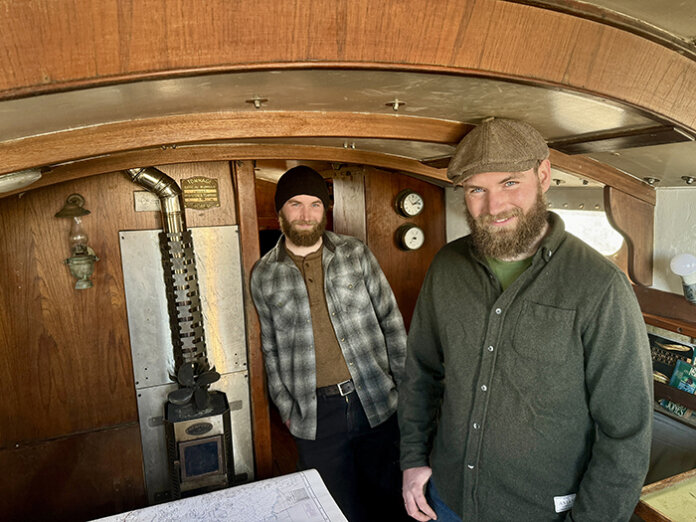
Salt Spring’s Callum and Cianan McGuffin seem eager enough to spend a little time ashore after completing a global circumnavigation Friday, Feb. 20 — in a sailboat older than the two of them combined.
But islanders should not expect the McGuffins to go too long between adventures. The brothers, now 26, learned to sail at the Salt Spring Sailing Club, as junior members racing 420s — they both pointed from the dock and smiled, having tied up Saumure only metres from where they first found a love of sailing.
They felt the call of adventure early on. Crewing aboard various boats across B.C., they found themselves choosing increasingly daring trips. After completing the storied Race to Alaska in 2019 as the then-youngest sailors in race history — in a “leaky little J/24,” Cianan chuckled, with third brother Finn and compatriot Conner Ekelund — the pair scarcely seem to have paused, working to set aside funds for a new journey. They started boat shopping — on a budget — landing on a 30-foot Hunter-Vogel built in 1970.
“There wasn’t a huge range of options,” laughed Callum. “But this one is old, with really thick fibreglass, a solid hull and full keel — and heavy. That’s what we were looking for. We bought it for $7,000, so it was well within our price range.”
The interior plywood was rotted, so much of it was replaced along with every single window. Callum was working at Leitch and McBride Sailmakers in Sidney at the time, he said, so he stayed late in the evenings and built Saumure’s sails.
Right from the start they’d been keen on sailing the Northwest Passage, but with pandemic restrictions that was off the table. A co-worker had regaled them with stories of sailing to New Zealand back in the 1990s, so they set off to do that — leaving Salt Spring Island on July 18, 2022.
They characterized the crossing to Hawaii — itself often a sailing “bucket list” trip — as a sort of “test run,” and said there had been some rough weather but all downwind. Coming into New Zealand was tougher, Callum said — 30-foot waves, a big storm with strong winds. At one point the anchor, which had been tied down on the bow, broke free.
“I was up on the bowsprit, holding on with one hand and trying to get the anchor tied off with the other hand, and then this wave came along,” he said. “And you can hear them coming, it’s like a rumble as they come in. It swept me, ripped my hand off the bowsprit and threw me against the mesh. I was tied on, so it wasn’t real danger, but it was a little unnerving.”
“There’s so much water coming over the decks,” agreed Cianan. “It all comes down through the hatches, down through the air vents, basically anywhere it can. And when you’re on deck, you’re just looking up at a wave, way up above you.”
After that harrowing finale to their five-month journey, they figured Saumure could probably get through just about anything. So after a “quick” two-month hike across the length of the South Island Te Araroa and a jaunt over to Australia to drive the Great Central Road, the pair flew back to their little boat to pore over maps and decide what to do next.
“So we’re looking at the charts,” smiled Calllum. “And when you look at it, it sort of looks like you’re halfway around the world.”
Cianan laughed. “It turns out you’re nowhere near halfway.”

Crossing the Indian Ocean, they “accidentally went through a cyclone,” Cianan said. Surprisingly it wasn’t the storm itself but rather the anticipation of it that was most disquieting.
“Seeing the cyclone on the chart coming toward us, and there’s nothing we can do to get out of its way,” he said. “That was unnerving.”
“So we came up with the idea, since cyclones spin clockwise in the southern hemisphere, we could just go down to the south of it and tuck in close,” said Callum. “We’re calling it the ‘cyclone slingshot,’ and it worked pretty well — we took like two weeks off our crossing to South Africa.”
“I don’t know if I’d recommend it,” chuckled Cianan. “But yeah, it worked well.”
After what had become a 34-day crossing to Richards Bay, between bouts with thieving monkeys they were warned about the Agulhas Current, a powerful south-board stream along South Africa’s east coast that moves like a nine-knot river. Picking the right weather was critical, they were told — quite often the wind and current run against one another, making for steep and dangerous waves.
“But along the route, everyone had always been telling us everything was ‘too dangerous,’ and how we shouldn’t be doing stuff, so we didn’t really pay much attention,” said Cianan. “It turned out in this case, they were right.”
They left Richards Bay with 70 knots of wind against them, and the current behind. Callum and Cianan estimated it was five days of 40-foot waves, water coming through hatches, a bilge pump struggling to keep up and practically no sleep — they had to keep extra watch, as they were also right in a shipping channel.
The reward was Namibia — like nothing they’d ever seen — giant sand dunes coming right down to the ocean. They visited shipwrecks and endless stretches of sand with virtually no humans around.
Then they had to decide between several options to get back home to Salt Spring. The Panama Canal would be expensive, they realized — and arguably not particularly exciting. Rounding Cape Horn would be practically the definition of excitement, but given the time of year they were going the wrong way and would be sailing upwind the entire time.
That put the Northwest Passage back on the menu. They went on to Saint Helena, a remote island in the middle of the South Atlantic, and began what became their longest and most gentle crossing of the trip — 54 days of good wind and weather, Callum said. Just past Bermuda, they were awakened to the sound of fermenting cans exploding in storage beneath their bunk, leaving them with an unpleasant smell below-deck and little in provisions — two kilograms of oats and “whatever fish we could catch” for the last two weeks into Halifax.
But they’d made it. Leaving Saumure in Nova Scotia, they came home to work again, then flew back to sail up to Greenland’s Disco Bay and meet the first of the trip’s icebergs. At Pond Inlet on Baffin Island, they learned there was ice moving east through Lancaster Sound.
“Coming to the Northwest Passage, we were so far behind schedule,” said Cianan. “And it just meant the weather was getting worse and worse and worse. But we just had to keep going.”
Turning south, they went through Prince Regent Inlet and “five- to seven-tenths ice coverage.”
“It’s like a maze, trying to find leads through the ice,” said Cianan. “It was actually pretty fun, if intimidating at times — sometimes you choose and don’t make it all the way through, and then it starts closing up behind you.”
Prince Regent featured a polar bear that swam after them for longer than they expected it might, followed by a stop at the long-abandoned Hudson’s Bay trading post at Fort Ross. Favourable ice-free conditions at treacherous Bellot Strait gave them access to King William Island and Victory Point, where they saw old sled runners and assorted other debris from when the Franklin Expedition crew came ashore, abandoning their boats in 1848 — and two more polar bears, cutting the McGuffins’ exploration short.
The real ice choke point was expected to come through Amundsen Gulf into Tuktoyaktuk, Callum said — but they stuck close to shore, sailing in relatively clear shallow water. The highly rustic sauna on Herschel Island was too alluring to bypass, and indeed kept them there two days — but from there it was one long journey all the way around the northern half of Alaska.
This leg was not without misadventure; at Point Barrow the wet exhaust fell off Saumure’s 16-hp engine, soaking the electronics and putting the motor out of commission and forcing several days of tedious upwind sailing. Once they got it running again, the clutches failed, so they carried on under sail power all the way to Nome, Alaska.
Accessing the clutches required lifting the engine, something accomplished by using Saumure’s boom as a makeshift block and tackle.
“We were able to switch our forward and reverse clutches,” chuckled Callum. “So we could go forward!”
After three weeks in Nome, they decided they couldn’t watch the ice thicken any longer — and seized a six-day weather window to make it to the Aleutians just before another storm. The stretch south through those islands was beautiful and easily among their favourites, they said. Near Bella Bella, Saumure broke her prop shaft; after spending almost a month and a half there — mostly waiting for the new shaft — they set off for the last 10 days’ journey to Salt Spring.
What was going through their minds in that last week?
“Honestly we thought a lot about what food we would eat when we got back,” laughed Cianan. “We actually had a notebook with everything we thought of that we wanted to eat. A long list!”
Three years, seven months and two days later, and after charting 37,070 nautical miles (68,654 kilometres), they sailed into Salt Spring, flanked by a welcoming flotilla from the sailing club. Saumure is moored there, at least for now; Callum said even while they were going through the Northwest Passage they were already plotting how they might return — with a more leisurely schedule and stopping more places, maybe even freezing the boat in somewhere and taking two full summers to explore.
Also in their minds for the future is something more “human-powered,” they said, revealing they’re mulling a canoe voyage across Canada.
For now, logging a trip around the world via the Northwest Passage is a rarely completed challenge to savour — the McGuffins believe they are just the 15th Canadian sailboat in history to manage it. Both brothers said their advice to would-be adventurers is to stop focusing on the obstacles and simply get out there.
“I would say just actually do it,” said Callum. “Everything is a lot easier once you start doing it; things are much more achievable than people think they are.”
Follow McGuffin Brothers Adventures on Facebook or at their criminally undersubscribed YouTube channel: @mcguffinsailing3715.