
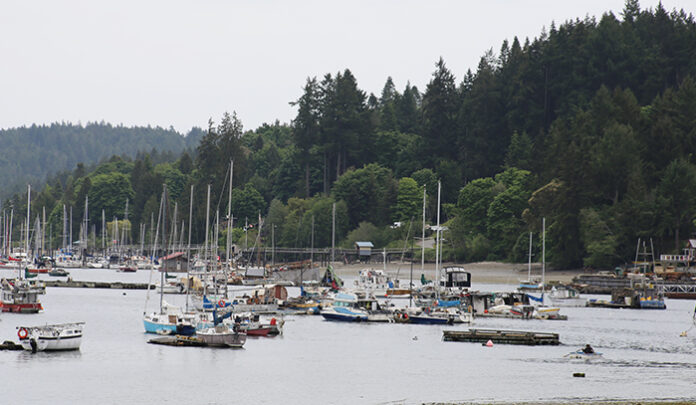
Salt Spring’s Local Community Commission (LCC) and Local Trust Committee (LTC) met jointly Friday, Feb. 28, the latest in a recent series of intergovernmental gatherings between the two that — for the first time — drew a crowd.
A discussion of harbour management was on the published agenda, and harbour users and residents filed into the meeting to ensure their voices were heard, over fears actions were being taken without their input. But despite reassurances — no decisions could be made during the two-body meeting, LCC chair Earl Rook noted early — concerns persisted that the most affected islanders were being left out.
That may not be an entirely unjustifiable position, locals argued; last spring, as the Capital Regional District (CRD) held its first early workshop meeting over “Collaborative Action to Resolve Boat-Related Issues in the Capital Region,” nearly 60 elected officials, staff and representatives from First Nations, regional government and municipalities attended to consider developing a regional service that might address the proliferation of private mooring buoys within CRD waters.
But representatives from the Harbour Authority of Salt Spring Island (HASSI) were not invited, nor were they allowed to attend when they asked.
“That was a direct request, from us to the CRD, to be included in that meeting,” said HASSI board chair Corey Johnson on Friday. “And we were flat-out denied, because we were not a government agency, because we are a nonprofit.”
And Salt Spring Islands Trust trustee Laura Patrick said that while the LTC had been invited participants, when the report from the meeting eventually came out they weren’t contacted for their thoughts regarding recommendations surrounding the establishment of a regional harbour service.
“The [CRD] Board did say it wanted feedback from all local governments, [but] we weren’t sent a copy of the report and asked to give feedback,” said Patrick. “I don’t know how this local government fell off the table, [but] we gave feedback anyway; we wrote a letter in support of the recommendations.”
Another group seemingly not at the table are the “liveaboards” themselves. Retiree Terry Greupner said he’s been a “harbour homeowner” living afloat for nearly two years, and felt the positive work being done by those on the water had been largely overlooked — including their assistance with what he said were some 40 derelict boats pulled out of the harbour in the last year. Greupner praised the work of Eagle Eye Marine’s Nick Boychuk and Transport Canada’s recent efforts, estimating there were around 135 vessels offshore at Ganges currently.
“And 35 per cent of those out there are liveaboards, full-time,” said Greupner. “These are people that do great and abide by the rules. We have some that aren’t, but there’s a problem with that everywhere.”
Clean and Safe Harbours Initiative (CASHI) spokesperson Glenn Stevens reiterated his call for that group’s self-styled harbour management plan, which among other suggestions would limit the number of liveaboard buoys in Ganges Harbour.
“Because we don’t want all of Canada and B.C. showing up,” said Stevens. “We think a parking lot scheme would be a good idea, where you get a permit to park in a certain space; we limit the number, we avoid congestion and confusion.”
But Greupner said the floating community was capable of meeting many of its own challenges.
“I’m going around finding out who owns boats, who doesn’t own boats, who’s on the [mooring] pins,” said Greupner. “They’re cooperating with me because I’m there on the water, working with them. That’s very important. They trust me, and I trust them.”
As far as a regional harbour service, for the moment it all might be moot regardless; CRD senior manager Stephen Henderson pointed out that the funding for that service was never approved.
“It was more environmental management-focused,” said Henderson, “but there is no funding for that service in the 2025 budget, so any activities that service was going to do in 2025 are really not moving ahead at this time.”
And until funding manifested, officials said, there was little they could do. Salt Spring LTC chair Tim Peterson noted the cost to implement even the simplest regulatory schemes — much less enforce them —was likely beyond either body’s budget; but, he added, as elected officials it was worth their time to coordinate.
“We can continue to think about strategies on how we can work together,” said Peterson. “And I think one of those things that’s important to consider is how we might jointly advocate to other levels of government — that have the money — to help us figure these problems out.”
Islands Trust regional planning manager Chris Hutton pointed out that the LTC was still at the very early stages of its project updating Salt Spring’s Official Community Plan and Land Use Bylaw, which might provide an opportunity for islanders living afloat to weigh in.
“We’re developing a very inclusive process of engagement,” said Hutton, “and we want to hear about housing issues, and identify where there are gaps in making sure housing is available, affordable and diverse.”
And while the liveaboard community was not currently identified as a specific stakeholder group for the process, Hutton said, it could be.
“We’re committed to working with the nonprofit and third-sector bodies,” he said. “So if the input is directing us to explore the matter of housing on liveaboards, then it’s something we could do.”