
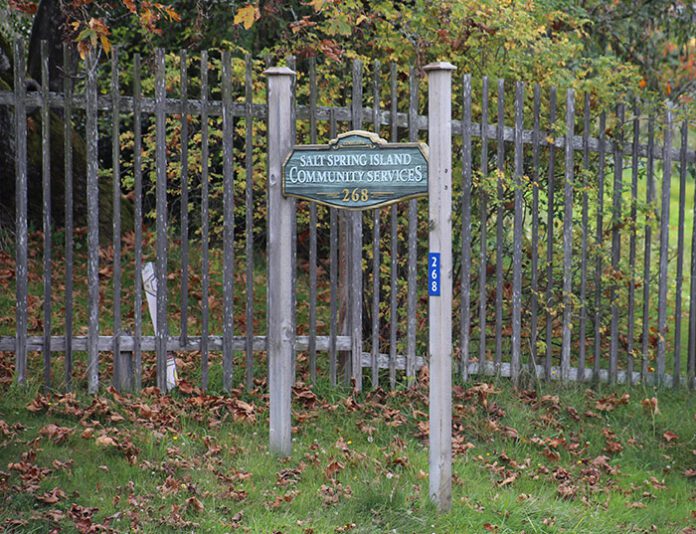
Using a little less than an hour, the board of what is perhaps Salt Spring Island’s most visible non-profit navigated a potentially turbulent annual general meeting (AGM), with directors and staff by the end delivering operational and financial reports — and a little history — to a space-limited but engaged public audience.
Island Community Services (ICS) — which still receives correspondence under its old name, the Salt Spring and Southern Gulf Islands Community Services Society — turned 50 this year, according to executive director Rob Grant; Grant presented a report Thursday, Sept 25, highlighting some of the charitable organization’s historical high points and hopes for the next half-century.
A recap of ICS’ fiscal picture followed, showing what finance committee chair Darryl Martin called a “return to stability after the tumultuous Covid years” — with last fiscal year’s operational budget closing out with a modest surplus against a two per cent decrease in revenues. Martin said donors were increasingly giving stocks and other securities, as well as committing to ongoing periodic donations; just five per cent of SSICS’ revenue came from donations, he added, with the lion’s share coming from governments and government-related sources through service agreements.
The largest funder was — as it had been for the last five years — BC Housing, which he said made up 21 per cent of the total budget.
“The trend continues of the largest portion of ICS’ budget going towards the basic needs program areas,” said Martin. “Food, shelter and housing made up 46 per cent of expenses.”
Martin said that SSICS owns half of the 14 properties it operates, assets valued at about $20 million, and between BC Housing operating agreements, forgivable loans and operating revenue from some properties, the nonprofit reduced its mortgage debt last year.
“We enter the 2025/26 year with some caution due to continued inflation, projected provincial government deficit, provincial labor and union wage demands and a general economic unease,” said Martin. “ICS has only modest cash reserves, so operational expenses will be managed carefully.”
Re-elected by consensus of members were returning directors Jennifer Lannan and Gary McNutt, as well as relative newcomer Colin How, recruited six months ago and now beginning his first full two-year term.
In response to a question from How, Lannan confirmed that the board of directors themselves constituted a majority of ICS’ current membership. Directors recently adopted a membership process that required 20 hours of volunteer service with ICS each year, in addition to director approval — a change that roiled community members who felt their attempts to participate in guiding the society’s future were being stymied.
Indeed, among the handful of non-members allowed into what they were told was a 25-person-capacity room were several who expressed displeasure, particularly with the board’s initial insistence that only members be allowed to ask questions.
Directors relaxed that policy as the meeting went on, and heard public concerns on issues ranging from inadequate safety for frontline staff and affordable housing tenants to broader notions of accountability.
How calmed some tense early moments by promising non-members that he and Martin would be hosting a “public Q&A” soon, and later by further expressing his earnest willingness to improve ICS.
“Six months ago, I joined this board because I was concerned,” said How, “There has definitely been a history of challenges with [ICS] that I couldn’t possibly wrap my head around. And I’m not going to deny it or act like some of those things didn’t happen or aren’t happening — but what I can say to you, with all of my heart and effort, I’m committed to the idea that this organization is going to be running properly going forward. And so are all of my board mates.”
ICS’ full annual report is available at its website, saltspringcommunityservices.ca.
—
This article has been updated since publication; an earlier version of this story misspelled the name of director Colin How.