
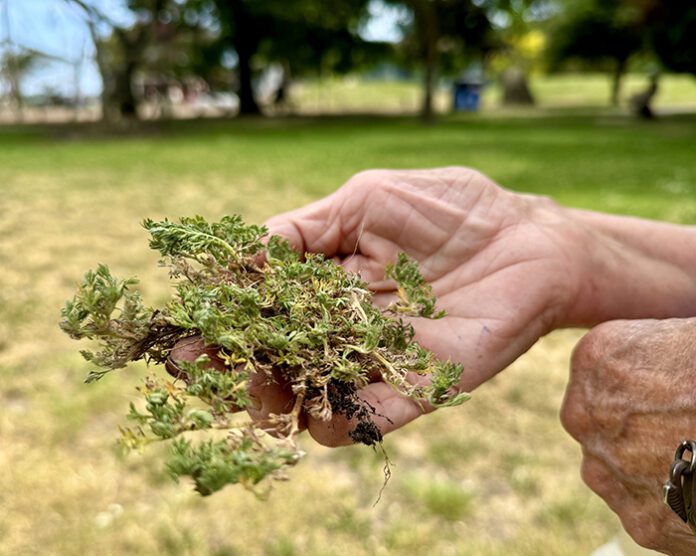
An invasive plant species never seen in Canada before it was discovered at Salt Spring’s Ruckle Provincial Park in the 1990s is cropping up again in the heart of Ganges — and biologist Kathy Reimer warns it could make Centennial Park ground zero for a new botanical outbreak.
Volunteers are working to remove carpet burweed, or Soliva sessilis, found growing in large patches on the hillside approaching the wharf. A winter annual native to South America, the plant’s discovery at Ruckle Park in 1996 sent alarm bells through the conservation community, as the inconspicuous dense groundcover can rapidly out-compete native species — and produce as many as 200 sharp, spiny seeds per plant.
Reimer and a handful of volunteers have been helping keep Ruckle Park’s carpet burweed at bay, protecting threatened species through an ongoing effort to identify, dig up and dispose of the tenacious plant. Carpet burweed spreads via its often-painful spiked seeds, hitchhiking on animals, clothing, blankets and even leather shoes.
On June 10, while the week’s Tuesday Farmers’ Market carried on in the background, Reimer and volunteer Tristan Haenep again walked methodically through Centennial Park, carrying plastic bags and butter knives, their eyes decoding the subtle differences between carpet burweed and less noxious “imposters.”
Another introduced plant, pineappleweed (Matricaria discoidea), looks a lot like carpet burweed; the giveaway, according to Haenep, is that only one of them smells like pineapples when crushed between fingers.
For a closer inspection, Haenep knelt with a knife, loosening the surrounding dry soil to pluck likely offenders out whole. Reimer raised her hand to show a tiny burweed seed that had pierced the skin, hooked into her thumb.

“They’re getting revenge on you!” laughed Haenep. “It’s so rough on pets’ paws, too. They’re super effective at hitchhiking to somewhere else — then wherever you pick it off, it starts growing there.”
Patches of burweed are too low to the ground to be effectively controlled with a mower. Reimer said she warned parks crews that mowing only spreads the seeds faster. The plants can be pulled out or — when the ground is wet — burned with a torch, ideally when it first pops up in spring. The shallow roots are relatively easy to remove without leaving anything behind, but the little seeds are eager travellers. Reimer advises parents to check their children’s clothes after visiting Centennial Park, as well as blankets and shoes.
“People think they’re looking for a little thing like a burr,” said Reimer. “But it’s got like a fishing hook.”
Reimer credited her visiting son James for the recent discovery of the plant in Ganges. His experience, she said, “following mom around” to pull out carpet burweed at Ruckle Park paid off.
“I don’t get why it was missed all these years,” said Reimer. “But these are some of the biggest plants I’ve encountered.”
Haenep said conditions at Centennial Park were likely ideal for larger plants to grow, considering the park’s broad sunlight and irrigation. Reimer said she doubted the seeds of this carpet burweed outbreak came directly from Ruckle Park, at least not recently, as the problem weed has been well managed there.
“I think we averted a terrible thing by getting on much of this before it all went to seed, because this is the farmers’ market,” said Reimer, gesturing back toward the tents. “They could end up with it on their farms.”
Reimer, Haenep and a small group of volunteers — largely drawn from the ranks of the Island Stream and Salmon Enhancement Society — stepped up on an ad hoc basis, and have already removed several large trash bags’ worth of carpet burweed from Centennial Park by hand. Capital Regional District (CRD) senior manager Dan Ovington said the CRD’s invasive species coordinator had been notified, and Reimer said they were hopeful a grant from BC Parks would help facilitate a detailed, accurate GPS map of the outbreak.
In the meantime, society members are out in small groups whenever they have time, digging, bagging and counting the plants — and, Reimer said, they wouldn’t turn down a little help, financial or otherwise.
“I saw the volunteer broom cutters from Ruckle come with their canes,” chuckled Reimer. “Everybody’s getting old! We’d appreciate anybody who wants to help us get back to doing our work on the creeks.”
To join the effort, email saltspringsalmon@gmail.com; for more information about carpet burweed visit crd.ca/media/14145.