

BY ROBIN JENKINSON
Pop Quiz: What celestial event do we celebrate with Nettlefest?
Answer: Spring Equinox!
The early spring growth of nettle greens coincides with these days when light hours surpass the darkness of winter. Stories of nettles from around the world feature themes of respect, protection, healing and magic. In Celtic lore, nettles grow where faeries dwell. Nettle celebrations offer us nature connection through traditional plant knowledge.
As a perfect spring tonic, nettles contain many vitamins (A, C, K, B, iron and more) and offer many medicinal benefits. Abundant and free, nettles are an important food source for sustainable and resilient island food systems.
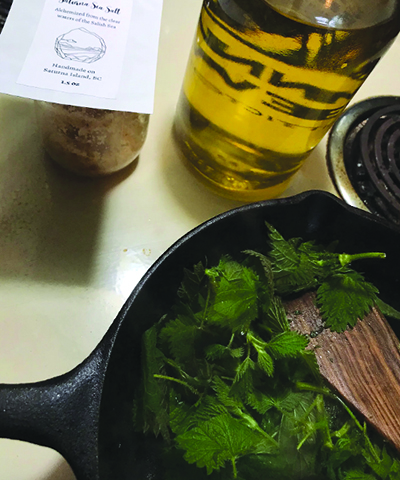
Enjoy nettle tea or cook the leaves and soft stems like spinach in any recipe. Each spring, I make enough enough nettle-garlic pesto to freeze for the year. Nettle lasagna is a real treat, and nettle spanakopita is our Easter weekend tradition. Read on for more tasty nettle ideas!
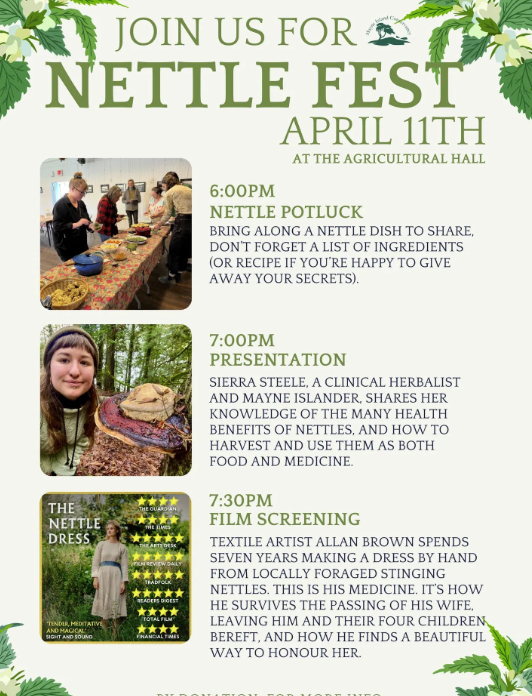
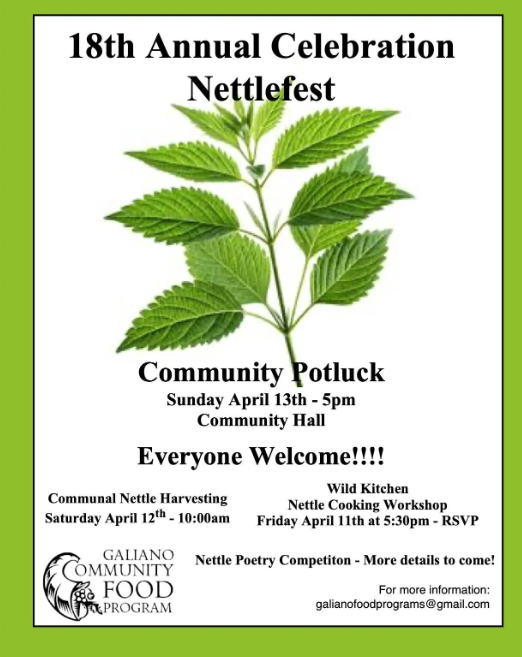
While Saturna celebrated Nettlefest on March 29 with an inspired six-course nettle meal, you still have time to partake and participate in Mayne and Galiano’s upcoming celebrations on April 11 and 13, respectively.
At nettle workshops this past weekend on Saturna Island, Sharon Kallis, author of Common Threads: Weaving Community through Collaborative Eco-Art and lead instructor with EartHand Gleaners Society, wore an entire outfit she’d woven of nettles! She also brought cordage, dyed yarns and nettle baskets. Participants foraged for Saturday’s fabulous nettle feast. For the Sixth Annual Saturna Nettlefest 2025, chef Hubertus Surm of Saturna Island transformed heaps of nettles into a six-course feast for 31 people. He was assisted by Sam Fache in the kitchen, with dessert made by Peggy Warren. Shirlanne Johnson decorated the space with wild edibles and spring blossoms and served alongside Raeanne House. Paired wines were from Sage Hayward Vineyards.
The menu ranged from Nettle Soup (a French delicacy) to Haida Gwaii Halibut with Nettle Pesto, and was topped off with Nettle Ice Cream with Nettle-Lime Macarons.
The jolly event featured Nettle Poetry by Ralph Cartar, Nettle Trivia with Robin Jenkinson and Ryan Dentry, a Toast to the Nettle by Sharon Kallis, and random readings by Athena George from 101 Uses for Stinging Nettle, describing applications from ulcer treatment to erotic flogging.
Throughout the Gulf Islands, fibres from dried nettle stems were used by W̱SÁNEĆ and other peoples to twine cordage, then woven into fishing nets and ropes in the winter. 1 Interestingly, the SENĆOŦEN name for nettle, ȾEXȾEX, is also used for “oyster,” because, as Carl Olsen explained, when harvesting, they both make your hands sting.
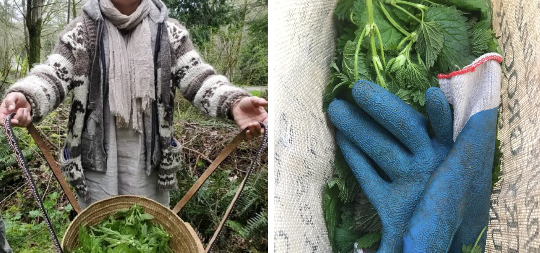
The best way to harvest nettles for eating is with rubberized garden gloves, latex, or other thick mitts and a big bag with handles. Gently snap off the tip and the top six leaves or so of each nettle plant and stuff them into your sack, compacting as you go. This allows the plants to resprout and feed wildlife. Make sure to leave some whole plants for the many species of pollinators who depend upon them for early nectar and caterpillar food.
Next day, I’m en route home to Salt Spring. My body feels replete and I’m well-provisioned with nettle breakfast. I feel better connected to this community and landscape through my primal belly. One of my fingers still tingles from nettle stings.
A sackful of freshly harvested nettles hangs from my bicycle handlebars . . . What would you make? Perhaps Deb Foote’s almond-nettle cake recipe (from her great nettle article on the mayneconservancy.ca website). Perhaps a warm honey tea for the bathtub? Or maybe they’d best be blanched and frozen in anticipation of the upcoming nettle potlucks at Mayne and Galiano Nettlefests.
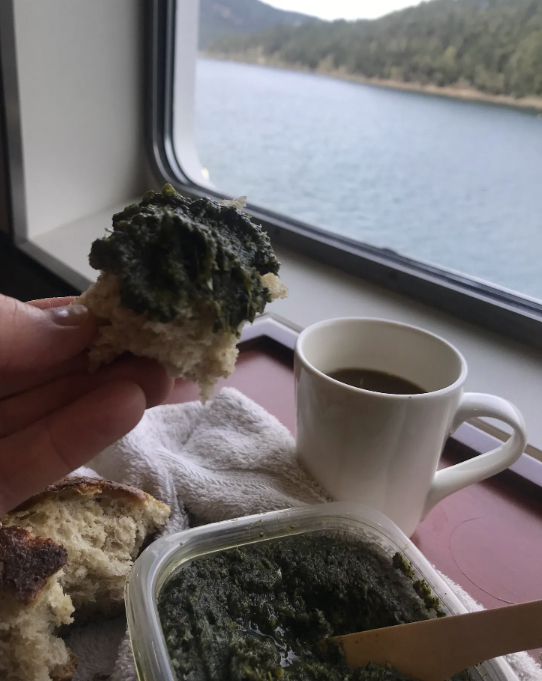
The window for harvesting young nettles here is short. They’re stringy and less nutritious once they flower. Luckily in this area, seasonal locavores are spoiled with a diversity of wild and farmed foods (check out maple flowers, clams and over-wintered carrots and beets right now). Otherwise, we’d run the risk of ending up nettle-green, like Milrepa, the 11th-century Tibetan Buddhist disciple who meditated in caves for years, eating only nettles, which turned his skin green, gave him a green aura and contributed to his enlightenment.
Thank you to Shirlanne Johnson and Heather Michaud for sharing their photographs.
1 “The Saanich Year” – by author Earle Claxton; author/illustrator: John Elliott. Published by the Saanich School Board #63.
The above article was first published on the author’s Substack site and shared with the Driftwood for publication.