
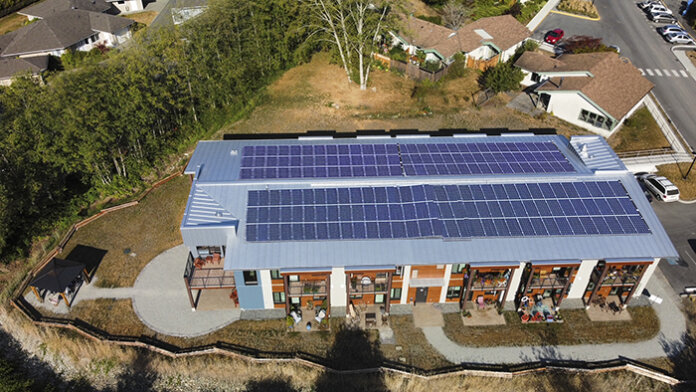
BC Hydro’s plans to shift how it pays rooftop solar customers for electricity they generate has been approved by the B.C. Utilities Commission (BCUC), a move local clean energy advocates say has likely upended financial viability for community solar generation on Salt Spring Island.
The independent regulator issued its decision on the utility’s net metering program Wednesday, March 24, replacing the current scheme with new “self-generation” and “community generation” service rates that set compensation at a flat 10 cents per kilowatt-hour (kWh).
But those rates come without contracts, according to Community Solar Coalition’s (CSC) Kjell Liem, who said the decision demonstrates how easily BC Hydro can change its structure.
Liem lives on Salt Spring, where the grassroots CSC grew out of the island’s 2016 Community Solar Summit. He said that unlike power purchase agreements, the new programs have no inflation adjustment mechanism — so the actual price will decline as electricity rates inevitably go up.
“It’s just not viable on the Gulf Islands,” said Liem, who had travelled to Vancouver in November to take part in BCUC’s public hearing process.
The two intervenor groups with direct interest in the Community Generation rate — both CSC and the Vancouver-based EcoSmart Foundation — opposed the new rate as presented; both had been part of the Net Metering Working Group.
Liem said the new rates and future uncertainty might not dissuade solar projects that had free access to acreages and federal financial assistance, but there were too many risks for smaller producers — such as community solar projects envisioned to build resiliency on islands.
“Despite over a decade lobbying for a shared solar rate, it’s unlikely that Salt Spring will be able to make use of the Community Generation rate,” said Liem. “It’s hard, if not impossible, to find the ‘community’ part of BC Hydro’s rate.”
The program also includes what BC Hydro has called “safeguards to ensure community participation” — a framework that adjusts the maximum amount of electricity that can be sold to the utility based on the number of participating customers. In its decision, the BCUC said it agreed with BC Hydro’s assessment that if rates were left unchanged, non-participating ratepayers would be gradually subsidizing an increasing share of program costs.
The new rates both take effect July 1, although net metering service rate customers who did not receive any rebate for their solar panels will have 10 years from the date they joined the program to transition to the new rate, according to the commission.