Home Blog Page 2

Women, leadership and local politics in focus at Prime Minister film night

SUBMITTED ARTICLE

Salt Spring is a place where people care deeply about their community, and don’t shy away from engagement. But when it comes to who steps forward to lead, some voices are still missing.

On Saturday, May 9 at 6 p.m., ArtSpring will host an evening that invites a more open, honest conversation about what leadership really looks like and who it’s for.

The night begins with a screening of Prime Minister, a documentary about former New Zealand leader Jacinda Ardern, who argued that the most important leadership qualities are the same ones we try to teach our children: empathy, curiosity, bravery and kindness.

That conversation will then come closer to home, with a panel of Islands Trust Council chair and local trustee Laura Patrick, Salt Spring Local Community Commission member Gayle Baker and Central Saanich councillor Sarah Riddell.

Together, they’ll speak candidly about their experiences in public life: what’s rewarding, what’s difficult and what often goes unspoken.

“Politics can look harsh and impossible from the outside, and for that reason, many people think it’s not for them,” said Riddell. “And of course there are tough moments, but there are so many beautiful ones of connection, collaboration and meaningful change. We want to share the full picture.”

Salt Spring has a strong culture of civic engagement, but like many communities, women remain underrepresented among local elected officials.

“Local government works best when it reflects the community it serves,” said Patrick. “And that means creating space for more diverse voices at the table.”

The goal of the evening isn’t to convince anyone to run for office, but to make the idea feel more accessible.

“For me, leadership is simply about the basics: listening, understanding, caring and having the courage to support changes,” said Baker. “Exactly the lessons I taught my children, it is now time for their generation, especially our young women, to move into leadership roles.”

With local elections approaching this fall, organizers hope the conversation will resonate with those who are curious, questioning or quietly considering getting involved.

The event is non-partisan, free to attend and open to all.

Tickets are available through the ArtSpring box office at artspring.ca.

Tsunami Circus troupe ready for Undertow show

SUBMITTED BY TSUNAMI CIRCUS

A wave of energy, creativity and determination is set to hit the stage this weekend as the Tsunami Circus Performance Troupe presents Undertow, an original youth circus production created by creative director Manda Hutchinson.

Featuring 45 island youth aged seven to 17, Undertow showcases the full spectrum of circus arts, including trapeze, lyra, hammocks, silks and aerial cube — and the troupe’s new aerial harness — alongside clowning, acro-dance and prop work. Undertow blends athleticism, artistry and storytelling into a dynamic, high-energy performance. Beyond the spectacle, it’s driven by something deeper: passion. These young performers have been working intensely to bring Undertow to life!

Since January, the cast has built a full-scale show with the support of 35 dedicated volunteer coaches and crew members. From experienced instructors to teens stepping into mentorship roles, the Tsunami Circus program is a true community effort, fuelled by a shared love of circus and collaboration.

Undertow is more than a performance, it’s an immersive experience. Audiences are transported into a world where the human realm and the ocean collide, exploring themes of environmental responsibility, connection and coexistence. Through breathtaking aerial acts and expressive movement, performers tell a story of what happens when nature pushes back, and what it means to care for our ocean world. The visual impact is equally compelling. Striking costumes, bold makeup and imaginative staging transform the Salt Spring Island Multi Space gymnasium into an underwater landscape, brought to life with dynamic music and theatrical flair. It’s a true feast for the senses.

“Undertow allows us all a moment away from everything,” said Hutchinson. “It’s a chance to dream, to be inspired and to see what’s possible when we come together.”

Performances run Thursday, May 7 (6 to 8 p.m.), Friday, May 8 (4 to 6 p.m.) and Saturday, May 9 (1 to 3 p.m. and 5 to 7 p.m.). Tickets are available at West of the Moon (cash only) or online via the ssicircusandgymnastics.com website.

Suitable for all ages, Undertow promises to inspire audiences young and old with its powerful message, stunning visuals and remarkable local youth talent.

Firefighters extinguish Stark garage blaze

0

While a recent blaze at a property on Salt Spring’s north end was quickly extinguished by firefighters, officials still cautioned vigilance — warning that a potentially dangerous fire season on the island is only just beginning.

About 15 Salt Spring Island Fire Rescue (SSIFR) personnel and multiple vehicles raced  from both ends of the island Friday, May 1, responding just after 1:30 p.m. to a call of a structure on fire in the 400 block of Stark Road. When they arrived, firefighters quickly took over for neighbours who had been bringing water to a burning carport that sent smoke billowing into the sky above the residential neighbourhood.

Crews were able to safely douse the fire, preventing flames from spreading to other buildings; the fire reportedly began on the outside of the carport, although the cause has yet to be determined by SSIFR officials. 

The fire came as temperatures in the region began to climb, and local fire danger level at press time on Monday afternoon remained at “high” on Salt Spring Island, with a two-hour fire watch in effect. The B.C. Wildfire Service advised that early May’s above-seasonal temperatures are expected to increase the likelihood of new wildfire starts. The Coastal Fire Centre has instituted a campfire ban across the region as of noon on Thursday, May 7.

There were 11 calls for structure fires on Salt Spring in 2025, according to the fire chief’s annual report, down from 13 the previous year and 12 in 2023.

For current fire danger rating and restriction information, people should visit saltspringfire.com.

Nobody Asked Me But: What really goes on behind the refrigerator door?

0

Everybody knows that living on an island is, by definition, a political act. Whether divided as north versus south, newcomer versus old-timer, working-class family versus empty nest retiree, or aggressive online entrepreneur versus the laid-back, back-to-the-lander, there’s always a line forming that will divide islanders into different camps.

Nowhere is this more apparent and evident than when you look at the shelves attached to the door or doors of your refrigerator.

What? Excuse me? Did I just say something about refrigerator door shelves? Yes, you heard me right.

Those fridge door shelves are more than just storage space for jars, packages, containers and other foods that don’t efficiently use up room in the main compartments of your refrigerator. No, they actually mark out a virtual pecking order of gourmet delicacies and specialty items that you long ago forgot you had purchased for an obscene percentage of your grocery budget. 

Take, for example, that squat glass jar of Conimex Sambal Oelek Vers Gemalen Chilipepers that has made its way all the way to the narrow top shelf of the door. The ingredients on the label have faded so badly that they are no longer legible. The expiry date is etched on the glass with hieroglyphics and it is impossible to know for certain whether the “best before” year date is BC or AD. To be sure, the Sambai Oelek must have been a key ingredient in an exotic recipe of some Paleolithic drawing chiseled onto a cave wall, but those days disappeared about the same time as the latest eruption of Mount Sambai.

Alongside the jar of Sambai Oelek, and probably just as mysterious in origin, sits a short canister of organic Maison Orphee Yellow Mustard with Turmeric (or, as they say in Paree, “Moutarde Jaune au Curcuma”) that had been verified as Non GMO even though it was probably processed back when genetic modification meant something you did to your pet gerbil when your parents weren’t home.

You may not believe this, but the position of the assorted food containers on the door shelves is by all accounts a contest of high status/low status. As time goes by, they work their way down lower on the door as they get older and it becomes harder and harder to remember why you bought them in the first place. By the time they make it down to the bottom shelf, it’s not worth the effort to bend over low enough to be able to identify which mystery food you are dealing with. In a sense, the bottom shelf of the fridge door is kind of a purgatory for specialty food items. When they reach this point in their nutritional descent, they can be easily hoodwinked into trusting that they are still of some culinary use. They may still believe that they have entered a Witness Protection Program portal for out of date condiments where they will be given new labels and identities. Little do they realize that, because they can’t get any lower on the fridge door, the next stop for that tube of Giovanni’s Gluten Free Anchovy Paste is the compost bin.

Somewhere tucked in the corner of one of your fridge door shelves is your collection of probiotic capsules and tablets. Maybe you’ve got the Double Strength Acidophilus and Bifidus with 10 billion active cells. Or perhaps you’ve stashed some Acidophilus Ultra with 11 billion cells for IBS support and restoration of intestinal balance. Either way, you know you will never open either probiotic in fear of unleashing billions of intestinal bacteria on this fragile earth.

A good way to help you remember where you have placed your precious little brown bottle of Blue Ice Fermented Cod Liver Oil Non-Gelatin caps is to regularly take photos with your camera phone of all the items inhabiting every shelf of your refrigerator door. We call these “shelfies,” and they can really cut down the time it takes to find that Favuzzi “The Artisan’s Way” Green Olive Tapenade before you decide it’s too dangerous to even try to pry open the canning lid. These photos may also help you to locate that collection of restaurant pads of butter and ketchup packages that you were sure you had placed somewhere safe in case of an emergency.

You can never really know what goes on inside your fridge once the door is closed. Just like the 1970s San Francisco comedy group, Firesign Theatre, spoofed in an ad when they described the finer selling points of a refrigerator, “Close the door and the light stays on,” all kinds of nefarious activities may be transpiring on the inside with most of the insidious actions occurring right there on the fridge door shelves. It is quite possible that insults are being hurled from one shelf to another and even between products occupying the same shelf. 

Most guilty of this demeaning behaviour and “trash talking” are the various mustards, which are always looking to increase their condiment status. As a result, the Dijon mustard spends much of its shelf life dissing the Heinz yellow mustard, but is itself ridiculed by the French’s Organic Classic Yellow Prepared Mustard. At the very top of the mustard food chain, and thereby occupying the top shelf, is that tiny little imported glass jar of brown speckled Edmond Fallot Moutarde au cassis de Dijon, which, even when it was still full, contained only enough mustard to barely flavour a single Reuben sandwich. Of course, none of these mustard containers were stored upside down on their shelves, and consequently when squeezed or shaken, produce only a thin runny liquid while a concrete-hard lump of the solidified substance remains stuck to the bottom of the jar or bottle.

Nobody asked me, but living on an island can feel an awful lot like being squeezed onto one of the narrow shelves of the refrigerator door. You may not know who or what you are. No one may know or care where to find you. You may not get along with your neighbours or they might not want to get along with you. You may be as compatible as Dennis’ Original Horseradish is with Uncle Luke’s Organic Maple Syrup. Nevertheless, you can still make it work. Just remember that just because the door is closed, the light may still be on.

Trash audit lifts lid on recycling

0

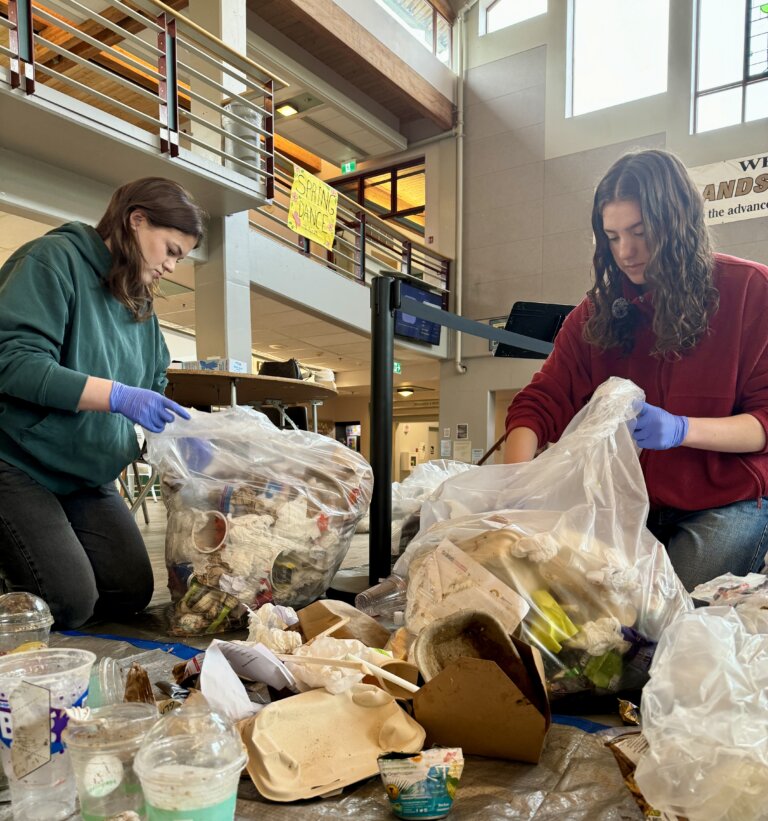
Sustainability advocates are warning high schoolers’ trash is being trucked to the U.S. rife with recyclables, as students conducting “waste audits” at Gulf Islands Secondary School (GISS) say they just want recycling — and composting — available at school.

On Wednesday, April 22, Earth Day started early for GISS Earth Club student lead Melody Silva. Before the morning bell had rung, the Grade 12 student was sorting through trash bags, collected by custodial staff for the club’s current project the night before. 

That “waste audit,” the first of two planned in coming weeks, will precede a two-week pilot plastic recycling program run by club students — and produce a snapshot of how much of the school’s trash could have been diverted from landfills. 

Judging by the first few bags tackled by club members, it’s a lot.

“One of the biggest things that inspired me to start on this project was looking in the garbage bin and seeing how much plastic was in there,” said Silva, gesturing around the pile. “We also want to show the other students just how much garbage we produce.”

Silva said both the audits and pilot recycling program would help inform a broader strategy the club intends to bring before the school board in June, including an estimate on volume and costs. The student initiative is partly supported by local advocacy group Transition Salt Spring (TSS) and its Youth In Action program, led by coordinator Fig Mulder. 

TSS provided advocacy training, Mulder said, surrounding topics like how to contact local government, formulate direct and respectful messages and “awareness-raising techniques.”

“The students came up with the idea of the waste audits,” said Mulder. “Separating out what could be recycled, as well as food waste, and then figuring out how much landfill waste could be diverted if there was a school-wide recycling and composting program.”

Mulder said the students had reached out for help funding both the audits and the recycling pilot, with groups from the Salt Spring Island Foundation to Mouat’s stepping in to help. In an April 22 social media post, TSS also thanked the Raffi Foundation and the Salt Spring Institute for Sustainability and Action.

But Mulder said while the high school’s administrators had been fully supportive of the club’s advocacy program, there were concerns that the school was “getting around” a longstanding recyclables and food waste ban at Harland Landfill by using a garbage service that sends trash elsewhere. 

In a social media post, TSS wrote that the GISS Earth Club’s efforts demonstrated “that the vast majority of what gets shipped to Washington State (at 14 cents a kilo) is actually recyclable paper and cardboard, plastic containers, aluminum cans [and] compostable food waste, which has been banned from BC landfills since 2015!”

According to Gulf Islands School District (SD64) secretary treasurer Jesse Guy, the district pays 41 cents per kilogram, not 14 — and, she added, while the district couldn’t confirm where their trash went after being picked up, she acknowledged the school’s lack of recycling options for students. 

“And I’m fully supportive of partnering and connecting with any infrastructure that will help us reduce putting things in the garbage; we are not standing in the way of any of these things,” said Guy. “But we can’t manufacture something that doesn’t exist.”

While the recycling depot on Salt Spring Island accepts a wide variety of materials at no fee, it’s only for use by residential households. According to its contract with the Capital Regional District (CRD), the depot is not required to accept material from schools, who must join restaurants, businesses and industrial operations — including CRD’s Salt Spring Parks and Recreation facilities — in paying private companies to take it away.

Commercial services on Salt Spring have routinely hauled trash they collect to Hartland Landfill. Nancy Hedger of Laurie’s Garbage and Recycling confirmed last week they still do and rely on their customers to sort recyclables and compost from refuse (and accept those items separately). Bin customers are advised they will be responsible for fines if prohibited items wind up in what they bring to Hartland. 

Salt Spring Garbage and Recycling (SSGR) representatives did not return messages by press time, but their bin rental agreements have similar language with extra fees and rates above the standard 41 cents per kilogram for dumpsters found with “banned from Hartland” items like cardboard and metal mixed in. The school district contracts with SSGR to take both trash and its sorted paper and cardboard, according to Guy.

So while the refundable bottles from the school’s vending machine are collected and the lunch program’s compost is picked up by a small-scale resource recovery company in Victoria, Guy said there is no funding stream for the district to expand refuse services at GISS.

“If there was a grant for the additional cost to sort, sift and truck these different things off island, we would [apply],” said Guy. “But there is no specific funding for that, so any additional spending would come directly out of classrooms.”

Smaller island schools within SD64 have come up with their own solutions. Saturna Elementary School, Guy said, found local grant funding for a modest indoor composter which creates material they use in their school garden. She suggested that works because they have fewer than a dozen students, and with those volumes it’s not unlikely that smaller island communities “turn a blind eye” to how much school recycling winds up in their local centres.

Guy said even if there were dollars for a GISS-sized composter, the district would then face managing community expectations around capacity, and even odour and pest control.

“I hate putting the word ‘business’ in front of education,” she said, “but we’re in the business of education; that’s our main mandate. We’re not in the business of public utilities.”

That leaves it up to students and parents for now, she said. 

“Reduce,” said Guy. “Take it home, put it into your personal recycling.”

That “pack it in, pack it out” philosophy has been part of most students’ vocabulary since at least  Salt Spring Elementary School; but Mulder and Silva worry that this district-wide tradition is unsustainable. 

“‘Pack it in, pack it out,’ ideally, would be great,” said Mulder. “Ideally, we would all be zero-waste and shopping at the Refillery and living that way, but the fact is we don’t. ‘Pack it in, pack it out’ takes the pressure off the schools, but that’s passing the responsibility on to the students.”

Silva agreed, noting there were no good solutions for “gross” recycling that needs cleaning before it enters the stream — or has to be put into a student’s backpack for several hours.

“In practice, it’s terrible,” she said. “At any point, there are probably 700 people in this building; we can’t expect them all to bring everything home.”

In 2023, a provincial announcement heralding six-figure funding to help create the composting facility at the Burgoyne Valley Community Farm specifically stated it would process organic materials generated by Salt Spring’s schools. Today, operating without a licence it has no clear path to acquire, it still can only accept material from the Salt Spring Abattoir — although earlier this month the CRD’s Environmental Services Committee recommended the regional district exempt the facility from CRD bylaws that restrict its inputs.

“The emails are all signed ‘we respect this land,’ and yet this is happening,” said Mulder. “On one hand, I can see that their main interest is keeping that price low; on the other, we’re hopefully teaching this next generation how to care for the earth, and the actions aren’t matching the words.”

The CRD Board could consider expanding contracts for electoral area recycling depots, but will most likely begin the process to exempt the Burgoyne Valley composter from its regulations sooner. Guy said SD64 was looking forward to news about that composter with “bated breath.”

“We would love at some point to partner with the project, and get our food waste into that composting system,” said Guy. “We would be happy to partner with anybody who will help provide those public utilities that allow a school district to integrate into a system and recycle and compost.”

Meanwhile, Silva said she would be spending time this week in classrooms, telling fellow students about the bins for the pilot program. The Earth Club will be ramping up its education effort throughout the school, she added, with posters and signs indicating what goes into the temporary bins. 

“You know, it’s not just about the recycling, it’s about taking some small steps,” said Silva. “I feel like in a world where so many things are out of our control, especially as younger people, this is a tangible thing we can do.”

She smiled. “It actually feels great to be doing something physically, here with my hands.”

Firefighters start ladder truck training

0

Firefighters will learn the ins and outs of their new-to-them ladder truck well in advance of bringing it out on an actual fire call, according to Salt Spring Island Fire Rescue (SSIFR) officials, who told district trustees the aerial apparatus is getting new decals put on this week.

When it arrives, the 2009 Smeal Spartan “Gladiator” aerial apparatus will be a first for the island, formerly in service for the Saanich Fire Department and joining the SSIFR fleet at no cost thanks to an anonymous donation. According to Deputy Chief Dale Lundy, a crew of eight Salt Spring firefighters is scheduled for training in Saanich with that department’s apparatus expert, Assistant Deputy Chief of Operations and fire service instructor Craig Ford. 

“Safety is paramount; we’ll be doing lots of training,” said Lundy at the fire board’s meeting Monday, April 20. “There will be some serious restrictions on who will be operating it.”

Ford will also likely be coming across to Salt Spring to deliver further instruction on aerial operations, he said, but in the meantime one SSIFR member would be attending part of the annual B.C. Fire Training Officers Association conference in Campbell River for a three-day course May 8-10.

“They call it a HOT training,’” said Lundy. “Hands-on for a Friday night, then all day Saturday and all day Sunday.”

Lundy said while the truck will meet firefighters’ needs to respond to events at multi-storey buildings, the department was also developing a mapping matrix to determine what kinds of calls should include the ladder truck — and where it can and cannot go.

“Ideally it’s going to be the second truck out,” he said. “So Engine 1 might respond with a two-person crew, and depending on the nature of the call would determine if the ladder is needed.”

Trustees also learned the new truck will join the rest of SSIFR’s fleet at the new Fire Hall No. 1 a little later than anticipated, as owner’s representative Hans Hazenboom broke the news that a two-week delay was impossible to overcome at this late point in the project, which broke ground in 2023.

“We’re basically behind by about two weeks,” said Hazenboom. “And any project at this stage, it’s difficult to catch up; whatever time gets lost, is lost.”

Hazenboom said the $13.7-million fire hall was still on-budget, and with progress as it stood he felt comfortable stating firefighters could start moving from the old hall starting May 6, to support fire operations at the new building beginning in mid-May.

“We’re not going to move in just in one afternoon,” said district CAO Rodney Dieleman, adding that with everything from telephone lines to vehicles being transferred, there would likely be around five days of work to become fully operational. Timing for an official opening event for the public was another matter; trustees voted to hold off on setting another date for that celebration. 

Editorial: All in a heap

0

There are many levers local governments can pull to nudge human behaviour.

But the ones grabbed most eagerly — and admittedly effectively — have always been any that target our pocketbooks. The Capital Regional District (CRD) reached for those once it became clear the region’s only landfill was filling up faster than it could raise money to expand it. 

As part of a multi-year ongoing increase scheme, the CRD raised Hartland Landfill tipping fees again to $160 per tonne for general refuse; through its regulation bylaw, fines for some kinds of prohibited trash can now be as high as $2,000.

It’s all done in hopes thrifty customers will take the hint, perhaps reduce their consumption but certainly take advantage of low- to no-cost recycling and organics drop-off options. 

And it may be working. We’ve seen how popular island recycling depots are, and it seems as if everyone is growing something each summer thanks to all the backyard composting that’s done.

But for institutional customers, it’s another matter. There’s no free ride on Salt Spring for a business, park, clinic or school that’s producing recyclable or compostable waste; they either pay someone to sort their trash and someone else to take it away, or pay someone to take it all and sort it elsewhere. Staffing costs make that latter choice pretty attractive, which we imagine leaves haulers in a similar situation later: pay someone to sort, or risk penalty costs at the landfill.

Or, possibly, find somewhere cheaper to take it all. The Cowichan Valley Regional District accepts trash it sends to landfills in Washington State for a relative bargain of 33 cents per kilogram.

Notably, for residential trash it’s an unsettled matter as to whether raising tipping fees causes more households to dump illegally; in rural settings, the baseline of random bags found at the end of quiet roads is unmeasured, and it’s hard to tell who’s burying what in their backyards.

But marketplace forces are far more predictable. If the cost of something goes up, every operation will search for a lower cost supplier. Business is business. 

It may not be the environment-conscious plan we’d hope for. But if the CRD’s goal is simply to divert island trash to anywhere but Hartland, its strategy may be working. 

Viewpoint: Webster to run for EA job

By BRIAN WEBSTER

While we’ve made progress over recent years, local government on Salt Spring still doesn’t serve our community as well as it should. I think we can fix this, so I’ll be running for Salt Spring Island Electoral Area (EA) director on the CRD board in October.

What’s wrong with our local government? It’s too uncoordinated. We have more agencies than we need and not enough action on important priorities like housing. We have too many disconnected elected bodies and not enough voice for community members such as renters, who aren’t allowed to vote in some of our elections.

If you elect me as EA director, I’ll work with other elected folks to try to change that. And I’ll bring to that work my experience, knowledge, energy and values.

I’ve been a Salt Spring resident, organic farmer and small business owner since 2011. Previously, I worked as a freelance writer, editor and communications consultant in Victoria. My experience includes seven years on Salt Spring’s PARC commission plus service on the boards of three local non-profits. I was elected to Salt Spring’s Local Community Commission (LCC) in 2023 and have served on it since then. All of this experience has increased my knowledge of our community and how local government works. 

As a farmer, I know the importance of hard work and teamwork. As an LCC commissioner, I do my homework and show up prepared, willing to question the status quo and push for positive change.

My values are simple. I believe in community and that we share responsibility for its wellbeing. I think we should be open and straightforward, even when it’s inconvenient, and I think value for money is local government’s top priority. I believe climate change is real and that we must work toward reconciliation with Indigenous peoples.

If elected, I’ll focus on housing, completing major public projects like the Harbourwalk, fixing our LCC budget, bringing all local CRD services under the LCC and starting a discussion with our two large improvement districts on how we can work together in the future.

We need a “made on Salt Spring” housing office to push for housing that’s affordable and sensitive to our natural environment. We need a coordinated approach to major projects, including decisions on priorities and funding.

We need to fix the LCC budget to better take care of our public amenities. We haven’t maintained the financial reserves we need to repair and upgrade amenities like the failing Centennial Park and Grace Point boardwalks. If we don’t act soon, we’ll either face a huge bill in the future, or we’ll lose these amenities entirely.

We need to break down Salt Spring’s local government siloes. Creating the LCC was a first step, but we must do more, starting with bringing the remaining CRD local services under the LCC and moving away from a single person making decisions such as the spending of gas tax funds.

To reduce fragmentation, increase democratic participation and improve access to funding, let’s talk with Salt Spring’s two large improvement districts on how we can work together for the benefit of our community.

We can’t do all of this in a day, but I know we can make progress over the next four years. I have the experience, knowledge, energy and values to achieve this. That’s why I’ll be asking for your vote as EA director in October 2026 local elections.

Canadian women adorned in Homage exhibit

By MEGAN WARREN

For ArtSpring

Art lovers, you’re in for a treat! From May 8 to 22, celebrated gold and silversmith Donald A. Stuart brings his acclaimed exhibition, Homage, to the ArtSpring Gallery for the collection’s first and only planned appearance on the West Coast, brought to us by ArtSpring’s gallery curator Zoe Zafiris-Casey.

Coming to the island from Ontario, the display features 40 handmade necklaces, each meticulously designed as a tribute to a woman who has helped shape Canada. More sculpture than jewellery, these pieces capture the spirit of subjects ranging from the 11th century to the present day, accompanied by detailed biographies and hand-drawn portraits by Salt Spring’s own Susan Benson, who curated the exhibition.

Homage highlights Stuart’s extraordinary range as a multidisciplinary artist. Beyond his reputation in metalsmithing, Stuart famously founded the Pangnirtung Weaving Studio on Baffin Island in 1969, and that weaver’s sensibility for texture shines through in his choice of materials. For a piece honouring Kwanlin Dün elder and former Yukon commissioner Judy Gingell, Stuart incorporated gold nuggets, moose hair, mastodon ivory, glass beads and caribou antler to evoke the mountainous Yukon landscape against an aurora-streaked sky. In contrast, he honoured jazz legend Diana Krall with a bold collar crafted from antique piano keys and walnut with 14K gold inlay. While Benson’s background in theatrical set design helped her identify the characters and physical traits of the subjects — such as suggesting a high collar for ballerina Karen Kain’s elegant profile — Stuart’s technical mastery translates those identities into physical form.

Homage is rooted in what Benson calls a “mutual admiration society” between herself and Stuart. At first, Stuart considered making brooches, but Benson suggested that “you can say more with a necklace.” Since they started working on the idea over a decade ago, the stunning sculptures have appeared across eastern Canada and as far west as Yukon Territory, sometimes even returning to galleries by popular demand.

“I wouldn’t tell him this to his face, but he’s very clever,” said Benson. 

To complement the display, ArtSpring will host four special events. On May 8, enjoy a glass of wine and meet the team who made this exhibition possible at the opening reception. On May 10, dig into Homage’s history at the curator’s talk, where Stuart and Benson will discuss this exhibition and Stuart’s other works. Then, two exciting panel discussions link the display with women doing important work closer to home.

In Icons on May 14, Elizabeth May moderates a panel of three other women making waves in male-dominated fields: Dr. Shazhan Amed, clinical researcher and paediatric endocrinologist at BC Children’s Hospital; Brenna Corner, artistic director of Pacific Opera; and Natalie Telewiak, principal architect at MG Architecture. On May 21, Amazing Island Women spotlights women who make Salt Spring Island tick. Photographer and journalist Connie Kuhns moderates a conversation with Aletha Humphreys, former executive director of Greenwoods Eldercare; Alicia Herbert, executive director IWAV; Sue Newman, dramatist, dancer and teacher; and the Driftwood’s own editor, Gail Sjuberg. 

Benson hopes that everyone comes to hear and learn from these panels. She is no stranger to the challenges of being a woman in a male-dominated field. Now 84 years old, she started her career in the mid-1960s at the Vancouver Playhouse when set design was very much a man’s game. 

“Even now, when I say I design sets, people will say to me, ‘Oh, you do the clothes,’” she said. “No, I do both. Don’t box me into one area, just because you don’t think women can do the architectural work.” 

Not only can Benson do the architectural work of set design, but she is officially one of the most accomplished designers in Canada. She was appointed into the Order of Canada in 2019, which is already a major accomplishment. Then, this year, she received a surprise phone call from the Governor General’s office: she has been selected for a 2026 Governor General’s Performing Arts Awards for Lifetime Artistic Achievement. 

“I actually cried when he told me, because I didn’t expect it,” she said. “Honestly, I’m at the end of my career now. You get to a point when you’re older when you think people have forgotten you. That’s it. Forget it. Then suddenly, you get an award like this. It is very special.”

Homage will be open daily from 10 a.m. to 4 p.m. from May 8 to 22. Visitors are invited to wear their finest jewellery to join in this celebration of Canada’s most glorious women. 

ArtSpring would like to thank Janet Halliwell, Sandra Heath, Seth Berkowitz Photography and Susan Benson for generously supporting this exhibition.

Homage Events

Opening Reception: Friday, May 8, 5 to 7 p.m.

Curator’s Talk: Sunday, May 10, 1 p.m.

Icons Panel Discussion: Thursday, May 14, 1 p.m.

Amazing Island Women Panel Discussion: Thursday, May 21, 1 p.m.

GISS student earns Team BC nationals spot


Submitted by GISS TRADES PROGRAM

Grade 12 Gulf Islands Secondary School (GISS) welding student Antoine Gonzalez will compete with Team BC at the 2026 National Skills Canada Competition in Toronto from May 28 to 30. 

Gonzalez earned his spot on Team BC after winning a gold medal at the prestigious Skills Canada Provincial Championships in Abbotsford on Wednesday, April 15. To gain a seat at the provincial championships, Gonzalez first took home the gold medal at the Skills Canada South Island Regional Competition at Camosun College in March. 

Gonzalez has been working towards his welding certificate since discovering the trade in metalwork class at GISS in Grade 11. He began his apprenticeship locally at Island Marine Construction on Salt Spring while he completed Grade 11 and 12 courses at GISS and set himself up to move to Victoria in August 2025 for the seven-month dual credit Welding Foundation program at Camosun College. 

Dual credit students are sponsored for tuition by their high school and gain high school course credits as well as the college program credentials. According to his instructors at Camosun, Gonzalez had a “strong technical foundation.” As well, they highlighted his “responsiveness to coaching and growing confidence.” His hard work paid off and he quickly rose to the top of his welding class, which resulted in competing at the regional Skills Canada event. 

Kevin Huebert, Corey Johnson and the team at Island Marine Construction have sponsored at least 10 GISS students for work experience or apprenticeship over the past 10 years. Huebert’s patience and skill have been passed on to all these students, most still working as welders locally or elsewhere in B.C. The trades community on Salt Spring has stepped up and supported the Youth Work in Trades programs for over 20 years, allowing young workers to enter the workforce with strong mentors and opportunity. GISS students consistently complete trades training at the top of their classes. 

Gonzalez’s apprenticeship at Island Marine Construction and the excellent instructors at Camosun College prepared him very well for the regional and provincial competitions. In a five-hour period, he followed a complex blueprint and assembled a steel box structure with multiple design features. The competitors were even granted an extra 30 minutes as the judges recognized the complexity of the task! Gonzalez was on the ferry returning to Salt Spring when he heard his name announced for the gold medal through the live broadcast from the Abbotsford Tradex. 

Gonzalez missed the evening award ceremony at Skills Canada provincials because it would have meant spending another expensive night in a Vancouver hotel. He is determined to be there for the medal ceremony at Skills Canada Nationals and has a strong chance of being back on the podium.

Event registration will be paid for by GISS Career Programs funding for trades training, but the flights and accommodation for five nights in Toronto add up quickly. The goal is to raise $15,000 to pay for Gonzalez, his mom, his welding mentor, who will coach him through the three-day welding competition and a staff member from GISS to attend. Watch for upcoming local fundraisers for the GISS Welding “A Team.” 

Charitable donations to support the trip can be made to the SD64 Gulf Islands – attention: Skills Canada Welding Competition. People are invited to contact Shari Hambrook, GISS Youth Work in Trades teacher, with inquiries at shambrook@sd64.org.